
by Colin May
November 04, 2026
Guest contributor Colin May enjoyed the musical diversity of the twelve acts playing showcases on the 2026 Jammin' Juan programme and has provided brief summaries of all the performances.
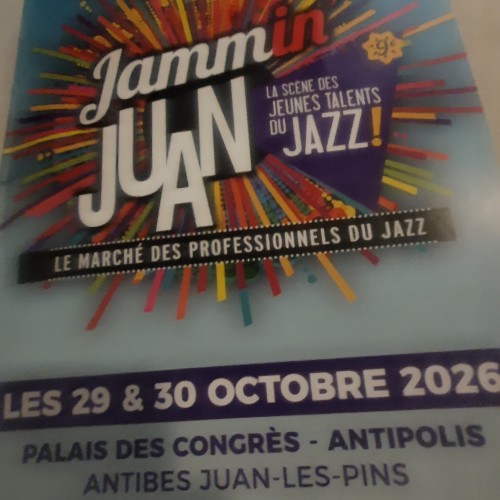
Jammin’ Juan
Palais des Congress, Antibes Juan-les-Pins
29th and 30th October 2026
The fun of the annual Jammin’ jazz market place is the chance to make new discoveries with six showcases every day, and the buzzy busy atmosphere with often hardly time to pause between one showcase finishing and the next one starting. I was looking forward to more of the same at this the ninth edition even though this year Jammin’ had been reduced from three days to two.
DAY ONE
CHRIS JENNINGS/PIERRE PERCHAUD DUO
The first showcase was a first for me as I’d never before heard an acoustic guitar and double bass duo. The interplay between Pierre Perchaud’s acoustic guitar and Chris Jennings’ double bass was very organic and unforced throughout the set which was a mix of originals and covers.
They started with an original inspired by J.S Bach which displayed their dexterity and synergy, followed by a version of a song of French singer- songwriter and poet Georges Brassens.
‘Glug’, a Pierre Perchaud original, was introduced as about the warm feeling from wine and the duo conveyed a warm tipsy feeing in their playing. There was a jazzy cover of Elton John’s ‘Goodbye Yellow Brick Road’ and they concluded with a lively, staccato number with the duo passing the lead back and forth.
Their emphasis on melody and their classy relaxed playing made it easy to be draw into their intimate world, and they were very enjoyable.
BUCK
Buck was a big contrast to the acoustic guitar/ double bass duo that had preceded them. They were a brass heavy act with two saxophonists, one of whom doubled on alto and baritone, a trombonist and a tuba player who handled bass line duties. Their line-up was completed by a drummer and an
electric guitarist whose role varied between rhythm and lead guitar.
In the event programme the group’s music was said to symbolise what the term deer /buck means to them. However, I did not ‘get’ this connection and just took their music at face value.
The natural habitat of Buck would most likely would be a club environment with lights synched to the music and the jazz equivalent of a mosh pit. They combined jazz, especially in the fiery soloing of the tenor saxophonist and of the trombonist, with a rock element embodied in the drummer and guitarist. The latter played a blistering extended solo that would have delighted fans of prog rock.
The set was high energy and when there was a more contemplative passage it did not last for long before being displaced by an up tempo burst. The energy was not only in the music but in the moves band members made on stage. Their energetic performance made a connection with the audience who gave them a big hand for their efforts.
KNOBIL
Knobil was Swiss double bassist singer and composer Louise Knobil who performed with a bass clarinettist using effects and a drummer: another rather unusual line-up.
In Louise Knobil’s world contemporary jazz, French chanson, pop glitter and an irreverent attitude come together in what she calls “glitter- jazz”. As if to underline this she took to the stage in a spangly dress.
She’s said on Facebook “I want to deconstruct the idea that Jazz always has to be serious” and she was a touch quirky in a good way, e.g. one of her songs was about finding pesto at the back of her fridge during the pandemic.
However, she came across as serious about jazz. Her vocals had excellent jazz phrasing, the arranging of her material was excellent too - the gelling of her voice with the effects on the bass clarinet produced textures that were subtle and beguiling. Also, she impressed as a double bass player- she played a dynamic unaccompanied solo that was edgy and exciting and in which she stretched the possibilities of her instrument. There was a lot to like about her performance.
ANTHONY JAMBON GROUP
This was guitarist-composer Anthony Jambon’s third appearance at Jammin’ Juan. His last appearance was as a solo guitarist when he worked with a sound designer/engineer to surround the audience with an immersive experience. His showcase this time was more conventional with Jambon fronting a line-up of bass, drums, piano/keys and trumpet.
Jambon used most of his allotted 35 minutes to perform a single track ’Reset’ from his latest album ‘Relativity’. The piece had a cinematic feel with expansive multi-layered textures. Jambon himself kept a low profile and the most significant solos came from the group’s drummer and trumpet player.
The outstanding feature of the performance however was the cohesive ensemble playing of what was a complex and extended piece, for which Jambon, as group leader, must be given a lot of credit.
AWA LY
Awa Ly is a French singer and actress of Senegalese origin. She has a great voice with a smoky jazz edge. However, the use she made of it was disappointing. She sang in uninteresting easy listening / pop styles and some of her lyrics were rather cliched. A pity.
MATTI KLEIN SOUL TRIO
The Berlin based Matti Klein Soul Trio was another group with an unconventional line-up. Matti Klein played a 1973 Fender Rhodes bass and a Wurlitzer with Lars Dieterich on bass clarinet with effects and also on tenor sax, and André Seidal on drums.
With no conventional bass Klein’s Fender Rhodes and the judicious use of effects with the bass clarinet provided rich warm bass lines. The sound of the two instruments in harmony was gorgeous.
The trio’s soul jazz had a compelling groove throughout, and with Klein’s compositions having catchy melodic hooks their music was always accessible.
They were very tight yet at the same time seemed to be spontaneous – the set opened with a number inspired by Ray Charles that featured a terrific bass clarinet solo.
All three were excellent individually and came together wonderfully well with drummer André Seidal as important as Klein and Dietrich in what appeared to be a partnership between equals. They absolutely nailed it, and their performance meant day one ended on a high.
DAY TWO
CROZPHONICS
Day two began with another act with an unconventional line-up. Crozphonics were a trio consisting of an accordion and two cello players.
Accordionist Charles Kieny’s compositions had a Balkan folk music feel and required some virtuosic playing particularly from the lead cellist. I had anticipated the trio would play chamber jazz and there were delicate contemplative passages and a rich palette of textures. However, what the trio mostly played was like a wall of sound, sometimes restless and sometimes like a wild ecstatic dance. It was stirring music and while perhaps it would not have satisfied a jazz purist, it was enjoyable to just go with the trio’s flow.
GUILHEIM FONTÈS and THOMAS BOURGEOIS DUO
This was a piano and percussion duo with a twist as Thomas Bourgeois played hand percussion and in particular the zarb, a Persian goblet hand drum with roots in classical Persian music.
Bourgeois’ playing of the zarb was virtuosic, his fingers often a blur as he extracted a remarkable number of different sounds and textures from the instrument. Guilheim Fontès’ piano playing was crisp, and when it came to a number based on Eric Satie’s ‘Gymnopédie 1’ very creative in how he
transformed the original.
Fontès switched to clarinet before returning to the piano, and Bourgeois switched to a daf frame drum for a very Middle-Eastern number inspired by the myth of a Persian unicorn with a hollow horn which when the wind blew emitted music never heard before.
The duo’s final number was said to have been also inspired also by unusual creatures, single cell organisms who were on the march in massive numbers. It had an ominous undertone but principally was a high paced romp, and was a fun way to end a set which went down well with the audience.
NILS KASSAP and FRIENDS
You can wait a long time to hear a bass clarinet and then three of them come along in the space of a couple of days.
Nils Kassap was the third bass clarinettist at this year’s Jammin’. His playing was heavily influenced by Eastern European and Middle Eastern styles and he used effects to set up echoes and loops. This was all set against a rock groove provided by his Friends which gave the performance plenty of drive.
The showcase was dominated by Kassap’s bass clarinet. The keyboardist was the only Friend who had a significant solo, and much as I love the sound of the bass clarinet the set might have benefited from a little more variety.
BRAM DE LOOZE
The solo piano showcase from 35-year-old pianist-composer Bram de Looze’s landed in territory where contemporary classical music and contemporary experimental jazz are near neighbours.
The opening piece was searching and quite intense. Sparse dissonant phrases succeeded one another with the whole being held together by a repeated underlying figure.
It was followed by ‘Tutu’ written by Bram De Looze for his young daughter. It was bright, affectionate and humorous with staccato phrases almost tripping over one another. It was easy to imagine this was De Looze’s daughter trying to take her first steps.
Inspired by a small island near Sicily, the third number was an elegantly played lyrical mainstream jazz piece.
The fourth and final piece was a re-imagining of the blues consisting of a succession of jagged fragmented phrases, each of which retained some element of the blues deep within.
Overall Bram de Looze came across as a composer of challenging and fascinating music, and as a pianist with a precise and refined touch.
JOHAN DUPONT TRIO
The Johan Dupont Trio were the only piano trio or piano quartet on this year’s Jammin’ Juan programme. Also, arguably they were the only pure jazz act on the bill.
While their music briefly became abstract, their emphasis was very much on melody and rhythm. They were a tight unit with the drummer and electric bass player at one with Dupont’s pianism.
Their bright opening number skittered along at pace. They played a contemplative ballad, and there was a lovely delicate piano solo piece - for me the highlight of their showcase, and they finished with an upbeat joyful number.
ELISE VASSALLUCCI QUINTET
Elise Vassallucci is a song-writer, vocalist and in this showcase also briefly a violinist who used effects with her vocals. There were a couple of nice solos from her quartet’s saxophonist and keyboard player, but her set was defined by her use of her voice as an instrument, several times she produced high register wordless vocals. While this was impressive, it just wasn’t to my taste.
OVERVIEW
Despite there being fewer showcases this year, twelve rather than seventeen or eighteen as in previous years, the selection committee came up with a programme that was possibly the most musically diverse Jammin’ ever. While the purist might argue that ‘pure ‘jazz was under represented, that has to be set against the opportunity this year to hear some unusual instrumental line-ups and styles which was refreshing.
My choice for the top acts would be the Matti Klein Soul Trio and solo pianist Bram De Looze, two very different acts who both had had an adventurous spirit. Nearly all the acts though were enjoyable, and after the rich diversity of this year’s event it is going to be fascinating to see what the selection committee come up with for next year’s Jammin’ Juan.
At the time of writing the full 9th Jammin’ Juan programme was still available
https://jammin.jazzajuan.com/programme-jammin-juan/
The Matti Klein Soul Trio did a UK tour in 2025. A review of their gig at Pizza Express Soho can be found here;
https://www.jazzwise.com/content/review/matti-klein-soul-trio-a-classic-funky-jazz-format-rendered-with-a-twist
COLIN MAY
blog comments powered by Disqus