

by Ian Mann
January 13, 2026
Ian Mann on the film "All Night Long" plus two very different musical performances by the Jon Lloyd Quartet and Raph Clarkson's Equal Spirits.
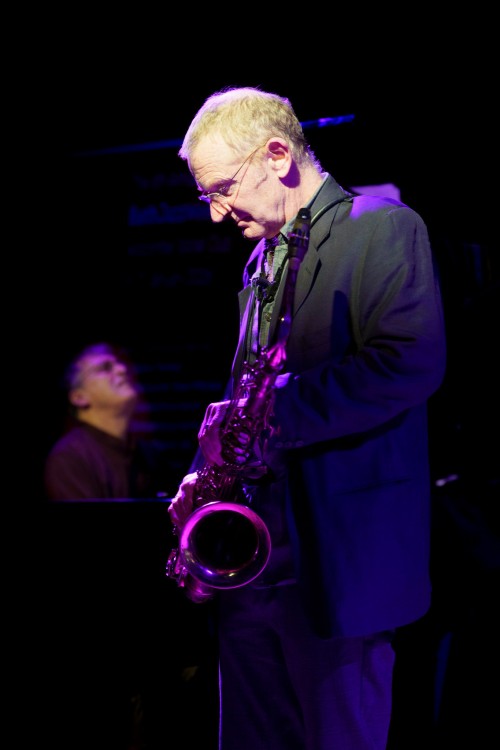
Photograph of Jon Lloyd by Tim Dickeson
6th ANNUAL BATH JAZZ WEEKEND, WIDCOMBE SOCIAL CLUB, BATH
FRIDAY 9th JANUARY 2026
PROLOGUE
2025 saw me attending the annual Bath Jazz Weekend for the first time and I enjoyed it so much that I was determined to return again in 2026.
Last year’s event was the fifth edition, so I guess I’ve been a bit slow off the mark but now I’ve discovered this wonderful event I’m going to be making up for lost time.
The 2025 event is the subject of three separate Jazzmann features, one for each day, and this sixth edition will follow a similar format.
Following Storm Goretti we were thankful to have got to Bath at all and were determined to enjoy all the music on offer and the experience in general, Bath is a beautiful city to visit at any time of the year.
The Bath Jazz Weekend is co-ordinated by Nod Knowles, a Bath resident with a distinguished career in music promotion and arts administration behind him. He has served as Head of Music at the Scottish Arts Council and as Chief Executive of Bath Festivals and was the Jazz Programme Director for Bath International Music Festival. It was Knowles who famously brought Loose Tubes to the 1987 BIMF for a much celebrated performance that was subsequently screened on BBC 2 and which remains available on YouTube to this day.
After some years away from the music business Knowles returned to the fray by promoting a series of jazz and folk events at the Widcombe Social Club on the south eastern outskirts of Bath under the ‘All Of The Above’ (AOTA) banner.
He founded the Bath Jazz Weekend in 2020, the inaugural event taking place in the January of that year, before the Covid lockdowns commenced. 2021 didn’t happen, for obvious reasons, but the next three BJWs in ‘22, ‘23 and’ 24 saw its popularity continuing to grow. It’s great way to kick off the New Year for audiences and musicians alike, a return to normal life after the excesses and nonsenses of Christmas and for most of the musicians featured on the 2026 programme it represented their first gig of the year, - and one in front of a large, supportive and knowledgeable audience at that.
Of course the weather can be a factor, but as long as you can get there and back safely BJW is a terrific event that offers a wide ranging programme embracing several different jazz genres and at just £95.00 for a full weekend pass covering ten live music events plus a film screening it also represents tremendous value for money.
I’m grateful to Nod for providing my wife and I with weekend guest passes and once again we stayed for two nights at the nearby Bath Waterside Travelodge, just a couple of minutes walk from the venue and only five to ten minutes from the city centre.
Widcombe Social Club, hereafter WSC, roved to be a well appointed venue well suited to the staging of jazz events and the musicians were well served by sound engineer Mark Burton and his team. On the whole the sound quality was excellent throughout. The presence of a ‘proper’ Yamaha acoustic grand piano was also a huge plus and the instrument was put to good use by a host of fine pianists over the course of the Weekend.
Knowles was keen to point out that WSC was a community focussed organisation that operates on a co-operative basis, as does BJW itself. This ethos all made for a very happy and friendly atmosphere and there was a real sense of ‘oneness’ and togetherness between the musicians and their highly appreciative audiences.
The programme featured many musicians from the South West jazz hotbeds of Bristol and Frome, all of them players with national reputations, plus others who had travelled up from London. The presence of the French duo of clarinettist Louis Sclavis and cellist Bruno Ducret helped to give the event a truly international feel.
ALL NIGHT LONG (FILM)
It has become a tradition for BJW to commence with the screening of a jazz related film. These are presented by BJW in conjunction with the Off The Wall cinema series, curated by Chris Baker, that also takes place at Widcombe Social Club. This joint promotion very much epitomised the collaborative spirit that informs both BJW and WSC.
This year’s offering was “All Night Long”, a 1962 British film that Knowles described as a “psycho-drama” directed by Basil Dearden (1911-71), an updating of Shakespeare’s Othello set in the London jazz scene of the early 1960s. For jazz fans it’s notable for the presence of several leading jazz musicians, among them John Dankworth, Tubby Hayes, Keith Christie, Colin Purbrook and Allan Ganley plus big name Americans Charles Mingus and Dave Brubeck, both of whom were visiting the UK at the time and who were persuaded to participate in the project.
The thespians involved include Richard Attenborough, Patrick McGoohan, Keith Michell, Paul Harris, Marti Stevens, Betsy Blair, Bernard Braden and Maria Velasco.
Shot in black and white the action takes place over the course of a single evening at a Thameside warehouse converted into a wealthy bachelor pad by the well heeled jazz aficionado Rod Hamilton (Attenborough) who has turned the middle storey into a night club space.
Mingus is the first musician to arrive, part of a band assembled by Hamilton to play at a first anniversary party celebrating the marriage of the black bandleader Max Aurelius (Harris) and his white vocalist wife Delia Lane (Stevens). Delia has retired from singing following her marriage, but Aurelius continues to lead his band, an ensemble that includes drummer Johnny Cousin (McGoohan), vocalist Bennie (Velasco) and alto saxophonist Cass Michaels (Michell), who also acts as the band’s road manager.
The scheming Cousin is hoping to start his own band and to tempt Lane out of retirement to serve as his vocalist. He has pitched the idea to the booking agent Lou Berger, a splendidly over the top Bernard Braden, and is also reliant on Hamilton financing the project. To secure the backing of both Berger and Hamilton it’s vital that he secures the services of Lane, still a much missed presence on the scene, otherwise Berger isn’t remotely interested.
To this end Cousin takes steps to affect a separation between the married parties Lane and Aurelius. He tries to convince Aurelius that Lane has been having an affair with Michaels, a close friend who Lane knew before her marriage to Aurelius. To further complicate matters Michaels in now the boyfriend of Bennie.
Michaels is a reformed drug addict but Cousin tempts him into smoking marijuana while suggesting that Berger has expressed the opinion that in view of Michaels’ previous issues he shouldn’t be road managing Aurelius’ band. Intoxicated by the marijuana Michaels sounds off at Berger, as a result of which Aurelius fires him from the band.
Cousin continues to sow the seeds of jealousy between Aurelius and Michaels using Hamilton’s recording equipment to tape a conversation between Michaels and himself about Michaels’ feelings for Bennie. He also tapes a discussion between Michaels and Lane, later splicing the tape to make it appear that Michaels and Lane are expressing romantic love for one another. Cousin’s machinations also involve the theft of Lane’s cigarette case, which he plants on Michaels.
When Cousin plays Aurelius the doctored tape the already suspicious bandleader accuses his wife of infidelity and attempts to strangle her. When Michaels attempts to intervene Aurelius throws him over the balcony railing on the top floor of Hamilton’s establishment and he crashes onto the night club floor in full view of the musicians and other guests.
Cousin’s put upon wife Emily (Baird) challenges Aurelius about the reasons behind this unexpected behaviour, to which Aurelius replies “ask Johnny”. Emily accuses the manipulative Cousin of being a liar and once Aurelius mentions the tape she begins to work out what has happened, something that Lane and Michaels, despite their injuries, are able to confirm.
Having been rumbled Cousins attempts to exit the warehouse, pursued by Aurelius who attacks him and attempts to strangle him, only for Lane to intervene. Aurelius then makes his peace with Michaels before the ambulance arrives to take Michaels to hospital, accompanied by Bennie.
The other guests and musicians all depart, leaving just Cousin, Emily and Hamilton. Cousin sits at the drum kit, improvising aimlessly. Emily attempts to make her peace with him but wallowing in self pity he dismisses her saying “don’t you understand, I don’t want to be loved…I love nobody. Don’t even love Johnny…Go find somebody else to love.” Emily exits the warehouse, followed by Hamilton, leaving Cousin alone, hammering hell out of the drums. The camera cuts to Aurelius and Lane walking arm in arm along the river bank as the credits roll.
So much for the plot, which I found all rather melodramatic, but to criticise it as such is basically to criticise Shakespeare, so I’ll leave it at that. That said although some of the character names borrow loosely from Othello the film gives the story an almost happy ending, nobody actually dies, which probably offended Shakespeare purists. The movie wasn’t particularly well received at the time of its release and recent interest in the film has probably been sparked by music fans rather than film buffs.
Tonight an audience comprised entirely of jazz fans was probably more interested in the music rather than in the story anyway and it was certainly a thrill to see such giants of the music as Mingus, Brubeck, Dankworth and Hayes in action. There were a number of musical set pieces, including a version of Brubeck’s “It’s a Raggy Waltz” from his 1961 album “Time Further Out”.
Mingus and Brubeck play together on an improvised piece that was subsequently titled “Non Sectarian Blues”.
Dankworth features on alto sax and the soundtrack includes his piece “Fall Guy”. Hayes doubles on tenor sax and vibes and his composition “The Chase” is also featured.
Other pieces to feature are “Sax Reference” by bassist Jimmy Napper and “Scott Free” by saxophonist / flautist John Scott.
Musical director Philip Green also contributed a number of compositions, presumably including the song “All Night Long”, sung in the film by the character Delia Lane.
Session musician Barry Morgan appears as a Brazilian bongo player improbably named Paco O’Toole and is actually featured quite extensively.
Apparently the drums on the soundtrack were played by Allan Ganley but McGoohan did take drum lessons prior to appearing in the film. McGoohan’s overall performance as the controlling Cousin is intense and convincing, including those moments when he’s seated at the drum kit.
A flawed but entertaining way to get BJW 2026 under way. Most people enjoyed the film, myself included, and for this audience it was the music, and the chance to see some long fallen musical heroes in action, that really counted.
JON LLOYD QUARTET
Jon Lloyd – tenor saxophone, John Law – piano, Nick Pini – double bass, Alex Goodyear – drums
Saxophonist and composer Jon Lloyd (born 1958) has enjoyed something of a creative renaissance in recent years as the leader of a quartet featuring his long time collaborator John Law on piano plus a rhythm section of bassist Nick Pini and rising star drummer Alex Goodyear. This line up recorded the acclaimed album “Earth Songs”, released on Ubuntu Music in 2024.
Lloyd has previously referred to this line-up as his “European Quartet”, the identifier inspired not by the geographical origins of the players but instead by the style of the music played by the group. As Lloyd has explained this is not American jazz rooted in the blues, but instead jazz informed by specifically European influences, and particularly classical music and folksong. The aesthetic of the German record label ECM and its founder Manfred Eicher has been cited as an inspiration and it remains a Lloyd ambition to actually record for the label.
In July 2024 I reviewed a live performance by this quartet at Black Mountain Jazz in Abergavenny which largely focussed on material from the then recently released “Earth Songs” album plus a number of selections from the repertoire of Naissance, Lloyd’s ongoing duo with Law, re-arranged for quartet. My account of the Abergavenny show can be found here;
https://www.thejazzmann.com/reviews/review/jon-lloyds-european-quartet-black-mountain-jazz-melville-centre-abergavenny-28-07-2024
Lloyd has clearly been busy over the course of the last eighteen months and has written a wealth of new material for the quartet. This is scheduled to be recorded later in January and the BJW audience was one of the first to hear this new music, which picks up where “Earth Songs” left off and which continues the distinctly ‘European’ aesthetic. Perhaps the most obvious comparison is with the music of American pianist Keith Jarrett’s ‘European Quartet’ with Jan Garbarek, although by and large Lloyd avoids sounding too much like the celebrated Norwegian saxophonist, preferring to channel Garbarek’s aesthetic rather than his tone.
Tonight we heard just one piece from “Earth Songs”, that album’s opening track “Al’Afiyah”, which also got things under way here. This was introduced by Law at the piano, whose arpeggiated figures suggested the influence of Minimalism and subtly incorporated prepared piano sounds. Pini and Goodyear subsequently responded, with the latter contributing some some delicate cymbal work. The drummer then established a gentle brush driven groove, augmented by Pini’s bass and Law’s continuing arpeggios, a golden thread running throughout the piece that helped to give the music a hypnotic, mantric quality. Lloyd made his own entry comparatively late, delivering a simple but beguiling tenor sax melody that he subjected to a series of subtle variations during the course of a gently exploratory solo. Law was also featured as a soloist, unaccompanied at first, improvising around his own arpeggios and deploying cross hand techniques as Pini responded with a series of bass countermelodies while Goodyear added succinct drum commentary. Lloyd then returned on beguilingly melodic tenor sax. An atmospheric closing section saw the re-introduction of prepared piano sounds and Pini’s brief flourishing of the bow.
For this evening’s show Lloyd chose to specialise entirely on tenor saxophone – there have been instances earlier in his career when he has focussed solely on soprano. The new composition “Anima” continued the air of rarefied refinement established on the opener with the sound of Lloyd’s tenor subtly echoed. Law’s piano solo featured him at his most lyrical while Goodyear, who can be a wildly exuberant player in other musical contexts, gave a wonderfully sensitive brushed drum performance that was outstanding in its delicacy. One senses with this quartet that they really are distilling this music to its very essence.
Also written for the new album, which Lloyd informed us would be recorded over the course of a single day, “Build a Fire” was a suitably slow burning piece with the focus very much on melody. Introduced by Law at the piano, as many of tonight’s pieces were, this performance included solos from Lloyd, Law and the excellent Pini, with Goodyear turning in another finely nuanced performance behind the kit. As far as I can recall he deployed either brushes or mallets all night, I don’t remember him using sticks at all.
Next came “Winter Light”, a composition that has been played, but not recorded, by the Naissance duo. This quartet version was ushered in by an extended passage of unaccompanied piano, subsequently joined by Lloyd’s tenor as he and Law went into Naissance duo mode. A second lengthy unaccompanied piano passage presaged the final quartet section, which saw a gradual gathering of rhythmic momentum behind Lloyd’s subtly probing tenor sax soloing. It will be interesting to see what form this piece will follow if it is selected to appear on the forthcoming quartet recording.
Another new composition, “Pria”, was based around an Indian scale and was introduced by the duo of Lloyd and Law, with the pianist’s strong left hand rhythms a distinctive feature. The introduction of bass and drums prompted a piano solo from Law, delicate and lyrical at first but becoming more percussive as the music continued to grow in terms of intensity, with Lloyd subsequently taking over on tenor and continuing to focus on melody.
This immersive and hugely enjoyable set concluded with yet another new piece, “If, Only If”, introduced by a passage of unaccompanied tenor sax, heavily echoed. Piano, bass and drums were subsequently added with Law emerging as a soloist, his explorations augmented by Pini’s bass counter melodies and Goodyear’s brushed drum commentary. Lloyd eventually took over on tenor with another gently smouldering solo as the music gradually began to grow in intensity, with Law subsequently taking over again towards the close.
The “Earth Songs” recording has been warmly received by critics and audiences alike and the distinctive sound of the Jon Lloyd Quartet has won the group something of a cult following. On the evidence of tonight’s performance Lloyd’s fanbase is going to be delighted with the new album when it eventually appears. It’s obviously not going to be a radical departure from its illustrious predecessor but it’s an album that will be very eagerly awaited as the quartet continue to hone, refine and develop their sound.
The performance was presented by Lloyd with a dry but warm wit and both the playing and the writing were simply excellent. A great way to begin the Weekend’s musical performances.
RAPH CLARKSON’S EQUAL SPIRITS
Raph Clarkson – trombone, vocals, Xolani Mbatha – vocals, Chris Batchelor – trumpet, flugelhorn, Phil Merriman – piano, synth, Riaan Vosloo – double bass, Yuval Wetzler – drums
One of the strengths of Bath Jazz Weekend is the sheer variety of music on offer and Friday’s second musical performance couldn’t have been more different to the quiet, tightly focussed beauty of the Lloyd Quartet.
The sound of trombonist, composer and occasional vocalist Raph Clarkson’s Equal Spirits was brash, colourful and celebratory, a homage to the musical and cultural links between the UK and South Africa.
Clarkson first came to my attention as a member of keyboard player Dave Morecroft’s band WorldService Project, appearing on that group’s first four albums before leaving to form his own ensemble The Dissolute Society.
The first Dissolute Society album, “Soldiering On”, was released in 2018 and represented a highly personal project for Clarkson, a kind of musical autobiography that dealt with themes of love, loss and family and personal history. Review here;
https://www.thejazzmann.com/reviews/review/the-dissolute-society-soldiering-on
The album had actually been recorded in March 2016 but the music had already been premièred at a packed out Vortex as part of the 2015 EFG London Jazz Festival, a performance that I was fortunate enough to witness and which was reviewed as part of my Festival coverage here;
http://www.thejazzmann.com/features/article/efg-london-jazz-festival-2015-second-sunday-22-11-2015/
The second Dissolution Society album “This Is How We Grow”, released in 2022, had its roots in Clarkson’s educational work which saw him acting as a workshop leader for various London based projects involving children with special educational and social needs. This led to a fascination with the concept of childhood as a whole and it’s theme which informs this fascinating, and very good, album. Review here;
https://www.thejazzmann.com/reviews/review/raph-clarksons-dissolute-society-this-is-how-we-grow
Clarkson’s latest project is Equal Spirits, a British / South African collaboration featuring musicians from both countries. The ensemble’s debut album “Wise and Waiting” was released in 2024 but was actually recorded during 2020 and 2021 at various location in the UK and South Africa.
The sextet that Bristol based Clarkson put together for tonight’s performance included album personnel Batchelor, Merriman and Wetzler plus Bristolian bassist Vosloo, the group completed by the South African vocalist Mbatha, now based in Leeds where he is concurrently a member of the group Ubunye. Clarkson had worked with a whole host of South African singers during his visit to the country in 2020 but couldn’t afford to bring them to the UK, so he was delighted to find Mbatha, who helped to bring a real air of authenticity to the performance.
Opener “Egoli Affirmation” featured the sound of sampled voices but also exhibited a true South African feel with the blend of Clarkson’s trombone and Batchelor’s trumpet particularly effective. Merriman also impressed with his piano solo.
“Back Again”, the opening track from the album, also had a genuine Township feel and included another exuberant piano solo from the excellent Merriman. Mbatha added his distinctive vocals, inherently soulful but also deploying the vocal clicks unique to South African music as he sang the Zulu language lyrics.
Clarkson spoke of the links between UK and South African jazz, citing those famous 60s exiles The Blue Notes, who left apartheid South Africa and settled in London, where they exerted a huge influence on British jazz musicians that is still being felt to this day.
Another South African musical hero was the late, great pianist and composer Bheki Mseleku (1955 – 2008), who moved to London in the 1980s and played and recorded with British jazz musicians. I was lucky enough to see him perform at Brecon Jazz Festival with a British band featuring Loose Tubes flautist Eddie Parker back in the 1990s. Tonight Equal Spirits performed Mseleku’s composition “Bringing Joy”, with Mbatha singing the lyrics as Batchelor, on flugel, and Clarkson on trombone, exchanged phrases and solos while Merriman doubled on piano and synth.
Clarkson’s own gospel influenced “Hymn” represented a “salute to the cultural links between the UK and South Africa” and was inspired by the church music of South Africa. One was sometimes reminded of the music of South African pianist and composer Abdullah Ibrahim.
“Hymn” was segued with “It Ends When It Needs To”, a celebration of the late, great Bristolian pianist, composer and improviser Keith Tippett (1947 – 2020) and his wife Julie Tippetts (born 1947). Keith was a great champion of South African jazz and worked regularly with South African musicians, including the recently departed drummer Louis Moholo Moholo. This featured an extended solo piano intro from Merriman, Mbatha’s wordless vocals and a melodic double bass solo from Vosloo, accompanied by the sounds of piano and Wetzler’s mallet rumbles. Merriman’s synth colourations underpinned Batchelor’s trumpet solo before Clarkson’s spoken word vocals evoking images of Keith and Julie as a “Couple in Spirit”, also the title of one of Keith and Julie’s duo albums.
The joyous “Skip” was written by Clarkson in conjunction with the Durban based singer and songwriter Nosihe Zulu, who appears on the album. It was appropriate that Mbatha, also originally from Durban, should sing the mix of Zulu and English language lyrics, the song title coming from the line “a skip in my step”. Instrumental solos came from Clarkson on trombone and Merriman at the piano.
Also written by Zulu and Clarkson “To Jo’Burg” emerged out of the trombonist’s improvisations with South African musicians. The song title is a reference to moving from Durban to the ‘big city’, in this case Johannesburg. It’s the South African equivalent to moving to London. Another exuberant performance featured Mbatha’s vocalising, Batchelor’s trumpet solo and a drum feature from Wetzler at the close.
“Shosholoza” is a traditional South African song that was originally sung by workers in the gold mines that has become something of an alternative national anthem. The likeable Clarkson encouraged the audience to sing along with this one, while Batchelor on flugel was the featured instrumental soloist.
The title track “Wise and Waiting” also included traditional elements that elicited another audience sing-along. Elsewhere a mix of African and English language lyrics were sung with great emotion by Mbatha. This was a rousing track with a direct and memorable melody that also imparted this song with a genuine anthemic quality.
The final piece, simply titled “Closing” featured the pounding piano of Merriman and also included a vocal set piece for Mbatha that was almost the equivalent of a rap and which included extended vocal techniques, such as that distinctive vocal clicking.
This was another highly enjoyable performance, very different to that of the Jon Lloyd Quartet but just as distinctive in its own way. The standard of the playing was consistently excellent with Merriman particularly impressive both as a soloist and as the glue that held the band together. Clarkson was a very democratic bandleader who soloed comparatively rarely, but who impressed when he did. Chris Batchelor, ex Loose Tubes and more recently a member of Brotherhood of Breath, is well versed in South African music and also made an important contribution. The rhythm team of Vosloo and Wetzler also delivered the goods. I have to admit that I wasn’t always totally convinced by Mbatha, but he certainly had his moments. My thanks to Raph for speaking briefly with me after the show.
Variety is the spice of life and this evening certainly delivered that. Overall my favourite performance had to be that of the Jon Lloyd Quartet, a study in quiet concentration and considerable beauty, although I’m sure that there will be those who preferred the vibrant and colourful music of Equal Spirits. It’s to the credit of Nod Knowles and the Bath Jazz Weekend that we were able to experience both.
blog comments powered by Disqus