

by Ian Mann
January 20, 2026
Ian Mann enjoys the final day of the Weekend and performances by the Rebecca Nash / Alex Merritt Duo, Elliot Galvin's 'The Ruin'' and the Emily Tran Quintet.
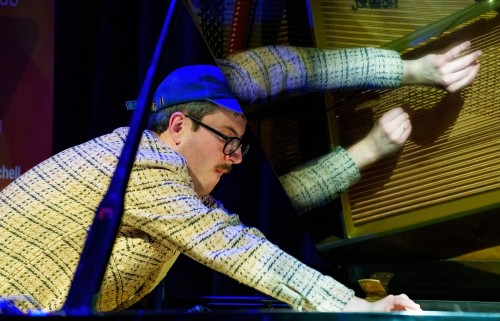
Photograph of Elliot Galvin by Tim Dickeson
6th ANNUAL BATH JAZZ WEEKEND, WIDCOMBE SOCIAL CLUB, BATH
SUNDAY 11th JANUARY 2026
REBECCA NASH / ALEX MERRITT DUO
Rebecca Nash – piano, Alex Merritt – tenor saxophone
A laid back start to the third and final day of the weekend with this intimate duo performance from pianist Rebecca Nash and tenor saxophonist Alex Merritt.
The versatile Nash has appeared on the Jazzmann web pages on numerous occasions, both as the leader of her own groups and as a prolific sidewoman. Nash’s albums “Peaceful King” (2019) and “Redefining Element 78” (2023) are reviewed elsewhere on these pages. Others with whom she has worked include saxophonists Dee Byrne and Iain Ballamy, vocalist Sara Colman and guitarist Steve Banks.
Merritt made his leadership debut in 2016 with the quartet album “Anatta”, which is reviewed elsewhere on The Jazzmann. With trumpeter Steve Fishwick he was the co-leader of a quintet that recorded the album “Mind-Ear-Ladder”, released in early 2022. He is associated with the Barcelona based Fresh Sound New Talent label and has been part of the Fresh Sound Ensemble, a group featuring the numerous British musicians who record for the label.
Still a relatively new combination the Nash / Merritt duo first came together through the pair’s shared admiration for the playing and composing of two British jazz greats, pianist John Taylor and trumpeter Kenny Wheeler, both sadly no longer with us. A love of classical music also represented common ground.
Today’s programme featured compositions by both Taylor and Wheeler, Duke Ellington and Hoagy Carmichael. The classical world was represented by a piece composed by Dmitri Shostakovich and we also heard an original from the pens of Nash and Merritt.
The duo commenced with a version of the Kenny Wheeler composition “Kind Folk”, ushered in by a passage of unaccompanied piano from Nash. The focus was very much on melody and lyricism and I wondered if Nash and Merritt drew inspiration from the piano / sax duo of Taylor and Stan Sulzmann, whose 1987 debut album “Everybody’s Song But My Own” took its name from Wheeler’s title track, a composition that has become something of a modern UK jazz standard.
A new duo arrangement of Nash’s “Platinum”, a piece from her “Redefining Element 78” suite, was introduced by an extended passage of unaccompanied piano that ranged from glacial tinkling to more lyrical passages featuring the addition of Merritt’s tenor sax, wispy and tentative at first before his sound became warmer and more rounded.
A further solo piano passage seemed to form the bridge into Merritt’s own composition “Bright”, a piece that featured his subtly probing tenor sax soloing.
The first John Taylor composition to be performed was “Autumn”, with Merritt speaking admiringly about the tune’s bright harmonic colours. It first appeared on Taylor’s solo piano album “Phases”. The recording included pieces written for all the seasons and today’s gently ruminative duo performance seemed to capture something of the “mellow fruitfulness” associated with autumn. Merritt’s warm toned tenor took the lead with a beautifully controlled saxophone performance.
Nash spoke of the duo’s love of musical light and shade and it’s also true that they love to mix musical styles, putting their own stamp on them in the process. This was exemplified by a segue of Duke Ellington’s “Prelude To A Kiss” and a piece by Shostakovich, the title of which I didn’t catch, two pieces united by their linear approach to harmony. An extended unaccompanied tenor sax intro was followed by a passage of solo piano, a pattern that was then repeated, although punctuated by instances of genuine duo playing. Nash’s playing on the Shostakovich section featured some appropriately flamboyant classical flourishes.
Taylor’s “Phases” album is clearly a touchstone for the duo and the second item selected from that recording was “Foil”, a piece described by Nash as “so cool”. This was a performance that featured the duo’s intimate rapport at its best with tightly interlocking sax and piano lines brilliantly linked together.
To close Nash’s arrangement of Hoagy Carmichael’s “Skylark” gave this much loved old standard a thoroughly contemporary makeover. The famous melody eventually emerging after an extended introduction, solo piano at first and then duo. Both Merritt and Nash then expanded upon the theme with further solos.
This intimate, understated duo performance was both immersive and compelling with Nash and Merritt adopting an intelligent and gently exploratory approach to a range of well chosen material, an admirably diverse selection that had been moulded to fit the duo’s distinctive house style.
Thanking the musicians BJW organiser Nod Knowles compared Merritt’s lyrical sax playing with that of Ben Webster. Maybe Stan Getz would make a suitable reference point too.
It is intended that the Nash / Merritt duo will record their debut album later in the year. On the evidence of today’s live performance it is a recording that will be well worth waiting for.
ELLIOT GALVIN ‘THE RUIN’
Elliot Galvin – piano, synth, kalimba, electronics, Ruth Goller – electric bass, vocals, electronics, Mandhira de Saram – violin, Corrie Dick – drums, percussion
Now based in the Somerset town of Frome pianist and composer Elliot Galvin has been a regular presence on the Jazzmann web pages both as the leader of his own trio and as a member of Dinosaur, the quartet led by his life partner, composer and trumpeter Laura Jurd. I’ve also seen or heard him perform with guitarist Dan Messore, saxophonists Binker Golding, Mark Lockheart and Phil Meadows, bassists Huw V Williams and Radhika de Saram and the band Led Bib.
Two of Galvin’s four trio albums are reviewed elsewhere on these pages as are recordings and live performances by Dinosaur.
Galvin’s latest album release is “The Ruin” (Gearbox Records 2025), which appears of the Gearbox record label. It’s an ambitious, semi-conceptual work based upon his upbringing in the Medway towns of Kent that features a broad mix of musical influences ranging through jazz, electronica and classical. In his album notes Galvin describes the concept behind the recording thus;
“It is a record inspired by my childhood and the ways in which we are all shaped by the ruins of our past.”
The recording features a core trio of Galvin, Ruth Goller on bass and voice and Sebastian Rochford at the drums, augmented on several tracks by the strings of the Ligeti Quartet. Shabaka Hutchings also guests on two tracks, playing a variety of flutes.
Today’s performance focussed on music from “The Ruin” played by a quartet featuring Galvin, Goller and drummer Corrie Dick, the latter a member of Galvin’s regular piano trio. Representing the classical side of the equation was violinist Mandhira de Saram, once of the Ligeti Quartet and a musician used to working in a jazz and improvised music context with saxophonist Trish Clowes among others.
The “Ruin” album features eleven tracks but the performance today was today divided into two lengthy segues, each incorporating several different pieces.
The first sequence commenced with an extended solo piano introduction to which was eventually added de Saram’s almost subliminal bowing, her playing bringing a ghostly quality to the music. Electronics played a large role in the music, in addition to playing piano and synth Galvin also manipulated a table full of electronic devices and both Goller and de Saram deployed effects pedals and other floor mounted gizmos. The stage was absolutely swarming with wires.
A self confessed ‘nerd’ Galvin has always harboured a love of toys and gadgets and has incorporated them into his music, doing so with a skill and imagination that transcends mere novelty, as this review of a 2015 trio show at Dempsey’s in Cardiff explains;
https://www.thejazzmann.com/reviews/review/elliot-galvin-trio-dempseys-cardiff-08-09-2015
The next section today featured the sounds of Goller’s electric bass and her haunting wordless vocals. Long admired as bass player with Oriole, Acoustic Ladyland, Let Spin and others Goller’s own project Skylla has seen her using her voice a lot more alongside fellow singers Lauren Kinsella and Alice Grant.
Dick had been sitting silently, patiently waiting all this time, but now established a drum groove, working in collaboration with Goller who also used the body of her bass as a form of percussion. This underpinned Galvin’s excursions on both electronics and piano before the drums dropped out once more, together with the bass as Goller now focussed on electronics as de Saram’s violin took the lead, her sound also treated electronically. The combination of violin drones and the subterranean rumble of Goller’s Fender Precision bass then helped to evoke a dystopian soundscape suggestive of the album title.
Galvin was now featured on kalimba, or African thumb piano, accompanied by the sound of de Saram’s pizzicato strings as the pair generated interlocking rhythms reminiscent of Minimalism.
This was picked up on by the whole band in a more groove based section featuring pounding electronic rhythms in addition to bass and drums, the music gathering in intensity and momentum as Galvin launched into a dazzling piano solo fuelled by Dick’s dynamic drumming, this turning into something of a feature in its own right.
Contrasting dynamics were very much a feature as the music rapidly cooled down again with Dick switching to brushes, but before the audience had got too comfortable the band were soon ramping up the tension again with piano and soaring violin underscored by pounding bass and drums.
This opening sequence had lasted around thirty five minutes and had been thoroughly absorbing as it explored a broad range of colours, textures and dynamics, skilfully blending acoustic and electric sounds as part of a rich musical tapestry.
Galvin likes to approach the piano as a “total instrument” and the opening of the second sequence saw him exploring under the lid in typically adventurous fashion, the sounds of dampened strings augmented by electronics and with drums and pizzicato violin helping to create a series of interlocking rhythms.
Goller’s bass was eventually added to create an odd meter groove, the development of which was aided by swirling electronica.
Dick was featured with an extended solo drum passage, this eventually punctuated by Galvin’s piano chording, which only served to make the drumming even more explosive.
Gradually Dick began to wind down and relax, the next section featuring the melancholic sounds of de Saram’s bowed violin, a total contrast, even when augmented by electronics. The reflective mood continued with the addition of piano and then the further introduction of Goller’s electric bass, played with a pick, and her ethereal wordless vocals. Galvin then took over at the piano, the atmosphere of lyrical reflection being maintained until the close.
Although not the easiest performance to describe this intriguing event represented my personal highlight of the day. Galvin and his all star quartet drew the audience into their distinctive electronically enhanced soundworld, the technology being deployed in a consistently creative and inventive manner. But it wasn’t just about the electronic hardware, all the members of the Galvin group are superb instrumentalists and there was plenty of high quality ‘conventional’ playing to enjoy too.
With all the technology on display this wasn’t the easiest of shows to stage and Galvin was quick to praise the efforts of sound engineer Mark Burton and the rest of the BJW team, who all did an excellent job over the course of a very full weekend.
EMILY TRAN QUINTET
Emily Tran – piano, vocals, Mali Sheard – alto & soprano sax, Christ-Stephane Boizi – trombone, Holly Reinhardt – double bass, Ethan Sweeting – drums
BJW has established something of a tie up with the Tomorrow’s Warriors organisation and the last two Weekends have featured performances by TW alumni with alto saxophonist Mali Sheard leading her own group in 2024 and pianist Ky Osborne leading his KO Trio in 2025.
This year it was the turn of pianist, vocalist and composer / songwriter Emily Tran leading her regular quintet featuring Sheard, trombonist Christ-Stephane Boizi and bassist Holly Reinhardt. There was one change in the usual line-up with Ethan Sweeting taking over from Joel Steyn in the drum chair and doing a terrific job.
Although inspired by the likes of Bud Powell, Oscar Peterson and Herbie Hancock Tran writes songs as well as instrumental compositions. The quintet commenced with “Spin Open”, which featured Norma Winstone like wordless vocals in addition to the lyrics. I was sitting in pretty close proximity to the horns and found it difficult to pick up on the lyrical content so I’m going to refrain from passing too much comment on Tran’s words. However the playing was excellent from all concerned with Sheard soloing incisively on alto, followed by Reinhardt on double bass.
“Dancing”, a song about Tran’s childhood saw the leader emerging as a piano soloist alongside Sheard and Boizy, with all three musicians impressing with their fluency.
“Signals” featured Tran on both piano and vocals and also included solos from Sheard on alto and Reinhardt on double bass. The bassist was singled out for particular praise by my fellow scribe Tony Benjamin, writing for Bristol 24/7. Meanwhile Tran lauded the contribution made by young drummer Ethan Sweeting, who gave an impressively assured performance at the kit.
“Salt”, described by Tran as being “a song about people who come and go” saw Sheard switching to soprano sax and I particularly liked the blend between this instrument and Boizy’s trombone. Propelled by Sweeting’s contemporary drum grooves the lyrics were centred around the phrase “like salt on my skin”. Meanwhile instrumental solos came from Sheard on soprano and the impressive Boizy on trombone.
Tran explained that the lyric of “Get Out Of My Head” was about her own tendency to overthink things. A recurring melodic motif served to emphasise the point. Reinhardt’s propulsive bass groove and Sweeting’s crisp drumming helped to fuel solos from Sheard on alto and Boizy on trombone.
Tran celebrated her Vietnamese heritage with “Nuoc”, the title a Vietnamese word translating as either “liquid” or “country”. This was effectively an instrumental ballad and featured Sweeting deploying brushes for the first time as part of a commendably sensitive drumming performance. The interplay between Sheard’s alto and Boizy’s trombone was particularly impressive with Sheard the featured soloist.
The quintet concluded with “Anti-Movement”, an instrumental piece that “actually moves around quite a lot”. Sheard’s incisive and attacking soprano sax solo exhibited a John Coltrane influence and there were also expansive solos from Boizy on trombone, Tran at the piano and finally Reinhardt on bass.
This was an enjoyable performance from a young group that exhibited a high level of potential. I have to admit that I preferred the all instrumental pieces to the vocal items, but that’s very much a personal choice.
Over the course of the last twelve months I’ve enjoyed a number of performances by bands led by Tomorrow’s Warriors alumni including groups led by Sheard, pianists Ky Osborne, Kezia Abouma trumpeter Klara Devlin and drummer Miranda Radford. All have been excellent and I’m also looking forward to seeing Ankora, the group formerly known as the Tomorrow’s Warriors Female Frontline when they visit the Marr’s Bar in Worcester for a Music Spoken Here event on February 12th 2026. The line-up will include Sheard and Reinhardt, plus Abouma, Radford and Devlin.
The quality of these young musicians augers well for the future of British jazz and my thanks are due to Emily Tran, Mali Sheard and Christ-Stephane Boizy for speaking with me after today’s gig.
WEEKEND OVERVIEW
Another excellent event superbly organised by Nod Knowles that created a real community atmosphere and which ran to time throughout the Weekend despite the multiple changeover of acts. The quality of the sound was also a notable factor and as a whole the Weekend represents great value for money with a diverse programme that embraces several styles of jazz. Although largely at the more contemporary end of the jazz spectrum there is pretty much ‘something for everybody’.
This was the second BJW that I’ve attended and it’s already an event that represents a definite highlight on my personal jazz calendar. Every act this year delivered, albeit in very different ways, and I hope to be back again in 2027.
Congratulations to Nod and his team for getting the Jazz Year off to such a terrific start.
blog comments powered by Disqus