

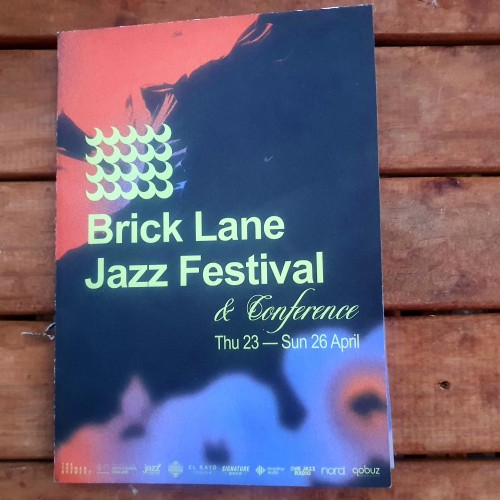
by Colin May
May 05, 2026
Guest contributor Colin May enjoys the energy of the second day of he 2026 Brick Lane Jazz Festival.
Brick Lane Jazz Festival
Various Venues, London
Friday 24 April 2026
A very ambitious programme had been laid on by the organisers for what was the festivals’ fifth anniversary. I could only make it down to London for one of the four days, Friday when there were twenty-four bands and eleven DJs on offer across ten venues. And Friday was a short day with the music starting at 5.45 whereas on Saturday and Sunday was a 2.00 start, so even more performances on those two days.
For the first time, the festival also had a conference, and ran for four days instead of three. The intention of the organisers for the conference was; “Across three days, we’re bringing together high-profile industry heads, cultural leaders and groundbreaking artists from across the music ecosystem to share ideas, lived experience and practical knowledge. “(Source email shot from Brick Lane Jazz Festival 12 Feb 2026).
I was only at one conference session but based on the programme it intertwined sessions on the U.K. scene e.g. “From Basement Clubs to Main Stage:The Evolution of the UK Jazz Scene” with developmental sessions e.g. “How musicians transform on -line buzz into real- world impact” and offered mentoring sessions in partnership with Women in Jazz. Also integrated into the conference programme were workshops at the Headline Audio Music Zone where it was possible to to try out the latest electronic keyboard kit from four companies, watch demos, and have questions answered by experts.
When it comes to the music the festival has developed very rapidly into a cross-genre event that leans towards giving a platform mainly,but not exclusively, to emerging talent. It is worth quoting some of what the organisers say about the festival’s growth and about this year’s event:
“Brick Lane Jazz Festival celebrates its fifth anniversary this year a milestone for a community that has grown from a grass roots idea into one of London’s most vital platforms for new music…creating a space for collaboration, discovery and connection across scenes…....we return with a genre-spanning line-up that reflects that evolution - bringing together jazz, hip-hop, neo-soul, R&B, broken beat, electronic music and much more..” (Source printed / hard copy of the programme).
There were names on the bill I recognised Brian Jackson , one half of a duo with Gil Scott Heron, jazz harpist Amanda Whiting, French trumpeter-composer daoud, and Joe Armon -Jones who was due to close the live music on Sunday night . But I did not know any of those playing on Friday with the exception of David Mrakpor.
However not knowing what you might come across is a large part of the fun of going to the Brick Lane Jazz Festival (BJLF). But I did some planning in advance identifying acts that were advertised as having a significant jazz element or that just seemed intriguing. I ended up with a list of ten from Friday’s bill of twenty-four but with several of my picks having overlapping stage times I knew that to see something of all of them I would have to rush from stage to stage and for most I would only have time to hear a few numbers and not their full set.
It all started calmly because when the initial two acts played there were no other performances going on when they played. Both acts were solo keyboardists playing thirty minute Nord showcases on a Nord instrument, Nord being one of the manufactures who were contributing to the Headline Music Audio Zone.
JOSHUA DOMFEH
JOSHUA DOMFEH who first played keys in public in church, moved between Jazz, African, Gospel and pop. His all instrumental set began with two covers of Stevie Wonder songs. ‘My Cherie Amour’ was slower and more etherial than the original had lots of tinkling which verged on being a few tinkles too many. This style was more successful in his version of Debussy’s ‘Clair de Lune’ ( Moonlight), a topical choice given the Artemis mission. Domfah made the familiar tune more mysteriously playing unusual voicings behind the beat. The other highlight was his playing of his own composition City Lights’ which was both hypnotic and painted a picture.
ELIANA GLASS
Australian born composer singer-pianist ELIANA GLASS was raised in Seattle and now is based in New York, and also is a painter. She was the second keyboardist giving a Nord showcase. A graduate of the The New School jazz course, according to the BLJF on -line programme she writes contemporary classical music, has a reputation for minimal performances and her work often explores repetition and subtle variation.
She explained that this was the first time she’d played a Nord keyboard and at one point was clearly surprised by the results saying,” I’ve never heard that sound before”. Perhaps because she wasn’t playing her own keyboard her playing was extremely minimal - even for a minimalist.
Her main instrument was her extraordinary voice. She played a set of her own songs which she delivered more in a singer songwriter than jazz style. I wrote what became a list of adjectives and phrases to try and characterise her voice: smokey, nuanced, several keys simultaneously, quiet yet insistent, but I don’t think any of these capture it entirely. Her songs tended to be slow paced with lyrics on the dark side. My friend found some of them depressing, but it was possible to block them out them if one wished and let oneself be beguiled by her voice.
KAU
After this it it was a first visit to the Jazz Warrior’s stage of which more later, and then to the El Rayo Stage at JuJu’s to catch the last part of the set from KAU. They are a German keyboardist, Italian bass guitar player and Norwegian drummer, based in Brussels so very much a European band breaking into in the BLJF’s natural London-centric focus. Except that their latest album ‘Unknown Waveforms’ “ fits with the BLJF ethos as it “has atmospheres oscillating between free music and wild dancing” (BLJF on-line programme notes).
Intriguingly the BLJF programme notes also announced that KAU who I anticipated to be noise merchants, were bringing a string quartet with them. Indeed there was a freedom and wildness in their pulsating free flowing blend of synths, bass guitar with FX and at times beat heavy drumming which drew a very positive response from the front ranks of the packed crowd who became part of the performance. They were noise merchants who blended experimental but accessible sounds and appealing quasi pop melodic lines with their drummer delivering a blistering solo.
I was only able to hear the string quartet when KAU opted out and left the music to the string quartet who then played in classical chamber music style. The contrast between the style and volume of the KAU and that of the string quartet worked to raise the excitement level and the room became febrile. If there was no out and out jazz it was very exciting to listen to and was a great atmosphere. On finishing all on stage received a well deserved roar of approval for their
efforts.
GARY WASHINGTON, THE URBAN CELLIST
By chance, heading to the next band on the list, I came across a solo cellist on Brick Lane who was not part of the official BLJF, and whose playing, supported by a backing track, came over as brilliant experimental jazz licks.. This turned out to be THE URBAN CELLIST or GARY WASHINGTON . A search on the internet disclosed he’s an American whose musical alma mater is New Orleans but now is based in Manchester and London. He’s described as a composer for orchestras and chamber groups, as having his own band and is a beat boxer. From what I heard he would be justified in adding playing jazz to the description.
BENJI ‘CHIEF’ APPIAH
This unanticipated happy accident did disrupt the schedule, and perhaps that’s how in a hurry I came to turn left off Brick Lane and into the Jazz re-Freshed stage at Ninety-One instead of the planned right turn into the venue opposite where I had intended to hear the improvising collective ‘Work, Money, Death’ who were billed as being inspired by the spiritual jazz of Pharaoh Sanders and Alice
Coltrane.
Instead I heard two extended numbers from a group led by south London drummer BENJI ‘CHIEF’’ APPIAH. the titles of which said volumes. They were both very personal and played with a fierce passion by the drummer and his four band mates none of whose names I caught. Appiah explained that ‘Pressure’ featuring a fierce solo from his saxophonist was a response to family opposition to him wanting to become a musician. “Well I did and I’m making a living at it”, and among his credits now are playing with Nubya Garcia and with Joe Armon-Jones
The other number I heard was introduced by Appiah as being for his girl friend. If the title ’ Blood, Sweat and Tears’ is descriptive it must be a demanding relationship, and it featured a fierce rock electric guitar duet from the lead and the bass guitarists before another fiery jazz sax solo. It again was a packed venue, another highly enthusiastic crowd and another vibrant atmosphere, and totally committed playing. No regrets then about turning left when the plan was to turn right.
CHARLIE STACEY
It was then onto Rich Mix one of the bigger venues but about ten minutes from the cluster of venues near the box office to see CHARLIE STACEY, another new name to me, who was billed as “one of the UK’s leading keys jazz players whose improvisational skills are unmatched” (BLJF on line programme).
Unfortunately because of ‘technical difficulties’ Stacey and his colleagues started about forty minutes later than scheduled, and additionally no one had thought to provide Stacey with a microphone and I couldn’t hear what he said about his music from where I was perched.
All in all not a good look, but what about the music?. Stacey opening sally was percussive and accompanied by heavy bass guitar and almost inevitably given this start, the number also featured a powerful drum solo. This set a template for quite a lot of what followed with another number having a dramatic chord sequence which could have been the denouement of a thriller.
Stacey did have a virtuosic touch and his playing had unexpected twists. Quite a lot of what he played was hard-edged and aggressive; playing not for the faint hearted. But also he played keyboard washes and soundscapes. In fact it was the most relaxed number that was the highlight of his set with him playing quietly and laid back, but still commandingly, over the bass and drums. At one point he made his synth sound like a flute playing a gentle air. It was a sharp contrast with how he’d started.
Charlie Stacy is an alumni of BLJF’s charity partner Tomorrow’s Warriors who were themselves celebrating their thirty-fifth year of supporting young jazz talent and it was to their stage that I headed next.
GENEVIEVE NAAMAZZI QUARTET
I had been there earlier to see the GENEVIEVE NAAMAZZI QUARTET. All four young players had played with a maturity beyond their years with all the numbers I heard composed by leader and double bassist Naamazzi who is of Ugandan heritage. I liked both her melodies and her arranging and particularly a number inspired by and named after the Ugandan word for antelope.
Also impressive was how as leader she gave a lot of space for soloing to her band colleagues and especially the very talented tenor sax player. In fact Naamazzi was the only member of this talented group who didn’t take a full solo in the three numbers I heard, instead confining herself to subtle short double bass vignettes . Hers was a straight ahead quartet dripping in promise.
BAD INFLUENCE
When I returned to the Tomorrow’s Warriors stage it was to hear BAD INFLUENCE fronted by a trombone and tuba. The first number featured a trombone solo using FX effects resulting in sounds I had never heard before. The set also featured fine tuba solos and a hearty number that mixed New Orleans and Psychedelia. The two principals also sang some soulful vocalise and the keyboardist also did some fine soloing. They were an unusual and very enjoyable group.
Also they were the last group I had time to see before I had to leave to make sure it wouldn’t be past 2a.m when I got back in Oxford. As things turned out I had seen fewer bands than planned, and only a small percentage of the total that were playing across the whole festival.
FESTIVAL OVERVIEW
Ending my visit at the Tomorrows Warriors stage, which was unintentional, did feel right though as BLJF is largely about nurturing emerging talent, and the members of the two groups I saw on that stage have the talent to be part of the UK jazz scene’s future.
If asked to sum up the Brick Lane Jazz Festival in a single word I’d say “energy” and include the organisers in that. Friday may have started low key but it took off with energy emanating from enthusiastic audiences as well as from the performers on stage playing their hearts out. It made for fascinating music, great atmospheres and a great evening and night out.
Thank you to Will Vincent for arranging my press pass.
For details of all the performers across the four days please see the Festival Programme Programme-Brick-Lane-Jazz-Festival-2026.pdf - Google Drive and also Day by Day Split see;
https://www.bricklanejazzfestival.com/2026-day-split
For the conference programme please see
https://www.bricklanejazzfestival.com/brick-lane-conference
The Urban Cellist Gary Washington can be found on Instagram and on You Tube
https://www.instagram.com/theurbancellist_cornwater/
COLIN MAY