

by Ian Mann
December 01, 2025
Ian Mann enjoys performances by the Kezia Abouma Quintet, the Erica Tucceri Quartet and finally Howl Quartet.
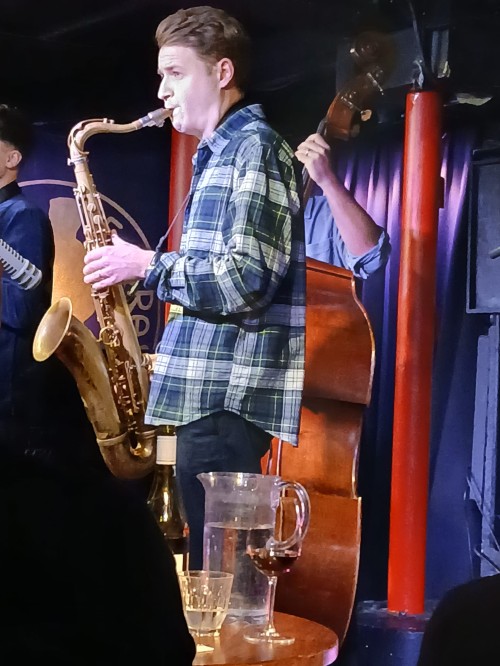
Photograph of Harry Brunt of Howl Quartet by Pam Mann
EFG LONDON JAZZ FESTIVAL 2025
DAY FIVE, TUESDAY 18th NOVEMBER 2025
KEZIA ABUOMA QUINTET, PIZZA EXPRESS JAZZ CLUB, SOHO
Kezia Abuoma – piano, Finn Hovi Ohrstrom – trumpet, Mali Sheard – alto & soprano saxophones, Tom Sheen – double bass, Miranda Radford – drums
Today’s events in the Heads Up series curated by Kasia Konstance featured this quintet led by the young pianist and composer Kezia Abuoma. She is a product of the Tomorrow’s Warriors programme and is currently studying at Trinity Laban Conservatoire, while at the same time making her mark on the London and wider national jazz scene.
Abuoma’s piano tutors have included Nikki Yeoh, Bruno Heinen and Deschanel Gordon. Her influences as a pianist and composer include Geri Allen, Herbie Hancock, Kris Davis, Kenny Kirkland and Wayne Shorter.
Of today’s line up I was already familiar with the playing of drummer Miranda Radford and bassist Tom Sheen, who I had seen perform as part of Radford’s own quartet at a hugely successful and enjoyable Music Spoken Here event in Worcester earlier in the year. I also recall seeing Sheard perform as part of the Royal Academy of Music Jazz Ensemble at the 2024 EFG LJF.
Abuoma and Radford are also part of the all female trio Sula, where they are joined by bassist Aleks Dimitrova. Abuoma is also a member of Tom Sheen’s quintet.
These are musicians who know each others playing very well and today’s programme featured Abuoma’s original compositions exclusively, which from my point of view was good to see and showed an admirable sense of ambition and self confidence. This was a real showcase event for Abuoma with a large and attentive audience and I’m pleased that she had the faith to trust in her own material.
Opener “Grace” commenced with an extended unaccompanied piano intro before Sheard, on soprano saxophone, and eighteen year old trumpeter Ohrstrom took up the main melodic theme, playing a mix of unison and contrapuntal melodic lines. Sheard took the first solo on soprano, followed by an expansive piano excursion from the leader, fuelled by the crisp drumming of the excellent Radford. The two horns then combined again on a reprise of the main theme.
Sheard continued on soprano for “Song Of The Sparrows”, again combining effectively with Ohrstrom, the young trumpeter coming more into his own as he shared the solos with Abuoma.
Sheard switched to alto for “Deliverer”, a highly rhythmic composition and one that featured fluent and expansive solos from Sheard, Ohrstrom and Abuoma, plus further excellent interplay between the horns.
The hymn like “Psalm” calmed things down once more with lyrical solos from Abuoma at the piano and Sheard on soprano, with Radford deploying brushes throughout.
“Njioecka”, the title meaning “being grateful for what you have, no matter how small” was played in the classic piano trio format with Radford making a particularly strong contribution, her drums almost appearing to lead at times. Abuoma was afforded the opportunity to stretch out impressively and at length at the piano and Radford enjoyed a lively and colourful drum feature towards the close.
Sheard rejoined the group on soprano for “Song For Cleo”, a composition dedicated to Abuoma’s late grandmother who had been the first black actress to appear at the National Theatre. Cleo was a great source of inspiration to Abuoma and this affectionate tribute featured exceptional solos from both Abuoma and Sheard, both fluent, imaginative and subtly probing.
Ohrstrom returned and Sheard switched to alto for the final number as the quintet played the optimistic “The Future Is Free” with its bright, punchy unison horn lines and fiery solos from Ohrstrom and Abuoma followed by a dynamic Radford drum feature.
I was impressed by both the playing and writing of Abuoma and it is to be hoped that she will one day be able to document this consistently engaging original music on disc. My thanks to her fo speaking with me briefly after the show and for verifying set list and personnel details.
Sheard was to return to the ‘Pizza’ the following day leading her own group. More on that later.
In the meantime I’m looking forward to see Abuoma again when she visits the Marr’s Bar in Worcester on February 12th 2026 for a Music Spoken Here event featuring the octet Ankora, the group formerly known as the Tomorrow’s Warriors Female Frontline. The Ankora line up will also include Sheard and Radford and this is an event that will be well worth seeing.
ERICA TUCCERI, RONNIE SCOTT’S
Erica Tucceri – flutes, electronics, percussion, vocals, Lewis Moody – piano, keyboards, Luke Winter – electric bass, Ziggy Zeitgeist – drums, percussion
Tonight’s early show at Ronnie’s featured a quartet led by the Australian flautist and composer Erica Tucceri. Melbourne based Tucceri is a busy presence on the Australian music scene and has appeared as a sidewoman on a host of recordings across a variety of genres.
Her own debut single “Iliamna” (LaSape Records, 2023) borrowed from the legacy of spiritual jazz and made quite a few waves, also picking up airplay in the UK. A debut album is in the offing and I assume that most of the original music that we heard tonight is scheduled to appear on that release.
Tucceri’s band included two long time collaborators from the Melbourne scene, keyboard player Lewis Moody, who is now based in London and the improbably named drummer Ziggy Zeitgeist, who leads his own bands and who had flown in from Berlin. The line-up was completed by bassist Luke Winter.
Tune announcements were scarce and the first piece was introduced by Moody at the piano, joined by Zeitgeist’s filigree cymbal work and his use of small items of percussion. Winter subsequently established an electric bass groove, this providing the platform for Tucceri’s expansive flute solo with its swoops and trills.
The next piece featured infectious samba style rhythms and saw Tucceri soloing on a smaller, higher pitched flute as Moody switched to electric keyboards. Zeitgeist’s agile and colourful drumming was particularly impressive, one could see why Tucceri had gone to he trouble of having him flown in.
Tucceri spoke for the first time to introduce the members of the band and to announce the highly melodic “Bumblebee”, which featured her as a flute soloist and also in dialogue with Zeitgeist’s drums.
Tucceri has spent time in Alaska and the next piece was inspired by an encounter with a grizzly bear! The music bristled with the kind of energy that one might associate with that kind of frightening experience with Moody featuring on both Rhodes and synth and Tucceri striking a cowbell and also adding wordless and electronics before finally taking up the flute for a quieter passage, an effective contrast before the momentum began to build once more.
Tucceri described the next item as being “more experimental” and this proved to be a hypnotic piece centred around a hypnotic drum groove with Zeitgeist deploying mallets on toms and cymbals and occasionally striking and rattling small items of percussion. Combined with Winter’s low register bass rumble this provided the platform for spacey keyboards and Tucceri’s ambient electronica.
The ethereal mood continued on the next item with wispy flute drifting above the shimmer of electric keyboards and a low key drum and bass groove. There was then something of a bass feature for Winter before Moody moved to acoustic piano for a more expansive solo.
Tucceri informed us that back in Australia she also runs an eight piece band featuring two percussionists. With this in mind I suspect that the next piece may have been the single “Iliamna”, which makes extensive use of percussion. Tucceri used pre-recorded loops featuring percussive sounds here and featured herself on alto flute.
We were told that the next tune was a cover, although Tucceri didn’t actually identify its title. I thought it sounded like a disguised version of Freddie Hubbard’s “Little Sunflower”, which featured the flute of James Spaulding on the original version. Tucceri’s flute was featured liberally above a funky electric bass groove and the performance also included an acoustic piano solo from Moody and a drum feature from the excellent Zeitgeist, who was very much a key figure in the proceedings.
The final piece tipped its hat towards 70s / 80s style fusion with its solid bass and drum grooves and solo features for flute and synthesiser, plus a further dialogue between Zeitgeist and the leader.
This was a show that celebrated the links between the London and Melbourne Jazz Festivals and on the whole I enjoyed it. Tucceri proved to be a bubbly personality and an excellent flautist, although it has to be said that the instrument lacks the range or bite of the saxophone. She was well supported by an excellent band, with Zeitgeist particularly impressive, and the standard of the playing was uniformly high throughout. That said the music was sometimes a little too smooth for my tastes, a tendency that is likely to be exacerbated on record. An enjoyable and worthwhile musical experience nevertheless.
HOWL QUARTET, PIZZA EXPRESS, SOHO
Harry Brunt – tenor saxophone, Dan Smith – alto saxophone, Pete Komor – double bass, Matt Parkinson – drums
Having favourably reviewed all three studio albums by Howl Quartet, “Life As We See it” (2021), “Airglow” (2023) and 2025’s “Night Song” I was particularly keen to see the band performing live for the first time.
They take their name from the celebrated Allen Ginsberg poem “Howl”, the idea for the band name coming from tenor saxophonist Harry Brunt, a former English Literature student.
The group first came to my attention through their bassist, Pete Komor, whose playing I know from his tenure at the Royal Welsh College of Music and Drama (RWCMD) in Cardiff. During Komor’s time in Wales I enjoyed seeing him perform at various venues in Cardiff, Brecon and Abergavenny in a variety of musical contexts.
Saxophonists Dan Smith (alto) and Harry Brunt (tenor) also studied at RWCMD and by 2015 they and Komor had moved to London to further their studies at the Royal Academy of Music and at The Guildhall. It was in the English capital that they met drummer Matt Parkinson, with whom they formed Howl Quartet in 2017.
As regards musical influences the band members cite saxophonists Warne Marsh and John Coltrane, guitarist Bill Frisell, drummer / composer Brian Blade and the bands The Bad Plus, Endangered Species and Claudia Quintet.
With their distinctive twin sax front line and flexible and intelligent rhythm section it always seems to me that Howl Quartet represent the natural heirs to the much missed Polar Bear, albeit minus Leafcutter John’s electronics. Although less wilfully eccentric than Seb Rochford’s outfit there’s still something vaguely whimsical and undeniably British about Howl Quartet’s music that I find very appealing. As writers they exhibit a genuine gift for melody and their arrangements are consistently interesting and highly effective.
Also, as Gareth Thomas in his review for UK Jazz News pointed out Howl Quartet are musical story tellers. Many of the pieces performed at the ‘Pizza’ had some kind of personal story behind them, these being outlined to the audience during the course of the tune announcements.
There was a pleasingly large and appreciative audience at the ‘Pizza’ for this show, the crowd including many family and friends of the band. All of the band members write and the programme included compositions from all four of them, spanning all three of the band’s studio albums – there is also a digital only concert recording “Fully Alive”, recorded at a live performance at the ‘Pizza’ on October 2024.
Tonight’s performance began with the title track of “Night Song”, a Dan Smith composition developed by the rest of the band. Kick started by Parkinson’s drums and propelled by Komor’s sturdy double bass groove this immediately demonstrated the quartet’s strengths with a solid yet fluid rhythmic foundation providing the platform for the melodic double sax interplay of Brunt and Smith. The two horns often provide unison theme statements but are also adept at playing off each other, introducing counter melodies and other elements of counterpoint. They complement each other superbly and even during their individual solo statements one never gets the impression that they are competing with each other. Brunt was a featured soloist here, alongside bassist Pete Komor.
Tonight’s show was a part of a wider tour in support of the latest album that had also taken in dates in Denmark, Germany, Belgium and Ireland.
Also by Smith, with some help from Brunt, “The Lookout” was inspired by a man who used to hide out in a car park behind Smith’s flat! It’s a tune that appears on the “Airglow” album. It’s a playful piece with an intro that saw the twin saxes playing tag, prior to a quieter passage featuring just Brunt’s tenor sax with double bass accompaniment only. The re-introduction of Parkinson’s drums saw Brunt continuing to develop his solo before being joined by Smith for a further series of saxophonic cat and mouse.
The stories and the music kept on coming. From the latest album “Smallhope” is a Brunt composition inspired by memories of his grandparents’ home in the Cotswolds. There was a suitably pastoral feel about the twin saxophone chorale that introduced the tune, underscored by double bass and brushed drums. The music later became more powerful with Parkinson switching to sticks and becoming more prominent in the arrangement.
Also by Brunt “Salt House”, a tune from the “Airglow” album, is inspired by a hotel in Chile’s Atacama Desert made entirely from salt! An extended solo tenor sax intro led into one of Howl Quartet’s most reflective and atmospheric pieces, with long, gently brooding sax melody lines floating above the sounds of economical double bass and Parkinson’s soft mallet rumbles and cymbal shimmers. In the live environment solos from Komor on double bass and Smith on alto were carefully woven into the fabric of the tune.
Howl Quartet is a highly democratic unit and announcing duties were shared around the group. Komor introduced his own composition “Embers”, a tune from the “Night Song” album. Centred around the composer’s languid bass line and with the two saxes gently intertwining the title seemed particularly apposite.
From the group’s first album “Fairfield” was Smith’s dedication to the home of his own grandparents on the west coast of Scotland. An atmospheric intro featuring the sounds of bowed bass, mallet rumbles, cymbal shimmers and the gentle brooding of the two saxes developed into a folk inspired melody, ending the first set on a delightfully bucolic note.
The second set began in more rousing fashion with Komor’s composition “Tolls”, which opens the “Night Song” album. Inspired by the tolling of the bells at a church that Komor used to live by his introductory one note bass motif replicated the tolling of a bell and the band developed the track from there via mallet rumbles and cymbal shimmers and the piping melodic lines of the two saxes. A sudden change in tempo led into something more forceful, with Brunt soloing on tenor supported by Komor’s deep, resonant bass lines and Parkinson’s crisp energetic drumming, with Smith’s alto later returning for a reprise of the main melodic theme.
One of Brunt’s grandfathers was a watch maker, something honoured in the saxophonist’s new, as yet unrecorded composition “The Ticking Room”. This proved to be a highly melodic composition with a gently nostalgic feel, emerging from Parkinson’s brushed cymbal intro and featuring gently intertwining saxes, with Smith’s alto taking the melodic lead. Komor was featured with a melodic double bass solo while Parkinson’s performance behind the kit was notable for its sensitivity.
Parkinson’s composition “Patience” and Brunt’s tune “Oku” were played back to back. The recorded version of “Patience” is a brief, atmospheric vignette that closes the “Airglow” album. Introduced by the composer at the kit it was extended here to incorporate a loosely structured passage also featuring double bass plus both saxes.
A sudden change of mood and pace then marked the transition into “Oku”, a piece inspired by the Japanese idea of “inner space”. With its driving drums and propulsive bass lines it’s one of the most powerful tracks on the “Night Song” album and featured some garrulous sax interplay before the rhythm section dropped out, leaving just the two reeds, tentatively still searching for that “inner space”.
“Falling Man” honours Brunt’s late great uncle, who died in a plane crash just after the second world war. The Band’s Facebook page states;
“This piece of music is the first from our upcoming album and was written in memory of Harry’s great uncle Colin.
Colin Branch served with 626 Squadron RAF and flew Lancasters. He survived the war, but died on 7 August 1945 when the aircraft he was travelling in crashed in the south of France on the way to Naples to pick up released British POWs. He was 23.”
Based around Parkinson’s gently marching rhythms, indicative perhaps of Colin’s forces background, this was a tender tribute with Brunt’s tenor sax taking the melodic lead while Komor contributed a succinct double bass solo. The music variously evoked the sounds of New Orleans and of 1940s big bands and I thought I detected a quote from “St. James Infirmary Blues” during the course of Brunt’s tenor sax solo.
Introduced by Komor at the bass “Gwdihw” was a celebration of the now defunct, but fondly remembered Cardiff venue that Brunt, Smith and Komor used to play at during their RWCMD days, some ten years ago. Powered by Komor’s muscular bass lines and Parkinson’s whip smart drumming this was less reflective and nostalgic than the recorded version and more of a full on celebration, with the sounds of the two carousing saxes, and particularly Brunt’s tenor, ‘singing’ Gwdihw’s praises.
It was perhaps fitting that the performance should end with “Back To Basics”, a Parkinson tune from the band’s debut. A solo brushed drum intro was soon joined by Komor’s melodic bass motif, the two reeds then adding the next layer with Smith’s alto sax underlaid by Brunt’s tenor. The two saxes continued to intertwine in true Howl Quartet fashion as Komor and Parkinson continued to keep the groove.
With it unusual twin sax line up the music of Howl Quartet isn’t the easiest to describe, but I absolutely love this band. Strong melodies combine with similarly strong rhythms and their refreshingly ego free approach makes for a unique band sound. The fact that there are real human stories behind many of their compositions only serves to make their music even more interesting. That interest was further enhanced by the fact that the live versions of the tunes sometimes differ significantly to the recordings, exhibiting a genuine commitment to the arts of both composition and improvisation.
Tonight’s show in front of a packed house at a venue they consider to be their ‘spiritual home’ was a triumph for the band and it was good to speak with the band members afterwards. The ‘Cardiff Connection’ will always mean that I have a bit of a soft spot for Howl Quartet and it’s good to see them making their mark on the national and international jazz stage, their success totally justified by the consistently high quality of the music on their three albums to date, allied to the quality of their live performances.
blog comments powered by Disqus