

by Ian Mann
December 07, 2025
Ian Mann on the avant rock of Tortoise at the Barbican followed by three very different big band performances forming part of the Guildhall Jazz Festival at Milton Court.
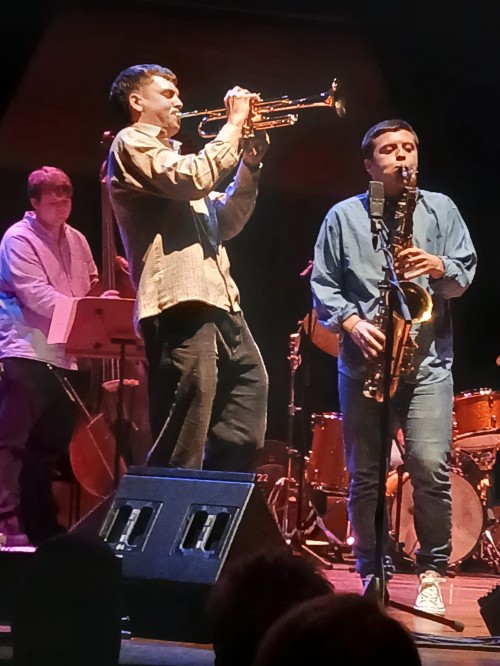
Photograph of NYJO trumpet / tenor sax ‘battle’ by Pam Mann
EFG LONDON JAZZ FESTIVAL 2025
DAY NINE, SATURDAY 22/11/2025
Another day spent in the locality of the Barbican Centre with a ticketed performance by the American avant rock group Tortoise at the Barbican Centre in the afternoon followed by three free admission performance at Milton Court in the evening, these forming part of the Guildhall Jazz Festival, a ‘festival within a festival’ taking place within the overall framework of the EFG LJF.
TORTOISE, BARBICAN HALL
Tortoise is Dan Bitney, John Herndon, Douglas McCombs, John McEntire, Jeff Parker.
So says the Bandcamp page of the Chicago based label International Anthem with regard to Tortoise’s latest album release, “Touch”.
It’s a bald, functional statement designed to reinforce the mystique of a band with a cult following, whose carefully cultivated anti-image as studio boffins is actually their image.
Formed in Chicago in 1990 Tortoise features five multi-instrumentalists who perform exclusively instrumental music that draws inspiration from many sources, among them rock, jazz, electronica, krautrock, dub reggae and minimalism.
They have released eight studio albums of original music, a set of re-mixes and a highly eclectic covers album, the latter a collaboration with Bonnie Prince Billy. The have also collaborated with the Dutch underground act The Ex.
Tortoise’s brand of experimental rock has won them a huge cult following. Today saw them playing two shows at the Barbican as part of EFG LJF, The evening show sold out almost as soon as it was announced and this matinee show was swiftly added and was also pretty much fully subscribed.
Although Tortoise have been part of the musical landscape for more than a quarter of a century they’ve largely operated beneath my personal musical radar. Nevertheless what I had seen and heard of them in the form of radio snippets and Youtube clips intrigued me and the prospect of seeing them live during a rare visit to the UK, part of a larger tour in support of the new album, was too good to miss.
There was some concern among Tortoise’s UK fan base that the group’s guitar specialist Jeff Parker, who also works as a solo artist, was unavailable for these London shows. His place was taken by James Elkington, another Chicagoan, who did a superb job in the role.
Elkington was the only player to concentrate on a single instrument. The stage set up included two drum kits with one usually occupied by either Herndon or McEntire, although some pieces featured the pair drumming in tandem. McCombs moved between electric bass and guitar and also added some percussion. Bitney featured on keyboards and tuned percussion, as did McEntire and Herndon. Instrument swapping was a constant throughout as the members of Tortoise demonstrated their versatility and virtuosity with the minimum of fuss.
No tunes were actually announced, the only talking came at the end of the set as the rest of the band thanked Elkington for helping them out and acknowledged the soundman, the support of EFG LJF and, of course, the audience.
The evening show featured a support set from Tortoise’s International Anthem label mates Jeremiah Chiu (synthesiser) and Marta Sofia Honer (viola). They didn’t play the afternoon show as a duo but Honer did make two brief cameo appearances during Tortoise’s set, adding a welcome element of variety to the quintet’s sound.
Tortoise’s brand of experimental rock makes use of rock rhythms, some of them complex and sophisticated, but despite being all instrumental their music could hardly be categorised as jazz. They also make effective use of feedback and other guitar effects, plus the use of samples, one section featured the use of sampled voices, including police announcements.
The music is dense, full of interlocking rhythms and melody lines, complex music informed by a keen intelligence that sometimes reminded me of King Crimson. Both bands seem to have a similar audience constituency of slightly earnest ageing male rock fans – guilty as charged your honour.
All of the band’s acknowledged influences came to the fore at various junctures of the performance. The krautrock element was particularly noticeable and the sound of the twin drums was at one point enhanced with a dub like echo. The encore sequence included some furious math rock riffing that elicited a bout of sit down head banging amongst some members of the audience.
So, not a tune by tune account but I hope I’ve given something of the flavour of Tortoise’s performance. The music was often jagged and angular, sometimes ambient, and even lush on occasions, particularly when Honer joined the band.
This was music that was consistently mutating and shifting in terms of moods, textures and dynamics. The band themselves are quick to emphasise the cinematic quality of their music with the following passage appearing on the Bandcamp page for the new “Touch” album;
“Close your eyes and you might see cars swerving around unlit rural roads, or cityscapes at night with bells clanging in the distance, or some abandoned warehouse where spies chase each other between towering stacks of boxes”.
Overall I enjoyed this performance from Tortoise, although it did seem to take a while to get going and the band’s studied air of detachment from the audience sometimes felt like a bit too much of a pose. Also for a regular jazz listener the rhythms, for all their complexities were a bit too rock, lacking the subtlety and flexibility of jazz.
The Tortoise faithful seemed to enjoy it well enough and Elkington’s contribution was very well received. Although not totally blown away by Tortoise, as I’d hoped I might have been, I was still convinced enough to decide to try them out on disc, but the queues for the merch stand after the show were so long I decided not to bother. Another visit to Bandcamp awaits.
THE JUNIOR GUILDHALL BIG BAND directed by OLLIE WESTON, MILTON COURT
Back to a still rather chilly Milton Court for an evening of performances featuring three different large ensembles beginning with the Junior Guildhall Big Band directed by Ollie Weston.
In addition to his work as an educator Weston is a talented multi reed player who leads his own groups and is also a member of Hejira, the popular Joni Mitchell inspired septet led by guitarist Pete Oxley.
Today’s performance featured this year’s crop of young musicians, plus some returnees from 2024. They were all scarily young – and scarily good.
The programme featured a series of arrangements associated with the Thad Jones Big Band, beginning with “Big Dipper”. Weston name checked some of the soloists using first names only. Here we heard from Gabriel on trumpet and Izzy on tenor, with piano and drums also prominent in the arrangement.
The ballad “Kids Are Pretty People” featured Izzy playing the theme on tenor and included a remarkably fluent solo from Thomas on bassoon, an instrument rarely seen in a jazz big band, or indeed jazz in general. Also featured was William on electric bass.
“Yes Sir, That’s My Baby” was recorded by Jones on his 1968 album featuring vocalist Ruth Brown. This represented a feature for the impressive young vocalist Bessie Taggart, at one juncture singing with double bass accompaniment only.
The blues “Trouble in Mind” also featured the vocalist and allowed Taggart the opportunity to demonstrate her versatility. Uncredited instrumental solos came from double bass and tenor sax.
Singing on her birthday Taggart’s last song was “Sonny Boy”, initially sung as a voice piano duet before the rest of the band kicked in, injecting a genuine sense of real big band swing to the arrangement. Izzy was again the featured instrumental soloist.
Lara Mehmet took over vocal duties for the bluesy “Moving To The Outskirts of Town”, an excellent but rarely heard song, the instrumental solo coming from one of the alto saxophonists.
Mehmet then demonstrated her ballad skills on “Do Anything But Be Mine” and followed this by linking up with the trumpet section on “Bye Bye Blackbird”, which closed the show.
Weston did an excellent job of directing the band and announcing the tunes and did name-check them all at the close but the fully justified audience applause made it impossible for me to note all the names. Instead I’ll just say well done to everybody concerned for a very enjoyable hour of music.
SAM EASTMOND & NYJO PRESENT JOHN ZORN’S MASADA
For me the highlight of the day was this collaboration between arranger and director Sam Eastmond and the National Youth Jazz Orchestra (NYJO) in this performance of selected pieces from the American composer and saxophonist John Zorn’s vast “Masada” repertoire, numbering some 630 tunes.
New York based Zorn, born in 1954, has been one of America’s leading figures on the experimental music scene for many years, his music embracing a broad swathe of influences and including jazz, free improvisation, contemporary classical, film music, his own Jewish heritage and so much more. He has been extraordinarily prolific with literally dozens of recordings to his credit and hundreds, if not thousands, of compositions.
I had high hopes of this performance after witnessing Eastmond direct a collective of the UK’s finest improvising musicians in a performance of some of the items in Zorn’s “Bagatelles” series at the 2024 Cheltenham Jazz Festival. This was a truly remarkable performance that is reviewed as part of my Festival coverage here.
https://www.thejazzmann.com/features/article/sunday-at-cheltenham-jazz-festival-05-05-2024
I’m happy to report that today’s event was just as good with Eastmond and his young NYJO charges feeding off each other’s energy to deliver a thrillingly exciting performance that delighted the audience. For all Zorn’s avant garde credentials his music is still readily accessible, and especially so when entrusted to Eastmond’s hands, the only British artist to have been given permission by Zorn to arrange and perform his music. Eastmond has recorded several albums by his own Spike Orchestra for Zorn’s Tzadik label, these featuring a mix of his own and Zorn’s compositions.
Directed by the always animated Eastmond NYJO lined up with a classic big band configuration of five reeds, four trumpets, three trombones, tuba, piano, guitar, double bass and drums.
The first item, “Sheloshim”, sourced from the third Masada album “Gimel” embraced rollicking big band charts combined with the influences of traditional Hebrew music. A trumpet solo included the use of extended techniques while one of the alto players delivered some stunning high register shredding. Dynamic contrasts are a characteristic of Zorn’s writing and the next section featured a gentle trumpet chorale, followed by deep trombone and tuba sonorities. The sonic palette was further broadened by some of the saxophonists doubling on clarinet and flute.
Next came a world premiere with a new arrangement of “Metatron” from Masada Book Two. An explosive start featured some gargantuan riffing and the shredding of both baritone and soprano sax, the baritone player continuing to solo before giving way to a blistering collective passage from the four trumpets. This wildly exciting performance concluded with a dynamic drum feature.
“Rahtiel”, from Masada Book Two, opened with a clarinet passage that seemed to tip its hat towards George Gershwin’s “Rhapsody in Blue”. Soft chorales were contrasted with rasping trombones, this leading to a passage of unaccompanied tuba. The tuba player then set up a vamp that underpinned a solo from the ensemble’s only female trumpeter, culminating in an unaccompanied trumpet cadenza. There was still more to come with the rasping trombones leading the rowdy closing section.
Next we heard one of the few tunes in the Masada repertoire not to be recorded by Zorn himself. With a title translating as “March of the Scorpions” this piece sounded as stinging and venomous as its title might suggest with a trumpeter and a tenor saxophonist coming to the front of the stage to lock horns in a thrillingly exciting musical battle. Great stuff.
The next piece, “Bacharach”, sourced from Masada Book One was a short, quick, jaunty tune played as an ensemble piece (no solos).
“Hazor”, also from Book One began with a solo drum intro before one of the tenor saxophonists came to the front of the stage to deliver a fiery, high register solo.
The deserved encore was an outpouring of near punk energy with the dynamics of a cop show theme.
Once again Eastmond had delivered with a set of thrillingly inventive arrangements of Zorn’s compositions. These were brilliantly performed by the members of NYJO, again I couldn’t catch all the names, who fully bought into Eastmond’s vision and performed Zorn’s music in a manner that would surely have made the composer proud.
An aside; Zorn described himself as “an energy vampire”, feeding off the energy of the musicians that he was directing. An interesting phrase, which led me to wonder whether he’d coined it himself or borrowed it from the Peter Hammill song “Energy Vampires”, from Hammill’s 1978 album “The Future Now”.
LONDON INTERCOLLEGIATE JAZZ ORCHESTRA directed by FINN GENOCKEY
The London Intercollegiate Jazz Orchestra features student musicians from three of London’s leading music colleges, The Guildhall, the Royal Academy of Music and Trinity Laban.
It is led and directed by drummer, composer and arranger Finn Genockey, who recently released the superb quartet album “Tacet Trust” on the Fresh Sound New Talent label. I was so impressed with both the writing and the playing that I awarded it a rare five star review, which can be read here;
https://www.thejazzmann.com/reviews/review/finn-genockey-tacet-trust
This superb debut album certainly whetted my appetite for today’s performance and I was pleased to find that today’s set list included one item from the record, arranged here for an eighteen piece big band.
Genockey concentrated on his role as director, with Simon Spires occupying the drum chair. The opening number was unannounced but included excellent solos from Gabriel Taylor on trumpet, Scottie Thomson at the piano, Kasper Rietkerk on alto sax and Spires at the drums. Genockey made a point of name-checking the soloists and I was able to gather more names than I had at the other big band gigs.
From Genockey’s album came a big band arrangement of his own composition “The Tree Atop The Hill” with its combination of folkish melodies and rousing riff based passages. The soloists here included Thompson at the piano, Joe Garland on guitar plus a trombonist and tenor saxophonist whose identities I didn’t catch. The GJF website did publish a line-up but it was much changed on the night.
Next an arrangement of “Adoration 2” from Igor Stravinsky’s “The Rite of Spring” by the recently deceased pianist and arranger Jim McNeely (1949-2025). Performed as a tribute to McNeely this was an interesting choice and featured the tenor sax soloing of Zac Taylor-Schindler, stepping into the role filled by Chris Potter on McNeely’s recording of the piece. Big shows to fill, but he did so with aplomb.
Next came the world premiere of “Geborgenheit”, a Genockey original with a title referring to a state of comfort or well being. The opening sequence, played by a combination of guitar, piano, electric bass and drums exhibited a rock influence. The addition of the rest of the big band saw the music becoming more complex and included solos from Matt Redmond on tenor, Iacopo Teolis on trumpet Garland on guitar and Spires at the drums.
The Genockey original “Ballad For Bob” was a tribute to the late valve trombonist Bob Brookmeyer, who was also a celebrated composer, arranger and bandleader. Soloists here included Matt Seddon on trombone, Matt Redmond on baritone sax and Klara Devlin on trumpet. Dynamic contrasts were a feature of this piece with a rousing big band section following, with features emerging for piano, alto sax and drums. Then a quieter passage, with guitarist Garland emerging as a soloist and ramping up the tension again with the collective weight of the band behind him, building towards the inevitable brassy big band finish.
The deserved encore, “Aurora’s Song” cooled things down once more with its gentle horn chorales and with Devlin on flugel the featured soloist.
Other musicians who received a mention during the performance were Ruta Sipola and Wren Clark (reeds), Ed Le Feuvre (bass), Brinley Heywood-Snell (trumpet), Joe Evans and James Wade Sired (trombones).
Another excellent performance to round off a very good day of music. I had hoped to speak to Finn after the show to introduce myself after our previous email contact about his album. However he was surrounded by family and friends so I decided to leave it. There’s no doubting that he’s a musician and bandleader that we will be hearing a lot more about in the future.
However the award for gig of the day has to go to Sam Eastmond and NYJO for a show that combined playing skill with pure energy in a quite dazzling performance. It’s incredible to think that it was presented for free.
blog comments powered by Disqus