

by Ian Mann
December 04, 2025
Ian Mann enjoys the Afternoon Showcases from student bands at the Guildhall Jazz Festival plus ticketed events featuring trumpeter Eddie Henderson and saxophonist Sam Newbould in the evening.
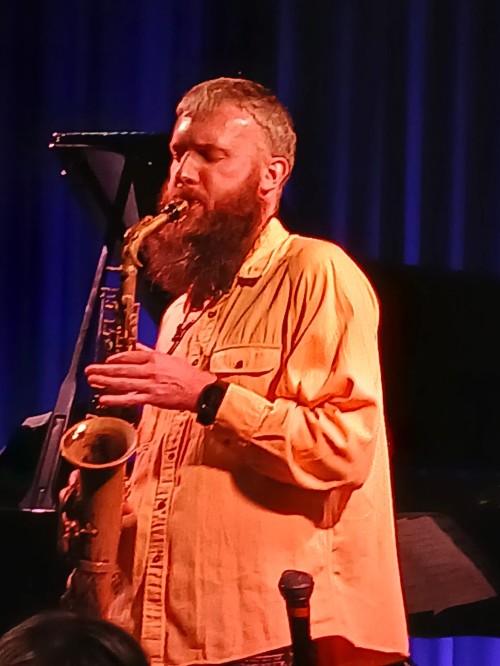
Photograph of Sam Newbould by Pam Mann
EFG LONDON JAZZ FESTIVAL 2025
DAY SEVEN, THURSDAY 20/11/2025
GUILDHALL JAZZ FESTIVAL, AFTERNOON SHOWCASES
There are only so many times you can eat your way through the Pizza Express menu so Thursday brought a change of routine and a visit to Milton Court to check out a different set of young musicians at the annual Guildhall Jazz Festival
The Guildhall Jazz Festival is a ‘festival within a festival’, an annual event that celebrates the work of the students and alumni of the Jazz Course at the Guildhall School of Music and Drama. Part of a collaboration with the wider EFG London Jazz Festival and running from 18th to 23rd November 2025 all events at the 2025 Guildhall Jazz Festival were free admission and included student showcases in addition to concerts by established names such as vocalist Jacqui Dankworth and bassist / vocalist Linda May Han Oh.
I covered several events at the 2024 GJF and thoroughly enjoyed them, the standard of the playing from both the students and alumni, including saxophonist Harben Kay, being excellent throughout.
The programme is co-ordinated by the Australian born vocalist and songwriter Jo Lawry who is Head of Jazz at the Guildhall and acts as MC for all the performances.
Today I enjoyed three afternoon showcases by student ensembles before moving on to ticketed events elsewhere in the city in the evening.
OSKAR JONES QUINTET
The first of three afternoon showcases featuring ensembles saw saxophonist and composer Oskar Jones, a post graduate student, leading a quintet showing several line up changes from that published on the GJF website.
He cites John Coltrane, Chief Xian aTunde Adjuah (aka Christian Scott) and Tigran Hamasyan as compositional influences and today’s performance began with his atmospheric original composition “Winter Sun”. This featured the sound of the composer’s electronically treated tenor, which added echo and drone effects. This was allied to arco bass and cymbal shimmers and the piece gradually mutated into a pleasingly melodic quartet performance.
The group was joined by a female trumpeter for the next number, the newcomer blending effectively with Jones on the next piece, the title of which was unannounced. The group’s pianist took the first solo, aided and abetted by the bassist’s counter melodies. Jones was then featured soloist as the music began to gather a stirring momentum.
The next piece was introduced by a passage of unaccompanied piano with bowed bass quickly added. The trumpeter played first with a Harmon mute and later with an open bell as she shared the solos with Jones’ tenor.
Jones announced the title of the next tune, “Near”, which was played in a quartet format with the interplay between tenor and piano particularly impressive.
The trumpeter returned for the next piece, a more forceful offering featuring the interplay of the two horns plus individual solos from both tenor sax and trumpet.
Introduced by a passage of unaccompanied double bass the closing “Laceration” was less wilfully aggressive than its title might suggest and included a subtly probing tenor solo from the leader plus further solos from trumpet and bass.
An enjoyable if slightly low key start to the afternoon’s proceedings.
BEYOND THE BLUE
Jude Lane – piano, Joe Tzabar – guitar, Jack Devonshire – alto & soprano sax, Cam Rossi tenor sax, Cubby Howard – cello, Alex Bresh – bass, Jonah Phillips – drums
Next up was Beyond Blues, a septet led by pianist and composer Jude Lane, a recent graduate and a Junior Fellow of the Guildhall.
As far as I could tell the line-up was the advertised one listed above, an unusual instrumental configuration well suited to the complexities of a music with influences from a range of genres, including jazz, classical and electronica. The band has already amassed a good deal of gigging experience, acquiring a healthy following along the way, and is due to release its debut album, “Mentality” in 2026.
Opener “This Is Not A Drill” established the septet’s signature sound as darting melodies combined with complex rhythms in a dense, knotty arrangement with Howard’s cello particularly prominent.
An extended passage of unaccompanied piano introduced “Presence”, with cellist Howard again catching the eye with an outstanding solo. Tzabar’s keening guitar and Phillips’ martial rhythms, including a solo drum passage, were also prominent in the arrangement.
Solo piano also introduced the third piece, with tenor and alto saxes, cello and mallet rumbles added to create a kind of ‘chamber jazz’ arrangement. An unaccompanied cello episode led into a cello and piano duet. The introduction of the other instruments created a more full band sound, the platform for a powerful tenor sax solo from Rossi and a further cello solo from the impressive Howard.
I assume that the closing “Verdict” was named for the Verdict Jazz Club in Brighton, one of the venues that the band has played. Introduced by Howard at the cello this also included solos from Devonshire on alto and leader Lane at the piano.
I was hugely impressed with Beyond The Blue, a band who have already developed a sound of their own. Lane impressed as both a writer and instrumentalist and is a musician who will surely make quite a name for himself in the future. Everybody played well but it was Howard who really caught the eye, his cello playing is very distinctive and adds something unique to the overall band sound.
The release of Beyond The Blue’s debut album is something to be keenly anticipated. Hopefully I will get the opportunity to review it in due course.
HAPPY GARDEN
Mo Cook – electric bass, voice Valentine Cheesbrough – guitar, Benji Charles – keyboards, Chris Clayden – tenor sax, flute, Sid Moon – trumpet, Isaac James – drums
The third and final act of the afternoon was Happy Garden, a sextet nominally led by bassist Mo Cook, but a band with a strong collective identity.
Cook is an extrovert personality and this is reflected in the band’s music, which is both eclectic and whimsical. Speaking above the sound of the band at the start of the set he promised us “ups and downs and twists and turns”, a pledge that he and the band delivered on.
Happy Garden’s influences range from nu-jazz to English psychedelia and more, a fascinating mixture of styles that lends itself to an integrated band approach, with the focus on the ensemble sound rather than individual solos. That’s not to say that the members of the band didn’t enjoy the moments when they did come to the fore, with pianist Charles, saxophonist Clayden and guitarist Cheesbrough all emerging as soloists at various points in the proceedings. James was also featured at the drum kit and Clayden and Moon enjoyed a series of tenor and trumpet exchanges.
With his five string electric bass Cook brought a strong funk element to the proceedings, combining well with guitarist Cheesbrough and drummer James. The final section saw him encouraging the audience to clap along to a bass feature that saw him slapping the bass with his thumb in a style reminiscent of Marcus Miller. Meanwhile a Cheesbrough guitar solo took us into the realms of metal and math rock. Dynamic variations were also a feature of the band’s music with airy flute melodies, gently rippling guitar and piano arpeggios and languorous, liquid electric bass contrasting effectively with the louder, more extrovert stuff.
Wilfully eclectic Happy Garden were good fun and very entertaining, but there’s a good deal of sophistications about their music too. Hopefully they will also be able to make a recording in the future.
But I have to give the nod for the best gig of the afternoon to Beyond The Blue, who will hopefully make a bit of a breakthrough with the release of their debut album.
EDDIE HENDERSON QUARTET, PIZZA EXPRESS, SOHO
Eddie Henderson – trumpet, Matyas Gayer – piano, Arnie Somogyi – double bass, Stephen Keogh - drums
This early evening show at the ‘Pizza’ attracted a capacity crowd to witness the playing of the veteran trumpeter Eddie Henderson, eight five years young and still looking remarkably youthful.
Henderson has released nearly thirty albums under his own name and during the course of an equally prolific career as a sideman he is probably best known as a former member of Herbie Hancock’s Mwandishi band back in the 1970s.
In recent years Henderson has been a member of the all star septet The Cookers, previous visitors to EFG LJF.
Tonight’s standards based set featured Henderson in the company of a London based trio led by pianist Matyas Gayer. It was a different trio to the one that had accompanied the American saxophonist Chad LB at Toulouse Lautrec the previous Friday with Gayer now joined by the vastly experienced rhythm team of bassist Arnie Somogyi and drummer Stephen Keogh. Somogyi and Henderson are long term acquaintances, the trumpeter having appeared on the marvellously titled “Accident and Insurgency”, the 2008 album from Somogyi’s group Ambulance.
The evening began with Henderson honouring his former boss with a performance of the Herbie Hancock composition “Toys”. This was notable for fluent and expansive solos from both Henderson and Gayer, with Somogyi also featured at the bass. Keogh’s exquisite cymbal work is also worthy of mention.
One of Henderson’s trumpet mentors was Freddie Hubbard, who was homaged with a performance of Hubbard’s composition “Up Jumped Spring”, which again saw Gayer, Henderson and Somogyi sharing the solos.
Another mentor was Woody Shaw, who was also honoured with a performance of Shaw’s composition “Sweet Love of Mine”. This featured solos from Gayer and Henderson plus a dynamic and hugely impressive drum feature from Keogh, the man dubbed by Henderson as “the chief of the fire department”, a reference to the drummer’s sometimes incendiary playing.
The flames were dampened on the Duke Pearson ballad “You Know I Care” with Keogh deploying brushes throughout and this time impressing with the sensitivity of his playing. Gayer and Henderson provided lyrical solos and Somogyi featured with a delightfully melodic double bass solo.
Henderson took a breather as Gayer led the trio on a rendition of an unannounced standard. This featured an extended unaccompanied piano intro, further solos from Gayer and Somogyi plus a series of piano and drum exchanges. I didn’t jot the title down and can’t remember what it was at this late date.
Suitably revived Henderson returned to tackle a second Woody Shaw tune, the fast moving bebop tune “Moontrane” with solos from Henderson and Gayer plus some explosive drum breaks from Keogh as he traded fours with Henderson and Gayer.
A second ballad, this time unannounced, cooled things down once more, with Keogh again deploying brushes behind the lyrical solos of Gayer, Somogyi and Henderson, these sliding seamlessly into one another.
The penultimate piece was a tip of the hat to Miles Davis with a performance of “Milestones”, the famous motif leading into solos from Gayer and Henderson plus a final drum feature from the excellent Keogh.
The show ended as it began with a composition by Herbie Hancock, in this instance the classic “Cantaloupe Island”, with solos from both Henderson and Gayer.
Overall this was an enjoyable, if rather predictable, set that saw Henderson sticking with what he knows, perfectly understandable for a man of eighty five! Considering his age Henderson played very well, if not spectacularly, and his between tune announcements were both succinct and informative. There was the sense that this show represented something of a history of Henderson’s career and of jazz trumpeting in general. Gayer and the trio did a great job in support, a well oiled unit but also capable of inspired individual solos, with Keogh in particular catching the eye and ear, a superb accompanist, but also a spectacular drum soloist.
SAM NEWBOULD QUINTET, THE VORTEX
Sam Newbould – alto sax, Bernard van Rossum – tenor sax, Xavi Torres – piano, Guy Salamon – drums, Ton Felices – double bass
I travelled up to North London for this performance at The Vortex from a quintet led by the saxophonist and composer Sam Newbould, Yorkshire born but now based in Amsterdam.
Newbould studied at the Conservatorium van Amsterdam, graduating in 2019 and staying on in the city, establishing himself as an important figure on the Dutch jazz scene.
Tonight’s show feature his Amsterdam based quintet, with whom he has released three albums, “Blencathra” (2019), “Bogus Notus” (2021) and “Homing” (2024). Tenor saxophonist Bernard van Rossum and drummer Guy Salamon have been with him since the beginning, but there have been numerous changes in the bass and piano chairs.
The latest release, “Homing”, features four of tonight’s line up, Felices being the new face after taking over from the album’s Jort Terwijn.
As is the way with jazz musicians most of the material was new and is scheduled to be recorded for the quintet’s fourth album, scheduled for release in the autumn of 2026.
I’m grateful to Sam for putting my wife and I on the guest list for tonight’s show and for reserving our seats at The Vortex. He had been in touch me earlier in the year and the Jazzmann was more than happy to publicise a short UK tour that also featured dates in Cardiff and Sheffield.
It was my first visit to the Vortex since before the pandemic and it felt good to be back. Recently re-furbished but still very much the same in spirit it remains an excellent, intimate space to hear live music and attracts a proper listening audience. Prior to the show the noisy convivial buzz of animated conversation had filled the club but as soon as the performance began the audience were totally attentive and as quiet as the proverbial church mice.
Newbould is a musician that I have heard on the radio and seen on Youtube. His compositions place a strong focus on melody and are readily accessible, but there’s plenty of musical sophistication on display too.
Newbould himself says of his group’s live performances;
“There’s an energy and joy in our live shows that we hope is for everybody—jazz fans and non-jazz fans alike. The songs are catchy, foot-tapping, but also sometimes dark and emotional. Expect spectacular solos, infectious grooves, and a few unexpected twists.”
It’s a self assessment that’s pretty much spot on. Newbould is a musical story teller and this quality, combined with alto / tenor sax front line sometimes reminded me of Howl Quartet, whose show at the ‘Pizza’ I’d covered a couple of nights before. But the Newbould quintet also has an exceptional pianist in the shape of Xavi Torres and ultimately their music was very different.
It was Torres who ushered the opening number, “Night Fisher”, a tune scheduled to be recorded for the forthcoming album. Double bass and the patter o Salamon’s hand drumming were added before the gentle tones of the leader’s alto stated the main melodic theme, augmented by van Rossum’s tenor sax harmonies. Torres took the first solo, his lyrical piano explorations complemented by Salamon’s subtly detailed drumming. Van Rossum’s tenor solo probed more deeply as the momentum of the music began to build, developing his ideas before the two reeds came together incisively as the music built to a peak, subsequently subsiding as the piece finished in much the same way as it had begun, with a quiet outro again featuring the sound of Salamon’s hands on the drum skins.
A second new tune, “The Bells of High Tide” was more up tempo, almost turbulent, and featured the soloing of Newbould on alto and the excellent Felices on vigorously plucked double bass. Salamon, also the leader of his own group, in which Newbould plays, was featured at the close.
“Warp and Weft” was inspired by industrial processes and featured attractive twin sax melodies allied to a Salamon drum groove that provided the platform for van Rossum’s tenor sax soloing as the momentum of the piece began to build.
Unaccompanied alto sax introduced “The Road We Run” with Newbould subsequently joined in dialogue by Torres. Tenor sax, double bass and brushed drums were then added to this wistfully melodic composition.
The first set closed with the more forceful “One Day We’ll Have A Window”, which incorporated incisive solos from the leader on alto and the excellent Torres at the piano.
Set two stated in rousing fashion with the busy “Beeline”, inspired, as its title might suggest, by Newbould’s love of bees – “we need bees”, he told us. Amen to that. The piece began with the inventive interplay and harmonies of the two saxes and incorporated a dazzling solo from Torres that saw him swarming all over the keyboard.
“Small Movements” built from appropriately small beginnings, the sound of unaccompanied double bass joined first by piano then soft, breathy alto. Van Rossum’s tenor was then added to create mesmeric unison horn lines played above pedal point rhythms as the piece continued to evolve slowly, in a manner very much in keeping with its title. Eventually Newbould broke away to solo on alto as Salamon introduced brisker, marching rhythms, with van Rossum’s tenor eventually joining to inject an element of wilful dissonance. This was a thoroughly compelling collective performance.
Newbould has an abiding love of folk music and likes to describe his compositions as “songs”. The next item, “Broadside Ballad” was inspired by the folk song tradition and drew on the same sources of inspiration that influenced the folk / rock / jazz big band Bellowhead. Introduced by piano and double bass Felices was the featured soloist here, with the Vortex audience hanging on every note from his double bass. Van Rossum and Newbould passed the main melodic theme around between themselves, each taking the lead at different points
The final piece had the working title “Long Beans” and was introduced by Torres at the piano. Initially the tune had something of an old school feel with quirky, whimsical quasi-trad stylings, the twin saxes carousing joyously. This then broke down into a kind of free jazz section crowned by a manic Salamon drum feature that had Newbould beaming with delight.
The audience clearly loved it too and the quintet remained on stage to perform “Barba tenus sapientes”, meaning “wise as far as the beard”, a title that offers a self deprecating nod to Newbould’s rather splendid face foliage. The opening track of the “Homing” album the piece boasts one of Newbould’s most memorable melodies and as the main theme returned following outstanding solos from Newbould and Torres, the latter a torrential, highly percussive outpouring of ideas, the audience erupted in a spontaneous sing-along, singing the melody back to the band in a joyous display of appreciation and celebration.
This was a hugely enjoyable gig and one that represented a triumphant return to the UK for Newbould. He’s a musician who has developed a distinctive compositional style and the quality of both the writing and the playing was warmly appreciated by the discerning Vortex audience. I treated myself to a copy of “Homing” after the show and have very much enjoyed listening to it at home. The opening track will always be a reminder of that spontaneous sing-along at the Vortex.
Thanks to Sam Newbould for speaking with me after the show, and also to guitarist Billy Marrows who was present as a member of the audience.
Billy invited me along to a gig that he was scheduled to play on the coming Sunday. It wasn’t one that I’d arranged to go to but a window in my schedule meant that I could catch the second set. I was very glad that I did and my account of that event will appear as part of that day’s coverage.
And in the meantime what a great gig from Sam Newbould and friends to mark my return to The Vortex.
blog comments powered by Disqus