

by Ian Mann
December 02, 2025
Ian Mann enjoys performances by Mali Sheard's Homestead, Jazzmeia Horn and 'Take The Coltrane' by the Dave O'Higgins Quartet.
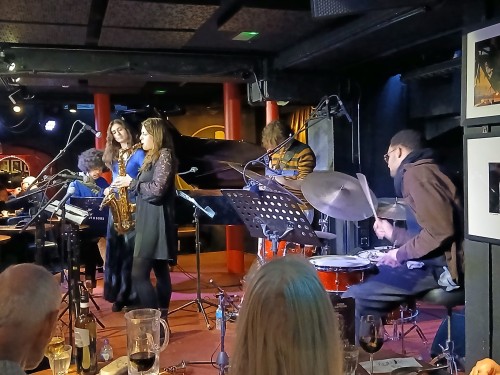
Photograph of Mali Sheard’s Homestead by Pam Mann
EFG LONDON JAZZ FESTIVAL 2025
DAY SIX, WEDNESDAY 19th NOVEMBER 2025
MALI SHEARD’S HOMESTEAD, PIZZA EXPRESS JAZZ CLUB, SOHO
Mali Sheard – alto & soprano sax, Keira Chakraborty – flute, Ky Osborne – piano, George Balmont – four and six electric bass, Luke McCarthy – drums
Saxophonist Mali Sheard had appeared at this same venue the previous day as part of a quintet led by pianist Kezia Abuoma. Like her colleague Sheard is a product of the Tomorrow’s Warriors programme and is currently studying at the Royal Academy of Music where her saxophone tutors include Rachael Cohen, Giacomo Smith and James Allsopp.
Although primarily an alto player she was featured mainly on soprano during Abuoma’s set. Today playing her own compositions she specialised more on alto as the leader of her excellent Homestead quintet featuring flautist Keira Chakraborty, rising star pianist Ky Osborne, bassist George Balmont and in demand drummer Luke McCarthy.
Like the Abuoma performance today’s event formed part of the Heads Up series curated by Kasia Konstance, a platform for young, emerging jazz musicians.
As with Abuoma the previous day I was pleased to see Sheard concentrate on performing her own compositions beginning with “There’s A Place”, introduced by a passage of unaccompanied piano from Osborne. Exhibiting both classical and folk influences the piece featured the unusual alto sax / flute front line of Sheard and Chakraborty but it was Balmont who took the first solo on six string electric bass, his sound almost guitar like at times with something of a Frisell like ‘twang’. Sheard’s own solo was expansive, fluent and both powerful and majestic.
“Elephants” proved to be both attractively melodic and pleasingly quirky, ushered in by Balmont on six string bass and featuring solos from Sheard on alto and Osborne, a bandleader in his own right, at the piano.
A new tune, “Growing Up” was a tender tribute to the importance of father / daughter relationships and was dedicated to Sheard’s own father who was present in the audience. The featured soloists here were Sheard on alto and Chakraborty on flute. Interestingly “Entity”, the most recent album by pianist and composer Neil Cowley, features “Father Daughter” a composition on the same theme written from a father’s perspective.
Described by Sheard as “a kind of Christmas song” “Can’t Count on Winter” featured a gently swinging brushed drum groove and playful solos from Osborne at the piano, the composer on alto and Chakraborty on flute.
“Three Wheels” saw Sheard moving to soprano and doubling up with Chakraborty on the melodic theme, accompanied by electric bass and brushed drums. This piece formed part of a segue with the marvellously titled “Afternoon Tea With A Demon”, a full on outpouring of energy featuring Sheard’s incisive soprano sax soloing and a dynamic drum feature from McCarthy. Osborne’s piano solo was a joyous outpouring of ideas before Sheard and McCarthy returned for a second bite at the cherry.
The set closed with “Escalation”, introduced by a passage of solo piano from Osborne and with Sheard returning to alto and sharing the solos with Chakraborty and Osborne. And did I detect an allusion to Wayne Shorter’s “Footprints” during Sheard’s solo?
Like Abuoma’s set the day before this was an enjoyable and hugely impressive set of contemporary jazz from a group of highly accomplished young musicians. Sheard impressed as both a writer and an instrumentalist and I predict that she’s a musician that we will be hearing a lot more from in the future.
In the meantime I’m looking forward to seeing Sheard again when she visits the Marr’s Bar in Worcester on February 12th 2026 for a Music Spoken Here event featuring the octet Ankora, the group formerly known as the Tomorrow’s Warriors Female Frontline. The Ankora line up will also include Chakraborty, Abuoma and drummer Miranda Radford and this is an event that will be well worth seeing.
JAZZMEIA HORN, RONNIE SCOTT’S
Jazzmeia Horn – vocals, Santiago Vazquez – piano, Gerald Portal – bass, Enrico Morello – drums
Tonight’s early evening show at Ronnie’s featured the Texas born, New York based vocalist and songwriter Jazzmeia Horn. Vocal jazz isn’t always my bag but the chance of seeing one of the world’s leading jazz singers was too good to resist.
A former winner of the Sarah Vaughan Vocal Competition Horn’s voice has been compared to that of Vaughan herself, and also to other jazz greats such as Betty Carter and Nancy Wilson.
Horn’s voice is certainly a remarkable instrument, but equally impressive is the fact that Horn writes all her own material. Tonight’s show represented her fifth visit to Ronnie Scott’s and much of the material in tonight’s set was sourced from her most recent album “Messages”, released in 2024.
Horn’s band included pianist Santiago Vazquez, bassist Gerald Portal and drummer Enrico Morello, a well drilled unit who offered her excellent support.
The opening number was unannounced but it was immediately apparent that Horn’s voice was a wonderfully flexible instrument able to navigate the most complex of material. Although undeniably the star of the show she also proved to be a generous bandleader who was prepared to allocate plenty of room to her instrumentalists with both Vazquez and Portal shining on this opening number alongside the leader’s vocals, including a stunning scat vocal episode.
Horn learned to sing in church and her singing still bears a strong gospel influence, as evidenced on “Happy Living” a song inspired by the stories that her grandfather used to tell. This included duets between Horn and Vazquez and Horn and Portal, the vocalist continuing to shine in these pared down situations.
“Submit To The Unknown” featured powerful wordless vocals soaring above driving modal rhythms rooted in the spiritual jazz tradition, with Horn’s vocals reminding me of Abbey Lincoln.Horn’s use of the voice as instrument was genuinely impressive as she shared the solos with pianist Vazquez.
Horn lives in the Bronx and many of her songs are inspired by family and by the black lived experience. “Remember Your Destiny” was inspired by her two young daughters, aged ten and eight, the lyrics carrying a message of both optimism - “destiny is knocking at your door – will you open it” – and defiance – “don’t you ever give in, never give in”. The instrumental honours here went to Portal with a melodic double bass solo.
Horn’s daughters also inspired the playful “When I Say”, an uptempo tune in a broadly ‘vocalese’ with quick fire lyrics sung from the perspective of a young child. Vazquez took the instrumental plaudits here.
The only cover of the set was the ballad “You’re Getting To Be A Habit With Me”, inspired by a recorded version by Shirley Brown, with Horn’s interpretation including a further example of her remarkable scat vocalising.
I mentioned in my Monday coverage the lack of ‘wriggle room’ between these early shows at Ronnie’s and later gigs elsewhere. The Ronnie’s shows are scheduled to finish at 7.50 and on Tuesday the ten minute window was just perfect to allow me to scamper up the road to the ‘Pizza’ for the 8.00 pm show. Tonight it was obvious that this wasn’t going to work, we’d already reached the official finish time and Horn had another song in the offing and very possibly an encore as well so I seized the opportunity for a discrete exit.
I had enjoyed the music that I had heard and could fully understand why Horn is regarded as one of the world’s premier jazz singers, and I enjoyed the contributions of her bandmates too. However I was less enamoured by Horn’s lengthy verbal ramblings between the songs, which were all a bit too ‘showbiz’ for me, much of it being about members of her family. As good as this set undoubtedly was less talking and more music would have made for a better show. By all means put the songs into context, particularly with regard to social and political issues, there was a serious side to Horn’s verbiage – but don’t overdo it and allow the songs to speak for themselves.
DAVE O’HIGGINS QUARTET, ‘TAKE THE COLTRANE’, PIZZA EXPRESS JAZZ CLUB, SOHO
Dave O’Higgins – tenor & soprano saxophones, Graham Harvey – piano, Jeremy Brown – double bass, Sebastiaan de Krom – drums
Saxophonist Dave O’Higgins (born 1964) is one of the most popular and in demand musicians on the British jazz scene. Emerging in the jazz boom of the late 1980s / early 1990s his early albums put the focus on original material and were considered to be pretty ‘cutting edge’ at the time.
In recent years he’s concentrated on playing in a more straight-ahead style, if the likes of Thelonious Monk and John Coltrane can be considered ‘straight-ahead’.
Tonight’s show at a sold out Pizza Express featured a Coltrane themed show performed by his regular quartet featuring pianist Graham Harvey, bassist Jeremy Brown and drummer Sebastiaan de Krom. The material featured a mix of Coltrane originals and arrangements of compositions associated with and recorded by him.
The performance began with the Gershwin composition “But Not For Me”, a tune re-harmonised by Coltrane for his 1961 album “My Favourite Things”, with both O’Higgins and his regular pianist Graham Harvey delivering fluent and expansive solos.
“My Favourite Things” was actually recorded in 1960, as was the album “Coltrane Plays The Blues”, which was eventually released in 1962. From the latter “Mr. Syms” featured O’Higgins on soprano saxophone, his sinuous solo followed by features for both Harvey and Brown.
Recorded in 1957 and released in 1961 the album “Thelonious Monk with John Coltrane” focussed on Monk’s compositions and included his tune “Epistrophy”. Tonight’s version saw O’Higgins returning to the tenor and sharing the solos with Harvey, who found plenty to say on his own account without resorting to any obvious ‘Monk-isms’. Finally de Krom weighed in with a dynamic drum feature on an absolutely terrific interpretation of this much played piece.
Following the musical fireworks ignited during the performance of “Epistrophy” O’Higgins elected to slow things down with a performance of the ballad “Dedicated To You”, sourced from the 1963 album that Coltrane made with the vocalist Johnny Hartman. Tonight’s instrumental version demonstrated O’Higgins’ skills as a ballad player and also included delightfully lyrical solos from Harvey at the piano and Brown on double bass.
The first set then ended with “Bessie’s Blues”, a dedication to Bessie Smith that appeared on Coltrane’s 1964 album “Crescent”. This proved to be swinging blues that provided the framework for outstanding solos from Harvey, O’Higgins and Brown.
The second set commenced in rousing and fiery fashion with “Resolution”, from Coltrane’s 1965 landmark album “A Love Supreme”. This featured powerful solos from both O’Higgins and Harvey, the latter channelling the spirit of McCoy Tyner.
With a title deriving from astrology “Fifth House” appeared on the 1961 album “Coltrane Jazz”. O’Higgins informed us that the tune was in fact a contrafact, based on the jazz standard “What Is This Thing Called Love”. The recorded version features Coltrane on tenor sax but O’Higgins put his own stamp on it by choosing to play it on soprano. His probing solo introduced something of the Arabic elements that Coltrane would experiment with later in his career. Harvey and Brown were also featured as soloists and there was another stunning drum feature from de Krom.
This set’s ballad was “Naima”, Coltrane’s dedication to his first wife. This was another example of O’Higgins’ mastery as an interpreter of ballads and the performance also included a lyrical piano solo from Harvey.
O’Higgins proved to be a most informative interlocutor between tunes. Thus we learned that the title track of Coltrane’s 1963 album “Impressions” was a contrafact based on Miles Davis’ “So What”, from the trumpeter’s famous 1959 album “Kind of Blue”, upon which Coltrane played. It may have been obvious to other listeners but I’d never really thought about it before so it was news to me. Every day’s a school day. Solos here came from Harvey on piano and O’Higgins on tenor.
Recorded in 1965 but released posthumously the closing “Dear Lord” appeared on the album “Transition” and was described by O’Higgins as “the only pretty tune on a pretty challenging album”. Melodic but still swinging this ballad featured solos from O’Higgins, Harvey and Brown.
Despite the familiarity of much of the material I was surprised by just how much I enjoyed this performance. The standard of the playing was exceptional throughout, as one would expect from musicians of this calibre, and of course the tunes were great. O’Higgins succinct but informative commentary on Coltrane’s oeuvre was the icing on the cake. We even got the dictionary definition of the word ‘epistrophy’. An unexpected Festival highlight. Well done to all concerned.
blog comments powered by Disqus