

by Ian Mann
December 09, 2025
Ian Mann on the final day of the Festival and performances by the Royal Academy Jazz Orchestra, Billy Marrows / Max Kahn Duo, Terje Isungset's Ice Quartet and Seb Rochford's Finding Ways.
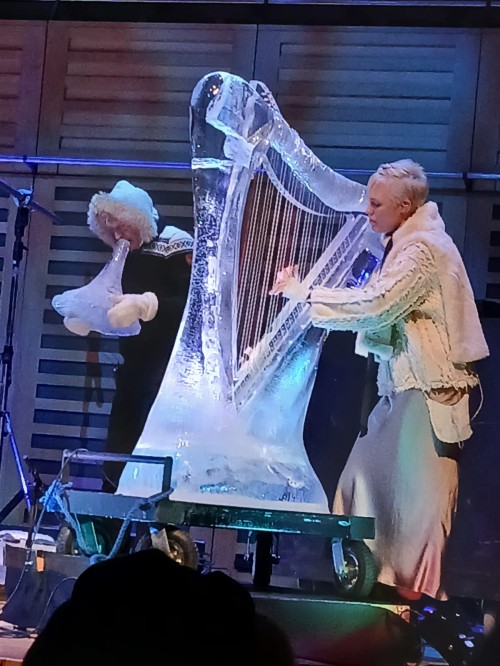
Photograph of Terje Isungset and Julie Rokseth of Ice Quartet by Pam Mann
EFG LONDON JAZZ FESTIVAL 2025
DAY TEN, SUNDAY 23rd NOVEMBER 2025
ROYAL ACADEMY JAZZ ORCHESTRA, PIZZA EXPRESS JAZZ CLUB, SOHO
My final visit to the ‘Pizza’ was for this lunchtime show by the Jazz Orchestra of the Royal Academy of Music, led by Nick Smart but today featuring guest conductors Nikki Iles and Pete Churchill, both of whom are also part of the teaching faculty at the RAM.
In addition to being an acclaimed jazz pianist Iles is also an accomplished composer and arranger for large ensembles and is currently the Chief Conductor of the celebrated NDR Big Band from Hamburg, Germany. Iles is the first woman to hold this prestigious post and today was a celebration of this, in addition to the links that the RAM has forged with the NDR Big Band.
The NDR has frequently performed the music of British composers and musicians and today also represented a celebration of these long running collaborations. Today’s programme featured several of Iles’ compositions for the NDR plus further works by Steve Gray, Andy Schofield, Mike Gibbs and others.
The nineteen piece RAJO included several musicians who had played with London Intercollegiate Jazz Orchestra (LIJO) at Milton Court just the night before.
The performance commenced with Iles conducting the band on a rendition of “Misfits”, the opening track on “Face to Face”, her 2023 album with the NDR Big Band for Edition Records. Celebrating creative people in a modern conformist society it includes a ‘misfit’ note in every chord, making for a distinctive ensemble sound, this brilliantly realised by the members of RAJO. Solos here came from tenor sax, guitar and drums.
Pete Churchill took over conducting duties for a Steve Gray arrangement of the standard “Old Devil Moon”, this featuring the singing of vocalist Emma Taylor, who when not singing centre stage remained a vital part of the ensemble with her wordless vocals. Churchill also informed us that Gray’s scores are now in the care of the RAM, thanks largely to the efforts of Churchill, Iles and vocalist Norma Winstone.
Iles returned to the podium for her own “Big Sky”, another composition from the “Face to Face” album. A celebration of her East Anglian heritage the composer describes it as “a very simple and direct tune” and it certainly captured something of the Fenland landscape with an outstanding trombone solo representing the instrumental highlight.
Next up was a tune with the grand title of “The Age of English Enlightenment”, written by Andy Schofield, an English composer born in Lancashire but now based in Prague. Iles informed us that the NDR regularly sends out open requests for scores to be sent to them for the band’s consideration. Iles acquired her position via this process, which also brought Schofield and other British composers to the NDR. One of the band’s two pianists was the featured soloist here – there was more than one player for most of the rhythm section chairs.
The first half concluded with British saxophonist Stan Sulzmann’s arrangement of the standard “Taking A Chance on Love”, a tune written by Vernon Duke. This included solos for soprano sax, piano and tenor sax, plus a drum feature at the close.
Set two began with “Gill B643”, a homage to Gil Evans recorded by Mike Gibbs but actually written by the American guitarist John Scofield, who toured and recorded with Gibbs back in 1991. Another tune described as being “quite simple, but very effective” this included solos for guitar and trombone, the instruments played by Scofield and Gibb respectively. Taylor’s wordless vocals were also a distinctive feature within the arrangement.
The Iles original “One For One” was written for her 2023 residency with the NDR and was a dedication to Doreen Wheeler, widow of the late, great trumpeter and composer Kenny Wheeler, who had been an inspirational figure for Iles. Both a lament and celebration this was two part piece that carried echoes of Wheelers’ own writing, a feature for the brass section seeming to represent a tip of the hat to him. The more celebratory second half included solos for tenor sax, trumpet and double bass and featured the soaring, wordless Norma Winstone style vocals of Taylor. This was an item that was particularly well received.
Taylor also impressed with her interpretation of a Steve Gray arrangement of the song “Ain’t No Use”, written by Leroy Kirkland and Sid Wyche and famously performed by Sarah Vaughan. Instrumental solos her came from muted trumpet and guitar.
Iles’ original composition “Hanging On To Your Dreams” was inspired by a Langston Hughes poem and included a superb solo from trumpeter Charlie Ballamy, son of saxophonist Iain. Also featured was the lyrical soloing if pianist Will.
The performance concluded with an arrangement of the Cole Porter song “You’re So Easy To Love” with Taylor’s vocals augmented by solos for alto sax, guitar and bass.
This was a hugely entertaining performance from these highly talented young musicians. Iles and Churchill presented the show in a way that was both humorous and informative. It was good to hear some of Iles’ compositions for the NDR and at the interval i treated myself to a copy of the “Face to Face” album, released by Edition Records. The recording features an Anglo-German line up, the British contingent including trumpeter Percy Pursglove, flautist Gareth Lockrane, guitarist Mike Walker and drummer Ian Thomas. Walker, Pursglove and Thomas are all featured as soloists.
I had to dash off to another performance so wasn’t able to stick around and get the full line up. Nevertheless another excellent performance from a young big band, following on from the previous night’s events at the Guildhall.
The quality of jazz education at all of London’s leading music colleges is exceptional and produces some brilliant young musicians. The future of British jazz is in very good hands.
BILLY MARROWS / MAX KAHN DUO, HANDEL HENDRIX HOUSE
Billy Marrows - guitar, Max Kahn - double bass
At the Sam Newbould gig at the Vortex on Thursday 20/11/2025 I talked to guitarist Billy Marrows, who was also a member of the audience. In 2024 I favourably reviewed Billy’s album “Penelope”, recorded with his Grande Familia ensemble. I’ve also reviewed recordings featuring Billy by saxophonists Tom Barford and Harry Brunt, drummer Rod Oughton, bassist Huw V Williams and by the large ensemble Patchwork Jazz Orchestra.
When we chatted at the Vortex Billy invited me to this duo performance with double bassist Max Kahn at the Handel Hendrix House, the house on Brook Street in Mayfair that at different times was home to both the classical composer George Frederic Handel, who lived there from 1723 to 1759 and rock and blues guitarist Jimi Hendrix who was there more fleetingly in 1969/70.
The house is now open as a museum that celebrates both its famous former inhabitants. The venue regularly hosts musical performances and Billy kindly put my wife and I on the guest list, meaning that we didn’t have to pay the normal museum admission fee.
I was able to catch the second half of his set with double bassist Max Kahn, which took place in the intimate environs of Hendrix’s old bedroom. The performance featured a mix of Hendrix’s original compositions and tunes sourced from his record collection, which was on display in the museum.
Marrows was playing lightly amplified electric guitar and Kahn acoustic double bass so the performance was quiet and intimate. The first song that I heard was a version of Hendrix’s own “Voodoo Chile”, this followed by an arrangement of the Paul McCartney song “Maybe I’m Amazed”
The duo continued to rotate Hendrix tunes with songs from the album collection as “Hey Joe” was followed by a delightful version of Bob Dylan’s “Don’t Think Twice It’s Alright”.
The duo’s take on Hendrix’s “Little Wing” really brought out the beauty of the melody in this pared down context. They signed off with a beautiful performance of Curtis Mayfield’s gospel inspired “People Get Ready”.
Most pieces featured solos from both Marrows and Kahn and this intimate duo performance in such a unique setting was a very welcome bonus, totally unexpected and the consequence of that chance meeting at the Vortex.
Marrows plays these Sunday afternoon slots on a regular basis and told me that he often plays them on acoustic guitar, which would be interesting. He’d brought the electric today as he needed it for a gig that he was playing with saxophonist Harry Brunt at The Green Note in the evening.
On January 11th 2026 Marrows will playing at Handel Hendrix House in a guitar duo with John Parricelli, of Loose Tubes fame. Unfortunately I won’t be able to make that, but it should be well worth seeing.
However assuming that I am able to come to EFG LJF 2026 I will utilise any downtime between gigs to come back to Hendrix Handel House and explore it more fully by doing a full Museum visit.
Thanks to Billy for introducing me to this fascinating place, I knew of its existence, but not much more, and to him and Max for such a delightful performance this afternoon.
TERJE ISUNGSET ICE QUARTET, HALL ONE KINGS PLACE
Terje Isungset -ice drum, ice percussion, iceofone, ice horn, Amalie Holt Kleive – vocals, electronics, ice drum and percussion, Julie Rokseth – ice harp, Toivo Fjose – ice bass
The most extraordinary concert that I saw during my spell in London had to be this one from the innovative Norwegian musician Terje Evensen and his Ice Quartet.
The event, part of a larger European tour, didn’t appear to be part of the official EFG / LJF programme, so I’m grateful to Yasmin Hoy, who handles the publicity for Kings Place, for arranging my tickets for this performance.
Styling himself “Nature’s Percussionist” Isungset has always been interested in creating music from natural materials such as wood and stone and in 1999 instigated the concept of creating music from instruments made of ice.
In 2000 he performed his first concert of ‘ice music’ inside a frozen waterfall in Lillehammer and in 2001 recorded the first of ten Ice Music albums, these attracting considerable critical acclaim. He has also established his own All-Ice record label.
He has created an annual Ice Music Festival which takes place in Norway and he has toured internationally with his Ice Music Touring Band, currently a quartet featuring vocalist / percussionist Amalie Holt Kleive, harpist Julie Rokseth and bassist Toivo Fjose, a line up that has been in existence for the past three years.
Dogwood Pictures are currently working on a feature length documentary film about Isungset to be titled “The Sound of Ice”.
Isungset’s latest album, released in 2024, features tonight’s line-up, albeit with bass duties shared between Fjose and Viktor Reuter. I suspect that this recording was pretty much played in full this evening.
Even before a note is played an Ice Quartet concert constitutes a performance as the instruments are removed from their protective jackets. They are sculpted from blocks of ice made from frozen lakes in Norway and are used for whole tours, on any given night an instrument will be slightly smaller than it was the night before due to the melting process.
The ice harp and the ice bass have ‘normal’ strings attached to bodies sculpted from ice and both are visually striking. Meanwhile Isungset’s percussion instruments are made entirely from ice, as are the implements, ‘ice mallets’ and ‘ice sticks’ used to play them.
In addition to the musicians sound engineer Mathias Gronsdal and Kristian Kvidstad Holm, a kind of ‘ice roadie’ or ‘ice tech’ were also vital to the group sound. Credited with ‘ice logistics’ Holm made regular on stage incursions to deliver instruments or to take them away and return them to their protective packaging.
The quartet began with a near half hour opening sequence that I suspect comprised of extended versions of the first four tracks of the “Ice Quartet” album. Fjose’s ice bass was the first instrument to be heard, joined first by Holt Kleive’s ethereal wordless vocals and then by Rokseth’s ice harp. For all the novelty value it was still innately musical and strangely beautiful. Isungset’s ice drum sticks on the already melting ice drum made a sound akin to brushes on a conventional drum kit.
The music was often ethereal and ambient, with Holt Kleive’s voice injecting strands of folk melody.
Home helped Isungset set up the iceofone, akin to a vibraphone, but with massive bars of various lengths made of ice and played with ‘ice mallets’ or with the hands, these encased in two layers of gloves. This sequence suggested the influence of minimalism or perhaps of gamelan music.
Meanwhile Rokseth deployed various devices between the strings of the harp, blending with Holt Kleive’s vocals and the boom of Isungset’s ice horn during a passage that sounded positively shamanistic, inspired perhaps by the Sami joiks of Northern Norway.
Gronsdal, credited with sound design, played his part with the introduction of sampled whale sounds captured off the coast of Greenland. Isungset is a committed environmentalist and has collaborated with Greenpeace and with climate scientists and various NGOs (non government organisations).
Composed by vocalist and percussionist Holt Kleive “Tundra” was more song like in construction and featured the sounds of harp, wordless vocals and deeply resonant bowed bass, a highly effective contrast to the composer’s ethereal vocals.
Rokseth also writes for the group and the next sequence began with her composition “Rimdrakt”, featuring her harp melodies and Holt Kleive’s wordless vocals underpinned by the sounds of bass and ice drums.
The harp was then covered during a passage when it was not in use, as Holm brought out blocks of ice that were suspended on a frame and played by Isungset in the style of tubular bells, the sounds of these ‘ice chimes’ augmented by those of running water, generated by Gronsdal at the back of the hall, the water sound getting louder and appearing to surround us, a reminder perhaps of the melting ice caps, accompanied by the baleful blasting of Isungset on ice horn and the deep rumble of arco bass.
“This concert is all about nature”, Isungset informed us as the music faded away, his statement seeming to reinforce the message conveyed by the music.
The next piece was a song by Isungset, the only one with actual lyrics, the words addressing the subject of feeling small in the presence of nature. Sampled sounds were also introduce of a blue whale and of a polar bear mother with her cubs, these skilfully integrated into the musical performance.
Announcing the last piece, “Ocean Memories” Isungset thanked the audience for “coming and using your ears”. This piece is the one that was played in a video co-operation with Greenpeace filmed on Spitzbergen and which can be seen on Isungset’s website http://www.terjeisungset.no
The music featured the sound of iceofone, wordless vocals and harp and pizzicato bass melodies.
A remarkable concert that transcended mere novelty to produce a unique music that was frequently genuinely beautiful and which carried an important environmental message.
I’m also pleased to report that even without the visual element the “Ice Quartet” album still represents satisfying listening in the home environment.
This is a show that everybody should try to see at least once. It really is unique. Also the hall wasn’t as cold as you might expect. I was actually warmer than I’d been at Milton Court during the Guildhall Jazz Festival.
SEBASTIAN ROCHFORD’S FINDING WAYS, JAZZ IN THE ROUND, COCKPIT THEATRE, MARYLEBONE
Sebastian Rochford – drums, Anders Christensen – electric bass, David Preston, Tara Cunningham, Matt Hurley – guitars
I ended EFG LJF with a bang and on a high with this brilliant performance from drummer and composer Sebastian Rochford and his new project Finding Ways.
Having followed Rochford’s music for the past twenty years in projects like Polar Bear, Acoustic Ladyland, Fulborn Teversham, Pulled By Magnets, his duo with Kit Downes and many more I just knew that his latest venture was certain to yield something of interest and would probably be very exciting. I was not to be disappointed.
Finding Ways is both a band name and the title of Rochford’s new album for Edition Records. It features the drummer leading a line up featuring electric bass and no fewer than three electric guitars on any given track. The album line up features a large cast of musicians, including all the members of tonight’s line up. Others to appear on the disc include bassist Ruth Goller and guitarists Adrian Utley (Portishead) and Simon Tong (The Verve).
Tonight’s show was a collaboration between EFG LJF and Jazz in The Round, the monthly series at The Cockpit co-ordinated by promoter / DJs Jez Nelson and Chris Phillips. Their sessions are normally on Mondays and feature three different acts, usually a solo artist, a young emerging act and a headliner. Tonight was different with a change of day and a single set from Finding Ways, preceded by a DJ set from Nelson.
The Cockpit is a great place to see and hear live music with the audience on all four sides – it’s actually a square rather than a circle – and with the musicians themselves playing in the round. It all makes for an intimate and supportive atmosphere – even if you can’t see every musician head on.
Of his latest project Rochford states via his website;
“Finding Ways is my new band / project and is inspired by practical ways I found each day to keep myself positive and to navigate this world. I wanted to explore raw, effectless guitar with this new music, playing with new musicians and also pulling together some of the incredible musicians I make music with in different settings. I hope you will enjoy what we made”.
Like Ice Quartet earlier in the day the focus was firmly on the new album and having since heard the disc I’m fairly certain that Rochford and the band played the whole record in sequence, beginning with “Maybe”, introduced by Rochford at the kit and featuring the interlocking guitars of Cunningham, Preston and Hurley. These are electric guitars, but in Rochford’s words they are “effectless”, there are no foot pedals, no floaty ambient effects and the sound is crisp and attacking, very post rock, with stabbing, jabbing chords and spidery lead lines all meshed together and underpinned by Christensen’s supple electric bass and the leader’s dynamic drumming. It all makes for a quite glorious racket that combines the energy of punk with something far more complex and sophisticated.
Rochford spoke to introduce the next piece, “People Say Stuff, Don’t Get Disheartened”, a typical Rochford title and another outpouring of energy featuring spider scratch guitars, mobile bass lines and hyper-active drumming. Combining driving rock inspired passages with squalling free jazz style episodes this was another thrilling musical roller coaster ride. Finding Ways don’t do ‘guitar solos’ in the accepted sense but Hurley appeared to be the featured player here.
Cunningham’s rapid fire strumming fuelled “Being Outside”, featuring more intricate guitar and electric bass interplay, all driven by Rochford’s highly propulsive, whip smart drumming. Preston was the featured player her with a ‘solo’ that seemed to draw on many influences, ranging from North Africa to Americana, all delivered with a punk like energy.
Rochford spoke again – I don’t think I’ve ever heard him talk so much on a gig – to introduce “Who’s Your Person”, a song about “who is the person you look to for inspiration in these times?”. For Rochford this is his grandfather who was a Japanese POW for three and a half years but who emerged as a fundamentally optimistic person who harboured no bitterness or resentment towards his former captors. ‘Finding Ways’, indeed.
“Ashley” was a dedication to Rochford’s uncle and was a tune displaying an indie rock sensibility with Cunningham the featured guitarist.
“Keeping The Love Alive” sounded like updated surf guitar and saw Cunningham striking her guitar so hard that she broke a string. An occupational hazard for the six string players in Finding Ways one would imagine.
“Community” featured reggae style rhythms alongside quieter, more loosely structured passages featuring the use of extended guitar techniques.
Following Cunningham’s strummed intro Christensen took over the melody on bass at the start of “What You Hold In Your Heart”, with Preston later taking over and injecting a Frisell style ‘twang’ into the proceedings.
“Don’t Know Where It’s All Leading To” saw Rochford playing with brushes for the only time on a noirish piece that reminded me of the Twin Peaks soundtrack.
The performance concluded with the final track on the album, “Start Your Morning Right”, a warning against going on your phone or computer first thing in the morning. Rochford also introduced the band again before the start of a piece that began in driftingly ambient fashion before becoming positively anthemic with both Hurley and Preston featuring as soloists, the latter delivering a powerful, shredding solo powered by the leader’ volcanic drumming. A terrific way to conclude a quite brilliant gig.
But there was more to come. Encouraged by Nelson Rochford agreed that the band would play a short encore, this written as recently as June after Rochford had made a visit to New York City. There was certainly a New York inspired energy about his piece as Finding Ways took things storming out. The final night had delivered one of the best gigs of the Festival.
Whether Rochford’s new music can be defined as ‘jazz’ is a moot point. It probably fits more neatly into the ‘avant rock’ bag and in this respect Finding Ways comfortably ‘out-Tortoised’ Tortoise, making the Chicagoans, who had played to two packed houses at the Barbican the previous day, sound quite pedestrian by comparison.
Tonight’s was a wildly exciting gig, made even more so by the intimate setting of Jazz In The Round. The Jazzmann has supported the series for years by listing its events but tonight was the first time I had been able to visit in person. I was very glad that I did, even if this was not a ‘typical’ JITR event. Nelson and Phillips have created something very special here, a series with a devoted following and a strong sense of community, something very much in the Finding Ways spirit, making Rochford’s band the perfect choice for this EFG LJF special.
Business at the merch stand was brisk, once Seb had got the card reader working, and the “Finding Ways” album still sounds wildly exciting in the home listening environment, a worthy addition to Rochford’s many past glories with a myriad of projects. It’s good to have him back as a bandleader.
Musically this was definitely the gig of the day, but the Isungset show was so visually spectacular that the accompanying image had to come from that. Also it wasn’t easy to photograph the Rochford group ‘in the round’. We have some nice shots of Seb talking to the audience when the rest of the band took a step back, but none of him actually playing.
FESTIVAL OVERVIEW
As ever the EFG LJF delivered with a wide selection of excellent performances spanning various jazz genres at venues ranging from concert halls to small clubs.
I enjoyed every performance that I saw but the two absolute highlights had to be the Michael Wollny Trio and Seb Rochford’s Finding Ways, both viscerally exciting in very different ways.
But there were so many other great performances, with the Sam Eastmond and NYJO performance of John Zorn’s “Masada” repertoire the pick of the free performances at Milton Court.
Several of the shows that I saw featured emerging jazz talent, whether leading their own groups or performing in youth jazz orchestras. There is some terrific young talent out there and the future of UK jazz would appear to be in good hands.
My thanks are due to William Burgess of Practise Music who organised the majority of my press tickets. Also to our hosts Paul and Richard for accommodating us, we couldn’t even think of doing the Festival if we had to pay hotel bills.
Finally, we saw a lot of shows at the Pizza Express and Ronnie Scott’s Jazz Clubs and I’d like to say thank you to the staff of both these great British jazz institutions for treating us so well and with such consideration.
blog comments powered by Disqus