
by Ian Mann
November 25, 2026
"A fascinating day of music" with three very different performances by Crowley / Goller / Glaser, Beyond Category with Jeru the Damaja and the Ari Hoenig Trio with Tom Ollendorff & Viktor Nyberg.
EFG LONDON JAZZ FESTIVAL 2026
DAY TWO, SATURDAY NOVEMBER 14th 2026
GEORGE CROWLEY / RUTH GOLLER / WILL GLASER, THE GREEN NOTE
George Crowley – tenor saxophone, electronics, Ruth Goller – electric bass, voice, Will Glaser – drums, percussion
A leisurely breakfast followed by a stroll along the Regent’s Canal from Islington to Camden for this matinee performance from the collaborative trio of saxophonist and sound artist George Crowley, bassist / vocalist Ruth Goller and drummer Will Glaser.
These London based jazz musicians are frequent collaborators and have worked together across a variety of jazz genres, but in recent years all have found themselves increasingly drawn to the world of totally improvised music.
At the 2024 EFG LJF I enjoyed a performance at this same venue by a quartet led by guitarist Harry Christelis that also featured Crowley and Glaser, plus trumpeter Christos Stylianides. This saw the quartet improvising around a loose framework provided by Christelis’ compositions, but it very much had the feel of an improv gig and featured the liberal use of electronics. My account of that performance can be found here;
https://www.thejazzmann.com/reviews/review/christelis-stylianides-crowley-glaser-the-green-note-camden-town-london-15-11-2024-part-of-efg-london-jazz-festival
With Christelis co-ordinating the schedule for Green Note’s contribution to the 2026 EFG LJF, (the venue is also famous for its folk and Americana programme) it came as no surprise to see two of his old mates invited back. Goller has also been a regular performer at the venue and I recall that the very first show that I ever saw at the Green Note featured her band Let Spin as part of a double bill alongside Alice Zawadzki.
Today’s two sets went a step further than the Christelis performance and featured two unbroken forty five minute sets of what I assumed to be totally improvised music. Pre-gig publicity had suggested some compositional input from Crowley, but this was not readily discernible.
In addition to his tenor sax Crowley also presided over a table weighed down with various electronic gizmos. Live looping and live sampling were important components in the trio’s music and the sound of Goller’s electric bass was also augmented by an array of effects pedals.
The first set commenced with an unaccompanied passage of drums and percussion that saw Glaser deploying an array of gongs, bells and cymbals in addition to the traditional drum kit. Wisps of tenor sax melody began to emerge as Goller strummed her bass and Glaser graduated from mallets to sticks as the music began to gather momentum with Goller and Glaser combining to create a hypnotic groove that provided the platform for Crowley’s sax soloing, his sound fairly orthodox at first but later subject to electronic manipulation including live looping and sampling techniques.
A solo electric bass episode featured Goller’s scraping of the strings and the use of a fuzz box to distort the sound of the instrument yet further as she entered into a dialogue with Crowley who deployed circular breathing techniques as Glaser dropped out entirely, eventually returning to add some impressively powerful mallet rumbles to the equation.
The music continued to ebb and flow with moments of lyrical reflection punctuated by more openly aggressive episodes. Goller varied her sound by sometimes playing with a pick, making her instrument sound almost guitar like at times. Glaser continued to gravitate between mallets and sticks as the music required, while Crowley’s approach to the sax embraced both the traditional and the avant garde, sometimes deploying over-blowing and multiphonic techniques in addition to electronic manipulation.
Although not a jazz singer in the conventional sense Goller has increasingly been using her voice as a kind of additional instrument on recent projects, most notably her own Skylla project but also with Let Spin and others. Here her typically ethereal wordless vocals were skilfully live sampled by Crowley to add an extra dimension to the trio’s sound.
The first set ended much as it had begun with Glaser’s drums and Goller’s strummed bass combining to generate a motorik style groove that provided the rhythmic fuel for Crowley’s powerful, electronically enhanced sax soloing.
Set two followed a similar trajectory, building from an intro featuring the rubbing and scraping of Goller’s bass strings and the rustle of Crowley’s saxophone key pads. This atmospheric intro also featured the looping and sampling of Crowley’s tentative sax melodies as Glaser added the delicate sound of brushes on cymbals.
The following sax led passage was melodic and almost song like, sounding as if it may even have been composed. However it was regularly punctuated by more abstract passages.
The sounds of echoed tenor sax and strummed bass then signalled a more vigorous passage featuring Crowley’s soaring tenor sax and swirling electronics, eventually leading, via a number of variations, to a gradual diminuendo.
A more abstract, obviously improvised, passage followed before a serious of ferocious sax blasts from Crowley signalled another full on sequence featuring powerful tenor sax and similarly muscular bass and drums.
Once again the music gradually veered towards abstraction with Crowley and Goller both deploying electronics as Glaser returned to the sounds of small percussion and covered drum skins.
Eventually the energy levels rose again with the establishment of another bass and drum groove allied to Crowley’s accompanying sax melody, the music gathering power and momentum and again veering close to a song like structure. This increasingly rowdy passage looked set to bring the performance to a satisfying climax, but of course there was a twist in the tail with a gradual diminuendo leading to a delicate closing passage.
Despite the occasional longueurs that are almost an inevitable part of most improvised music performances this was an absorbing and enjoyable set featuring some excellent playing and the skilful and imaginative deployment of a variety of electronic devices. Like all truly improvised performances this was a genuinely unique event.
In addition to the music I also enjoyed chatting with vocalist and songwriter Brigitte Beraha who was present in the audience. She was primarily there to support Crowley who is a member of Beraha’s Lucid Dreamers group. I was to catch up with Beraha again the following day when I was to see her singing with the London Jazz Orchestra at The Vortex – but more on that in another feature.
Thanks also to George and Will for speaking with me after the show.
A good start to my jazz day at the wonderfully intimate – and award winning – Green Note venue.
BEYOND CATEGORY with JERU THE DAMAJA,
HALL TWO, KINGS PLACE
Pete Horsfall- trumpet, Alex Harper – tenor sax, Alex Garnett – alto sax, Dan Higham – trombone, Will Barry – piano, Ferg Ireland – double bass, Matt Skelton – drums
with Jeru The Damaja – MC
I’ll be honest, this wasn’t my first choice gig, but the Chip Wickham performance at Ronnie Scott’s was already sold out before I made my ticket applications.
Looking around for a suitable alternative I decided that this mash up of the music of Duke Ellington with modern day hip hop might make an interesting proposition, and so it proved.
Founded by drummer Matt Skelton and led by trumpeter Pete Horsfall Beyond Category is a septet featuring some of London’s leading jazz musicians. Its members play across a variety of jazz genres and I was to see both Will Barry and Ferg Ireland perform in very different contexts later on in the Festival.
For this performance Beyond Category were joined by the American hip hop artist Kendrick Jeru Davis aka Jeru the Damaja, who first made his name in the 1990s and who remains active today. The seemingly unlikely alliance of British jazz septet and US rapper presented a programme centred around the music of Duke Ellington as they investigated the links between these two genres of Black American Music.
The performance began with a take on Ellington’s “My People”, a piece from the composer’s “New Orleans Suite”. Although the band got things rolling the charismatic Jeru was soon introduced and he immediately got the crowd to their feet for a little call and response with the audience shouting back the key phrases of Jeru’s rap, the words a paean to resistance and solidarity.
Next up was a hip hop version of Ellington’s “La Plus Belle Africaine” with Jeru, the showman, still commanding the crowd. Born in 1971 he’s a first generation hip hop artist but is still a bundle of energy with a twinkle in his eye. This was hip hop meets old fashioned showmanship. In addition to Jeru’s words the piece was also notable for Horsfall’s trumpet soloing. The dynamic between the scholarly Horsfall and the incorrigible, streetwise Jeru seemed to become part of the act and was never less than entertaining.
I’m assuming that Jeru put his own words to Ellington’s instrumental compositions, although this wasn’t fully explained. Next up was “The Mooche”, named for a Harlem character that Jeru told us had been Ellington’s drug dealer. Whatever. Again Horsfall was featured on trumpet as Jeru continued to work the crowd.
Jeru left the stage for a while as the band performed a series of instrumentals. The arrangements for this project were written by Horsfall’s fellow trumpeter Reuben Fowler and the all star line up certainly did them justice.
“Mood Indigo” was introduced by a passage of solo piano from the excellent Will Barry and incorporated a solo from Horsfall on plunger muted trumpet.
Barry also featured on “Portrait of Louis Armstrong”, sharing the solos with Horsfall on another composition from the “New Orleans Suite”.
The ballad “Solitude”, which was also recorded by Billie Holiday, saw Horsfall moving to flugel and Garnett doubling on clarinet. The performance featured concise solos from Higham on trombone, Harper on tenor sax, Barry at the piano and Ireland on double bass.
“Second Line”, again from the New Orleans Suite”, saw the return of Jeru with a freestyle rap augmented by the brief but rousing instrumental soloing of Harper on tenor, Horsfall on trumpet and Higham on trombone.
The performance concluded with an all instrumental version of “Cottontail” which incorporated features for every member of the band with the exception of Ireland and with Horsfall again making use of the plunger mute.
Overall I enjoyed this performance. The standard of the playing was excellent throughout, as one would expect from musicians of this calibre.
I have to admit that by and large I preferred the instrumentals. Some of Jeru’s crowd pleasing antics soon wore a bit thin as far as I was concerned and I’ve never been much of a hip hop fan in the first place. Devotees of the genre would probably dismiss the comparatively veteran Jeru as too tame and cosy but he went down well enough with what seemed to be a predominately a jazz audience.
Today’s performance marked the official launch of Beyond Category’s debut album, which appears on the Jellymould Jazz imprint. I assume that Jeru also features on the new release, the vinyl version of which was on sale at the merch desk after the show. The lines to purchase the recording were long and as far as the band were concerned today’s show could be regarded as a considerable success.
ARI HOENIG TRIO, THE VORTEX
Ari Hoenig – drums, Tom Ollendorff – guitar, Viktor Nyberg – double bass
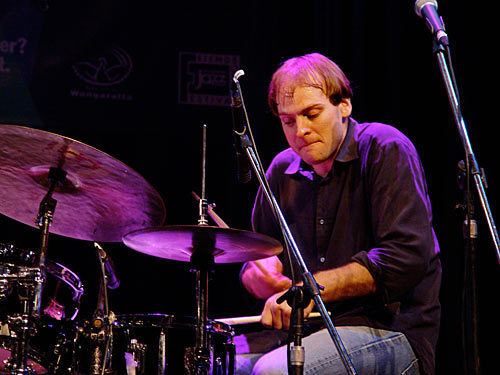
Ari Hoenig (pictured) is an American drummer, composer, bandleader and educator with an international reputation. Born in 1973 he has recorded frequently as a leader with leading musicians from both sides of the Atlantic and has amassed an impressive back catalogue.
His current international project features the young British musicians Tom Ollendorff (guitar) and Conor Chaplin (double bass), a collaboration that began as long ago as 2017 when Ollendorff studied with Hoenig during a visit to New York City. A strong musical rapport was established and in 2019 Hoenig visited the UK to play a series of live shows with Ollendorff and bassist Conor Chaplin.
Post Covid Hoenig visited the UK for further gigs with with Ollendorff and Chaplin and following the two week tour the trio recorded the album “Enchanted” at Giant Wafer Studios in Mid Wales. The album was released on the Barcelona based Fresh Sounds New Talent imprint, a label with which both Hoenig and Ollendorff have close associations.
The Jazzmann has been documenting Ollendorff’s career since his student days at the Royal Welsh College of Music in Cardiff and has charted his rise as one of the UK’s leading jazz guitarists. It’s good to see him rubbing shoulders with such an illustrious figure as Hoenig, a musician I’d only heard on disc prior to this evening.
In the absence of Chaplin, who was playing elsewhere with Norwegian saxophonist Marius Neset, the bass chair was filled by Viktor Nyberg, also a regular Ollendorff associate, who filled in brilliantly. Chaplin will be joining Hoenig and Ollendorff for the rest of the trio’s European tour.
I obviously wasn’t the only one to be excited by the prospect of seeing this trio play live and The Vortex was packed to the rafters for the second of two shows from this group, the other having taken place earlier on in the evening.
The chemistry between Ollendorff and Hoenig was apparent right from the start with the pair facing each other on stage and consistently bouncing ideas off each other, with Nyberg acting the role of mediator. Ollendorff’s melodic, Pat Metheny influenced guitar style was the perfect foil to Hoenig’s distinctive and consistently inventive drumming. Having seen Ollendorff perform on numerous occasions over the years and in a variety of different contexts I don’t think I’ve ever heard him play as brilliantly as he did tonight – I use the word ‘heard’ advisedly as in a crowded Vortex I really couldn’t see the sit down guitarist too well.
The trio opened with “Lyric”, a Hoenig tune dedicated to his daughter that featured Ollendorff at his most melodic as Hoenig played with a combination of brushes and bare hands. Nyberg was also featured as a soloist on this comparatively gentle opener.
The trio’s version of Wayne Shorter’s composition “Deluge” began with a solo drum introduction, with Hoenig subsequently entering into a series of call and response exchanges with Nyberg at the bass. Ollendorff bided his time before entering the fray, his melodic interventions evolving into an absorbing three way musical discussion with Nyberg and Hoenig, which in turn subtly morphed into a Hoenig drum feature.
The third item was a bebop style interpretation of the Thelonious Monk tune “We See” which saw Hoenig’s rapid brush work underpinning a series of guitar and bass exchanges between Ollendorff and Nyberg. Ollendorff’s characteristically fluent guitar solo was then followed by a drum feature from the irrepressible Hoenig.
The trio’s album takes its title from their extraordinary interpretation of the song “Some Enchanted Evening”, a spacious, slowed down ballad interpretation featuring the sounds of coolly melodic guitar, languid double bass and delicately brushed drums, with Hoenig delivering some particularly exquisite cymbal work. Ollendorff’s solo with its subtle jazz variations around the theme was followed by the sounds of Hoenig’s mallets on the outro.
The riff based Hoenig original “Arrows and Loops” with its broken beats and odd meter grooves introduced an element of musical humour between the players prior to a feverish guitar solo from Ollendorff that provoked a suitably dynamic response from Hoenig.
A second Hoenig original, “Child’s Prey”, reintroduced the trio’s bebop leanings with Ollendorff’s lithe guitar soloing underpinned by the driving rhythms of Hoenig and Nyberg, the performance culminating in a Hoenig drum feature that incorporated some truly volcanic drumming. A constantly restless presence behind the kit Hoenig is capable of generating a ferocious power, but he’s equally capable of great subtlety and delicacy. These qualities, allied to his mastery of the most complex of rhythms combine to make him a brilliant all round drummer, and one with a unique musical approach that goes beyond mere technical excellence.
Tune announcements went out of the window at this point but the next piece was ushered in by Nyberg’s solo double bass intro, this eventually evolving into a dialogue with the mallet wielding Hoenig. The entry of the guitar steered the music into more straight-ahead bebop style territory as Ollendorff’s solo combined sophisticated chording with elegant single note runs. Hoenig’s drum feature saw him deploying mallets to sketch melodies on the drums.
The inevitable encore featured more of the fiery but eloquent dialogue between Hoenig and Ollendorff that had distinguished the whole performance. But in a piece that displayed a skilful command of dynamics there were more reflective moments too, including an unaccompanied guitar episode before Hoenig rounded things off with a typically inventive drum feature.
This really was an exceptional performance from a superbly balanced trio. The idiosyncratic Hoenig may have been the dominant figure but there was a real chemistry between him and his colleagues, and particularly the excellent Ollendorff.
After the show I treated myself to a copy of the “Enchanted” album, from which many of tonight’s tunes were sourced, and I can confirm that it sounds just as good in the home listening environment.
I reflected that on successive nights I’d enjoyed live performances from two of the world’s greatest drummers, Gary Husband and Ari Hoenig, but my vote for the best gig of the Festival thus far has to go to Hoenig and his trio. Hoenig convinced as both a powerhouse and a colourist and has very much developed his own personal style of drumming. It was a privilege to see him play.
I was also delighted for Ollendorff, who just keeps getting better and better and whose career is going from strength to strength. Nyberg’s contribution to the success of the evening shouldn’t be forgotten either.
A terrific way to round off a fascinating day of music.
blog comments powered by Disqus