

by Ian Mann
November 04, 2025
Highly enjoyable. The format of the Festival with its focus on multiple small ensembles ensures that there is plenty of variety with no single line-up or improvisation allowed to outstay its welcome.
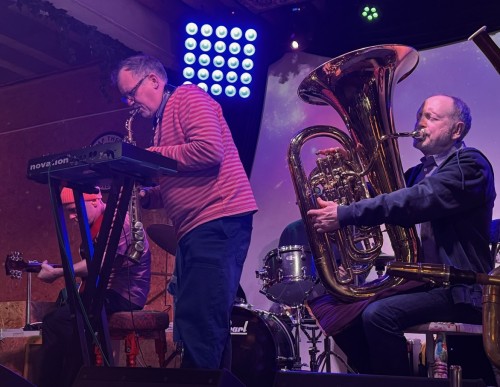
Photograph by Claudia Lis
Fifth Stourbridge Festival of Improvised Music, Claptrap The Venue, Stourbridge, West Midlands,02/11/2025.
I first visited the Stourbridge Festival of Improvised Music for its third edition, which took place at the Claptrap venue on 14th November 2021. This proved to be an interesting and very enjoyable event and is comprehensively reviewed here;
https://www.thejazzmann.com/features/article/third-stourbridge-festival-of-improvised-music-claptrap-the-venue-stourbridge-west-midlands14-11-2021
Instigated by promoter Richard Clay and curated by saxophonist Bruce Coates the event has its origins in a UK tour being undertaken by a band led by trombonist Sarah Gail Brand and featuring drummer Mark Sanders. Unable to secure a suitable Birmingham venue Clay put the event on at Claptrap, then a fairly new Stourbridge venue that prides itself on being both “alternative” and “independent”, qualities particularly appropriate to the art of improvisation. The success of the Brand event, plus other events staged by Clay at the Claptrap venue, eventually led to the first Stourbridge Festival of Improvised Music.
The SFIM usually takes place in November and for me often clashes with my annual visit to the EFG London Festival. Fortunately that wasn’t the case this year with SFIM being scheduled earlier in the month and I was able to make my return to Claptrap after missing the fourth edition of the Festival, which took place in 2022.
The SFIM is an afternoon event that features a ‘pool’ of invited musicians which is subsequently broken down into a number of smaller ensembles before all coming together for a final ‘mash up’ at the conclusion of the Festival.
The ‘pool’ features leading improvising musicians from the Midlands and surrounding areas and this year featured;
Bruce Coates – alto & soprano saxophones
Fliss Evans-Waite: baritone saxophone
Alicia Gardener-Trejo: baritone saxophone/flute
Alex Astbury: trumpet
Becky Lockett: trombone
Fiona Troon - bassoon
Mark Summerfield: tuba
Mike Bethel: acoustic guitar
Barry Edwards: guitar
Matthew Grigg: electric guitar, electronics
Dave Nock: guitar, percussion
Steve Tromans: piano
Andrew Woodhead: piano, synth
Trevor Lines: electric bass
Jasper Coates: drums
Jonno Gaze: drums
Walt Shaw: drums, percussion, electronics
Some of these musicians, notably Barry Edwards, Steve Tromans, Andrew Woodhead and Alicia Gardener-Trejo have been fairly regular presences on the Jazzmann web pages. I was also aware of the playing of Bruce Coates, Trevor Lines and Jonno Gaze from previous Festivals and other live events and had heard Walt Shaw on disc. The other musicians were unknown to me and as such represented exciting new discoveries.
Claptrap, which functions as a multi purpose venue hosting rock, DJ nights, spoken word etc. is a pleasingly friendly, Bohemian space well suited to the staging of improvised music. An attentive and supportive audience comprised of musicians and music fans made for a relaxed atmosphere highly conducive to spontaneous creativity.
ENSEMBLE ONE
Matthew Grigg – electric guitar, electronics, Mike Bethel – acoustic guitar Alicia Gardener Trejo, Fliss Evans-Waite – baritone saxophones, Steve Tromans - piano Jonno Gaze – drums
The afternoon got underway shortly after 2.00 pm with an unusual ensemble featuring two baritone saxophones plus the contrasting guitar styles of Matthew Grigg and Mike Bethel. Steve Tromans was at the venue’s upright acoustic piano with Jonno Gaze completing the line up at one of the two drum kits.
Grigg largely played the guitar on his lap and regularly deployed a bow and various other devices on the strings. He also boasted an impressive display of foot pedals and used the instrument primarily as a textural device, his playing was far from conventional.
Acoustic guitarist Bethel’s technique was more orthodox, but far from being unadventurous.
With Gaze providing subtle drum commentary the music varied between loosely structured, obviously improvised passages and what sounded like more organised sections featuring the intertwining of the two baritone saxes in a manner that sometimes reminded me of the music of Seb Rochford’s Polar Bear.
At the piano Tromans took a little time to integrate himself into the performance but eventually emerged with an otherwise solo piano episode punctuated by Gaze’s drum commentary.
This opening improvisation continued with a dialogue between the two guitarists with Bethel’s pointillistic acoustic guitar figures underpinned by Grigg’s scratches and drones, realised via the use of extended guitar techniques and various electronic effects.
Things concluded with the staccato riffing of the baritone saxes in a climactic passage that reminded me of the music of the band Sloth Racket, led by baritone saxophonist Cath Roberts, when that group develops a riff and latches on to a groove.
I very much enjoyed this opening improvisation which embraced a variety of musical styles and which delivered a lot of information during its twenty minutes or so duration.
ENSEMBLE TWO
Becky Lockett – trombone, Alex Astbury – trumpet, Andrew Woodhead – synth, Dave Nock – guitar, percussion, Walt Shaw – drums, percussion, electronics
Next up was a quintet fronted by the contrasting horn sounds of trumpeter Alex Astbury and trombonist Becky Lockett. The latter made effective use of a variety of mutes, including what looked like a vinyl record, this creating a distinctive buzzing sound.
The horns took turns in sharing the lead, with Astbury playing both with an open bell and later with a mute.
Their improvisations were underscored by the spacey sonic texturing of Woodhead’s Novation synth and Nock’s FX laden guitar. Locally based Nock, actually a Stourbridge resident, also played some percussion, namely maracas and tambourine, sometimes scraping the latter along his guitar strings. Further rhythmic impetus was provided by drummer / percussionist Walt Shaw, who also added a little judicious electronica.
This was a shorter improvisation, probably around ten minutes or so, and although consistently interesting I found it less varied and immersive than the first, which had set a very high bar for those that followed.
ENSEMBLE THREE
Barry Edwards – guitar, Bruce Coates – soprano saxophone, Fiona Troon – bassoon, Mark Summerfield – tuba, Jonno Gaze – drums
The third ensemble of the day was an unusually configured quintet that included bassoon and tuba in the line-up.
Many listeners enjoyed hearing the unusual timbres of the bassoon in an improvised context. Mick Beck and the late, great Lindsay Cooper (1951-2013) are the only other jazz bassoonists that readily spring to my mind.
Truth to tell Troon’s bassoon was a little overwhelmed in this line up during the course of a ten minute improvisation that was centred around the soprano sax explorations of Coates, who regularly played standing on one leg in a manner reminiscent of Jethro Tull flautist / vocalist Ian Anderson.
This quintet’s urgent, fidgety interplay also featured the sound of Edwards’ scratchy, spidery guitar, his improvisations augmented by the astute use of his effects pedals. Summerfield’s tuba added considerable heft to the sound while Gaze provided apposite drum commentary.
Urgent, intense and unmistakably improvised this was perhaps the most challenging improvisation thus far.
ENSEMBLE FOUR
Fiona Troon – bassoon, Mike Bethel – acoustic guitar, Walt Shaw – drums, percussion, electronics, Andrew Woodhead – piano, Matthew Grigg – electric guitar, electronics
Troon was heard to better effect in this quintet, whose improvisation began with an extended dialogue between her bassoon and Bethel’s acoustic guitar. Shaw subsequently joined to make it a trio, adding subtle drum commentary and punctuation.
Woodhead was next to come on board, this time playing piano, followed by Grigg on electric guitar.
Troon was often the prominent instrumentalist in this ensemble but there were also piano led passages and a further dialogue between the two guitarists, with both deploying extended techniques, with Grigg again using a variety of different devices on the strings. Their combined guitar tracery was augmented by Shaw’s use of a variety of small percussive devices.
This was a particularly immersive episode and it was pleasing to hear the bassoon being deployed so effectively.
ENSEMBLE FIVE
Becky Lockett – trombone, Alex Astbury – trumpet, Mark Summerfield – tuba, Alicia Gardener-Trejo – baritone sax, Fliss Evans-Waite – baritone sax
Initially I wasn’t quite sure what I would make of this fifth ensemble, a wind quintet featuring a preponderance of lower register instruments. However their often beautiful performance proved to be one of the highlights of the day.
The tone was set by Astbury’s solo trumpet introduction, which in the week leading up to Remembrance Sunday was evocative of The Last Post. He was joined by Lockett’s trombone and by Summerfield’s muted tuba, the bell of his instrument filled with what must be the biggest mute I have ever seen! The music had a mournful, song like quality and was possessed of a genuine beauty.
The twin baritones kept their powder dry at first before eventually joining the proceedings and subsequently taking over the lead as the music gradually veered off into more obviously free jazz territory, with Lockett’s trombone subsequently coming to the fore.
An unexpected highlight.
ENSEMBLE SIX
Barry Edwards – guitar, Dave Nock – guitar, percussion, Bruce Coates – alto saxophone, Steve Tromans – piano
This quartet featured the twin guitars of Edwards and Nock, with the latter also deploying tambourine and maracas and occasionally making use of the cymbals on the drum kit situated immediately behind him.
Coates squiggling alto successfully navigated its way through the interplay of the two guitarists but Tromans, isolated from the others at the piano was too often inaudible, although he did begin to assert himself more towards the close. Nock’s amp seemed to be cranked up particularly high and he seemed overly dominant in the sound mix, with Edwards resorting to power chords to compete with Nock’s percussive guitar playing.
ENSEMBLE SEVEN
Bruce Coates – soprano sax, Trevor Lines – electric bass, Jasper Coates – drums
The final small group of the afternoon was this trio featuring regular collaborators Bruce Coates and Trevor Lines, these two joined by the young drummer Jasper Coates, presumably Bruce’s son.
The performance was centred around the absorbing interplay between Bruce’s soprano sax and Lines’ supple electric bass, with Jasper, who appeared to still be in his teens, providing an impressively mature commentary from the drum kit. Lines’ bass playing exhibited an admirable fluency and sometimes featured the use of a pick, but in this pared down line up it was inevitable that Bruce’s soprano sax should end up being the dominant instrument in what was overall an impressive trio performance with every group member making a significant contribution.
THE LAST PIECE
It’s a SFIM tradition for the Festival to end with a performance featuring the whole company, and this year was no exception. All of the players featured with exception of young Jasper and also Troon and Lockett who had both left early to avoid picking up parking fines.
The final mash up began with a core septet featuring Grigg, Tromans, Woodhead (on synth), Gardener-Trejo (on flute), Edwards, Astbury and Shaw.
These seven kickstarted the final mash up, gradually being joined on stage by the other members of the company.
Things commenced with the ethereal sounds of Edwards’ guitar FX and Woodhead’s Novation synth. As the rest of the septet joined in trumpeter Astbury delivered the nearest thing to an orthodox jazz solo that the afternoon had seen, albeit one underpinned by the unusual sound of Grigg’s bowed guitar.
Gradually the other musicians came to the stage with Bruce Coates joining on alto as Astbury moved to muted trumpet. Lines was next to join the party as Gaze installed himself behind the second drum kit.
Gardener-Trejo switched to baritone as she was joined by her partner in crime, Evans-Waite. Nock then plugged in as Coates embarked on an alto sax solo as Summerfield and Bethel completed the line up, the full ensemble building towards a powerful, skronking collective crescendo that seemed to herald the end of the performance.
Except we weren’t quite through yet as Astbury delivered a trumpet coda before Tromans began to develop a piano motif that provided the gateway for an Edwards guitar solo as Tromans investigated the piano’s innards.
Instead of the expected climactic conclusion this final piece actually wound down gently with a passage of unaccompanied piano.
FESTIVAL OVERVIEW
The Stourbridge Festival of Improvised Music is always an interesting and enjoyable event with a relaxed and informal atmosphere, the ambience enhanced by the quirky but comfortable setting of the Claptrap venue, although it was decidedly chilly in there on this November afternoon.
Once again the Festival delivered some fascinating improvised music in a variety of instrumental formats, some of them probably unique. Highlights included the twenty minute opening sequence, the wind quintet, the ‘bassoon’ quintet, the Coates / Lines trio and, of course, the final mash up. There were plenty of excellent individual contributions but it was the overall collective ‘all in this together’ ethos that was perhaps most impressive with these dedicated improvisers united in the pursuit of a common goal.
Promoter Richard Clay declared himself delighted with the quality of the music that the afternoon had produced, even in the absence of such big hitters as saxophonist Paul Dunmall, who has been a fixture at previous Festivals.
Despite the occasional longueurs that are almost inevitable in the world of fully improvised music this was a highly enjoyable event. The format of the Festival with its focus on multiple small ensembles ensures that there is plenty of variety with no single line-up or improvisation allowed to outstay its welcome.
There was plenty of fascinating music to be enjoyed here and it is to be hoped that the Stourbridge Festival of Improvised Music will return to Claptrap for its sixth edition in 2026.
My thanks to Claudia Lis for providing the photograph that illustrates this article.
blog comments powered by Disqus