

by Ian Mann
July 06, 2026
Ian Mann enjoys the global sounds of the trio Za Górami (Alice Zawadzki, Fred Thomas, Misha Mullov-Abbado) and the Senegalese / Irish duo of Dudu Kouate and Shunya.
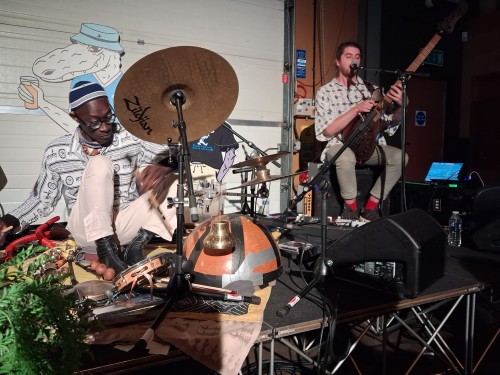
Photograph of Dudu Kouate and Shunya by Pam Mann
FIRST SATURDAY AT CHELTENHAM MUIC FESTIVAL, 04/07/2026
PROLOGUE
The mainly classical Cheltenham Music Festival was founded in 1945 and recently celebrated its 80th anniversary. It specialises in presenting new British music, some of which extends beyond contemporary classical into other musical genres, including jazz, folk, world and electronic music.
Cheltenham Music festival is presented by Cheltenham Festivals Ltd,. who also run the Jazz Festival (founded 1996) and the Science and Literature Festivals.
Although this site specialises in jazz the Music Festival sometimes features events which are of interest to jazz listeners and over a period of years I have covered a number of such ‘crossover’ events.
In 2013 I reviewed the event SANS - Ethno-Ambient Journey at the Parabola Arts Centre. This featured an international quartet led by the multi-instrumentalist and composer Andrew Cronshaw and included Finnish singer Sanna Kurki -Suonio, Canberra based reeds player Ian Blake and Armenian duduk specialist Tigran Aleksanyan. The programme featured the music of several different folk traditions from around the globe and my review of a fascinating performance can be found here;
https://www.thejazzmann.com/reviews/review/sans-etho-ambient-journey-at-pac-cheltenham-06-07-2013-part-of-cheltenham-m
The Jazzmann then covered two 2014 CMF events, also at the Parabola Arts Centre with a film and talk about the history of the Moog synthesiser followed by a live performance by the Smith Quartet with percussionist Joby Burgess playing the music of three contemporary composers, the programme consisting of;
Steve Reich - “Different Trains”
Graham Fitkin – “Distil”
Steve Martland - “Starry Night”
My account of the above evening can be found here;
https://www.thejazzmann.com/features/article/an-evening-at-cheltenham-music-festival-04-07-2014
in 2015 The Jazzmann covered a CMF event at the Parabola Arts Centre featuring a rather challenging collaboration between saxophonist Trish Clowes and her Emulsion Sinfonietta ensemble in conjunction with the Anglo-Norwegian electro-improvising duo Food (saxophonist Iain Ballamy and drummer Thomas Stronen). Review here;
https://www.thejazzmann.com/reviews/review/emulsion-sinfonietta-featuring-food-parabola-arts-centre-cheltenham-04-07-2
Although the intervening years have presented other tempting ‘crossover’ events I didn’t return to CMF until 2025 and the Songs for the Earth event at Pittville Room.
Songs for the Earth, co-led by the husband and wife team of double bassist Misha Mullov-Abbado and the Australian born violinist Bridget O’Donnell, is a wide ranging project that embraces elements of jazz, folk and classical music. The programme at their 2025 CMF show featured arrangements of nature-inspired music from Celtic, Nordic, North & South American, Eastern European and Middle-Eastern music traditions, featuring a mix of traditional folk songs from hundreds of years ago and more recent songs by contemporary songwriters. Originally commissioned by Sinfonia Cymru Songs for the Earth was inspired by the lockdown period when musicians such as O’Donnell and Mullov-Abbado were unable to tour and found themselves spending more time re-connecting with nature.
The Songs for the Earth quintet also included Simmy Singh on violin and shruti box, David Shaw on viola and Colin Alexander on cello. My account of an excellent performance that both entertained and educated can be found here;
The 2026 Festival saw Mullov-Abbado returning to the Pittville Pump Room in the same Saturday afternoon slot to perform with Za Górami, a trio featuring his bass playing alongside the voice and violin of Alice Zawadzki and the piano and drums of multi-instrumentalist Fred Thomas. A full account of the Za Górami performance appears below.
This year’s visit to CMF also saw me covering a second even in the evening at the Swamp performance space at DEYA Brewery, a new venue for CMF. This featured the remarkable duo of the Senegalese percussionist, vocalist and multi-instrumentalist Dudu Kouate and the Irish bassist, violinist and vocalist Alan Keary, also known as Shunya. More on them later.
ZA GORAMI, PITTVILLE PUMP ROOM
Alice Zawadzki – vocals, violin, Fred Thomas – piano, drum kit, Misha Mullov-Abbado – double bass
The three musicians listed above share equal billing on their debut album, “Za Górami”, released in 2024 on the prestigious ECM record label. They were still billed as such when I enjoyed an exceptional live performance from the trio, plus their guest Palestinian oud player and vocalist Saied Silbak at that year’s EFG London Jazz Festival. That show took place at Hall One in Kings Place and is reviewed here.
https://www.thejazzmann.com/features/article/efg-london-jazz-festival-2024-second-saturday-23-11-2024
Za Górami now seems to have been adopted as a band name and the core trio were billed as such for this Cheltenham Music Festival appearance.
Nevertheless it’s difficult not to think of the trio as Zawadzki band. The title of the album, now a band name, comes from a Polish phrase meaning “beyond the mountains”, but which can also be translated as “once upon a time”, that references Manchester born Zawadzki’s Polish heritage.
I first discovered Zawadzki’s music at the 2012 EFG LJF when she led her band at a gig at the tiny Green Note venue in Camden. I’ve been a fan ever since and have favourably reviewed both her previous album releases, “China Lane” (2014) and “Within You Is A World Of Spring” (2020).
Her first two albums, both released by Whirlwind Recordings, feature her own songwriting fairly prominently, but they also include arrangements of folk songs from various cultures and it’s this aspect of her work that forms the nucleus of the “Za Górami” project. “Within You Is A World Of Spring” featured a pool of musicians that included multi-instrumentalist Fred Thomas and bassist Misha Mullov-Abbado, who have continued their musical relationship with Zawadzki via this trio.
Zawadzki was making her second visit to Cheltenham Festivals this year having appeared as half of a duo with guitarist James Kitchman at Cheltenham Jazz Festival, the pair playing an enjoyable show in the intimate environs of the Family Tent. The programme featured a fascinating mix of songs sourced from around the globe and embraced a variety of musical genres.
Today’s performance in the elegant setting of the Pittville Pump Room featured six songs from the “Za Górami” recording plus a further four songs from the trio’s repertoire.
It was one of the ‘new songs’ that got things underway, “Cucurrucucú paloma”, a song written in 1954 by the Mexican songwriter Tomás Méndez. Introduced by the combination of piano and double bass the piece featured Zawadzki on both violin and vocals, and also featured her whistling at the close. This song was performed as an encore at the trio’s 2024 EFG LJF appearance.
The sight of Thomas traversing the stage was to become a regular feature of the afternoon as he moved to the drum kit for “Dezile A Mi Amor”, the opening track on the trio’s album. With a title translating as “Tell My Love” this is a traditional Ladino song sourced from what Zawadzki has described as “the deep well of Sephardic culture”. Today’s performance featured the sounds of double bass both bowed and plucked and the varied use of mallets, bare hands and brushes on the drums. Zawadzki’s emotive, increasingly impassioned vocals exhibited an almost shamanistic quality.
Thomas returned to the piano to introduce the song “Nani Nani” with a passage of unaccompanied playing, subsequently joined by Zawadzki’s vocals and Mullov-Abbado’s underpinning bass. Mullov-Abbado was also to feature as an instrumental soloist. Again sourced from the Sephardic (or Judo-Spanish) tradition this was a lullaby whose lyrics have a darker, barbed edge, these finding expression in Zawadzki’s flexible but passionate vocals.
Written by the Venezuelan songwriter Simon Diaz “Tonada De Luna llena”, a title translating as “Song of the Full Moon” was described by Zawadzki as “a song where love drives you completely insane”. Introduced by the combination of piano and double bass this was a further demonstration of Zawadzki’s extraordinary ability to sing with passion and conviction in a variety of different languages and to do so thoroughly convincingly. The arrangement also featured a piano solo from Thomas and was notable for introducing a little wilful dissonance into the trio’s ‘chamber jazz’ aesthetic.
The next song was the as yet unrecorded “Pizzica di San Vito”, a tarantella from southern Italy, introduced by a passage of unaccompanied double bass from Mullov-Abbado. Thomas had returned to the drum kit and the addition of his cymbals saw Mullov-Abbado move briefly to the arco technique before establishing a strong pizzicato bass groove, augmented by Thomas’ brushed drums. This provided the platform for Zawadzki’s subtly theatrical singing of the somewhat bloodthirsty Italian lyrics, her vocalising augmented by a series of simple but effective hand gestures. This song was also performed by the trio at Kings Place, on that occasion in the company of Saied Silbak.
Thomas returned to the piano for “Gentle Lady”, Thomas’ setting of a James Joyce text. Introduced by a passage of solo piano, with Thomas making occasional use of the instrument’s innards this piece offered a rare opportunity to hear Zawadzki actually singing in English. An extended, highly lyrical piano solo was underscored by Mullov-Abbado’s simple bass pulse. The latter stages of the song then featured Zawadzki’s soaring, ethereal wordless vocals.
Next a song new to the trio’s repertoire, “Esta Pareia”, a Ladino song from Venice that saw Thomas return to the drum kit and Zawadzki take up the violin for a second time. The performance saw Zawadzki singing and playing violin simultaneously, a difficult feat one imagines. Thomas gravitated between mallets and brushes on a piece that combined traditional melodies with vibrant rhythms.
“Za Górami” itself began with a solo vocal introduction, with Zawadzki singing in Polish, eventually joined by the sounds of Mullov-Abbado’s fingers fluttering on the bass strings and the gentle trill of Thomas’ piano shadings. As Zawadzki’s singing became powerful and impassioned the instrumentalists responded in kind and again embraced an element of dissonance as vigorous double bass was combined with pounding piano. Thomas deployed both ends of the keyboard of the Pump Room’s Yamaha grand piano as left hand low end rumbles combined with ethereal right hand trills and ripples. A gentler, more lyrical passage followed, featuring voice and piano only, prior to a closing section that featured the sounds of dampened piano strings and bowed bass alongside Zawadzki’s voice.
Translating as “Untie The Ribbons” “Sueltate Las Cintas” is a song by the Argentinian songwriter and composer Gustavo Santaolalla. Featuring a sensuous lyric it was performed in a slow burning arrangement that included an extended piano solo from Thomas, gentle and lyrical at first but becoming increasingly florid as the piece progressed.
The final item was “Tancas”, a Sardinian rebel song with a lyric raging against the actions of tyrannical barons and with a refrain translating as “we’re going to unhorse you”. As Zawadzki pointed out this is a song that hasn’t really dated, there are still plenty of modern day tyrants in the metaphorical saddle. This song was performed at Kings Place and also at the Cheltenham Jazz Festival where Zawadzki encouraged the children to join in by making horse noises ranging from neighing to the clopping of hooves. She tried the same trick with the adults here, who responded with equal enthusiasm. Protest songs can be fun too. Featuring Thomas at the drum kit this piece also included a violin solo from Zawadzki.
The deserved encore was “Arvoles Lloran Por Lluvias”, the final track on the trio’s album. A traditional Ladino song, with a title translating as “The Trees Weep For Rain”, this was a beautiful piece featuring the sounds of voice, prepared piano and bowed bass on the hymn like intro, with the music gradually gaining slightly greater momentum and attaining even more of an anthemic quality. Thomas was featured with a lyrical piano solo.
This was a beautiful and delightful way to conclude an entrancing afternoon of music making. Once again Zawadzki’s performance had been totally compelling. Prior to this trio I’d always considered her to be fifty per cent singer, fifty per cent instrumentalist, but in this context the focus is very much on her as a vocalist and in this role she again delivered brilliantly. Her contributions on violin were both skilful and enjoyable, but with Za Górami it’s in her contributions as a vocalist and as an interpreter of songs that she really shines.
For all the intensity of the performances Zawadzki’s presentation style was warm, witty, informative, refreshingly down to earth and sometimes outright humorous. It made for a pleasing combination. She’s a performer who takes her music seriously, but not herself.
In Thomas and Mullov-Abbado she had the perfect accompanists, the former a skilled and versatile multi-instrumentalist, the latter a consummate double bass player and a bandleader in his own right.
Mullov-Abbado’s solo career has also been well documented on these web pages and three of his four albums as the leader of his long running jazz sextet have been reviewed elsewhere on this site, as have a number of other live performances featuring his talents.
Meanwhile Thomas, who also plays double bass, is involved in a myriad of projects spanning the jazz and classical genres and more. He and Zawadzki have a piano and voice duo exploring the repertoire of Schubert’s Lieder. It’s just one of the many diverse projects with which he is involved.
See http://www.fred-thomas.co.uk for more details of his diverse musical activities.
My thanks to the members of the trio for speaking with me after the show and to Fred Thomas for providing me with a set list, which was helped enormously in the writing of this review.
Today’s show was made even remarkable by the logistical problems that the trio had encountered en route when Mullov-Abbado’s car broke down on the outskirts of Cheltenham. A kind local resident helped to get the band and their gear to the venue and the show went ahead pretty much to time and with the trio performing superbly, as you’ve just read. I just hope they all got back to London safely and without too many further difficulties.
DUDU KOUATE / SHUNYA DUO, THE SWAMP, DEYA BREWERY
Dudu Kouate – percussion, vocals, miscellaneous instruments
Alan Keary ‘Shunya’ – electric bass, violin, vocals, electronics
My second event of the day took place at The Swamp, the performance space at the highly successful DEYA Brewing Company, the Cheltenham based craft brewery. DEYA have established a productive partnership with Cheltenham Festivals and sponsored the Jazz Arena venue at the 2026 Cheltenham Jazz Festival.
For Cheltenham Music Festival The Swamp is acting as a kind of ‘official fringe venue’ and is hosting a number of events, including tonight’s duo performance from the Senegalese musician Dudu Kouate and his Irish collaborator Alan Keary, aka Shunya. Such was the demand for tickets at this admittedly intimate venue that a matinee show was also added, with both the afternoon and evening shows selling out.
There was a neat link to the Za Górami performance as Kouate sometimes plays in a trio with Fred Thomas, the latter playing double bass, together with pianist Liam Noble. On other occasions Thomas and Noble play with American kit drummer Gerry Hemingway, so I would imagine that these two trios actually sound very different.
Born in Senegal in 1963 of griot heritage Kouate is now based in Italy where he has worked with jazz saxophonists Guido Bombardieri and Pietro Tonolo and with the group Odwalla. His playing has also appeared on numerous film soundtracks. His recordings include the solo album “Africation”, recorded in Italy.
From Limerick, Ireland, Alan Keary, aka Shunya is a multi-instrumentalist, singer and songwriter. He is the son of Dave Keary, guitarist and musical director for Van Morrison. As Shunya he has released the full length album “I Have Aspirations for Dragonflies” plus a number of EPs and stand alone tracks. His music embraces a broad range of musical genres, ranging from traditional folk to electronica and many points in between. Shunya’s solo recordings are available via his Bandcamp page here;
Kouate and Shunya met through their shared membership of South African cellist Abel Selacoe’s band, a line up that also includes Fred Thomas. Establishing a musical rapport through their work with Selacoe they have continued to work as a duo – “Senegal meets Donegal”, as one wag in the audience put it.
Arriving early we were able to secure front row seats that provided us with a good view of Kouate’s veritable battery of instruments, including a dizzying array of bells, shakers, cymbals, bowls, gongs and so much more more, including a calabash and a variety of wind instruments. He sat to play and on the tiny stage at The Swamp he was literally surrounded by instruments.
Shunya’s set up included a five string electric bass and a violin, both linked to impressive arrays of foot pedals. He also had a lap top on stage enabling him to carry out further sound processing. The contrast between the contemporary musical technology and Kouate’s array of idiophones, some of them self constructed, was striking, but also very effective.
The performance was almost entirely improvised, similar in spirit to jazz but sounding very different.
The first sequence, which lasted for the best part of half an hour, began with the sounds of liquidly melodic electric bass, augmented by various FX pedals, and vocalised wood flute, with Kouate simultaneously playing brushed cymbals in addition to various bells, bowls and shakers. Shunya then added vocals to the high register sounds of his bass, his voice a beguiling blend of power and vulnerability as Kouate provided ongoing percussive commentary.
Shunya’s singing incorporated lyrics and after the show I asked him if the words were improvised too, as I’ve seen guitarist / vocalist Charlie Beresford do in a variety of musical contexts. Shunya explained that with regard to the lyrics he’d “repurposed and recycled” some of the songs from the “I Have Aspirations for Dragonflies” album.
As the opening sequence continued to unfold Shunya looped and layered his bass as Kouate added bird calls and other wind instrument sounds before making his own vocal contribution. Like Shunya he’s an accomplished vocalist, who here augmented his singing with the sounds of bells, shakers and other percussion. The combination of Shunya’s bass motif / groove and Kouate’s assorted percussion then brought this immersive and visually striking first sequence to a conclusion.
Kouate introduced the second sequence solo, playing a small Indian frame drum, closely miked for maximum effect. Shunya featured on violin, or perhaps ‘fiddle’ would be most appropriate in this context. as the duo explored the musical links between Indian rhythms and those of the Irish slip jig. Such musical and cultural connections are an ongoing source of fascination and inspiration for the duo. The vocal section of this sequence was an adaptation of the Bjork song “Unravel”, with Shunya later playing a pizzicato violin solo that sounded almost guitar like at times.
The introduction to the third sequence was played by Kouate on a kalimba, or thumb piano, that looked as if it might have been self constructed. He also generated an electronic sound-wash of his own as Shunya added pizzicato violin. Shunya moved to the bow as Kouate began to sing, also adding the sounds of shakers, bells and cymbals. Shunya then moved back to electric bass as Kouate stood up to whirl two lengths of plastic tubing around his head generating flute like sounds. I was reminded by a performance by the late great UK drummer Martin France and his Spin Marvel group at Cheltenham Jazz Festival many years ago. Kouate’s ethereal, high pitched sounds were underpinned by the low end rumbles of Shunya’s electric bass. An effective contrast. The final part of this section then included Kouate’s vocals and the Jews harp like sound generated by one of his numerous wind instruments.
The closing sequence began with an extended solo introduction from Kouate on talking drum as Shunya moved to violin. It was also Kouate’s final vocal contribution of the evening. He tried to get the audience to sing along with his chanting, but it was a bit too complicated for a bunch of reserved Brits and the best he could get out of us was “hey!”
Nevertheless audience members at the Swamp responded well to a duo performance that was variously deeply immersive, charmingly exotic and often just plain fun. The pair took it in turns to make announcements with Shunya taking the lion’s share of these, delighting the crowd with an Irish charm that encouraged plenty of verbal interaction between band and audience.
The deserved encore saw Kouate demonstrating his self built hydrophonic flute, in conjunction with Shunya’s violin, the latter electronically treated and with Shunya holding it to his face and singing through it. Astonishing stuff all round.
This duo performance from Kouate and Shunya at an unusual venue represented something of a departure for Cheltenham Music Festival but it was well received by an enthusiastic and appreciative audience and was an undoubted success.
It was also a success in musical terms, far more than a ‘musical novelty act’. Yes, it was very different but it was also immersive, emotionally involving and visually fascinating with such a wide array of instruments being used. For a duo the pair produced an astonishing panoply of sounds, all rooted in the sheer musicality of both the players. These were two genuine virtuosos at work and the fact that the music was rooted in improvisation made it all the more impressive. The heavyweight musical company that Kouate keeps, notably Fred Thomas and Liam Noble represents an impressive endorsement of his abilities.
Again my thanks to both musicians for speaking with me at the end of a very enjoyable and stimulating day at Cheltenham Music Festival, an event that continues to widen its musical and cultural horizons in the 21st century.
My thanks to Jade Beard and Dan Hartland for arranging my press tickets.
blog comments powered by Disqus