

by Ian Mann
August 11, 2026
Ian Mann enjoys the first full day of the Festival and performances by Tomos Williams' Blodeugerdd, the Ursula Harrison Quartet, Liane Carroll and Jack Mac's Funk Pack.
FRIDAY AT BRECON JAZZ FESTIVAL, 07/08/2026
The 2026 Brecon Jazz Festival was the second to be organised by the current management team headed by Chris Jones. Following a successful inaugural event in 2025 ticketed events continued to be held in three main venues, The Guildhall, The Muse and Theatr Brycheiniog, the latter replacing the Market Hall.
Once again there was also an extensive free music programme on the Bulwark Stage in the centre of town and also on the Bethel Square Global Stage, the latter co-ordinated by the Cardiff based Tan Cerdd Community Interest Company.
With Fringe events also taking place in seemingly every pub and club in town and with buskers performing in the streets there literally was music around every corner as the ‘Brecon Buzz’ returned for another year.
My reviews will concentrate on the ticketed performances and this first day saw me attending four events at three different venues.
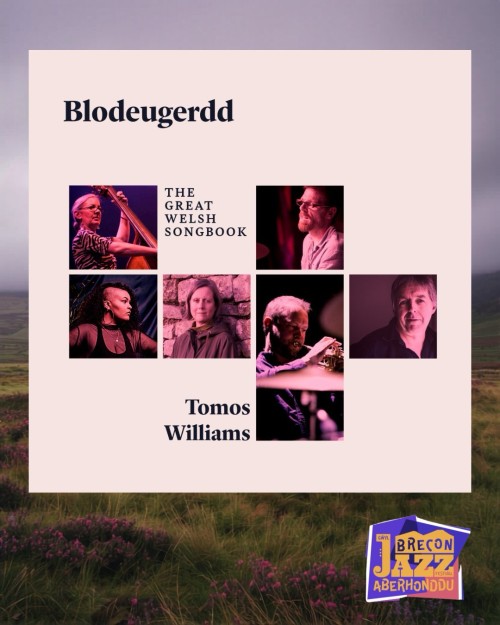
TOMOS WILLIAMS – BLODEUGERDD – THE GREAT WELSH SONGBOOK, THEATR BRYCHEINIOG
Tomos Williams – trumpet, Rachel Musson – tenor sax, Eadyth Crawford – vocals, Huw Warren – piano, Paula Gardiner – double bass, Mark O’Connor – drums
The day’s first ticketed performance took place at Theatr Brycheiniog and featured an all Welsh ‘supergroup’ with the sextet line-up listed above.
The Blodeugerdd project is led by trumpeter and composer Tomos Williams, a musician who has featured regularly on the Jazzmann web pages.
He first came to my attention as the co-leader, with his saxophonist brother Daniel, of the jazz/folk sextet Burum. This band’s albums “Caniadau” (2012), “Llef” (2016) and “Eneidiau” (2022) have all been reviewed elsewhere on this site, as has a live appearance at the 2014 Brecon Jazz Festival.
Williams is also a member of Khamira, which sees a quartet of Welsh jazz musicians, all of them associated with Burum, collaborating with a trio of Indian born musicians to create a unique musical and cultural hybrid of jazz, Indian classical music and Welsh folk. Khamira’s eponymous debut album (2017) and the follow up “Undod / Unity” (2022) are both favourably reviewed elsewhere on this site. As a paying customer I have also enjoyed live performances by the band on different tours at the Borough Theatre in Abergavenny and at the Chapter Arts Centre in Cardiff.
Williams also leads Seven Steps, a jazz quartet dedicated to exploring the music of Miles Davis. His other musical activities include his long term membership of the Welsh folk group Fernhill, and a duo with Welsh triple harpist Llio Rhydderch, with whom he recorded the album “Carn Ingli”.More recently he has been fronting a trumpet led jazz trio featuring Aidan Thorne on double bass and Matt Holmes at the drums. This trio line up performed at a Brecon Jazz Club event at The Muse in March 2026.
But Williams’ crowning achievement is his Cwmwl Tystion trilogy, a series of suites, each of seven movements, exploring themes of Welsh identity and culture. The title “Cwmwl Tystion” (literally ‘a cloud of witnesses’) is originally Biblical in source and was derived from a poem by the Welsh poet, pacifist and nationalist Waldo Williams (1904-71) called “Beth yw Dyn?” (or “What is Man?”).
All three instalments of the Cwmwl Tystion trilogy, “Witness”, “Riot!” and “Empathy” have been reviewed elsewhere on The Jazzmann, as has a live performance of “Empathy” at the Lost ARC in Rhayader in 2024. Each episode of the Cwmwl Tystion series has featured a different line up, the first comprised entirely Welsh musicians, the second an Anglo-Welsh collaboration featuring saxophonist Soweto Kinch and vibraphonist Orphy Robinson, and the third a truly international affair with the core Welsh line up augmented by American bassist Melvin Gibbs and French-Vietnamese guitarist Nguyen Le. The Cwmwl Tystion series is an ambitious and brilliantly realised body of work that draws inspiration from leading American musician / composers such as trumpeters Wadada Leo Smith, Don Cherry and Ambrose Akinmusure and saxophonists Matana Roberts and John Zorn. I can’t recommend it highly enough.
The Blodeugerdd project draws several strands of Williams’ music together. Blodeugerdd means “anthology” in Welsh while the “Great Welsh Songbook” aspect tips its hat to the timeless jazz standards of the ‘Great American Songbook’.
Blodeugerdd draws upon the kind of Welsh folk music that Williams has performed in a jazz context with Burum and also features musical settings of the poems of Waldo Williams, the man who helped to inspire the Cwmwl Tystion project.
There’s also a degree of continuation with the Cwmwl Tystion project thanks to the inclusion in the Blodeugerdd line up of vocalist Eadyth Crawford, who sang on both “Riot!” and “Empathy”, and Mark O’Connor, Williams’ drummer of choice for all his projects.
Today’s performance began with “Lloer Dirion”, which translates as “Tender Moon”, a traditional Welsh folk tune previously recorded by Burum. This was introduced by Warren at the piano with Crawford adding the Welsh language lyrics, the purity of her voice combining superbly with Warren’s grand piano. As Gardiner’s bass was added to the equation the vocals became more dramatic, with trumpet, tenor sax and drums all shadowing Crawford’s voice. The establishment of a more orthodox double bass and drum groove then provided the platform for instrumental solos from Musson on tenor, Welsh born but the only member of the group to be based in London, and Warren at the piano. Warren’s expansive and increasingly percussive solo variously reminded me of Thelonious Monk and John Taylor. Crawford’s voice was again featured at the close, an atmospheric passage that saw Warren reaching into the piano’s interior. An excellent start.
“Ffarwel” was a segue of two Welsh folk tunes saying ‘goodbye’ to various places. One of these, “Ffarwel i Aberystwyth has also been recorded by Burum. Introduced by Gardiner at the bass, soon joined by piano and brushed drums, today’s version featured Crawford’s rendition of the Welsh language lyrics plus Warren’s use of prepared piano techniques. Trumpet and tenor sax combined melodically prior to a more loosely structured free jazz episode featuring the sounds of trumpet, sax, bass and drums, this evolving into a full on drum feature from O’Connor. Crawford subsequently returned to reprise the lyrics, with the horns providing melodic punctuation.
Warren temporarily left the stage as another Welsh folk tune “Y Gwydd”, translating as “The Goose”, was introduced by the sounds of trumpet, tenor sax and double bass. The pianist later returned to duet with Crawford before embarking on a forceful solo accompanied by the sounds of propulsive bass, rapidly brushed drums and punchy horn punctuation. On this occasion his playing was positively Tyner-esque.
The Blodeugerdd project has previously been presented at Aberystwyth Music Festival and at the National Eisteddfod in Pembrokeshire. The latter represented a particularly appropriate platform for the settings of the Waldo Williams poems. The first of these was “Blodyn A Pfrwyth”, or “A Flower and a Fruit”, ushered in by the combination of trumpet and double bass, with Gardiner’s bass motif later augmented by glacial shards of piano and Crawford’s singing of the poet’s words. Warren continued to explore extended piano techniques, strumming the strings as Williams and Musson combined on the melody. Crawford then returned to sing again, prior to instrumental solos from Williams and Warren, with Crawford again re-appearing at the close.
Also with words by Waldo “Pitran Patran” began with Gardiner’s bass groove, with piano, drums and voice subsequently added. Warren continued to play a major role, his piano solo variously percussive, jagged and playful.
Waldo’s “Yr Eco” (“The Echo”) then featured an unaccompanied piano intro from Warren. The introduction of the other band members was also the cue for Crawford’s vocals, which incorporated both Waldo’ words and wordless vocal lines. This was a gentle piece that included a lyrical trumpet solo from Williams and a melodic bass solo from Gardiner, who entered into a dialogue with Warren, their musical conversation paced by O’Connor’s economical drumming.
The last of the Waldo settings was “Chwarae”, which commenced with Crawford reciting the poem before handing over to the instrumentalists. The accompanying tune was the most obviously ‘jazz’ piece so far with a bebop inspired head punctuated by O’Connor’s sparky drum breaks acting as the jumping off point for solos from Warren at the piano and Musson on tenor. Musson has more of a background in free jazz than the other players in this sextet and her solo was relatively conventional at first but later explored elements of abstraction, this leading into a closing drum feature from O’Connor.
Prior to the final number Williams was fulsome in his praise for Brecon Jazz Festival and recalled witnessing performances that had influenced his own decision to become a musician, among them performances by free jazz legends such as pianist Cecil Taylor and drummer Tony Oxley plus a truly apocalyptic and monstrously loud performance by the American quartet of saxophonist David Murray, guitarist James Blood Ulmer, bassist Jamaldeen Tacuma and drummer Ronald Shannon Jackson. The last named was in 1990 and I was there too – it’s probably the most extraordinary performance that I’ve ever seen at Brecon Jazz.
The performance concluded with a final Welsh folk tune “Cob Malltraeth”, named for a location in Anglesey. Introduced by bass and voice only this included solos from trumpet and double bass before the full ensemble came together for a collective passage that embraced a gradual gathering of power and momentum, an unstoppable wave that for some strange reason reminded me of “Würm” from “The Yes Album”. This was followed by a loosely structured diminuendo featuring the sounds of arco bass and plucked piano strings.
The Blodeugerdd performance got the day off to a terrific start. This is a project that compares well with the glories of Burum and Cwmwl Tystion and I was delighted to learn that Tomos hopes to record it next year. I’m also grateful to him for writing out the full details of the set list.
The performance was well received by the audience at Theatr Brycheiniog, with several members commenting on the beauty of Crawford’s voice. She was excellent, but so were the rest of the ensemble, with Warren making a particularly striking contribution.
Williams himself was an unobtrusive leader, preferring to quietly direct proceedings as a member of the ensemble and soloing only occasionally. But there was no mistaking that this was very much his project, he’s a musician who is just brimming with ideas and who has established a distinctive brand of Welsh jazz. As he has observed if Poland, Italy, France and Finland, among other European countries, can carve out their own unique jazz identities then why shouldn’t Wales? Williams is the man with the skill, vision and determination to make that happen.
URSULA HARRISON QUARTET, THE GUILDHALL
Ursula Harrison – double bass, electric bass, acoustic guitar, Amund Totland –electric guitar, Jakob Oland – piano, Marcus Kendellen – drums
From one great Welsh jazz musician to another. Bassist, composer and songwriter Ursula Harrison is the daughter of Paula Gardiner, making another neat link with the previous performance.
Winner of the BBC Young Jazz Musician of the Year in 2024 Harrison is a great favourite with Brecon jazz audiences and has performed regularly at both Brecon Jazz Club and Brecon Jazz Festival.
At the 2024 Brecon Jazz Festival Harrison led her own one off quartet featuring mum Paula Gardiner on guitar, plus saxophonist Coren Sithers and drummer Liz Exell. The 2025 Festival featured Double Double, a trio featuring the twin basses of Harrison and Gardiner with Exell at the drums. Both of these performances are reviewed as part of my Festival coverage for the relevant years.
Harrison studied both mathematics and music at Cardiff University, where her music tutors included bassist Yuri Goloubev and pianist Huw Warren. She’s also part of the European Jazz Master’s Programme, variously studying in Amsterdam, Berlin and Trondheim. She has also studied in Newfoundland, Canada.
As a performer Harrison has played with the National Youth Jazz Orchestra (NYJO), the JM World Jazz Orchestra and the Amsterdam based CvA Jazz Collective. Her small group credits include work with Warren, guitarist Ant Law, violinist / vocalist Angharad Jenkins and pianists Rachel Starritt, Nils Kavanagh and Geoff Eales.
Her most notable sidewoman appearances have been with pianist and composer Eddie Gripper. She appears on Gripper’s acclaimed debut album “Home” (2023) and subsequently toured extensively with his trio.
Harrison’s regular groups include her duo with vocalist Sylvie Noble, daughter of pianist Liam Noble. The Jazzmann has been championing the work of the Sylvie + Ursula duo for some time and has reviewed their performances at a club night at Black Mountain Jazz in Abergavenny, and at Brecon Jazz Festival, both in the summer of 2025. The second of those performances, although very similar, was just as magical and compelling as the first. This is a musical partnership that really is something special as evidenced by their debut album “New Eve”, released earlier in 2026 and also reviewed on The Jazzmann.
The duo have also been covered by the national jazz press with Noble and Harrison having been recently interviewed by Jazzwise magazine. The album has also been favourably reviewed by the same publication. Both articles appear in the June 2026 edition
Harrison also leads the sextet Orbit Street, which blends indie folk with jazz and which features her on both bass and lead vocals. That group also includes saxophonist Blyth Bennett, guitarist Dan Edgecombe, keyboard player Charlie Herbert and twin drummers Sam Green and Patrick Barrett-Donlon, the last named also a member of the Eddie Gripper Trio.
Tonight’s performance featured the young Norwegian quartet that Harrison formed during her time in Trondheim. It was a performance that was introduced by BJF chair Chris Jones who explained that tonight’s event would feature music specifically commissioned by Brecon Jazz Festival and that it would be the first such work commissioned by the current administration.
The work also represented a first commission for Harrison and the young musician was clearly delighted to be commissioned by a Festival so close to her heart – and that of Paula Gardiner too, who has appeared at more than forty editions of the Festival. The commission was made possible by the financial support of the Hinrichsen Foundation.
The new work “Songs About Birds” is a reflection of Harrison’s academic background and applies mathematical principles to musical composition with Harrison citing such composers as Iannis Xenakis and Witold Lutoslawski as sources of inspiration. The work also draws inspiration from the writings of the late American poet Mary Oliver (1935 – 2019) and also addresses some of Harrison’s environmental concerns.
The Harrison quartet has already recorded the digital EP “Living Planet”, a title that has also been used as a band name. Before performing the new suite the band warmed up with three other pieces beginning with “Walking Meditation”, which developed from a single double bass note via a simple piano motif into something more complex and stormy, with hints of wilful dissonance. It was a piece that was notable for its effective use of space between the notes. Totland was the featured soloist and cut a striking figure with his distinctive headless guitar, of a type once used by the late, great Allan Holdsworth.
It was Totland who introduced the next piece, the provocatively titled “Blood”. The extended intro featured spacey, atmospheric effects with the guitarist eventually joined by double bass, keys and brushed drums. Oland was the featured soloist, favouring an acoustic piano sound at his electric keyboard, his solo growing in intensity, with drummer Kendellen switching to sticks. Totland then delivered a spiralling guitar solo, followed by the leader on double bass.
The last of these ‘warm up’ numbers was “Human Intervention”, a tune from the “Living Planet” recording, ushered in by a passage of unaccompanied piano from Oland that evolved into a dialogue with Totland that featured the latter’s celestial guitar effects. The addition of double bass and brushed drums saw a gentle guitar melody emerge, followed by a similarly melodic bass solo from Harrison. The piece concluded with the sound of Totland’s skilful deployment of delay effects.
Now we came to the commission, “Songs About Words”, a forty five minute piece divided into eight contiguous movements as follows;
1. “They Didn’t Even Know They Had Wings”, the title a quote from a Mary Oliver poem and intended as a celebration of nature.
2. “Morning Chorus”, the music a transcription of birdsong. Perhaps Olivier Messiaen should be added to the list of influences.
3. “Conversations Between The Magpies”. A territorial dispute observed by Harrison
4. “You Do Not Have To Be Good”. Another Oliver quote.
5. “Flight Simulator”.
6. “27 %” - the percentage of birds living in Wales that are on the Environment Agency’s Red List.
7.”With Thanks To The Field Sparrow”
8. “Black Sun”, the literal translation of the Danish word for a murmuration of starlings.
Harrison told us all this as she introduced the work and at first I tried to demarcate the movements, but the music was so immersive that eventually I gave up.
Things commenced with unaccompanied piano, with guitar, bass and drums subsequently added, with the leader’s melodic bass taking the lead. Later eerie bowed bass combined with similarly spooky guitar effects.
Next came a bass led free jazz episode which saw the four musicians exchanging ideas, this followed by a more forceful jazz rock passage featuring the soloing of Totland on guitar and Oland on piano.
The music continued to evolve with the drums sitting out for a quieter musical conversation between guitar, piano and bass. Further episodes featured FX laden guitar and arco bass, with Harrison deploying extended bass techniques.
Oland’s rippling piano arpeggios suggested not only a fascination with mathematical patterns but also the influence of Minimalist composers such as Steve Reich and Philip Glass.
Totland then delivered a soaring guitar solo. His playing, and particularly his skilled deployment of the various effects at his disposal, sometimes reminded me of Rob Luft.
Harrison’s move to electric bass saw her instigate a mesmeric riff that led to an extended trance like math-rock section featuring strummed electric bass and the abrasive Rhodes like sound of Oland’s keys.
Harrison’s final instrument change was to acoustic guitar with an unaccompanied passage followed by a dialogue with Oland’s keys, featuring both acoustic and electric piano sounds. A further musical discussion featured the contrasting guitar sounds of Harrison’s acoustic and Totland’s electric, before Harrison was left alone with just her acoustic to end the performance.
This shapeshifting suite was well received by the Brecon audience, despite its complexities and its occasional longueurs. It’s a work that deserves to be heard more than once and Harrison gave us the good news that while her Norwegian colleagues are in the UK they will be going into the studio to record the music for a potential album release in 2027.
LIANE CARROLL TRIO, THEATR BRYCHEINIOG
Liane Carroll – piano, vocals, Roger Carey – electric bass, Russell Field – drums
It’s been a long time since I last saw the Liane Carroll Trio play live at the 2011 Titley Jazz Festival. Therefore I was very much looking forward to tonight’s show featuring her trio with bassist (and husband) Roger Carey and drummer Russell Field (Mark Fletcher was in the drum chair in 2011).
A lot of water may have flowed under the proverbial bridge in the last fifteen years but in Carroll’s musical world world little seems to have changed. She’s still an accomplished pianist, a superb interpreter of songs and a quick witted raconteur, a genuine force of nature.
Carroll doesn’t just limit her song choices to the orthodox jazz canon, she picks songs from everywhere as long as they’re good and offer room for interpretation. Tonight’s set included a mix of jazz standards, pop and rock songs and a dip into the deep well of the blues to round off the evening.
Like Ian Shaw, with whom she’s often worked, she peppers her set with jokes and stories, often weaving these into the fabric of the songs themselves. She’s a laugh a minute and her shows are richly entertaining, combining excellent musicianship with a ready, and often salty, wit.
Carroll visited BJF in 1988 and 2004 and again in 2019 when she played a solo show at St. Mary’s Church in aid of the charity Side By Side With Refugees.
She kicked off tonight’s show with Cole Porter’s “Love For Sale”, offering a humorous take on this tale of prostitution as she demonstrated her pianistic and vocal chops as she segued into “Fever” by way of “My Heart Belongs To Daddy”. Carey and Field weren’t forgotten, offering Carroll understated support while enjoying their own bass and drum features.
An exuberant take on “I Didn’t Know What Time It Was” saw Carroll displaying her impressive scat vocal abilities, and Carey was again featured on electric bass before Carroll and Field indulged in a series of scat vocal / drum exchanges.
Carroll’s take on Hoagy Carmichael’s “Skylark” offered a beguiling mix of humour and pathos and included a liquidly melodic electric bass solo from Carey.
A brief foray into “Jeepers Creepers” (“where did you get those slippers”) presaged an equally playful interpretation of “They Can’t Take That Away From Me”, which included brief instrumental cameos from Carey and Field.
Next came a segue of Donald Fagen tunes, apparently requested by a member of the audience. Could it have been photographer Bob Meyrick, a big Steely Dan fan? The two songs were both from Fagen’s celebrated solo album “The Nightfly” with a speeded up, swinging arrangement of “The Goodbye Look” incorporating a scat vocal episode and a Latin-esque piano solo from Carroll plus a Russell Field drum feature.
This segued into a vivacious take on “Walk Between Raindrops”, which also featured Carroll as an instrumental soloist alongside Carey.
The jazz standard “No Moon At All” was given an inventive tango style interpretation, with Carey again featuring as a soloist.
Carey and Field left the stage as Carroll delivered a slowed down, but still vivacious, version of Joni Mitchell’s “Big Yellow Taxi”.
Carroll was born into a musical family and her mother was a singer with the Ken McIntosh Big Band. Mum’s favourite song was “Here’s To Life” and a poignant version of this followed with Carroll doing full justice to the beauty and wisdom of the lyrics.
Next a funky version of the ever adaptable “Caravan” featuring scat vocals and instrumental features for bass and drums.
A Ray Charles inspired version of the ballad “You Don’t Know Me” was followed by a rousing “St. Louis Blues” to round off the show. A delighted audience hollered their approval and the trio delivered a deserved encore with “Bye Bye Blackbird”.
A mere list of songs doesn’t do justice to a Liane Carroll live show, you really have to be there to appreciate the full experience with the excellence of the singing and playing augmented by Carroll’s often surreal stream of consciousness verbal ramblings and her frequently funny jokes and asides. Then there’s the banter between her and her loyal, and very possibly long suffering, bandmates. Not to mention her easy rapport with the audience. She really is ‘something else’ and a national treasure of the UK jazz scene. But besides all the fun and games she’s a formidable musical talent and a brilliant interpreter of a good song.
JACK MAC’S FUNK PACK, THE MUSE
Jack Mac – tenor sax, vocals, Thom Dalby-Anning – trumpet, vocals, Daniel Edgecombe – guitar, Charlie Herbert – keyboard, Ethan Evans – electric bass, Alex Burch – drums
Following the conclusion of the Liane Carroll gig I made my way up to The Muse where a large crowd was already dancing to the infectious grooves being laid down by the six piece ensemble collectively known as Jack Mac’s Funk Pack.
Saxophonist Jack McDougall aka Jack Mac is a great favourite with Welsh jazz audiences as both a performer and an educator. He runs the youth jazz programme at Black Mountain Jazz in Abergavenny and with his fellow tutors bassist Nick Kacal and drummer Ryan Thrupp performs monthly gigs as the BMJ Collective in the company of an invited guest musician, usually from South Wales, Bristol or more recently, London. Many of these shows have been reviewed elsewhere on this site and all of been of an astonishingly high standard. The word has got out in the business as to just how good the BMJC are and now London based musicians are queueing up to play with them.
Mac loves the music of New Orleans and also runs the hugely entertaining Full House Brass Band plus the NOLA Review and a variety of other outfits embracing the sounds of jazz, funk and soul.
New Orleans informs the sound of the Funk Pack with artists such as Trombone Shorty, Galactic and Dumpstaphunk all named as influences on the band’s sound. Mac also writes original material for the band and the group’s latest album release “The Circus Sessions” is a live set of all original material recorded at the No Fit State Circus venue in Cardiff.
The recording captures the excitement of a Funk Pack live performance and this was very much in evidence tonight. By the time I arrived The Muse was a sea of swaying, dancing bodies and this was a gig for joining in rather than sitting quietly taking notes, although I did manage to jot a few things down.
Mac and Dalby-Anning shared the vocal duties, and did so convincingly. These two, plus guitarist Daniel Edgecumbe and keyboard player Charlie Herbert were the principal instrumental soloists. All four delivered some barnstorming instrumental solos, with Herbert deploying a variety of keyboard sounds, including electric piano and organ. Driven by the funky high energy grooves of bassist Ethan Evans and drummer Alex Burch the Funk Pack was an unstoppable juggernaut that had their audience in the palm of their collective hands.
Original material included the relentlessly funky “Calling Mr Mac” and the New Orleans inspired “Knock Knock” with its sing along chorus that the audience was more than happy to belt out along with the band. This piece also included solos from Dalby-Anning and Herbert, plus a crowd pleasing drum feature from Burch.
Dalby-Anning took the vocal on the soulful “Take Our Time”, one of the comparatively gentle numbers, with Mac soloing on tenor sax and Herbert on keyboards.
The group dipped into the jazz/funk/fusion bag with a version of Billy Cobham’s “Red Baron”, something of a vehicle for Edgecumbe, who shared the solos with Mac and Dalby-Anning.
They finished off with “Pass The Peas”, another audience sing along written by former James Brown saxophonist Pee Wee Ellis that also featured solos from Mac on earthy tenor sax, Edgecumbe on guitar and Herbert on keys, plus further features for Evans and Burch.
This good natured, high energy performance represented a great way to round off an excellent day’s music that had delivered a wide variety of jazz styles, musical diversity having always been one of Brecon Jazz Festival’s great strengths.
I’d certainly welcome the opportunity of enjoying a full length performance from Jack Mac’s Funk Pack at some point in the future.
blog comments powered by Disqus