

by Ian Mann
May 06, 2026
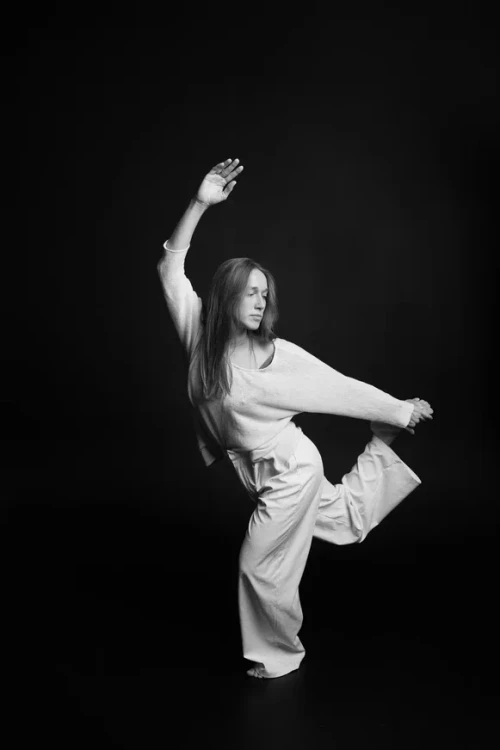
Jazz dancer Elena Tatarenkova, who performs under the stage name of Lea, talks about her latest project, "Jazzing Bodies" and much more. Interview by guest contributor Taliya Hafiz.
On the poly-semantic nature of jazz as body music: Initiation into Jazz Dance with motion artist Lea
Interview by Taliya Hafiz
This article is being written to the sounds of “It Never Entered My Mind” by the legendary Miles Davis. The room is filled with music that perfectly captures the essence of the musical and physical movement discussed hereby: the Jazz Dance. It came as a breath of fresh air into the world of dance where, as in Nature, the primordial source of all things, habitats and weather conditions change, but the desire for freedom and creativity remains constant. It came into the dance world where this always relative freedom of expression pre-existed in classical ballet with its own regulations and technique. Jazz dance, as its name implies, has brought its own freedom of improvisation, its own weather conditions, its own microclimate to the world of dance.
“It Never Entered My Mind” begins similarly: first with waves of classical arpeggios on the surface of the ocean, over which the ballerinas’ honed pirouettes emerge. Then, against this backdrop, a jazz trumpet is heard, like the sail of a ship arriving under the name of freedom from a distant shore. This voice of jazz transforms classical pirouettes into something new, carefully preserving the past, without which it would lose its structure, foundation, and form. After all, Isadora Duncan, Pina Bausch, Martha Graham, and the followers of the Jazz Dance movement all came from classical dance, but, hearing the sounds of the Miles Davis era and subsequent music, they became innovators and improvisers of their era. They dance on the waves of pirouette-arpeggios to these languid sounds, breathing freedom, aspiration to new horizons, and reflections on the meaning of existence.
The heroine of our article, Elena Tatarenkova, performing under the stage name of Lea, is a representative of the new dance generation and the Jazz Dance movement, an internationally recognised judge and teacher, and a DJ. Together with her, I plunged into an ocean of new music and dance that had previously “Never Entered My Mind”…
TH;
Elena, let’s begin our introduction to Jazz Dance in the light of your latest project, “Jazzing Bodies.” Is this dance about the body, driven by jazz and by the freedom inherent in jazz?
LEA;
Jazz dance, like jazz in music, is about freedom of expression. Coming after classical ballet, it introduced freer forms of movement. Since it emerged in response to contemporary cultural trends, it was called Modern Jazz Dance, later shortened to simply “Jazz Dance”. Under this name, a wide variety of dance productions are now presented to the public, no longer connected to jazz per se or even improvisation. In this case, a specific brand, a trendy name, is now at work: Jazz. And such dance implies that it is no longer ballet or classical. Just as in painting, there are classical movements and more expressionistic ones, characterised by freer forms.
Jazz dance today has many branches. One of them is the UK jazz, which places a strong emphasis on tap- like footwork. This relatively new movement emerged in England in the late 1980s. The UK jazz emerged in response to the music of the time and combined a distinctive footwork technique, a commitment to its own aesthetic and classical beauty, and elements of tap dance.
Ten years ago, we gave the UK Jazz masterclasses in Japan, where, just as in Korea, this dance culture is being embraced with great interest. Jazz dance, like jazz music, encourages improvisation and deviations from initial choreography, resulting in the dance becoming even more independent. Such performance appears as a unique creative expression of the dancer, where creativity lies not only in the interpretation but also in the choice of movements.
My latest project, “Jazzing Bodies” is a lecture series exploring improvisation in dance. We explore how improvisation impacts our quality of life, our brain, and what it offers us in terms of dance and life, adaptation, and decision-making. Having lived as an immigrant for a long time, several years in Paris and one year in Lisbon, I realised the importance of being flexible and adapting to new conditions. You need to establish your own path in life, but also be able to flexibly adapt to new circumstances. I believe improvisation is an important skill; it brings mental agility.
As part of the “Jazzing Bodies” project, we held a lecture on how movement acts like a supporting ground. We talked about how we can return to movement, to dance, to our bodies to find stability. Even if everything around you has collapsed, you still have yourself, your body, and you can do something with it. Trust, find exercises. Movement is our strength, our support, and we can use our bodies as tools in difficult times.
We also held a lecture with pianist and composer Igor Mikovenko, with whom we discussed conceptualism in music, the influence of music on people, and changes in music and its canons and patterns. At one of my other events, I taught “footwork” jazz dance, and a friend of mine taught “authentic jazz dance” and we watched a film about Miles Davis. It’s great to create such events and bring together like-minded people who understand what it’s all about. Because, in general, this dance movement is a complex topic… I love jazz, and it’s difficult to define what kind of dance the “jazz dance” is, what kind of culture it is. Because this dance can be very diverse, just like jazz music. But at the same time, all its styles exist in a single line. I try to promote this culture through my work. And I do this with the feeling that I enjoy this path and with a perception of the overall history of this movement.
TH:
In a previous interview, we mentioned Gershwin’s phrase “Life is best when you improvise”; and discussed the importance of improvisation in life. When you’re in the here and now, you’re able to improvise, even if things aren’ t going according to the plan or the score. You understand that what’s happening now is the best you have, and you build on that. It’s akin to improvisation in music, where you start from the chords defined by the melody, building on the harmonic grid, but still develop your own creative direction based on the events that have been set. What’s your view on improvisation in life, in dance?
LEA;
Yes, improvisation is an absolutely essential quality. I like this approach in dance because it teaches you self-expression, it teaches you to draw something out of yourself, and not to imitate others. Improvisation develops the brain; choreography is great, but it’ s not you. It’s something created for you. I also periodically give my students some choreographic sketches; we work through the routines. Even if they are uncomfortable for some, we still try them. And I understand that they might be uncomfortable for the students because it is my creation rather than theirs. But we first try to strain our left part of the brain to memorise the choreography, and then we break that connection, finding something of our own in it.
We take a movement and explore its concept. If I don’t like a particular movement itself, I’ll try to take a specific concept from it and build on that in my further creative search. What else can I do, how else can I execute this concept? What if I turn, what if I lengthen my arms, what if I extend the movement? Such challenges invigorate the mind. In such a dialogue, you begin to trust yourself more, develop your knowledge, and gain your own personal experience, not just that of the teacher.
TH:
How do you think this approach can be integrated into the dance competition format?
LEA;
I started learning dance quite late in life relative to the canons of classical dance. And it was in the competition system that I began to develop. I participated in the so called battles, won them, and gave master classes. This was my path, allowing me to advance further. You win a battle, and you’re invited to give master classes or judge a festival. And in the battle system, dancers are also divided into those who improvise more and those who perform memorised routines. Dancers who specialise in combinations often win, but they sometimes lack naturalness. Those who think exclusively in blocks can find it difficult to connect with the music in the moment, because your blocks may not always fit what’s playing. A vivid, lively perception of the situation helps here, as you need to be able to adapt to the music. That’s why improvisation has always been my preferred method. I participated in the battles knowing what I wanted to show from my existing work, but at its core, my dance was improvised. I simply juggled pre-prepared sketches, using what best suited the moment, choosing what felt most natural, always keeping several options in mind. After all, I never knew for sure: maybe I’d forget all the sketches altogether and then would dance something completely different, something new.
TH:
Perhaps you have some inspirations. These could be dancers or other artists from related disciplines. What inspires you, what nourishes you when you’re in the flow of improvisation?
LEA:
I think without inspiration, we probably wouldn’t do anything in life. I’ ve always imagined myself as being an artist. I’ve always felt that being an artist is something heavenly, magical… This state inspires me. Our generation can be materialistic in views sometimes; there’s a common belief that being an artist doesn’t imply earning a lot of money and you have to choose a profession that lets you that. Being a dancer isn’t a reliable profession in this regard; a dancer is also a kind of artist. But I’ve always enjoyed drawing and have been interested in the various forms of artistic expression in art. I like movements like Impressionism, Cubism, and the paintings of Picasso and
Malevich. I think non-realism helps one immerse oneself in art: not looking at specifics, but perceiving the artistic product through one’s own filter, through one’s own prism. That’s why I really admire mid-20th-century artists in everything they do: design, painting, and other fields.
I’m also inspired by the process of creating something aesthetic. When I arrived in Paris, I started collecting vintage ceramics. I opened a small boutique selling various plates, planters, and pots made of French ceramics. I was collecting them and selling. I collected as if for myself; I loved my entire collection. I either sold or gave some of it to friends when I moved, and now I want to get back to that. Finding something special. Not going to a mass-market Zara to buy a plate, but to find it somewhere, discovering who the artist was, what is written on the back: maybe it’s the plate’s origin—Corsica or some other corner of the planet. Or maybe it has a signature, information about the artist, or a little-known production company. In general, I’m inspired by this process of research, this “digging”, this deep-diving. I’m interested in learning about these artists, about the people who produce something unique and beautiful. Especially if these products aren’t mass-produced. Because for some reason, they haven’t gained popularity, yet they can be very high-quality and cool. This process energises me. Especially when my tactile senses engage and I explore what I can touch: something that can inspire me with colour; something that has its own story.
TH:
Could you please share your musical preferences. For those new to the UK Jazz, are there, for example, a top three tracks that will help get them moving and introduce them to the music of this dance?
LEA;
The UK Jazz is electronic music fused with jazz style and loops. It’s created by musicians who mix at speeds above 120 bpm, adding jazz chords and, for example, hip-hop rhythms to the electronic music. In my opinion, it’ s a modern interpretation of jazz, its next stage of development, as we’re currently experiencing a time when everything is becoming more electronic and synthetic, yet still harkening back to its roots. This style is present in the work of IG Culture, Selectors Assembly, and Yusef Kamal, who can be considered contemporary UK Jazz musicians.
These musicians are probably my favourites. It might be quite complex and intellectual music to listen to, it’ s not always relaxing. I personally also enjoy ambient music, which I can listen to for the creation of a particular atmosphere. I also enjoy classic jazz by John Coltrane and Miles Davis. For a New Year’ s mood, you can listen to 1920s jazz. But overall, I prefer rhythmically complex tracks with improvisation.
TH:
You are also a DJ and have spoken about the electronic music that accompanies the UK Jazz. Did you come to DJing from dance?
LEA;
Yes, my dance background is directly related to my work as a DJ, because when you go to a battle or a festival, the DJ plays their own music selection. There are several DJs in Amsterdam whose selections I really like. This inspired me to collect my own music and master DJing techniques so I can let other people listen to it. I wouldn’t say I’m some kind of super DJ, because I don’t produce my own music, and many of my DJ friends do. For me, this is the highest level of initiation into the DJing: when someone not only plays other people’s music but can also produce their own. I don’t write, I just put together music playlists, buy tracks I like, and share them to convey my mood. This activity requires focus; you begin to better understand music by its frequencies; listening to it, you separate it into layers: bass, vocals, highs. You begin to relate to music a little more deeply, understanding the interconnectedness of all its levels. And this perception enriches you as a dancer, nurturing your dance. You understand that everything is one.
TH;
What are your literary preferences?
LEA;
I’ve always loved Bulgakov’s “The Master and Margarita”; And in poetry, I’ve always enjoyed the works of Pushkin and Mayakovsky. It’s fascinating to immerse yourself in their worlds.
TH;
What do you think of haiku poetry? You mentioned you’ve been to Japan…
LEA;
Yes, I judged a competition and we performed there. Haiku/blank verse is an interesting genre of poetry, also very abstract. I don’t know much about Japanese culture and I’m not particularly familiar with Japanese authors except with Miyazaki’s work, for instance. Overall, I like this culture. I appreciate the high quality of life and dance production in Japan. They meticulously strive to achieve perfection and diversity, while still paying tribute to culture and traditions. For example, if you go to a store to buy a notebook, you’ ll have four floors of notebooks in every colour to choose from! And most Japanese dancers are very skilled. But if we’re talking about a geographic location that inspires me, I’m probably like Russia: somewhere between Asia and Europe.
TH:
In conclusion, can you share your favourite quote or a motto that reflects your life principle?
LEA:
Enlightenment comes when you’re relaxed. At first, I simply liked this phrase; I kept it for myself, and only later understood its meaning. Indeed, when we relax, let go of inhibitions like “I need to be here; or “this is definitely meant to be”; we simply understand that even if we need something, we don’t have to hold on to it with all our might. Then it comes more easily. Work, projects, the right people. When you’re relaxed, you’re happy with life, you embrace everything you have. Everything becomes even more fulfilling, because we probably reflect what we feel.
TH:
Beautifully said. The world is like a mirror.
LEA:
Yes, it’ s a complex vicious circle: when you’re used to feeling in a certain way, it’ s hard for you to feel differently, and what you feel is reflected back to you. It’ s sometimes very difficult to break out of this, but sometimes you manage to catch momentary events and that wave that affirms: all is well. This is Zen thinking. And to avoid getting stuck in some wrong direction, it’s crucial to sometimes return to this zero and set off again, creatively, on the waves of life. I think this is my perception of life.
TH:
Since we’re talking about spiritual beliefs, what resonates with you: perhaps Zen Buddhism?
LEA;
I’ve always been interested in different religions. I read a lot, including anti-religious books, and I was interested in Nietzsche’ s philosophy. That’s how I came to believe that there is energy, and it’s present in everything. And there’s also some higher energy, which is probably God, but everyone portrays Him in different ways. It’s important to understand that you’re not the centre, and that there’s something higher than you. And this higher energy leads you to good actions, to good deeds. This is important. I believe in karma and the laws of energy attraction. I’m definitely not an atheist, but I don’t believe in a specific system either. I think religion in our country at some point
became more of a source of influence between church and state, so knowing a certain history, you understand that everyone tries to use everything to their advantage, even encroaching on sacred things. But everyone needs to have their own faith, which will help them in difficult times, and which will serve as a moral guide.
TH:
Is dance a kind of prayer for you? Or is there something else that resonates with you in this regard?
LEA:
I meditate. For me, dance isn’t a prayer, but rather my inner dialogue and the resolution of my psychological questions and needs; it’s an outlet for my energy. Because if you don’t give, you don’t receive. Generating energy is crucial. For me, meditation is a state of gratitude for what I have. I do yoga every morning and devote a few minutes to some kind of inner dialogue with myself. Let’s call it meditation. Or some kind of energy practice. You breathe, you listen to yourself. Dance is more of a manifestation of my energy, of myself. Improvisation in dance also contains a meditative state, because without flow, it lacks unity and consists only of broken fragments.