

by Ian Mann
August 13, 2026
Performances by Jane Williams / Bella Collins / Gareth Evans Trio, Will Barnes Quartet, Phoenician Blinds, Orphy Robinson, Grounded Thread, Francesca Tandoi / Emma Smith Quartet, Dionne Bennett.
SATURDAY AT BRECON JAZZ FESTIVAL, 08/08/2026
JANE WILLIAMS, BELLA COLLINS & GARETH EVANS, THE MUSE
Jane Williams – vocals, snare drum, ukulele, Bella Collins – vocals, acoustic guitar, Gareth Evans – acoustic guitar, vocals
An early start at The Muse for this trio of local heroes. Although guitarist Gareth Evans had previously worked in duos with both Jane Williams and Bella Collins this was only the second time that all three musicians had performed collectively as a trio.
Brecon based Williams is a great friend of the Festival and a member of the organising committee. As a performer she has appeared with such big names as Van Morrison and Wild Willy Barrett as well as playing locally on a regular basis.
Cardiff based guitarist, bassist, singer and songwriter Bella Collins has a foot in both the jazz and blues camps and her duo with Evans has appeared previously at both Brecon Jazz Club and the 2022 Brecon Jazz Festival. She also plays some of the country’s leading blues festivals, including Tenby and Upton, and in 2026 she co-ordinated the acoustic stage at Upton Blues Festival.
Barry based Evans is an ace guitar picker who is well known for his series of online guitar tutorials which are presented under the name Goliath Guitar Tutorials. He is particularly adept at the gypsy jazz guitar style and has performed solo shows in this format but he is comfortable with any strand of music that deploys finger style guitar. He is also a more than adequate vocalist and his harmonies blended well with the voices of Collins and Williams.
Festival scheduling clashes meant that I wasn’t able to catch all of this show but I managed to catch a large chunk of it, a very enjoyable forty five minutes worth.
The trio commenced with that most familiar of jazz standards, “All Of Me”, with Collins taking the lead vocal supported by Evans’ harmonies. Evans enjoyed a series of gypsy jazz style guitar breaks as Williams provided rhythmic impetus with the patter of brushes on her snare drum. She also added some scat style vocals towards the close.
A playful interpretation of Meghan Trainor’s “All About That Bass” was mashed up with Bobby McFerrin’s “Don’t Worry Be Happy”, with Williams and Collins sharing the lead vocals and with Evans the featured instrumental soloist.
Another mash up teamed Fleetwood Mac’s “Dreams” with Human League’s “Don’t You Want Me”, with Collins taking the lead vocal on the former and Williams on the latter. The arrangements were paced by snare drum allied to fast acoustic guitar strumming, with Evans taking a lead guitar break.
Williams delivered an authentically bluesy vocal on the trio’s version of Eric Clapton’s “Got You On My Mind” before diversifying into scat. Evans played the Clapton role with an acoustic guitar solo.
Williams continued to handle the lead vocals on the Screamin’ Jay Hawkins song “I Put A Spell On You”, which was later covered by Nina Simone among many others.
The last song that I got to hear was “You’re Really Going To Like Having Me Around”, an original by Williams and Evans written in the style of a jazz standard with Williams and Collins delivering alternate verses as Williams switched to ukulele and Evans played the role of instrumental soloist.
Thus far this had been a hugely enjoyable set, good humoured and a little ragged around the ages, but still featuring some excellent singing and playing. I was rather reluctant to drag myself away but felt that it was necessary to make it to Theatr Brycheiniog in time for the start of the performance by the Will Barnes Quartet.
WILL BARNES QUARTET, THEATR BRYCHEINIOG
Will Barnes – electric guitar, Jack Gonsalez – piano, Aidan Thorne – double bass, James Batten – drums
with Erin Hughes – live visuals
The Jazzmann has a been a big supporter of this quartet led by the Montgomeryshire based guitarist and composer Will Barnes and has favourably reviewed both of the bands album “Source of the Severn” (2023) and “Outside The Light” (2025).
I have also covered a number of the quartet’s live appearances at venues in Brecon, Shrewsbury, Kidderminster and Hay on Wye.
Originally only released on vinyl “Source of the Severn” was distinguished by a lavish album package that featured the distinctive artwork of Erin Hughes with, each track inspiring an accompanying visual image.
Hughes has since toured with the band and selected dates have seen her artwork complementing the music. Although I’ve seen the group perform on several occasions I’ve never had much luck with regard to the visual side of things. Of the shows that I’ve seen Hughes was only present at one, but the venue in Shrewsbury was too small and cramped for this aspect of the performance to be appreciated properly.
Today at the capacious Theatr Brycheiniog it was to be very different with Hughes’ images projected onto a huge screen behind the band. I wanted to fully immerse myself in this aspect of the performance, hence my decision to leave the event at The Muse early.
Initially I had expected Hughes’ album artworks to be projected behind the group as they played, but instead the visuals were far more interactive and abstract with Hughes using live liquid marbling techniques to create a light show that reminded me of the Hawkwind shows of the 1970s. I suspect that Hawkwind’s lighting engineer Jonathan Smeeton (aka Liquid Len) probably deployed similar techniques, as did the Grateful Dead’s lighting gurus. At Shrewsbury Hughes had explained something about her techniques to me so I knew roughly what to expect today.
For today’s show Hughes was actually on stage with the band and it was interesting to see her working alongside the musicians. Unlike some other audio-visual shows that I have seen where the visuals have presented something of a distraction Hughes’ amorphous, swirling images added greatly to the atmosphere but were sufficiently abstract to be overly diverting. For me, it represented an almost perfect balance between sight and sound.
The music commenced with the flowing melodies of “Annwn”, the opening track on the “Outside The Light” album. Like its predecessor the album draws inspiration from Welsh landscape and folklore and this piece represented an excellent example of the quartet’s current style with its emphasis on flowing melodies and a strong sense of narrative. Barnes cites guitarist Pat Metheny and pianist Brad Mehldau as being among his primary musical influences and much of Barnes’ work exhibits a Metheny like gift for melody, and none more so than this opening piece. Melodic solos came from Barnes on guitar, Gonsalez at the piano and Thorne on double bass. The tune’s title is the Celtic name for the ‘other world’, supposedly reached behind the famous waterfall Pistyll Rhaeadr.
From the “Source of the Severn” album, and also its opening track, “Mad March Hare” introduced a more bebop orientated approach suggestive of the playing of another of Barnes’ guitar heroes, the late, great Wes Montgomery. As lively as its title suggests this piece featured a fleet fingered guitar solo from the leader, who was followed by Gonsalez at the piano, who was clearly relishing the opportunity to play a ‘proper’ grand piano. The performance concluded with a drum feature from the impressive, but largely understated, Batten.
A return to the “Outside The Light” repertoire for “The Longest Day”, a gently melodic ballad introduced by a passage of unaccompanied piano and featuring lyrical solos from guitar and piano underscored by delicately brushed drums. I also thought that Hughes’ visuals were particularly effective here. The performance also incorporated a more freely structured episode led by Thorne’ bass.
From the same album “Devil’s Bridge” was based on a Welsh folk tale that was succinctly recounted by Barnes by way of his tune announcement. This was a piece with a strong narrative arc and one which introduced something of a flamenco / North African / Middle Eastern aspect to the leader’s playing,
Not every tune title was announced but I suspect that the next item was “Bloom”, also from the second album. Closer to the band’s bebop roots, but still sounding thoroughly contemporary this featured solos from Gonsalez, Barnes and Thorne plus a drum feature for Batten towards the close. Once again Hughes’ swirling visuals seemed to be particularly attuned to the busyness of the music.
Dedicated to Barnes’ late cousin, Harry Webb of nearby Crickhowell, “Light of the Beacons” was another beautiful ballad, this time ushered in by a passage of unaccompanied guitar. Double bass, piano and softly brushed drums were added in support of a guitar solo that owed something to the Americana sounds of Metheny and Bill Frisell.
Next a solo guitar piece from Barnes with correspondingly sparse visual accompaniment from the receptive Hughes.
There was a marked increase in the energy levels with “Never Done”, a musical depiction of the franticness of harvest time with farmers rushing to pick their crops while the good weather holds. As a former agronomist Barnes knows about what he writes, although the title was actually provided by Batten. Musically the piece reached back to Barnes’ bebop roots and fairly bustled along, powered by Batten’s rapidly brushed drums and with both Barnes and Gonsalez delivering lively solos. Batten was then featured with a similarly spirited drum feature towards the close.
The performance concluded with a segue of the final two track from the most recent album. First we heard the Gonsalez original “Lleuad Fedi”, a title translating as “Harvest Moon”. This was introduced by an extended passage of unaccompanied piano, with guitar, double bass and the sounds of Batten’s cymbals eventually added. Centred around the composer’s piano motif the piece included a subtly blues tinged guitar solo from Barnes.
The fast moving “Otherworld” presented a dynamic and stylistic contrast as the quartet’s bebop leanings again came to the fore with the tricky theme providing the platform for vivacious solos from Gonsalez and Barnes, plus a final drum feature from Batten.
This combination of music and visuals was particularly well received by the audience, with Hughes taking her bows alongside the musicians.
The deserved, and probably unplanned, encore saw the quartet performing the title track from “Source of the Severn”, an episodic composition perhaps intended to mirror the journey of the river itself as it flows through the Welsh landscape. The performance incorporated fluent, melodic solos from Barnes and Gonsalez, with Thorne and Batten continuing to provide sympathetic, well judged rhythmic support.
The Will Barnes Quartet is an ensemble that always delivers the goods in live performance and this was perhaps the best show from them that I have seen. The playing was characteristically excellent throughout but seeing the visuals properly for the first time, plus the presence of that grand piano, really put the icing on the cake.
My only regret was not being able to hang around after the show to speak with the guys as I had to dash off to another event.
PHOENICIAN BLINDS, THE GUILDHALL
Tom Sochas, Mark Young – keyboards, Julian Knapp – tenor & soprano sax, Oli Cross – electric bass, Filippo Galli – drums
Festivals are all about making exciting new musical discoveries and for me this year’s major new find was the London based quintet Phoenician Blinds.
I’m not quite sure how this band, which was formed in 2015, has managed to slip under my radar for so long. It’s a truly international outfit featuring Franco-American pianist Tom Sochas, German saxophonist Julian Knapp, Italian drummer Filippo Galli and the UK’s own Oli Cross on electric bass. The group began as a quartet but has since added second keyboard player Mark Young, making for a very distinctive instrumental line-up.
Phoenician Blinds have recorded three full length albums, “Elephantine” (2016), “A Second of Silence” (2018) and “The Sight, the Seer and the Seen” (2020). Sochas, who also has a parallel solo career, is the band’s principal composer with Knapp and Cross also writing for the group. The band seems to have accrued a strong following and a number of established fans were present in a pleasingly sizeable audience at the Guildhall.
The opening piece “Edal” established the quintet’s sound with Sochas emerging as the principal keyboard soloist, focussing on acoustic piano and Rhodes sounds from his electric keyboard. Young’s role was essentially textural with an emphasis on synth and other electronic keyboard sounds. The opener was ushered in by Sochas at the piano, joined by Knapp on tenor sax before Cross combined with Galli to establish a sturdy groove that underpinned the soloing of Sochas on piano and Knapp on tenor.
The most recent Phoenician Blinds album came out six years ago so it was no surprise to discover that today’s set included a whole raft of newer, as yet unrecorded tunes. Among these was “Wheels of the night”, introduced by Cross’ electric bass melody, subsequently augmented by brushed drums and keyboards. Knapp then stepped up to deliver the main theme on tenor before handing back to Cross to solo on electric bass. Knapp then resumed the lead on tenor, developing his solo slowly and incrementally with Galli initially playing with bare hands before graduating to sticks as Knapp gradually ramped up the power.
“On A Good Day” commenced with the sound of tenor sax floating above the sounds of twinkling keyboards, courtesy of both Sochas and Young. To me it sounded like a musical depiction of a particularly beautiful sunrise. The music then began to develop momentum with Knapp soloing on tenor above an increasingly powerful rhythmic groove. Having reached a peak the piece then concluded quietly with a passage of unaccompanied piano, perhaps this time representing sunset.
Knapp then switched to curved soprano sax for his own composition “One Step Away”, a piece that features on the band’s most recent album. With the assistance of bass and drums Sochas’ insistent piano motif underscored Knapp’s soaring soprano solo, before the tune ended with a passage of unaccompanied soprano sax.
“Pull” saw Knapp revering to tenor sax and stating the theme to a lyrical piece that featured an expansive piano solo from Sochas underpinned by Gallo’s brushed drums. Once again the music began to gather momentum with Knapp adding long tenor sax melody lines. I’m grateful to Knapp for speaking with me after the show and allowing me to photograph the set list. A number of pieces bear the legend “PB Jam” in brackets after the tune titles, suggesting that the latter stages of several of today’s pieces were essentially improvised.
From the band’s first album the slow burning “Guenevere Part 2” began with the twin keyboards exchanging phrases, Young’s Nord Stage 2 producing celeste like sounds alongside Sochas’ more conventional piano timbres. The addition of Knapp’s tenor sax saw the music begin to build in intensity, before subsiding again with a long passage of unaccompanied piano. Then it was time to ramp things up again with Knapp returning to deliver a forceful and incisive solo on his curved soprano sax. Sochas described the piece as “a two chord blues”, but there was rather more to it than that.
Knapp continued on soprano for “Hasmat”, soloing above Galli’s brushed drum grooves and Young’s swirling synth textures. Cross, an irrepressible personality, delivered a lively solo on his five string electric bass. A piano / soprano sax dialogue featured Knapp’s use of extended techniques before the full band kicked in again towards the close.
A hugely enjoyable set concluded with a tune that Sochas described as “a groovy one”. This was “Rush Hour”, a piece from PB’s most recent album and their most frequently streamed track. Introduced by Galli at the drums this was certainly the band’s funkiest track, and was further enlivened by a series of Latin flourishes. Knapp took the first solo on tenor, followed by Sochas on electric piano, underpinned by Cross’ fluid and mobile electric bass. As the music gathered momentum Cross was noted deploying slap bass techniques on the hard grooving outro.
I very much enjoyed this performance from Phoenician Blinds and I certainly wasn’t alone as the Guildhall crowd gave the quintet a great reception. I particularly liked the way they developed their compositions, which were often centred around a fairly simple motif, and was variously reminded of the music of Portico Quartet, Mammal Hands and the Danish group Girls In Airports. I’m a fan of all those bands and can now add Phoenician Blinds to that list. They’re definitely an act to keep an eye on in the future.
ORPHY ROBINSON’S P-FUNK COLLECTIVE, THEATR BRYCHEINIOG
Orphy Robinson – vibes, vocals, harmonica, electronics, Jean Toussaint – tenor sax, Dennis Rollins – trombone, Kenny Barry – guitar, vocals Toby Baker – keyboards, Tiago Coimbra – electric bass, Cosimo Keita Cadore – drums
Vibraphonist, or should I say multi-instrumentalist, Orphy Robinson is one of my jazz heroes, from his solo work back in the 1990s through to his more recent collaboration with pianist Pat Thomas as the duo Black Top. I also remember with considerable affection a performance by the Clear Frame quartet (Robinson, saxophonist Lol Coxhill, bassist Hugh Hopper and drummer Charles Hayward) at the Bishop’s Meadow venue at a BJF back in the early 2000s.
With this in mind I was very much looking forward to today’s performance which saw Robinson and a stellar band, Rollins and Toussaint are Jazzmann favourites too, paying tribute to the American keyboard player and bandleader George Clinton and his Parliament and Funkadelic bands, a diverse collective of musicians working under the unifying P-Funk umbrella and releasing albums under the two separate band names.
As a jazz listener I’ll admit to not being particularly familiar with the Parliament / Funkadelic back catalogue but hoped that this wouldn’t affect my appreciation of today’s concert too much – after all I wasn’t familiar with any of Phoenician Blinds’ music either but I thoroughly enjoyed them.
Given my admiration for Robinson as both as a musician and a human being it pains me to say that I was left bitterly disappointed by today’s show. This was partly due to a poor sound mix in which Baker’s keyboards were often inaudible – he kept motioning frantically to the sound desk for them to be turned up, but ultimately to little avail.
In addition to this Robinson’s vocals were also too low in the mix and were often drowned out by the horns. Plus for all his skills as a multi-instrumentalist – vibes, steel pans, piano and more – Orphy isn’t really a singer and his voice wasn’t powerful or charismatic enough to carry the tunes. As a front man he lacked the stage presence of his old mate Courtney Pine and should perhaps have considered employing a specialist vocalist for this project. He could still have handled the announcements, which were interesting and informative, but bringing in a singer would also have freed him up to play some more. We heard very little of his trademark vibes.
Today’s show paid tribute not only to Clinton and his various projects but also to James Brown, the Ohio Players and other funk pioneers. I’m aware of the importance of Brown and Clinton with regard to musical and cultural history but hand on heart I can’t say that I particularly like the funk genre, which is designed for dancing to rather than listening to and 4.30 in the afternoon in an all seater theatre perhaps wasn’t the best setting for this visceral, rhythmically intense music. Robinson’s band, and particularly the rhythm section of Coimbra and Keita Cadore, was commendably tight, but still only a handful of audience members got up to dance. Maybe they needed a Pine like figure to get everybody on their feet.
This isn’t going to be the usual song by song account, tune announcements were rare and there seemed to be a general assumption that the audience members would already be familiar with the material. That was certainly the case for some of the Clinton aficionados in the crowd but given that this was a jazz festival there must have been others like myself who were less familiar with Clinton’s oeuvre. Among the pieces I did recognise were Funkadelic’s “Knee Deep” and “one Nation Under A Groove”, plus “More Bounce To The Ounce” by P-Funk offshoot Zapp.
After a while I began to find the relentless funk grooves rather too repetitive – when does a groove become a rut? - and although I enjoyed the instrumental soloing of Rollins and Toussaint, and also that of Kevin Barry, I would have preferred to have heard them in a more obvious jazz context.
Although there were some who very much enjoyed this show I certainly wasn’t alone in feeling disappointed and several other audience members commented on the poor quality of the sound mix.
It pains me to have to write so negatively about a musician whose playing and overall musical and social philosophy I very much admire, but I can only be honest about my disappointment regarding this particular show. I’d be more than happy to see Robinson again in another musical context, and particularly the always excellent and interesting Black Top.
GROUNDED THREAD, THE MUSE
Pablo Sonnaillon – acoustic and electric bass, Alex McDowall – guitar, Georgina Aasgaard – cello, Hannah Ballard – tap dance
There was a forty five minute break between the conclusion of the Orphy Robinson gig and this event at The Muse, a valuable time window that allowed us the opportunity to grab a quick bite to eat courtesy of the local chip shop.
Suitably revived we found our way to The Muse to enjoy a performance by the unusually configured quartet Grounded Thread. The line up of guitar, bass and cello was essentially a chamber jazz trio with tap dancer Hannah Ballard from the Sole Rebel tap dance group acting as the quartet’s wild card and percussionist.
I’ve enjoyed performances by jazz groups with tap dancers before, most notably saxophonist Xhosa Cole’s collaboration with dancer Liberty Styles. This saw Styles’ beats fully integrated into the music and this was even more apparent today with Ballard playing an integral and absolutely crucial role in Grounded Thread’s music.
The group is based in Liverpool and used to run a regular jazz tap jam at the city’s now closed Caledonia venue. They write their own music in addition to covering the work of others.
Opening number “Again But Different” saw both bass and cello played with the bow before Aasgaard switched to the pizzicato technique, her spiky, forcefully plucked cello lines combining well with Ballard’s tap dance rhythms.
McDowall’s composition “The Least Of Your Worries” also featured bowed sounds from both string players and also included a series of exchanges between Ballard and the three instrumentalists in turn that was essentially the equivalent of a jazz drummer ‘trading fours’.
Aasgaard likes to take cello works by contemporary classical and experimental composers and do something different with them. “Julie-O” by the American composer Mark Summer has been performed as a two cello piece and also by cello and beat box. Grounded Thread’s version sees tap replace the beat box. This duet between Aasgard and Ballard was a fascinating interpretation with the cellist deploying both arco and pizzicato techniques as folk like melody combined with vigorous rhythms, generated by both feet and hands.
Sonnaillon’s composition “Pictures On The Wall” was a purely instrumental piece with Ballard temporarily leaving the stage. It was introduced by Aasgaard’s bowed cello, joined shortly by the composer’s bowed bass. Sonnaillon then switched to the pizzicato technique as McDowall’s guitar was added and Aasgaard dropped out. The resultant guitar and bass duet, essentially McDowall soloing over double bass accompaniment appears on the set list as “11th Blues Duet”. This segue concluded with a reprise of the opening sequence with bowed cello and bass, and finally plucked bass and guitar.
Sonnaillon switched to bass guitar as Ballard returned to the stage to usher in the bassist’s “Gumptionololgy” with an unaccompanied passage of tap dancing, essentially the equivalent of a drum solo. She was followed by a cello solo from Aasgaard before this highly rhythmic tap dancing showcase saw Ballard enter into another ‘trading fours’ series of exchanges with her colleagues. McDowall rounded things off with a guitar solo.
The guitarist described his composition “Some Things Change” as a “bossa in seven”. This saw Ballard rising to the rhythmic challenges that this posed with a solo tap intro. McDowall and Sonaillon then picked up the rhythm as Ballard dropped out leaving the instrumental trio to play out the piece in ‘chamber jazz’ style with solos for guitar, cello and electric bass.
Aasgaard’s second duet with Ballard was “Black Run”, a composition by the Swedish cellist Svante Henryson. Originally written as a solo cello piece the composition has also been performed in a duo format by Henryson and drummer Magnus Persson. There’s some terrific footage of these two playing it on Youtube and this may have given Aasgaard the idea to transpose it for cello and tap. In the classical world Henryson is something of a maverick and this piece is a joyous hoe-down that saw Aasgaard variously bowing, plucking and utilising the body of the cello as a percussion instrument as Ballard responded in kind. This was exciting stuff that absolutely thrilled the audience at The Muse.
An aside – in 2011 The Jazzmann reviewed the album “Night Song”, a release on the ECM label by the duo of Henryson and the Norwegian pianist and composer Kjetil Bjornstad. Like Grounded Thread this was a project that skilfully straddled the boundaries between chamber music and jazz – but absolutely no tap dancing was involved!
Sonnaillon moved back to upright bass for McDowall’s composition “Blues For All Time”, essentially a slow blues played in a chamber jazz format with solos for guitar, bass and cello.
As I recall Ballard sat this piece out before returning for the final number, a composition by Sonnaillon titled “Breathless”. This saw the composer back on electric bass and delivering a virtuoso solo alongside further features for guitar and cello. There was also a final tap salvo from the brilliant Ballard.
Once again I hadn’t known quite what to expect but I loved this quirky and entertaining performance. The players of the conventional instruments were all superb musicians while Ballard’s tap dancing also represented a vital component of the music – this was a genuine quartet performance. Ballard was also interesting to watch, a master of her craft and a great visual focus for the quartet. Announcing duties were shared around the three instrumentalists and were both informative and entertaining.
All in all I was very impressed and would have considered purchasing the group’s album had it been available in the CD format, however it was vinyl only. Shame. A great show nevertheless.
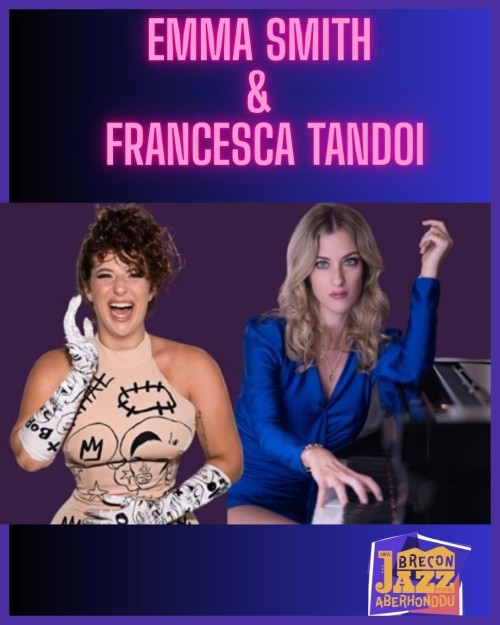
FRANCESCA TANDOI / EMMA SMITH QUARTET, THEATR BRYCHEINIOG
Francesca Tandoi – piano, vocals, Emma Smith – vocals, Stefano Senni – double bass, Pasquale Fiori – drums
This event was a collaboration between the Italian pianist, composer and vocalist Francesca Tandoi and the British vocalist Emma Smith.
Tandoi appeared with her regular working trio featuring bassist Stefano Senni and drummer Pasquale Fiori, both of whom appear on her latest album “Songbook Vol. 1”. Although a new name to me Tandoi is well established on the international jazz scene and has several album releases to her credit.
UK singer Smith is slightly more familiar. She has also established herself as an international jazz artist and was the recipient of the Parliamentary Jazz Award for Best Vocalist in 2024. She has also been a member of Post Modern Jukebox, the Puppini Sisters and has recorded with pop and rock musicians such as Robbie Williams, Michael Buble and Seal.
Things didn’t get off to a good start. The Italian contingent was subjected to flight delays en route and on arriving on British soil were forced to take a circuitous route to the venue following local road closures due to wildfires. Thus the start of the show was delayed – but what a terrific performance the four musicians put on once they finally did get going.
Senna and Fiori took to the stage first allowing the glamorous Tandoi to make the grand entrance. Once seated at the keyboard she quickly gave notice of just how accomplished a pianist she is as she delivered a dazzling solo on an unannounced instrumental. She really is a superb technician and her impressive rapport with the members of her trio was also readily apparent. I was immediately reminded of Zoe Rahman – yes, Tandoi really is that good.
The equally glamorous Smith made her own grand entrance to sing “East of the Sun and West of the Moon”. She too established her credentials immediately, a phenomenally gifted vocalist with a genuine talent for jazz phrasing and a willingness to take musical risks. The quartet’s performance included instrumental solos from Tandoi and Senni, who was also excellent. Meanwhile Smith entered into a series of vivacious, and sometimes explosive, scat vocal / drum exchanges with the similarly impressive Fiori. A born improviser Smith even managed to work something of the quartet’s travel travails into the song’s lyrics.
The ever adaptable Ellington classic “Caravan” was couched in an inventive arrangement that saw Smith’s interpretation of the lyrics followed by another impressive Tandoi piano solo.
The two women performed the Italian jazz standard “Estate” (meaning “Summer”) as a vocal duet with Smith singing in English and Tandoi in Italian, alternating the lines. The piece was also notable for Tandoi’s unaccompanied piano introduction and Senni’s melodic double bass solo.
A swinging rendition of Irving Berlin’s “Cheek To Cheek” was delivered at a fast pace with Smith’s rapid fire delivery of the lyrics drawing inspiration from Ella Fitzgerald. The vivacious singer also enjoyed a scat vocal episode alongside Tandoi’s fluent piano soloing.
Tandoi first performed “God Bless The Child” in response to a request from an audience member at a concert back home in Italy. Tonight’s version featured an unaccompanied piano intro, Smith’s blues inflected vocals and, following the introduction of bass and drums, a more expansive piano solo.
A Tandoi arrangement of an Antonio Carlos Jobim tune was performed as an instrumental and offered further evidence of her prodigious abilities as a pianist.
A second vocal duet saw Tandoi singing in heavily accented English as she and Smith again exchanged lines on the sensuous “Teach Me Tonight”, with Tandoi also featuring as an instrumental soloist.
The quartet’s version of “Doodlin’”, a blues written by pianist Horace Silver, saw Smith singing the risqué vocalese lyrics, written I believe by Jon Hendricks. The performance also featured an expansive piano solo from Tandoi and a dazzling scat vocal episode from Smith, genuinely using her voice as an instrument. Senni and Fiori also enjoyed their individual features.
A brilliant group performance concluded with “How High The Moon” which featured more virtuoso pianistics and vocalising.
One would never have guessed that this was only the second time that Tandoi and Smith had performed together. This was a really classy show and the newness of their musical relationship perhaps helped to give it an additional sparkle, but without descending into mere slickness. Not that there was anything rough and ready about the show either. Everything was just right, including a superb sound balance that came as a welcome relief after the sound issues at this same venue earlier in the day.
Tandoi and Smith really have established a terrific rapport and have done so very quickly. One hopes that they will continue to work together from time to time. Senni and Fiori also deserve praise for heir excellent contributions. I’d relish the opportunity of seeing a Tandoi trio show too, should that chance ever arise.
DIONNE BENNETT & THE PEPPERSEEDS, THE MUSE
Dionne Bennett – vocals, Simon Kingman – guitar, backing vocals, Mark Sambel – keyboards, Jon Goode – electric bass, Gary James – drums
It’s become something of a BJF tradition for Cardiff based vocalist Dionne Bennett to play a late night ‘party show’ at The Muse. A great friend if the Festival she’s a member of the organising committee and sometimes introduces other acts at other venues.
Bennett also has close connections to Brecon Jazz Club and is the head and founder of the Tan Cerdd Community Interest Company in Cardiff. She says of the Tan Cerdd organisation;
“Tân Cerdd is a Black-led, Black music Community Interest Company (CIC) committed to championing and advocating for the inclusion and elevation of Black artists in Wales. Their mission is to empower and amplify the voices of Black, Asian, Multi-Ethnicity, and working-class Welsh artists, ensuring they have the opportunities and infrastructure needed to flourish within the music industry”.
Tan Cerdd presents an annual showcase at Brecon Jazz Club and in 2026 also co-ordinated the World Music Stage in Bethel Square at Brecon Jazz Festival.
As a performer Bennett is perhaps best known as the former vocalist of the band Slowly Rolling Camera, the group led by keyboard player, composer and Edition record label owner Dave Stapleton.
In 2022 she released the solo album “Sugar Hip Ya Ya”, recorded in Budapest with a group of Hungarian musicians.
As a great friend of Brecon Jazz Bennett has performed at the Festival as a solo artist on four occasions in 2022, 2023, 2024 and 2025. She was also part of the all female collective 6.0, led by bassist and composer Paula Gardiner, that appeared at the 2021 Festival.
Bennett’s 2025 show was credited to Dionne Bennett & The Pepperseeds and although this year’s show was billed simply as Dionne Bennett it looked like exactly the same line up to me, so I’m going to stick with the DB & The Pepperseeds moniker.
Arriving late from the Tandoi / Smith gig I joined the party at least half way through the band’s set and found The Muse to be packed out with most of the audience already up on their feet and dancing. There was a real party atmosphere about the gig and I soon settled into the happy vibe.
Once again the singing and playing were both first rate, Bennett has a remarkable voice, big, powerful and soulful and is an energetic and compelling stage presence with an infectious enthusiasm for the music. She’s a real force of nature. The Pepperseeds band is a tight, well drilled outfit with two outstanding soloists in Kingman and Sambel and a hard driving rhythm section in Goode and James.
The room was too hot and crowded to even consider taking notes so I just swayed along to the music and soaked up the atmosphere. Most of the music featured in this high energy performance was in the soul and funk bag and was thus totally conducive to dancing. Among the few song titles I recall are “Heaven Help Us All”, “Got To Get Ya” and a joyous, audience sing-along version of the Isley Brothers’ “Harvest For The World”.
Every time that Bennett promised us that the next song would be the last the audience hollered for more and refused to let her go. There must have been three or four ‘last songs’ and the gig ran well over its advertised running time. Not that anyone was complaining, this was a hugely enjoyable way to round off another great day of music.
blog comments powered by Disqus