

by Ian Mann
May 08, 2026
Ian Mann enjoys a day of remarkable performances from bands led by Joshua Redman. Elaine Mitchener, Matt Carmichael and Theon Cross, plus the student musicians at the annual Jazz Exchange event.
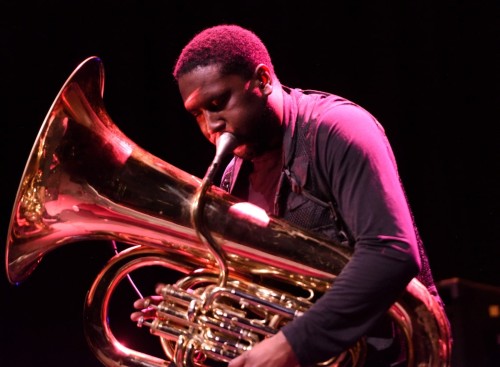
Photograph; Theon Cross. Cheltenham 2026. Photo copyright John Watson / jazzcamera.co.uk
SATURDAY AT CHELTENHAM JAZZ FESTIVAL, 02/05/2026
ROYAL BIRMINGHAM CONSERVATOIRE and SIENA and HAMBURG JAZZ EXCHANGE, PARABOLA ARTS CENTRE
The long running annual ‘Jazz Exchange’ event has become a popular and successful part of the CJF calendar, almost an institution one might say. Showcasing the talents of students on the Jazz Course at the Royal Birmingham Conservatoire alongside their counterparts from various equivalent European institutions it has become a tradition for the ‘Jazz Exchange’ to open the Saturday programme at the Parabola Arts Centre.
For many years the visitors were from Trondheim in Norway but more recent Exchanges have featured students from Paris and from the Siena Jazz-Accademia Nazionale del Jazz in Italy. This year’s event featured students from Siena and from the Hochschule für Musik und Theater, Hamburg, Germany.
As is now traditional at this event three different ensembles, in this case all quintets, known simply as Groups One, Two and Three, each presented a short programme of music. Each ensemble was international but since the advent of Brexit travel to the UK has become more difficult and there is now a preponderance of RBC students. In pre-Brexit days the split was far more even.
Parabola Quintet One
Piano: Jude Bloor
Double Bass: Giacomo Lauretti (Siena)
Drums: Johannes Kalt (Hamburg)
Alto Sax: Tim Cash
Guitar: Jamie McLeish
The first group to appear opened their programme with “Common Ground”, a composition by the American saxophonist Bob Reynolds, of Snarky Puppy fame. Ushered by Kalt’s drums the music had a contemporary jazz feel with Cash’s alto sax doubling up with McLeish’s guitar on the theme statement. This provided the jumping off point for their individual solos. The tune then concluded with a drum feature for Kalt, delivered above McLeish’s circling guitar chords.
Pianist Jude Bloor handled the announcements and informed us that the group members had only met on the previous Wednesday and had made their first public performance the previous evening (Friday) in Birmingham. This is fairly standard for this event and I’m always amazed at how these young ensembles cohere so well so quickly, and particularly so when they play original material.
Next up for Group One was the Bill Frisell composition “Strange Meeting”, a showcase for the impressive McLeish who delivered some suitably Frisell-like guitar atmospherics and engaged in a dialogue with Italian bassist Lauretti that was reminiscent of Frisell’s duo with bassist Thomas Morgan. Frisell himself was due to perform as part of a duo with violist Eyvind Kang later in the day at the Town Hall. I’m sure young McLeish was intending to be among the audience for that. McLeish and Lauretti were also featured soloists once the rest of the band had entered the proceedings, as was alto saxophonist Cash.
A passage of unaccompanied piano marked the transition into Bloor’s own composition “Home From Home”, with Cash taking up the melody as the rest of the group joined in. McLeish and Bloor enjoyed expansive solos before Cash eventually returned to restate the main melodic theme. Drummer Kalt was then featured at the close, underscored by a muscular collective vamp.
All in all an excellent start to today’s event.
Parabola Quintet Two
Guitar: Elio Mauro (Siena)
Double Bass: Macy Wright
Drums: Freddie Dal
Alto Sax: Reuben-James Gilbert
Piano : Marcus Coates
If anything Group Two was even better as they commenced their performance with an impressive and compelling original composition from guitarist Elio Mauro. Initiated by the hand drumming of Dal this was a piece that unfolded slowly and organically following the introduction of guitar, piano and bass and finally Gilbert’s long sax melody lines. The focus here was on beauty and ensemble textures rather than orthodox jazz soloing, with Dal playing hand drums almost throughout, only switching to sticks as the music eventually gathered momentum and became more assertive towards the close. He then reverted to hand drumming during the long, slow fade. This was a stunningly mature piece of writing to introduce the programme.
Gilbert and Wright had both played at 2024’s equivalent Jazz Exchange event. I also saw Gilbert when he appeared as a member of the Doug Sides Legacy Band that appeared at the Corn Exchange in Ross-on-Wye in April 2025. He also performed with tenor saxophonist Ben Partridge’s quintet at the same venue in October 2024.
The effervescent Gilbert acted as the group’s MC and announced the next tune, “The Highest Pleasure”, written by the late American saxophonist Rudolph Johnson (1942 – 2007) as being “an absolute banger”. It was hard to disagree with him as Wright introduced the tune at the bass, later combining with Dal to create a muscular groove that fuelled fiery solos from Mauro on guitar, Gray herself on double bass, Coates at the piano and Gilbert on alto sax. It was such a contrast to the opening number with the band members really tearing it up and rounding off the performance with a dynamic drum feature.
This was real crowd pleasing stuff and the quintet followed this up with a similarly energetic take on the Joe Henderson tune “The Kicker”, a real hard bop delight featuring agile solos from Gilbert on alto, Coates on piano, Mauro on guitar and Wright on double bass, with Dal launching another drum salvo towards the close, just prior to a collective reprisal of the ‘head’. Again this was very well received by the audience, who gave the young quintet a rousing reception for a set that mixed the ambitious, Mauro’s original, with the tried and tested, two hard bop inspired barnstormers.
Parabola Quintet Three
Piano: Jacob Eckert (Hamburg)
Bass: Harvey Lees
Drums: Ollie Talbot
Alto Sax: Gerardo Pizza (Siena)
Trombone: George Farrell
Group Two took some following and although generally less dynamic than their immediate predecessors the third and final quintet was arguably the most ambitious of the three with its unusual trombone / alto sax front line and its focus on all original material.
They began with a gently exploratory composition by saxophonist Gerardo Pizza and named for his mother. This was introduced by its composer on alto, with piano and bass subsequently added. The addition of Farrell’s trombone led to an engaging passage of sax / trombone interplay followed by a lyrical solo from Eckert in the piano trio format. The piece played out with the unison melody lines of the two horns.
Bassist Harvey Lees, who had also appeared at the 2025 event, handled the announcements. His composition “The Notion of Motion” was ushered in by unison horn melody lines that led to an expansive, intelligently probing piano solo from Eckert. Lees’ own bass solo was both melodic and expansive and was accompanied by Talbot’s deft brush work. The piece played out with the sounds of gently intertwining horn melody lines.
Finally we heard an original composition by Eckert, although I didn’t catch the title. Once again the piece was introduced by unison horn melody lines, but it was Farrell’s expansive trombone solo, which fully utilised the instrument’s range, that really impressed. Pizza followed on alto sax and then Eckert on piano, his daring solo combining expansiveness with percussiveness. Lees and Talbot, the latter deploying brushes, rounded things off as this popular and well attended event drew to a close.
Every year the quality of the musicianship at this event amazes me and speaks volumes for the quality of the teaching at the musical establishments involved. Jeremy Price is the Head of Jazz at RBC and deserves praise, as do his counterparts in Siena and Hamburg.
Although it seems invidious it’s also tempting to single out individual musicians. For me this year’s star performer was guitarist Elio Mauro from Group Two, both for the quality of his original composition and for his exceptional soloing. Other commentators singled out pianist Jacob Eckert from the last group, who also featured as a composer. But everybody was excellent. Well done to all the student musicians, and to their teachers. The Jazz Exchange event remains an integral part of the Festival programme and represents one of its highlights.
JOSHUA REDMAN QUARTET, CHELTENHAM TOWN HALL
Joshua Redman – tenor & soprano saxophones, Paul Cornish – piano, Philip Norris – double bass, Nazir Ebo – drums
American saxophonist and composer Joshua Redman has been a fairly regular visitor to Cheltenham and appeared with his trio featuring Reuben Rogers on double bass and Gregory Hutchinson at the drums at this same venue at CJF 2019. That performance was also notable for a guest appearance from British alto saxophonist Soweto Kinch.
This year’s visit saw Redman leading his regular quartet featuring pianist Paul Cornish, bassist Philip Norris and drummer Nazir Ebo, the group that appears on his latest album release “Words Fall Short” (Blue Note Records, 2025). Much of today’s set was drawn from this undeniably impressive recording, comprised entirely of Redman originals.
The quartet commenced with the opening track from the record, “A Message To Unsend”. Introduced by Cornish at the piano, soon joined in duet by Redman on tenor sax, this was a lyrical opener that demonstrated Redman’s ease and fluency as a tenor sax soloist. He was joined by Cornish, a new name to me, who delivered a thoughtful and expansive piano solo. Norris and Ebo offered understated and intelligent support. Their moments in the spotlight were to come later.
Continuing with the album running order the next selection was “So It Goes”. The recorded version commences with a tenor sax duet beween Redman and guest performer Melissa Aldana but this afternoon the unaccompanied sax intro was Redman’s alone and featured some impressive playing in the instrument’s upper register plus the judicious deployment of multiphonics and the percussive fluttering of Redman’s fingers on the saxophone’s key pads. A more robust offering than the opener this also featured a more conventional sax solo from Redman as he again shared the spotlight with Cornish while the rhythm section offered more obviously propulsive support. The piece then ended much as it began with an unaccompanied sax cadenza.
A slight change to the album running order for the tenor sax ballad “Borrowed Eyes”, introduced by Cornish at the piano, subsequently joined by bass, brushed drums and the leader’s sax. Redman’s lyrical and memorable theme statement was followed by an extended double bass solo from the Canadian born Norris that combined a strong sense of melody with an impressive dexterity. Redman followed on tenor, his fluent solo gradually gathering momentum as it progressed.
Redman moved to soprano for the title track of “Words Fall Short”. Having made his mark Norris was featured again with an extended unaccompanied double bass intro. The introduction of the other band members saw Redman embark on an expansive soprano sax solo, followed by Cornish at the piano.
Having effectively played the first half of the “Words Fall Short” album, which features eight tracks, Redman now abandoned the album repertoire for the remainder of the set. Next up was a tune titled “Legal Formalities”, “something we appear to be dispensing with”, commented Redman in an understated dig at Donald Trump. The tune itself featured a tricky, bebop style head that provided the launch pad for a concise tenor sax solo from Redman and a more discursive offering from Cornish at the piano. These excursions were followed by a lengthy series of exchanges between the leader’s tenor and Ebo’s drums as the quartet upped the energy levels.
“Here’s something you’ll recognise” declared Redman, before adding “even I don’t know what it is yet”. An extended solo tenor sax intro eventually led into a heavily disguised version of Hoagy Carmichael’s “Stardust”, performed as a ballad with Ebo’s brushed drums combining with Norris’ bass to support expansive solos from Redman and Cornish. The piece closed with an extended solo tenor sax cadenza, often in the upper registers and with multiphonics again being introduced.
The performance concluded with a new, as yet unrecorded composition, of which I didn’t catch the title. This saw Redman moving back to soprano on a piece with a folk inspired melodic lilt. Redman and Cornish entered into a series of increasingly incendiary exchanges, with Norris and Ebo combining to stoke the fires.
A great end to an excellent concert, although one does rather get the impression that Redman, a lithe fifty seven year old and a musician at the peak of his powers, could probably do this kind of thing standing on his head.
There has been some criticism of the sound in the Town Hall for this event, but in fairness I actually thought it was pretty good. It’s a big barn of a venue and the sound does tend to bounce around, but generally it’s fine for acoustic jazz performances such as this. It’s when amplification is introduced that things become a problem and anything played at rock volume tends to sound muddy and horrible – like the Nadine Shah gig in this same room a couple of years ago. One has to select one’s Town Hall events with care. I picked just two this year, both essentially acoustic jazz performances, the other being by vocalist Georgia Cecile.
Today it was the lights that were an issue. At one point they were shining directly into the crowd and dazzling members of the audience. Redman had to call for them to be adjusted. Later a dry ice machine, presumably intended for use at an event later in the day, was inadvertently triggered to the general amusement of the band. All a bit distracting, but nothing that really detracted from the overall quality of the musical performance from a very talented and well balanced quartet.
ELAINE MITCHENER – THE POWER OF FOUR, PARABOLA ARTS CENTRE
Elaine Mitchener – vocals, thumb piano, percussion Pat Thomas – piano, Neil Charles – double bass, Mark Sanders – drums, percussion
Elaine Mitchener is one of the UK’s most adventurous and inventive vocalists. She appeared at CJF in 2015 in a duo format with pianist Alexander Hawkins, a performance that is reviewed elsewhere on this site.
Today’s event teamed her with three of the UK’s most formidable improvising musicians, pianist Pat Thomas, bassist Neil Charles and drummer / percussionist Mark Sanders. Originally the show was billed as ‘Elaine Mitchener’ but the billing was subsequently amended to ‘The Power of Four’, suggesting something more equal and collaborative, as one would expect from such accomplished improvisers.
As it turned out the show was still essentially Mitchener’s, the only performer to be spotlighted throughout as the instrumentalists toiled in semi-darkness.
This wasn’t a free jazz performance as such and the music revolved around a central concept with Mitchener taking the poetry of the Jamaican poet Kei Miller as a source of inspiration with selected poems being selected by Mitchener ‘on the fly’ as sources for the group’s improvisations, with the musicians being invited to respond to the selected text.
The first piece featured the words of Miller’s poem “What The Mapmaker Ought To Know” from his collection “The Cartographer Tries to Map a Way to Zion”. Charles’ bowed bass combined with Thomas’ glacial piano tinkling and Sanders drum commentary as Mitchener’s extraordinary voice bent Miller’s words out of shape, mirroring the text of the poem- “On this island things fidget. Even history”. Her singing combined gospel influences with extended vocal techniques honed by a lengthy career in various forms of experimental music. The range of her voice is astonishing, from a whisper to a scream and all points in between and capable of an extraordinary power. The members of the trio shadowed her every move with acumen and conviction and when Mitchener delivered the pay off line “whole places will slip out from your grip” Thomas unleashed a torrential piano solo that variously recalled Cecil Taylor, Keith Tippett and Myra Melford.
From the same Miller collection the story of “Goldilocks” became an anti colonialist / imperialist polemic with the musical responses including the sounds of interior piano scrapings, arco bass and bowed cymbals.
Another piece commenced with a solo vocal improvisation incorporating extreme extended vocal techniques, the instrumentalists sitting back and biding their time before Thomas responded with a turbulent piano solo, urged on by equally agitated bass and drums.
A further item featured Mitchener augmenting her vocals with the sounds of thumb piano and percussion while the final piece featured an extended piano and drum dialogue between Thomas and Sanders, this followed by a bout of stunning wordless vocal gymnastics from the extraordinary Mitchener.
This was by far the most challenging performance of the entire Festival and some audience members made an early exit, but one does have to ask “what on earth were they expecting?”. For many other listeners this event would have represented the ultimate Festival highlight.
Personally I found myself somewhere in the middle. I’m an admirer of all four musicians and following the name change I was expecting something more collaborative and combustible, a real four way musical discussion in the free jazz tradition. Instead it was very much Mitchener’s show, centred around an underlying concept, albeit a very interesting and thought provoking one.
Nevertheless one felt that the instrumentalists were comparatively underused, essentially functioning as a foil to Mitchener’s admittedly extraordinary vocalising. One wonders if his was partly due to the tightness of the Festival scheduling and whether a similarly themed show from these same four at a venue like Cafe Oto or The Vortex would result in something more expansive and democratic when presented across the course of two full length sets.
Nevertheless this was a memorable and thought provoking musical experience, and unlike a small minority I was very happy to be there.
MATT CARMICHAEL SEXTET, PARABOLA ARTS CENTRE
Matt Carmichael – tenor saxophone, Owen Spafford – fiddle, James McKay – guitar, Finn Carter – piano, Ali Watson – double bass, Corrie Dick – drums
Twenty seven year old saxophonist and composer Matt Carmichael is a former BBC Young Jazz Musician of the Year finalist and has accrued a considerable following for his merging of jazz and traditional Scottish folk music.
The jazz and folk scenes in Scotland are closely interlinked and the blending of jazz harmony and folk melody isn’t exactly a new concept, but in recent years both Carmichael and particularly pianist Fergus McCreadie have achieved considerable commercial success with it, at least in jazz terms. They’ve also attracted considerable critical acclaim in the process.
Two of Carmichael’s albums “Where Will The River Flow” (2021) and “Dancing With Embers” (2025) are both reviewed elsewhere on these pages, as are live appearances at Kidderminster Jazz Club in 2022 and at the 2025 EFG London Jazz Festival. Guest contributor Mike Wright recently covered an event in Manchester that saw Carmichael guesting with the city’s NQ Jazz Orchestra. Carmichael’s recorded output also includes “Marram” (2022) and the digital only “Live At Bimhuis” (2024).
Fergus McCreadie plays on Carmichael’s albums but his own busy schedule means that he rarely features at Carmichael’s live shows. Today’s show saw several other line-up changes with several sextet regulars missing but such were the skills of the musicians that were actually on stage that hardly anybody noticed. Folk musician Owen Spafford filled in brilliantly for Charlie Stewart while the great Corrie Dick, depping for Tom Potter, is an asset to any group.
A passage of unaccompanied guitar introduced the opening segue of “Red Sky” and “The Far Away Ones”, with McKay subsequently joined by Dick’s brushes and Watson’s melodic double bass. The addition of Spafford’s fiddle and the leader’s tenor sax saw the familiar folk inspired melodies begin to emerge, the two instruments intertwining prior to a passage of unaccompanied fiddle from Spafford. Carmichael then added further shards of folk like melody, carefully shadowed by Watson’s bass. An uplifting final section incorporating a kind of jig / reel ended this introductory sequence on a joyous note.
“Morning Geese” was introduced by Carter at the piano, with Dick providing succinct drum commentary. Carmichael’s tenor then developed the melody with the aid of Watson’s bowed bass before the music became more turbulent, as if the geese of the title were being buffeted in flight by the wind. Carmichael’s skilful command of dynamics ensured that the eventual transition into something more serene seemed effortless, unforced and wholly organic with a passage of solo guitar from McKay eventually providing the link into the next section.
Carmichael likes to segue his tunes together and it was difficult to detect quite where one piece ended and another began, even after Matt kindly provided me with a set list after the gig. “Wide Eyes”, “Road From The Sea” and “Aglow” were all featured as the gorgeous folk melodies continued to flow, buoyed by the rhythmic impetus provided by Watson and Dick. Along the way we enjoyed melodic and lyrical solos from Spafford on fiddle, Carter on piano, Watson on bass and, of course, Carmichael on tenor. By this time I was just emerging myself in the music and those consistently gorgeous folk inspired melodies. Carmichael’s music really does conjure up all those old cliches about swirling Celtic mists. The rest of the audience seemed to be similarly enchanted, and there was to be even more concrete evidence of this later.
The sextet rounded off an exceptional performance with a closing segue of “Mangata” and “Kite”, both from the “Dancing With Embers” album. The recorded version of “Mangata” features the guest vocals of Rachel Sermanni but here the piece was played as an extended piano / tenor sax duet. Meanwhile “Kite” combined wistful folk inspired melodies featuring keening fiddle, sax and electric guitar with a gradually accelerating rhythmic groove, this uplifting combination bringing the event to a joyous conclusion.
Just how comprehensively Carmichael and his colleagues had enchanted their public was evidenced by the length of the merch queue after the show. I don’t think I’ve ever seen such a long line at the PAC. Carmichael sold out of vinyl completely and also shifted an impressively large number of CDs. It took a long time before I was actually able to speak with him. Fortunately I didn’t have to rush off to another show as my final event of the day was also at the PAC.
Some commentators have expressed the opinion that Carmichael’s music verges on the bland and soporific, but although I can see where they’re coming from it’s not a point of view that I’d subscribe to. For me, Carmichael’s highly personalised blending of folk melody with jazz harmony and sophistication makes for music that is readily accessible and it is a sound that has won him a considerable following, but without any hint of compromise in terms of artistic integrity. This gig represented a triumph both for him and for Alex Carr, Head of Programming at the PAC.
THEON CROSS QUARTET, PARABOLA ARTS CENTRE
Theon Cross – tuba, electronics, James Akers – tenor saxophone, Nikos Ziarkis – guitar, electric bass, electronics, Nate Ricketts – drums
Saturday at the PAC ended with a remarkable performance from tuba player Theon Cross and his quartet.
London based Cross emerged from the Tomorrow’s Warriors programme and first came to real prominence as a member of the band Sons of Kemet, led by saxophonist and composer Shabaka Hutchings. He’s also been part of Brass Mask, the New Orleans inspired ensemble led by saxophonist and composer Tom Challenger and of Seed Ensemble, the ten piece band led by alto saxophonist and composer Cassie Kinoshi.
Cross also leads his own groups and was one of the numerous London based musicians whose profiles were increased by their involvement on Gilles Peterson’s celebrated “We Out Here” compilation, the album that gave rise to the similarly named festival.
Cross released his first recording as a leader in 2015. “Aspirations” was a five track EP featuring the trio of Cross on tuba, Nubya Garcia on tenor sax and bass clarinet and Moses Boyd at the drums. The EP was well received and earned Cross nominations for Best Instrumentalist in the Jazz FM Awards of 2016 and 2018 and Best Newcomer in the 2016 Parliamentary Jazz Awards.
2018 saw the release of his first full length album “Fyah” which featured Garcia, Boyd, and numerous other musicians, including Theon’s trombonist brother Nathaniel Cross. “Fyah” was well received critically and is reviewed elsewhere on this site.
Cross’ profile has increased further in the intervening years and in 2021 he released he “Intra-1”, which featured his playing alongside a variety of guest vocalists.
Cross, Garcia and others have also begun to make their mark in the US and have worked regularly with the American drummer, composer and bandleader Makaya McCraven, who was to lead his own trio at the Jazz Arena the following day. More on that later.
Cross’ latest album release is “Affirmations”, a live recording documented at the Blue Note Jazz Club in New York City.
I’d previously seen Cross perform with Sons of Kemet and with Brass Mask so the prospect of seeing him leading his own group was an appealing one. In an unfortunate ‘fixture clash’ for the ‘serious’ jazz listener he was scheduled opposite US guitarist Bill Frisell who was presenting his duo project with violist Eyvind Kang at the Town Hall. I’ve covered a few performances by Frisell over the years and felt that I knew roughly what to expect from him. I can hardly believe that I’ve got blasé about Frisell, who remains one of my favourite artists, but the Cross quartet seemed like the more intriguing prospect. I was not to be disappointed.
The quartet took to the stage looking as if they meant business. The combination of brooding electronics and rushes of breath through the leader’s tuba helped to create an ominous atmosphere, full of urban menace. This was eventually punctured by Cross’ foghorn like blasts, these paving the way for Akers’ tenor sax solo, which was supported by Cross’ rollicking tuba bass lines and Ricketts’ hip hop influenced drum grooves. The drummer was far more busy and involved than he had been with singer China Moses’ band the previous evening and his playing was a vital component of the Cross group’s sound. Further solos came from guitarist Ziarkis and from Cross himself as the quartet set their stall out in impressive fashion.
A passage of unaccompanied tuba introduced the next piece, with Cross eventually joined by Akers in a brass / reeds duo, a ‘brotherhood of breath’, if you will. The addition of guitar and drums saw Akers stating the main melodic theme and taking the first solo. He was followed by the consistently impressive Ziarkis, who made very effective use of his bountiful array of foot pedals.
Unaccompanied tuba also ushered in the next piece, with Cross demonstrating his extraordinary virtuosity on his chosen instrument, both with and without the aid of electronics. His solo intro included pecking and growling techniques and he also demonstrated that he’s not blind to the comic possibilities of the tuba as he injected a little musical humour into the proceedings. Cross’ sheer physical resourcefulness is also something to be admired, the tuba is a big old beast to be lugging around over the course of a seventy five minute set. The leader’s remarkable introduction was followed by an Akers sax solo played above a backdrop of guitar FX, astonishingly agile tuba bass lines and Ricketts’ dynamic, hip hop influenced drumming. Cross returned to solo and to engage in a dialogue with Ricketts’ drums as Ziarkis’ guitar effects swirled in the background. A further passage of unaccompanied tuba gave Ziarkis the opportunity to switch to electric bass as Cross continued to solo, where does he get the energy from? Akers, who also plays with the Levitation Orchestra as well as leading his own group, eventually gave his leader the opportunity to pause for breath by taking over on tenor.
Cross spoke briefly to introduce the members of the band before announcing that the next number would be the title track of the “Affirmations” album and that it would be introduced by the Greek born, London based guitarist Ziarkis. This proved to be a stunning passage of unaccompanied guitar involving the extensive use of electronics and with Ziarkis making effective use of e-bow to create his immersive soundscapes. I don’t think I’ve seen anybody make such superlative use of guitar and electronics since the Norwegian guitarist Stian Westerhus, himself a regular visitor to CJF back in the day. On the “Affirmations” album Ziarkis’ solo guitar feature is credited as separate track, the title “Transcending” representing a very accurate description. The audience at the PAC were totally transfixed by Ziarkis’ remarkable performance here.
“Affirmations” itself featured the sounds of long, tuba generated melody lines underpinned by Ziarkis’ guitar arpeggios before Akers unleashed a towering tenor sax solo, with the leader following suit on tuba, prior to a gradual wind down played out above a range of tuba and guitar generated electronic effects.
The sounds of the Caribbean have always had a profound influence on both Sons of Kemet and on Cross the solo artist. Following an unaccompanied tuba intro the final item embraced choppy reggae style rhythms and deep dub grooves and this was the most obviously ‘Caribbean’ number of the set, with Akers emerging as the featured soloist.
This was a remarkable performance and fully vindicated my decision to choose Cross over Frisell. Having not seen Cross as a leader before I was genuinely surprised and excited by what I saw and heard as the quartet mixed together musical genres ranging through jazz, hip hop, electronica and reggae, filtering them through a uniquely London perspective.
Saturday at CJF had delivered some remarkable performances ranging from the classic post bop of Joshua Redman to the conceptual free jazz of Elaine Mitchener and Power of Four and the distinctly Scottish folk jazz of Matt Carmichael, not forgetting the promise exhibited by the student musicians at the Jazz Exchange event.
But the award for ‘gig of the day’ has to go to he extraordinary Theon Cross and his quartet, who rounded the day off with a performance of power, conviction and a high level of musical skill.