

by Ian Mann
September 30, 2026
Performances by the BMJ Collective with guests 'The Welsh New Wave' of pianist Ross Hicks and saxophonist Dan Newberry and by the Olivia Cuttill Quartet paying homage to Clark Terry & Oscar Peterson.
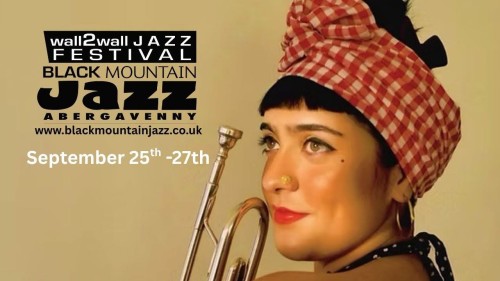
Saturday at Wall2Wall Jazz Festival, Melville Centre, Abergavenny, 26/09/2026
The second day of Black Mountain Jazz Club’s annual Wall2Wall Jazz Festival was like a microcosm of a typical month at BMJ.
The Club traditionally presents two events per month, the first an early evening show featuring the house trio, the BMJ Collective with an invited guest performer, the second a slightly more formal performance featuring jazz artists from all around the UK across a variety of jazz genres.
Today’s Festival line up featured a 4.00 pm performance from the Collective and their guests Ross Hicks (piano) and Dan Newberry (tenor sax) followed by an 8.00 pm show from the London based trumpeter Olivia Cuttill and her quartet.
BMJ COLLECTIVE – THE WELSH NEW WAVE
Jack Mac (Jack McDougall) – soprano sax, Nick Kacal – double bass, Ryan Thrupp – drums
with
Dan Newberry (tenor sax), Ross Hicks (piano)
BMJ Collective is essentially the house band of Black Mountain Jazz. Originally formed in 2021 for that year’s ‘hybrid’ Wall2Wall Jazz Festival the line-up has undergone a number of personnel changes and currently features founder member Jack Mac on reeds and occasional vocals, together with Nick Kacal on double bass and Ryan Thrupp at the drums.
Mac, Kacal and Thrupp also act as tutors at the BMJazzKatz sessions which bring young people together for regular jazz sessions at the Melville Centre, with the intention of forming a youth big band. Mac is heading the programme and the Katz, together with their tutors, have already made a number of public performances, with some of these covered elsewhere on this site.
The idea of the tutors then performing for the public in the evening following the Sunday afternoon sessions is not only for ticket sales to contribute towards the teaching costs, but also for the students to see their tutors performing at their best and embodying the JazzKatz motto of “work, play, inspire”.
As these BMJ Collective gigs have now become regular monthly events it is intended that a different guest musician will be invited to perform with the group each time. To date the ‘BMJ Collective With’ series has featured vocalist Sarah Meek, pianist / vocalists Hilary Cameron, Fabienne Ambuehl and Gareth Williams, pianists Jim Blomfield, Alex Hutton, Ross Hicks, Michael Blanchfield, Tom Berge. Dom Pipkin, John Crawford, Sean Hargreaves and Anders Olinder, trumpeter Gethin Liddington and guitarists Rob Luft, Chris Cobbson, Denny Ilett, John Close, Nigel Price, Nicolas Meier and Mike Outram Founding member Alex Goodyear also returned for a guest appearance at the drum kit, temporarily replacing Ryan Thrupp. All of these performances have been hugely enjoyable events and the majority have been reviewed elsewhere on The Jazzmann.
Every performance in the series has included an interesting selection of material sourced from the jazz canon and beyond, the majority of it chosen, or written, by the guest performer. All of the gigs have exceeded my expectations, representing far more than the usual obligatory or perfunctory ‘house trio with guest soloist’ session. As I have previously observed, “this is a series of events that continues to punch well above its weight”.
Nick Kacal spent many years on the London jazz circuit before re-locating to South Wales. He quickly established himself as a vital presence on the Welsh jazz scene but has retained his links with the English capital and more recently many of Kacal’s old London friends have been travelling up to Abergavenny to play a guest slot with the BMJ Collective.
When the BMJC With series first began the majority of the guests were from South Wales or Bristol but the word has got around within the jazz community about just how good the BMJ house band is and how appreciative the Melville audience is. Established London names now seem to be queueing up to come to play with the Collective in Abergavenny. I’ve consistently championed the series for “punching above its weight” and I’m pleased to see that its fame is continuing to spread. It’s become a very attractive gig for London based musicians, the usual early start time of 7.00 pm making it easy for them to get back to ‘town’ at a reasonable hour.
However today’s special Festival performance, which saw the BMJC performing with not just one guest but two, represented something of a ‘return to roots’ with the visit of pianist Ross Hicks and tenor saxophonist Dan Newberry, both fairly recent graduates of the Royal Welsh College of Music & Drama in Cardiff (RWCMD) and both still based in South Wales.
The ‘Welsh New Wave’ band name from Kacal and represents a nod to the new wave of French cinema rather than a reference to 1970s British and American punk rock.
Sharp eyed observers will note that Hicks has guested with the Collective before. He has also performed at Black Mountain Jazz on numerous other occasions, most notably as a member of the ‘house trio’ that accompanied the Tubby Hayes inspired saxophonist Simon Spillett at a performance in August 2023. Spillett was fulsome in his encouragement and praise of an exceptional trio that also included bassist Ashley John Long and drummer Alex Goodyear. My review of this remarkable quartet performance can be found here;
https://www.thejazzmann.com/reviews/review/simon-spillett-quartet-the-music-of-tubby-hayes-black-mountain-jazz-melville-centre-abergavenny-23-08-2023
The Hicks / Kacal / Goodyear trio has also accompanied Spillett’s fellow saxophonist Alan Barnes.
Hicks was also part of a jazz trio that also featured trumpeter Ben Thomas and drummer Ian Williams as they provided improvised musical responses to the words of poets Ric Hool, Lyndon Davies and Graham Hartill as part of a “Poetry & Jazz Improvisation” event. My account of this unusual but thought provoking performance can be found here;
https://www.thejazzmann.com/features/article/poetry-jazz-improvisation-black-mountain-jazz-melville-centre-abergavenny-24-03-2024
Hicks has doubled up on piano and electric keyboards with the young Cardiff based jazz / funk /soul octet Freshly Cut Grass, led by guitarist / vocalist /composer Owain Hughes and with the similarly inclined South Walian jazz-funk sextet Bunker, led by saxophonist Joe Northwood.
As an acoustic pianist Hicks has proved himself to be an excellent and in demand accompanist for jazz vocalists such as Debs Hancock, Emma Davidson and Kai Hoffman and he has regularly performed in this context during the course of Wall2Wall’s Community Sunday Afternoon Jazz Trail series of events in the cafes and bars of Abergavenny.
In March 2024 Hick’s released his debut album “Three Elms”, a hugely impressive trio recording that featured today’s bassist Nick Kacal alongside rising star drummer Alex Goodyear, who had appeared in this same venue the night before as a member of vibraphonist Roger Beaujolais’ excellent Spin Quartet.
My review of “Three Elms”, from which much of the above biographical detail has been sourced, can be found here;
https://www.thejazzmann.com/reviews/review/ross-hicks-three-elms
Variously referred to as Dan or Daniel tenor saxophonist Newberry has also visited BMJ previously and in 2018, while still a student at the RWCMD, he led his own quintet at that year’s Wall2Wall Jazz Festival.
He was also part of 2020’s Virtual Wall2Wall Festival’s ‘Tomorrow’s Leader’s’ livestream event alongside four other rising stars of the Welsh Jazz scene, the young musicians accompanied by a house trio led by Alex Goodyear.
In 2023 Newberry appeared alongside fellow saxophonist Alex Clarke when the pair were guests of a BMJ Collective that at that time featured Goodyear, pianist Eddie Gripper and bassist Clem Saynor. It was an event that led to further collaborations between Clarke and Gripper, who later retuned to BMJ as co-leaders of their own group.
Meanwhile Newberry has also appeared at Brecon Jazz Festival as part of a trio featuring trumpeter Gethin Liddington and pianist Huw Warren. He has also worked as a sideman with guitarist Gerard Cousins, bassist Mattheus Prado, pianists Dave Jones and Eddie Gripper and trumpeter Linley Hamilton.
Newberry has led his own Bristol based quartet featuring pianist George Cooper, bassist Henrik Jensen and drummer Matt Stockham-Brown.
Today’s performance followed the usual BMJC With.. format and featured a mix of jazz standards alongside original compositions by the two guests. The quintet introduced themselves with a hard swinging version of the Wayne Shorter composition “One By One” that featured powerful solos from both saxophonists, with Mac featuring exclusively on soprano as Newberry specialised on tenor. Hicks, Kacal and Thrupp were also featured as soloists.
The first original of the afternoon was Newberry’s “Song For Kenny”. It wasn’t made clear who the dedicatee was, but I’d guess at either trumpeter Kenny Wheeler or saxophonist Kenny Garrett. This was a multi-faceted composition that featured the two horns playing the head in unison before Mac delivered an expansive solo featuring the sinuous and incisive sound of the soprano sax. A more reflective episode featuring the composer’s tenor provided the link into a more expansive Newberry solo as he gradually ramped up the tension, his playing becoming more impassioned and increasingly powerful, urged on by Mac’s vocal exhortations. Hicks’ piano solo followed a similar trajectory to Newberry’s, reflective at first but later becoming more animated and joyous. The horns then came back together to restate the theme prior to a dynamic Thrupp drum feature played out against an insistent sax and piano vamp.
The two saxophonists left the stage for a trio performance of the title track of Hicks’ “Three Elms” album. This was introduced by an extended passage of unaccompanied piano before embracing a blues tinged lyricism that was also the basis for a melodic double bass solo from Kacal. Hicks then stretched out more expansively in the classic piano trio format.
Also written by Hicks the as yet unrecorded “Severn Song” saw the return of the horns but was initially ushered in by piano and bass, with drums subsequently added for a further passage in piano trio mode, with Hicks delivering a percussive piano solo. Mac finally made his mark with a soprano sax solo, followed by Newberry on tenor. The newly shorn Thrupp also impressed with one of his trademark hand drumming features.
This concluded an enjoyable first set. There may only have been four tunes but the featured soloists had stretched out expansively and impressively on all of them.
Set two commenced with Hicks’ adaptation of a Bach fugue, introduced by a passage of unaccompanied piano, with Hicks subsequently joined by bass, drums and the two horns. In the spirit of Bach the contrapuntal interplay between the two saxes, plus the piano, was consistently engrossing. Jazz interpretations of Bach are not exactly new, but this was a lot more robust, and ultimately more engaging, than Jacques Loussier.
Newberry is due to record his debut album in Prague with his European Quartet, featuring Kacal, Thrupp and Czech guitarist Libor Smoldas, a musician best known to UK audiences for his work with fellow guitarist Nigel Price. From the forthcoming album the saxophonist’s original “Kafka’s Conundrum” was an engaging post bop composition featuring an expansive tenor sax solo from Newberry with Kacal the other featured soloist. The composer was also featured with a solo tenor sax cadenza towards the close. This was a quartet performance with Mac sitting out
Also from the forthcoming album and also played in a quartet format Newberry’s ballad “Calisto” showcased the more reflective side of his writing. Again the composer stated the main melodic theme and took an extended tenor sax solo, underscored by Thrupp deploying variously brushes and mallets. Hicks’ lyrical piano solo began with bass accompaniment only, with Kacal subsequently dropping out to leave the pianist alone. After a solo piano passage bass and brushed drums were added for a further sequence in piano trio mode. The return of Newberry’s tenor signalled a switch to a sound more yearning and anthemic with Thrupp switching to mallets to add to the drama.
Mac returned for a final Newberry composition, “Cameo”, a piece inspired by Macao Parker. This demonstrated yet another aspect of Newberry’s writing with its funky, shuffling groove underpinning the unison sax theme statement. This was a piece that really set the audience’s feet tapping and represented a thoroughly uplifting way to end the second set. Mac took the first solo on soprano sax followed by the composer on tenor, accompanied at one juncture by Thrupp’s drums only. As piano, bass and eventually soprano sax returned Newberry’s playing became more and impassioned, before the band eventually returned to the arresting ‘head’.
The deserved encore saw the quintet having a bit of fun with a playful version of “If I Only Had A Brain” from “The Wizard of Oz”, a tune that Mac likes to throw into his sets from time to time. It may have been a whimsical choice but there was still some impressive soloing here, and particularly so from Hicks whose expansive and percussive solo sounded positively Monk-like at times. Mac and Newberry also featured as soloists, with the tenor man’s offering embracing both bass only and full band accompaniment. Kacal was also featured as a soloist before he and Mac delivered on off mic rendition of the lyrics at the close.
Today’s performances maintained the high standards set by the BMJC With… series and offered an interesting preview of Newberry’s forthcoming album, which should be well worth waiting for.
A very enjoyable start to the second day of the Festival.
OLIVIA CUTTILL QUARTET
Olivia Cuttill – trumpet, Sam Davies – piano, Lorenz Morabito – double bass, Miles Pillinger – drums
Saturday’s headline event featured a performance from a quartet led by trumpeter Olivia Cuttiill. Born in London into a musical family Cuttill is a graduate of the Jazz Course at Leeds Conservatoire and retains strong ties with that city and still sometimes appears with the splendidly anarchic Leeds based large ensemble Ferg’s Imaginary Big Band.
Since returning to the capital Cuttill has established her own quintet featuring vocalist Issey Chivers, pianist Tom Harris, bassist Fergus Quill (Ferg of FIBB) and tonight’s drummer Miles Pillinger. This line up has recorded two albums comprised largely of Cuttill’s original material with “The Whole Damn Plan” (2024) followed in 2025 by “And Writing And Singing And Tunes To Be Swingin’”. Josh Vadiveloo replaced Quill in the bass chair for the latter.
A member of the National Youth Jazz Orchestra (NYJO) Cuttill has also played with Orchestra Mambo International and is currently a member of Miles Pillinger’s own quintet. She has also recorded with the Manchester based bassist and composer Joshua Cavanagh-Brierley .
A rising star of the UK jazz scene Cuttill has been nominated in the “Jazz Newcomer of the Year” category ot the Parliamentary Jazz Awards which will take place on Tuesday 13th October 2026. Also nominated in the same category are vocalist Sylvie Noble and bassist Ursula Harrison, who have both also appeared for BMJ in Abergavenny.
It was originally intended that Cuttill’s regular quintet would perform her original music at Wall2Wall but as not all members of the group were available to perform on the night in question a compromise was suggested. Cuttill agreed to perform a themed show paying to a homage to an album that had been a profound influence on her, the 1964 recording “Oscar Peterson Trio + One”, the ‘one’ in question being the late, great trumpeter Clark Terry (1920 – 2015).
Tonight’s set list included all the tunes from the Peterson / Terry album, played in sequence but punctuated by small selection of some of Cuttill’s other favourite jazz standards. Cuttill proved to be an informative and highly personable presenter and explained that while she was playing the Clark Terry role pianist Sam Davies would be starring as Peterson, with Morabito and Pillinger cast as Ray Brown and Ed Thigpen respectively.
The quartet commenced with the album’s opening track, “Brotherhood of Man”, written by Frank Loesser. This featured Cuttill soloing with a plunger mute, followed by Davies at the piano and Morabito at the bass and with Pillinger enjoying a drum feature towards the close. This lively opener represented a good introduction to the individual instrumental voices of the band. As Cuttill explained this was a project that took her away from the ‘musical comfort zone’ of her own quintet and which presented a considerable technical challenge, particularly with regard to the frequent use of plunger and Harmon mutes, devices that she rarely deploys when playing her own music. She rose to the challenge magnificently and it was obvious from the outset that she is a highly accomplished trumpet player with a formidable technique.
Also from the album “Jim” (Caesar Petrillo, Milton Samuels, Nelson Shawn) was a beautiful ballad, introduced in the piano trio format with Davies’ piano lyricism augmented by Morabito’s bass counter melodies and Pillinger’s brushed drums. Cuttill eventually entered playing with a Harmon mute in such a style that one immediately appreciated the influence that Terry, the older by six years, must have had on Miles Davis. Cuttill went on to effectively spar with herself, alternating Harmon muted phrases with those played with an open bell, an intriguing series of exchanges that were apparently conceived in the moment. Davies followed with a more conventional piano solo.
“It Could Happen To You” saw the group breaking away from the album repertoire with Cuttill’s expansive trumpet solo followed by Morabito at the bass as he exchanged ideas with pianist Davies.
It was back to the album for the Peterson original “Blues for Smedley”, another piece to feature the sound of plunger muted trumpet as Cuttill took the first solo, followed by another dialogue between Morabito and Davies, these two players seeming to have a particularly close musical relationship. The excellent Pillinger delivered a neatly constructed brushed drum feature that also incorporated the effective use of the bass drum. Cuttill’s plunger muted trumpet was again featured towards the close, with Pillinger now switching to sticks.
“Roundalay”, another Peterson original from the + One recording incorporated solos from Davies at the piano and from Cuttill on trumpet, playing with an open bell and also entering in a series of spirited musical exchanges with the pianist.
The recording features Terry’s vocalisations or ‘mumblings’, most notably on the track “Mumbles”, a Terry original. For this piece Cuttill successfully managed to convey something of Terry’s sound via her trumpet, again deploying the plunger mute to create a bluesy sound that also incorporated elements of musical humour, something emphasised by her rolling eyes as she played. Davies’ barnstorming piano solo incorporated the sounds of dampened strings to provide a percussive effect. This concluded an excellent first set that was warmly appreciated by an audience that was larger in terms of numbers than the previous evening.
Set two commenced with an intriguing arrangement of Brecht and Weill’s “Mack The Knife” that was initially more restrained than most renditions of this piece but which eventually developed a considerable head of steam via the soloing of Cuttill on plunger muted trumpet and Davies at the piano, the latter really making the hammers of the Melville Centres’ acoustic upright dance.
The Jerome Kern / Herbert Reynolds ballad “They Didn’t Believe Me” slowed things down once more with Cuttill’s rich, round, warm tone on trumpet sounding distinctly flugel like. This was complemented by Davies’ lyrical piano solo.
There was another move away from the album repertoire, and also an injection of pace, with the quartet’s version of the jazz standard “If I Should Lose You” with Cuttill’s open bell solo followed by Morabito at the bass. Pillinger was then involved in a series of drum / piano exchanges with Davies before Cuttill returned for a second trumpet excursion.
A return to the album for the Peterson original “Squeaky Blues” introduced by an unaccompanied double bass passage from Morabito, to which was added the sound of Harmon muted trumpet and rapidly brushed drums, with Davies adding one handed piano commentary. Cuttill’s solo was delivered in largely trumpet trio format before Davies took over, often playing with the right hand only. Pillinger was then featured at the drum kit.
Also from the + One recording the ballad “I Want A Little Girl” featured the sounds of open bell trumpet, lyrical piano and brushed drums with Cuttill and Davies sharing the solos.
There was a final breakaway from the album for a rendition of the Charlie Parker composition “My Little Suede Shoes”, ushered in by a neatly constructed solo drum passage from Pillinger. Davies and Cuttill were subsequently featured on piano and trumpet respectively.
Effectively acting as a very well deserved encore the last piece of the evening was the final track of the album, the Clark Terry original “Incoherence Blues”. This was a genuine blues that reintroduced Terry’s ‘mumbling’ via the vocalised sounds of Cuttill’s trumpet, played both with and without the plunger.
I have to admit to not being previously familiar with the Peterson / Terry album, although some other audience members clearly were. Nevertheless I was hugely impressed by the Cuttill Quartet’s interpretation of it as they brought plenty of themselves to their chosen material. The standard of the playing was exceptional from all members of the group, who cohered very effectively as a unit as well as delivering some exceptional individual moments.
It’s possible that the audience may have enjoyed this themed show more than they would have Cuttill’s own music, but it would be interesting to see her invited back to Abergavenny with her regular quintet at some point in the future. In the meantime tonight’s show was a triumph for her and must have won her many new fans.
My thanks to Olivia for speaking with me before and after the show, and also to Miles Pillinger, whose forthcoming album I’m hoping to hear in the not too distant future.
blog comments powered by Disqus