

by Ian Mann
August 16, 2026
Ian Mann enjoys the final day of the Festival and performances by Hot Club Gallois, Jon Crespo, Ferg's Imaginary Big Band, Jack Pearce Quintet, Dave Jones' Trunk of Funk, Jacqui Dankworth Quartet.
SUNDAY AT BRECON JAZZ FESTIVAL, 09/08./2026
HOT CLUB GALLOIS, THE MUSE
Xenia Porteous – violin, Luke Archard, Hywel Maggs – guitars, Mike Morgan – bass, vocals
Hot Club Gallois is a gypsy jazz quartet from South Wales that has accrued a highly devoted following thanks to the quality of its good natured and exciting live performances. Their popularity in their homeland is reflected in the fact that this was the first BJF event of 2026 to officially sell out, beating even Courtney Pine in this regard. This achievement represents quite a feather in their collective cap.
Hot Club Gallois evolved out of the Cardiff based quintet 5 Go Swing and the current four piece line-up has been in place for a number of years now. The group features the classic gypsy jazz configuration of violins, two guitars and bass. In addition to this both bassist Mike Morgan and regular guitarist Richard Jones also sing, adding even greater variety to a repertoire that includes gypsy jazz classics, original songs in the gypsy jazz style and adaptations of tunes from other jazz styles, such as Chick Corea’s “Spain”.
Jones was unavailable for this gig and his place was taken by Hywel Maggs, a former member of the group and still one of Hot Club Gallois’ pool of musicians.
Hot Club Gallois is a band that I’ve seen and enjoyed on numerous occasions at both club and festival events in Brecon and Hay on Wye. Violinist Xenia Porteous is a great friend of Brecon Jazz and has also appeared as a guest performer at other events, including appearances with guitarists Robin Nolan jean Guyomarc’h, Trefor Owen and Andy Hulme, saxophonist Pavel Zlamal, jazz french horn player Rod Paton, the Anglo- Serbian duo Faith i Branko and the Argentinian ensemble La Malbec Orquesta
Porteous is also a founding member of Swing Strings Trio, an ensemble that also features harpist Ben Creighton-Griffiths and bassist Ashley John Long.
Hot Club Gallois have a particular fondness for the music of the founding father of gypsy jazz, the late, great Django Reinhardt. The afternoon got off to a lively start with a rendition of Reinhardt’s composition “Django’s Tiger”,ushered in by Archard, who was later to emerge as the first featured soloist. The always excellent Porteous then followed on violin. Archard and Maggs were to share lead guitar duties throughout the show with each player moving seamlessly between lead and rhythm functions. Maggs was the next to feature as a soloist before Archard returned in a reprise of his earlier contribution.
A passage of unaccompanied guitar from Archard introduced the Reinhardt’s “Anniversary Song”, which featured the same solo order of Archard, Porteous, Maggs, with Archard and Porteous later returning for a second bite of the cherry. Porteous then rounded off the performance with an unaccompanied violin cadenza.
A waltz with a title translating as “The Crowd” sounded almost quintessentially French, with Porteous’ violin leading the way and sharing the solos with Maggs and Archard.
Reinhardt’s “Artillerie Lourde” (or “Heavy Artillery”) featured solos from Maggs, Porteous and Archard and saw the quartet toying with the audience with a teasing false ending.
The first original piece was the Porteous / Maggs composition “Blues On The Green”, a tune inspired by the gypsy jazz jam sessions at the Inn on The Green venue in Bristol. This proved to be unexpectedly slow and melancholic and featured the now familiar soloing order of Maggs, Porteous and Archard.
Described by Porteous as a “gypsy jazz classic” the quartet’s version of “Them There Eyes” picked the pace up once more and featured solos from Archard, Porteous and Maggs.
The Gershwins’ “Lady Be Good” represented the first vocal item of the set and was sung by Morgan, today the band’s only vocalist in Richard Jones’ absence. Morgan and Jones are both adequate, but not great, singers but nevertheless their vocal abilities add variety to HCG’s performances and also serve as a reminder as to the origins of so many of these tunes. The featured instrumental soloists here were Maggs, Porteous and Archard.
Morgan, playing his home made electric upright bass, an instrument dating back to 1989, was also the writer of the original tune “Belle Americaine”. This proved to be a relaxed, medium paced composition with Maggs the featured soloist.
Introduced by a duet between Porteous and Archard “Djangology” marked a return to the Reinhardt repertoire and also served to increase the pace, with Archard, Porteous and Maggs providing the solos.
The quartet’s interpretation of the Chick Corea composition “Spain” was presaged by a passage from Rodrigo’s “Concerto D’Aranjuez. This is the most technically challenging piece that the group plays and is not usually part of the gypsy jazz repertoire. Today’s interpretation was introduced by the twin guitars with violin and bass subsequently added as the quartet navigated the numerous twists and turns of the piece, while finding room for solo excursions from Porteous, Maggs and Archard.
Morgan delivered a particularly effective vocal performance on a Nat King Cole inspired version of the eden ahbez song “Nature Boy”, with first Maggs and then Porteous skilfully shadowing his vocal lines. Porteous was also a featured instrumental soloist, followed by Archard, who had sat out the opening stages.
The bassist also sang on “Embraceable You”, introduced by the sounds of voice and pizzicato violin, with subsequent instrumental solos from Archard, Porteous and Maggs.
Maggs, Porteous and Archard then featured on a Nino Garcia tune, the only piece I failed to get the title of.
The show concluded with Django Reinhardt’s “Latcho Drom”, a high energy performance that saw furiously chugging rhythm guitars underpinning a particularly playful Porteous violin solo. The guitarists subsequently delivered dazzling solos of their own as the performance ended on an upbeat and invigorating note.
A delighted audience called the band back for a deserved encore, spirited romp through another classic from the gypsy jazz canon, “Dark Eyes”, with a still playful Porteous sharing the solos with Maggs and Archard.
Even in the absence of regular band member Jones this was still a hugely enjoyable show and one which was performed with great energy and elan, allied to a high level of technical ability. Jones usually acts as the band’s spokesman, but Porteous handled the announcements superbly, her tune introductions concise, witty and informative.
It’s easy to see why Hot Club Gallois are such a popular act with audiences and these local heroes – and heroine – got the final day of the Festival off to a highly entertaining start.
JON CRESPO QUARTET, ‘BEYOND ARMSTRONG’, THE GUILDHALL
Jon Crespo – trumpet & flugelhorn, Mark Sambell – keyboard, Jon Goode – electric bass, Greg Evans – drums
Festival scheduling meant that I was only able to enjoy a small part of this performance from another group of local heroes, led by the popular trumpeter Jon Crespo.
Crespo was born in Chile but the volatile politics of his original homeland resulted in his family moving to Ontario, Canada when Crespo was still a child.
His older brother started playing trumpet in high school and Jonathan followed suit, studying classical music but also absorbing the rock the music of the era including The Who, Led Zeppelin, Stevie Ray Vaughan, Pink Floyd and The Beatles. Crespo has since described himself as a “rocker in a trumpet player’s body”
Crespo discovered jazz via Chet Baker and studied the music at Humber College in Toronto, a specialist jazz college. Crespo later became a member of the Humber College Music Program Advisory Committee, an honour also shared by the late, great jazz pianist Oscar Peterson.
Crespo’s versatility has led to an interesting and diverse career that has included touring with the Beach Boys, KC and the Sunshine Band, The Box Tops and Lenny Kravitz among many others. He has acted as trumpet player and musical director for a number of mainstream entertainers such as Michael Ball and Gareth Gates, with this aspect of his work also including stints on US cruise ships and residencies in lounges and casinos in Atlantic City, New Jersey.
Crespo has been resident in South Wales for a number of years, firstly in Cardiff and now in Barry. An acclaimed educator he teaches jazz, classical and commercial trumpet to students in Cardiff and the Vale of Glamorgan and is a popular and active presence on the Welsh jazz scene. Prior to the pandemic he ran a weekly Saturday night residency at the now sadly defunct Jazz Cafe in Cardiff.
I first encountered Crespo’s playing in 2016 when he was part of a Cardiff based ensemble that performed with the late, great vocalist Tina May at that year’s Brecon Jazz Festival. Crespo appeared on both trumpet and percussion at this themed event titled “Tina May Sings The Music of Brazil”. The following year Crespo returned to BJF as part of the Slice of Life Big Band, led by trumpeter and broadcaster Rhys Phillips.
Also in 2017 Crespo brought his own quartet featuring pianist Dave Jones, bassist Ashley John Long and today’s drummer Greg Evans to Black Mountain Jazz in Abergavenny to play an enjoyable standards based set.
I didn’t catch up with Crespo again for a number of years until he turned up not once but twice at the Brecon Jazz Springtime Jazz Day Festival in April 2025. Here he made a brief but memorable cameo appearance with saxophonist Jack McDougall’s Full House Brass Band at The Muse prior to leading his own group, featuring Jones, Evans and vocalist / ukulele player Jane Williams at The Brecon Tap.
2025 also saw Crespo return to Abergavenny and BMJ with today’s line up to present his show “Beyond Armstrong” which saw Crespo and his colleagues exploring the music of trumpeter / composers who emerged post Louis Armstrong, but who still bore, or bear, his indelible influence. Crespo describes his project thus;
“Beyond Armstrong is a unique tribute to trumpet players who were inspired by and appeared on the jazz scene after Louis Armstrong. Arguably, one would suggest that modern jazz trumpet playing owes its roots and influences to him. In some way, every trumpet player owes approach, understanding and their sound to Armstrong. This tribute will explore and pay homage to some of those players - including Miles Davis, Tom Harrell, Woody Shaw and more.”
My account of the “Beyond Armstrong” performance at Abergavenny, from which much of the above biographical detail has been sourced, can be found here;
https://www.thejazzmann.com/reviews/review/jon-crespo-quartet-beyond-armstrong-black-mountain-jazz-melville-centre-abergavenny-31-08-2025
As at Abergavenny Crespo made the ‘Grand Entrance’ to the strains of Carl Orff’s “Carmina Burana” – this man is not just a trumpeter, he’s an entertainer, a legacy perhaps of his days on the cruise ships.
But make no mistake, Crespo can play, as he demonstrated on the quartet’s version of the Miles Davis composition “Four” which featured his fluent trumpet soloing above Evans’ rapidly brushed drum grooves. Sambell was also featured as a soloist, adopting an acoustic piano sound on his Yamaha electric keyboard. Both Sambell and Jon Goode had featured The Muse the previous evening with vocalist Dionne Bennett and the bassist was next to feature as a soloist. Finally Evans, who functions very much as Crespo’s ‘right hand man’ entered into a series of exchanges with trumpet and piano.
Crespo changed to flugel for the Tom Harrell composition “Train Shuffle”, a more subdued and thoughtful performance that saw Evans deploying both sticks and brushes as appropriate and with Sambell and Crespo the featured soloists.
The next piece was unannounced but was introduced by Evans’ hand drumming prior to his switch to sticks as the piece began to develop and the energy and momentum began to build, with the music taking on a subtle funkiness. Crespo had reverted to trumpet and shared the solos with Sambell, who adopted an electric piano or ‘Rhodes’ sound. Evans was also featured at the kit before Crespo brought things to a close with an unaccompanied trumpet cadenza.
The last piece that I got to hear was the Crespo original “Stranded”, which he dedicated it to the memory of two old friends from Canada, both sadly no longer with us. This blues tinged offering featured solo from the leader on trumpet and Sambell on electric piano.
I was reluctant to drag myself away but felt that I couldn’t afford to miss a single minute of the performance by Ferg’s Imaginary Big Band at Theatr Brycheiniog. I’d heard great things about FIBB and was told that this was a performance that I must not miss – and after all I had seen the “Beyond Armstrong” performance before. For a fuller overview of Crespo’s project please refer to my review of last year’s “Beyond Armstrong” show in Abergavenny, which can be found here;
https://www.thejazzmann.com/reviews/review/jon-crespo-quartet-beyond-armstrong-black-mountain-jazz-melville-centre-abergavenny-31-08-2025
FERG’S IMAGINARY BIG BAND, THEATR BRYCHEINIOG
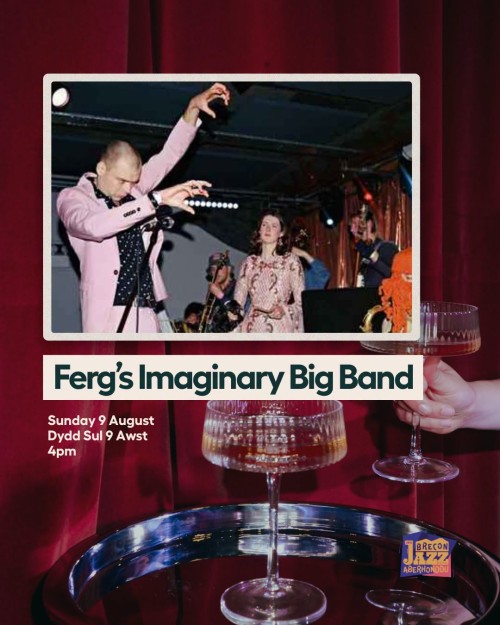
Led by bassist, multi-instrumentalist and composer Fergus Quill Ferg’s Imaginary Big Band is an aggregation of Leeds based musicians, many of them graduates of Leeds College of Music.
The FIBB draws on a pool of thirty or so musicians and the ensemble’s latest album release “The New Atomic” was partly financed by the receipt of the Peter Whittingham Jazz Award.
Quill is a remarkable character, a musical polymath who plunders across the genres in search of musical inspiration. The result is the kind of musical culture clash that made Loose Tubes, perhaps the most obvious parallel, so exciting. Like LT in their 80s heyday the membership of the FIBB is young and irreverent with a punk like ethos informing the edgy, eclectic energy that informs this band’s music. Quill is a restlessly creative artist and his Bandcamp page features a whole raft of music that he has recorded in various incarnations, including the FIBB, over the past five years.
There’s a political aspect too with Quill commenting; “Music like this has to come from a sense of love, joy, communion, solidarity – the power of the people”. With this in mind any profits from the sale of the “New Atomic” album will be donated to the War Child charity.
Quill borrows from anything and everything that takes his fancy – acknowledged influences include Charles Mingus, Sun Ra, John Zorn, Sunn O))), Duke Ellington, Bob Dylan, The Beatles, Charlie Haden’s Liberation Music Orchestra and much, much more. I’d certainly add Frank Zappa, Darcy James Argue and Carla Bley to that list and there must be many others. The album title and cover design tips its hat in the direction of Count Basie.
Today’s show commenced with Quill bounding onto the stage accompanied by a single trombone player. The leader then sat down at a Nord Stage 3 electric keyboard and entered into a musical dialogue with the lone trombonist. Above this the sounds of other music could be heard from the back of the hall as the rest of the band processed through the audience to join the onstage duo. It’s not an original idea, Loose Tubes, Sun Ra and even Pat Metheny have all done much the same thing but it did emphasise FIBB’s cheerful irreverence and sense of theatricality. There were some pretty exotic sartorial get ups among the ranks of the band members too, again in common with Loose Tubes, and in some cases also with Sun Ra.
As the musicians assembled on the stage we were treated to a musical mash-up featuring a mix of big band brass, punk thrash guitar, and a brief excursion into what sounded uncannily like The Batman theme. In amongst the general chaos an alto sax solo almost went unnoticed until the musician in question was left all alone at the end of this opening sequence.
The FIBB line up was absolutely huge with six saxes, four trumpets, four trombones, tenor horn, guitar, viola, electric bass, two keyboard players, two drum kits, two percussionist / vocalists, the ‘noise’ of electronic musician Hamish ‘Sonic’ Dixon, and of course the madcap presence of Fergus Quill himself. Like Loose Tubes the number of band members is almost impossible to count and I couldn’t begin to name them all, although a few names did get announced during the course of the performance so I will make reference to those.
As it turned out I was familiar with two of the major players in the band’s line up, vocalist / percussionist Amy Clark and trumpeter / vocalist Emyr Penry Dance thanks to their work with the septet Awen Ensemble, a group that I enjoyed seeing perform at an Sy; Gigs event in Shrewsbury earlier in the year.
Clark’s vocals were to feature prominently on the next item, which delivered what was to become a typical FIBB mix of tenderness and chaos with Nat Martin on tenor horn and Dan Coulthurst on trumpet among the featured instrumentalists. The piece also featured the vocal chants of the band’s massed ranks while Quill wielded a giant football rattle adorned with the message Viva Mexico!
From “The New Atomic” album “Do The Right Thing” was a composition by keyboard player Nico Widdowson. Fuelled by Bess Shooter’s monstrous, skronking baritone sax riff, working in conjunction with the other horns, the piece also featured a delightfully bizarre solo from Hamish Dixon delivered on some kind of EWI (electronic wind instrument).
“Branches” represented FIBB’s tribute to the late, great American trumpeter, vocalist and composer jaimie branch (1983 – 2022), a musical kindred spirit and also a musician with a strong social conscience. An appropriately mournful arrangement offered evidence of this huge ensemble’s more sensitive side.
It was back to business as usual as Quill announced that the band were going to do their own take on an old Lou Donaldson number. The band fairly tore it up as the tune crashed in with a thunderous introduction from the two drummers. Meanwhile Quinn moved in with the trumpet section as the band’s guitarist unleashed a shredding solo, a real case of FX pedal overload.
“We travel with a monster”, declared Quill as he introduced “Besszilla”, a second feature number for Shooter, who again produced the kinds of sounds that even the big beast of a baritone sax shouldn’t be capable of making as she jammed a microphone into the bell of her horn. Grungy and metallic and featuring Quill’s own stentorian vocals the piece variously sent up horror movie cliches, Michael Jackson and Black Sabbath and really was terrific fun, in a thrillingly cacophonous sort of way.
The new album includes a Quill arrangement of the traditional song “I Shall Not Be Moved”, chosen as a symbol of the band’s defiantly anti-fascist stance. Sung solo by Quill at first, but then by the whole band in the style of a gospel choir this piece was simple but strangely moving.
The Awen Ensemble performance in Shrewsbury had revealed Emyr Penry Dance to be an excellent vocalist as well as a fine trumpeter. As his name might suggest he is of Welsh heritage and he emerged here from the trumpet section and came to the front of the stage to sing the Welsh hymn tune “Calon Lan”, a well received homage to the location of today’s performance.
Dance and Clark also sang very effectively as a duo during one of this afternoon’s rare ballad episodes.
FIBB finally exited the stage much as they had entered, marching and skipping back out through the audience as they merged the galactic whimsy of Sun Ra’s “Interplanetary Music” with “Let’s Go Fly A Kite” from “Mary Poppins”.
For myself, and I suspect many others, FIBB represented the discovery of the Festival. I loved their youthful exuberance and irreverence but behind the wilful eclecticism there was also a serious political and social message, this allied to razor sharp playing and some high quality vocalising, particularly from Clark and Dance.
Quill himself proved to be an eccentric but compelling leader and front man, his maverick spirit informing the entire performance. There’s a bit of a buzz about FIBB at the moment and it’s one that’s likely to grow on the back of astonishing live performances such as this. FIBB is an important act with an important message to spread. I think we’re going to see and hear a lot more from them.
This was a show that was almost ‘too good’. There was so much going on and I was enjoying it so immensely that I almost forgot to keep taking notes and I’ve got the nasty feeling that I might have missed out something important. But writing about FIBB can never do them justice. Go and see them for yourselves.
JACK PEARCE QUINTET, THE MUSE
Jack Pearce – alto saxophone, Joe Frost – piano, Alex Alder – guitar, Dan Sanderson – electric bass, Patrick Barrett-Donlon – drums
The Muse featured another Leeds based band, a quintet led by alto saxophonist and composer Jack Pearce. Today’s show represented the group’s second visit to the venue following a successful Brecon Jazz Club appearance in November 2025. I missed out on that as I was covering London Jazz Festival so I was delighted to finally catch up with the band today.
This afternoon’s line up featured three regulars, Pearce, pianist Joe Frost and bassist Dan Sanderson, plus two ‘deps’, guitarist Alex Alder and drummer Patrick Barrett-Donlon. The latter, based in Cardiff, is a well known figure to Brecon Jazz audiences but this was the first time he had ever played with the Pearce Quintet. He slotted in seamlessly and did an absolutely terrific job.
The Quintet’s blend of melodic post bop was very different to the mayhem of FIBB but I thoroughly enjoyed their performance too. The focus was exclusively on original material written by Pearce and the band are due to release their debut album “Church Lane” on October 9th 2026, which is something to look forward to.
I arrived during the first number “Tinhead”, just in time to enjoy the fluent soloing of Frost at the piano and Pearce on alto sax, plus a drum feature from Barrett-Donlon.
The first number that I heard in full was “Green Eyes”, a beautiful ballad written by Pearce for his girlfriend and featuring lyrical solos from Pearce, Frost, Sanderson and Alder, followed by a sax and piano duet at the close. Jack claimed he’d written the piece to get some ‘brownie points’. On the evidence of this performance he must have earned a whole load of them.
Electric bass opened “Half Moon”, a piece that saw Pearce delivering a subtly probing solo above a gently rolling groove, but a groove that gradually acquired an increasing momentum and intensity.
“Fellowship” embraced a more obvious hard bop style and featured solos for guitar and piano plus a drum feature for the excellent Barrett-Donlon.
It would seem that Pearce writes with specific locations in mind. “St. Mary’s”, a tune that will appear on the forthcoming album, featured Pearce’s fluent and expansive sax soloing.
The quintet concluded their performance with “Church Lane”, the title track of the forthcoming album. This included solos from Pearce and Frost plus a feature for local hero Barrett-Donlon.
The Pearce Quintet has acquired quite a following in Brecon and will visit the town for a third time when they play a date for Brecon Jazz Club in January 2027. By that time the album will be out and it is a release that will be very keenly anticipated in this part of the world.
My thanks to Jack for speaking with me after the show and for verifying some of the set list details. I’m now looking forward to seeing him and the band again in January.
Finally a shout out to Patrick Barrett-Donlon for his contribution to the success of this performance. His sight reading skills and innate musicality ensured that he sounded like a fully integrated member of the ensemble. It was as if he’d been playing with the quintet for years. Well done, Patrick.
DAVE JONES’ TRUNK OF FUNK, THE GUILDHALL
Dave Jones – keyboards, Ben Waghorn – alto & tenor saxes, Paul Carr – guitar, Jon Goode – electric bass, Elliot Bennett – drums, Glenn Thompson – percussion
Port Talbot based pianist and composer Dave Jones is a popular and much in demand figure on the South Wales jazz scene, but he’s also a musician with a wider national reputation.
In addition to being a hugely accomplished pianist and all round keyboard player Jones is also a skilful and prolific composer. He has released a series of jazz recordings featuring all original material, the majority of these in an orthodox trio or quartet format. A number of these are favourably reviewed elsewhere on these web pages, as are several live performances by a number of Jones led groups.
Jones is not an artist who is content to limit his music to just one genre. His other current projects include tonight’s outfit, Trunk Of Funk, and also Stratospheric, his new prog jazz project and a group that has recently released its debut album. Jones also composes ‘library music’ for television and cinema. He is also a prolific side man on the South Wales and Bristol Jazz scene.
In addition to performing his own material Jones also likes to celebrate the music of others. His regular jazz quartet has paid homage to the music of saxophonist Kenny Garrett. Trunk of Funk takes this process a whole stage further and pays tribute to a whole genre, jazz-funk-fusion by playing the music of David Sanborn, Freddie Hubbard, Chick Corea, Marcus Miller and more. The six piece line up includes saxophonist Ben Waghorn, who also plays in Jones’ regular jazz quartet, plus other leading musicians from the Welsh jazz scene.
Trunk of Funk is where Jones likes to turn up the volume and tonight’s performance was LOUD, with Jones specialising on electric piano and synthesiser. Things kicked off with Waghorn on alto sax as the sextet tackled “Run For Cover”, a tune by the late, great US alto saxophonist David Sanborn. Waghorn’s incisive alto soloing was a particular feature of this piece, alongside further solos from Carr on guitar and Jones on synthesiser. Bassist Jon Goode, who had also featured with vocalist Dionne Bennett and trumpeter Jon Crespo was staking his claim for the ‘busiest musician at Brecon award’ and added some distinctive slap bass sounds here.
The Trunk of Funk project has been going for two years and has developed an impressive book of suitable material. Usually a quintet the group is augmented on selected dates by the experienced percussionist Glenn Thompson, who adds extra rhythmic colour to the band’s sound.
Next up was “Straight From The Heart”, a tune played by Sanborn but written by Marcus Miller. Waghorn was again featured alto alongside Carr on guitar and Jones on synth.
Announcing the next item Jones recalled seeing Chick Corea’s Electrik Band at Ronnie Scott’s in London in the 1980s. From that group’s repertoire Corea’s composition “Electric City” was ushered in here by a ferocious synth and drum barrage, followed by a guitar solo from Carr that saw him unleashing his inner Frank Gambale. Waghorn switched to tenor and delivered a powerful solo, followed by Jones on synth. The piece played out with a series of sax and guitar exchanges.
Jones also saw trumpeter Freddie Hubbard at Ronnie’s, leading a band that featured one of Jones’ piano heroes, the late, great McCloy Tyner. Hubbard’s composition “Red Clay” has become something of a fusion classic, its memorable hook providing the spark for solos from Jones on electric piano, Carr on guitar and Waghorn on tenor.
Next we heard “Snakes”, another tune written by Marcus Miller for David Sanborn was brought to the Trunk of Funk band by drummer Elliot Bennett. One could see why, Bennett was a busy presence behind the kit throughout, introducing the tune with an opening drum salvo before his hyperactive drumming fuelled the incendiary soloing of Waghorn on alto, Carr on guitar and Jones on keyboards, this time adopting an organ sound.
There was a second Freddie Hubbard tune with the eternally popular “Little Sunflower”, which introduced yet another keyboard sound, that of the string synth. Hubbard’s memorable melody was further embellished by the soloing of Waghorn on tenor, Carr on guitar and Jones on electric piano.
The sextet signed off with the heavy duty funk of “The Chicken”, a composition by saxophonist Pee Wee Ellis with solos from Waghorn on tenor and Goode on bass, plus a series of exchanges between bass and drums.
I rather enjoyed this loud, brash bout of fusioneering and Jones and his colleagues took a great delight in playing it, with all the musicians really ‘going for it’, particularly during their solos.
It was all good fun but at the end of the day I’d rather hear Jones playing his own music rather than somebody else’s. Nevertheless the fact that he can embrace so many styles of music is impressive and commendable. I’m looking forward to checking out his Stratospheric prog-jazz project next.
JACQUI DANKWORTH QUARTET, THEATR BRYCHEINIOG
Jacqui Dankworth – vocals, Charlie Wood – piano, vocals, Oli Hayhurst – double bass, Sam Green – drums
The Festival curtain came down at Theatr Brycheiniog with this flagship performance by vocalist Jacqui Dankworth and her quartet. Dankworth is, of course, the daughter of Sir John Dankworth and Dame Cleo Laine and had been due to appear at this same venue as part of the 2025 BJF. That performance had to be postponed as it was scheduled just shortly after the passing of Dame Cleo.
Fast forward a year and Dankworth finally made it to Brecon in the company of a quartet featuring her pianist (and husband) Charlie Wood, her regular bassist Oli Hayhurst, and at the drum kit the young Cardiff based musician Sam Green. The latter was only playing his second show with the group and like Patrick Barrett-Donlon with the Jack Pearce Quintet earlier in the day he too acquitted himself superbly.
I was lucky enough to catch a show by the Dankworth Quartet, with Ralph Salmins on drums on that occasion, at the 2025 EFG London Jazz Festival when they gave a free of admission performance at the Milton Court Concert Hall. It was an event that proved to be an unexpected Festival highlight as far as I was concerned, with Dankworth and her collaborators turning in a very classy performance. Today’s set was longer than the Milton Court show but, not unexpectedly, it did include many of the same songs.
Things got underway with a swinging arrangement (by pianist Malcolm Edmondstone) of “It’s Almost Like Being Love”, which served as a good introduction to the individuals in the band with Dankworth’s assured vocals complemented by concise solo features from each of the instrumentalists.
Dankworth’s latest album release is titled “Windmills”. From this came a remarkable arrangement, by Charlie Wood, of what is essentially the title track, “The Windmills of Your Mind”, a song composed by Michel Legrand with wonderfully evocative and poetic lyrics written by Alan and Marilyn Bergman. This was given a distinctive jazz / flamenco treatment complete with handclaps, a playful and innovative take on the song that offered an intriguing contrast to the solemnity of the original. The decision to tackle the song in such a way was a reflection on Dankworth’s upbringing, as a child she was cared for by a succession of Spanish nannies.
Dankworth studied at the Guildhall School of Music and Drama in London and is also a trained actress with a continuing love of musical theatre, and particularly the work of Stephen Sondheim.
A sequence of Sondheim songs began with “Being Alive”, from the musical “Company”, with Dankworth’s emotive vocals complemented by Wood’s piano solo and Green’s delicate brush work.
This was followed by the more playful “Not When I’m Around” from “Sweeney Todd”, which incorporated a melodic bass solo from the excellent Hayhurst.
Dankworth played Cinderella in the Sondheim musical “Into The Woods” and arranged the quartet’s version of “No One Is Alone”, introduced by an extended voice and piano duet prior to the addition of double bass and brushed drums.
The final song in this Sondheim sequence was the wittily satirical “The Ladies Who Lunch”, a song initially made famous by Elaine Stritch.
Dankworth is a songwriter and lyricist on her own account and her original song “Sweet Devotion” was a moving dedication to her late father, that again featured Hayhurst as an instrumental soloist.
Hayhurst and Green then left the stage as Dankworth and Wood duetted on Duke Ellington’s “I’m Beginning To See The Light”, played in a New Orleans ‘second line’ style with Wood featuring as both singer and piano soloist.
The rhythm section then returned for a Dankworth / Wood arrangement of “Baubles, Bangles and Beads”, with Wood again featuring as an instrumental soloist alongside the young and highly impressive Green.
Dankworth chooses songs from many sources and the next item was drawn from the folk world with an arrangement of Ewan McColl’s “The First Time Ever I Saw Your Face”, performed by Dankworth with an appropriate mix of emotion and gravitas, sensitively supported by the members of the trio.
Dankworth and Wood duetted vocally on a second Ellington number, the immortal “It Don’t Mean A Thing”, with both contributing scat vocal episodes alongside instrumental cameos from Hayhurst and Green. This was lively, swinging stuff and paved the way for the final number, the “low down and dirty blues” of “Sitting On Top Of The World”.
The audience absolutely loved Dankworth and her band and the inevitable encore was arguably the most famous Sondheim song of them all, “Send In The Clowns”.
Once again it has to be said that this was an excellent performance. As a vocalist Dankworth is pure class and she was given superb support from an equally accomplished band. Sam Green, a bandleader and composer in his own right, fitted in superbly on what a particularly prestigious gig for him and did an absolutely terrific job. As a jazz listener I’d have preferred to have heard a bit more Ellington and a bit less Sondheim, but I suspect that many of Jacqui’s devoted audience would probably disagree with me. Nevertheless this was a very enjoyable show, a sophisticated and classy way to round off the Festival.
FESTIVAL OVERVIEW
Congratulations to Chris Jones and the Brecon Jazz team on a second successful Festival. The programming was admirably diverse and encompassed a broad style of jazz and jazz adjacent genres and featured a good mix of established names (Courtney Pine, Orphy Robinson, Jacqui Dankworth), rising stars (Ferg’s Imaginary Big Band, Jack Pearce Quintet, Phoenician Blinds) and local heroes, far too many to mention.
The organisation was good overall with most events running to time and the sound was largely good at all venues.
My only real caveat would be the scheduling of some events with a number of concerts overlapping by around fifteen minutes or so, making it impossible to see both shows in their entirety. I appreciate that at Festivals choices have to be made but greater attention to timings might be a benefit to ticket buyers and help to increase sales overall. A thought for next year perhaps.
My thanks to Chris Jones and the Festival team for allowing me to cover the entire event.
blog comments powered by Disqus