

by Ian Mann
May 10, 2026
Ian Mann enjoys 'Super Sunday' at Cheltenham Jazz Festival and performances by Makaya McCraven, Robinson Khoury, Camilla George, Georgia Cecile and Yazz Ahmed.
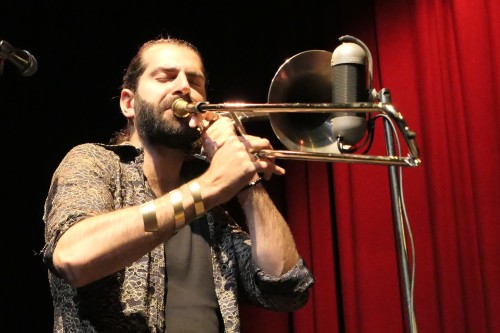
Photograph of Robinson Khoury by Justin McKeon
SUNDAY AT CHELTENHAM JAZZ FESTIVAL, 03/05/2026.
MAKAYA McCRAVEN TRIO, DEYA JAZZ ARENA
Makaya McCraven – drums, percussion, Marquis Hill – trumpet, electronics, percussion, Junius Paul – electric bass
The first date at the newly named DEYA Jazz Arena, sponsored by local craft brewery DEYA, featured this stellar trio led by the Chicago based drummer, composer and producer Makaya McCraven.
McCraven comes from something of a Chicago jazz dynasty and I recall seeing his father, Steve, playing drums with saxophonist Archie Shepp’s quartet at the 2015 CJF.
Makaya, born in 1983, is now an established star in his own right, a serial collaborator who works regularly with both American and British jazz musicians, playing a style of music rooted in both jazz and hip hop. Among the Brits with whom he has appeared are saxophonist Nubya Garcia and tuba player Theon Cross. The latter had led his own quartet at the Parabola Arts Centre the previous evening and is one of the musicians featured among the four different line-ups that appear on McCraven’s latest recording, the double album “Off The Record”, a live recording documented at various locations in the US and the UK. Both of today’s collaborators, trumpeter Marquis Hill and bassist Junius Paul also appear on that recording and selections from “Off The Record” were among the items performed at today’s show.
From the album the trio opened with “Away”, the introduction to which featured McCraven and Hill rustling various items of small percussion in a manner that evoked memories of the Art Ensemble of Chicago. Cymbal scrapes and the use of electronics also featured as Hill made the move to trumpet, sketching melodies above the increasingly hypnotic rhythmic grooves being generated by McCraven and Paul. The leader’s drums were very much at the heart of the trio’s sound, an ever evolving kinetic flow of rhythmic ideas, it’s no wonder that McCraven refers to himself as “The Bear Scientist”.
McCraven’s compositions appear to act as ‘sketches’, brief musical outlines that act as the catalyst for improvisation. The recorded version of “Away”, recorded with Paul and guitarist Jeff Parker, sounds, perhaps inevitably, very different to today’s interpretation of the same piece. As McCraven was later to explain his music is “rooted in improvisation”, adding that “improvisation is a natural state of being”.
The next item was centred around Paul’s implacable, loping bass groove as he locked in with McCraven’s drums to allow Hill the room to soar on trumpet. Hill is a bandleader in his own right and I recall enjoying seeing his Blacktet group at Ronnie Scott’s as part of the 2018 EFG London Jazz Festival. I have also seen him perform as a sideman with bassist Marcus Miller.
Perhaps the tight knit rapport that the trio exhibit shouldn’t come as too much of a surprise. McCraven and Paul also play in Hill’s current quintet. Bassist Paul was given an opportunity to express himself more fully with a solo on the pensive and brooding “Three Fifths a Man”, with Hill also featuring on echoed trumpet, his sound sometimes reminiscent of electric era Miles Davis.
Also from the “Off The Record” record, McCraven couldn’t stop himself repeating this joke, “Sweet Stuff” featured the sound of Harmon muted trumpet, another nod in Miles’ direction, although Hill’s expansive solo also featured him playing with an open bell. The trumpeter was supported by Paul’s muscular electric bass grooves and the seemingly indefatigable McCraven’s continued outpouring of rhythmic ideas.
McCraven finally took a rest when the next item, “This Place, That Place”, commenced with an extended solo bass passage from the consistently impressive Paul, which saw him using the body of his instrument as a form of auxiliary percussion. McCraven and Hill eventually rejoined him, with Hill taking over as the featured soloist.
By this point we were around fifty minutes in to what was billed as a seventy five minute set. I had to leave at this juncture to make my way to the Parabola Arts Centre for a performance by the French trombonist Robinson Khoury and his quartet. It was hard to drag myself away from McCraven’s compelling and rhythmically sophisticated music, music that appealed to both the head and the feet. As I took my leave bodies were swaying all around the arena in response to the ‘Beat Scientist’s’ experiments in groove.
On my way to the PAC I dipped into the on site record store to snaffle a copy of “Off The Record”, which I’ve been enjoying listening to ever since. I may have missed the grand finale, surely there must have been a full on drum feature somewhere along the line, but I’m very glad that I took the opportunity to see and hear Makaya McCraven and his trio.
I was sad to leave, but even better things were to come.
ROBINSON KHOURY QUARTET, PARABOLA ARTS CENTRE
Robinson Khoury – trombone, vocals, Eve Risser – piano, flute, vocals, Lina Belaid – cello, Simon Drappier – double bass
Part of the joy of jazz festivals is that they throw up exciting new musical discoveries, and I’ve enjoyed plenty of those at Cheltenham over the course of the last thirty years.
This year’s find was this quartet led by the French trombonist Robinson Khoury, a musician I hadn’t even heard of before this year’s CJF programme was announced. PAC programme co-ordinator Alex Carr had seen Khoury perform with his “Quatuor Demi-Lune” project at the 2025 Jazz Sous Les Pommiers festival in Coutances, France, and was determined to bring him to Cheltenham.
Today’s set featured a mix of jazz, classical and Arabic music with J.S. Bach, Henry Purcell, Arvo Part and Steve Reich all cited as musical influences. Khoury is also well versed in Arabic music and has links to both Lebanon and Syria.
In the CJF programme notes we were promised “not only a musical encounter, but also a quest for harmony, a tribute to the beauty of differences. It invites reflection on identity, sharing, and the resilience of cultures”.
This was music with a socio-political undercurrent, something reflected in the quartet’s sartorial choices, the men wearing what looked like skirts and the women trousers – or am I reading too much into that? What did subsequently become clear was Khoury’s disdain for the Israeli government and its actions in Palestine and Gaza.
Of the musicians on stage the only name I was previously familiar with was that of pianist Eve Risser, a leading figure on the French avant garde jazz scene. Her use of prepared piano techniques and other ‘under the lid’ activity was a distinctive component in an opening twenty five minute sequence comprised of the Robinson compositions “Sarabande” and “Invention in C Minor”, the later described by Khoury as “a response to J.S. Bach”. These classical influences were part of a performance that combined a ‘chamber jazz’ approach with a more challenging and vigorous aesthetic inspired by the jazz avant garde. Cellos and double bass were variously bowed and plucked as the music demanded and the performance included a bowed string duet plus a solo passage of pizzicato double bass. Relatively more conventional ‘jazz’ solos came in the form of more expansive offerings from Khoury and Risser. This was intelligent and absorbing music that touched many bases, brilliantly played by four superb technicians.
After introducing the band and announcing the contents of the opening segue Khoury promised us “something a bit different”. This proved to be a spellbinding excursion into the world of Arabic music featuring the highly rhythmic sounds of percussive bowing and dampened piano strings. Again strings were variously bowed and plucked with Drappier’s bass strings also dampened to provide a percussive effect. Khoury was featured on trombone while the consistently impressive Belaid delivered a stunning bowed cello solo that may have reminded British listeners of the UK’s own Shirley Smart, another musician with a thorough knowledge of Middle Eastern music forms.
One of Khoury’s other projects, MŸA, a trio with percussionist Anissa Nehari and pianist Léo Jassef: explores Middle Eastern music more fully, often in the company of guest vocalists such as Natacha Atlas. The MŸA album was released in 2024.
The next item was introduced by a passage of unaccompanied piano, later joined by trombone and plucked cello. This piece was also notable for the first use of Khoury’s singing voice, his wordless vocalising was high pitched but also assured and confident, despite its apparent vulnerability. All of the other group members added haunting vocal harmonies. This was a truly beautiful piece of music, further embellished by another flawless cello solo from Belaid. We later learned that this piece was titled “Dust” and that it represented a lament for those lost in the war in Palestine.
The cellist also introduced the next piece, subsequently entering into a dialogue with Khoury’s trombone, with bass and piano eventually added to the equation. As the music continued to evolve it took on a dance like quality that was very much in accordance with its title, “Bouree”. Khoury’s trombone solo saw him making use of a Harmon style mute, his playing woozy and impressionistic at first, accompanied by the sounds of bowed strings and piano innards. As Khoury’s brilliantly constructed solo continued to unfold he adopted a vocalised tone that imbued the music with a darker, more threatening quality. The piece eventually resolved itself with a return to the joyous dance inspired melodies of the opening section.
The closing “Ostinanto” featured Risser doubling on flute alongside the leader’s muted trombone and Drappier’s bass undertow. Khoury removed the mute for a virtuoso passage of unaccompanied trombone, pensive at first but then more confident and assertive. The introduction of piano, bass and cello then led to a beautiful, hymn like closing section that also featured the quartet member’s backing vocals.
This was an intelligent and imaginative performance that mixed many musical styles and which was brilliantly performed and presented. The quartet received a rapturous ovation from the audience at the PAC, the majority of whom must have been seeing the band for the first time.
The Robinson Khoury Quartet was this year’s big discovery and by a narrow margin my overall Festival highlight. It took a lot to top McCraven’s earlier performance – but this remarkable quartet managed it.
CAMILLA GEORGE QUARTET, PARABOLA ARTS CENTRE
Camilla George – alto sax, Renato Paris – piano, keyboard, vocals, Daniel Casimir – double bass, Rod Youngs – drums
From the shock of the new to the comfort of the familiar. Camille George has been a regular fixture on the Jazzmann web pages. Her three albums to date “Isang” (2016), “The People Could Fly” (2018) and “Ibio- Ibio” (2023) have all been reviewed elsewhere on these pages, as have live appearances by her quartet at Midlands gigs in Kenilworth and Coventry.
Nigerian born but London raised George’s music combines jazz influences, particularly bebop and hard bop, with West African elements. It’s a sound that has won her a considerable following, her popularity with audiences enhanced by her engaging personality, and there was a large and expectant crowd at the PAC for this afternoon’s event.
George brought along her regular quartet featuring pianist and occasional vocalist Renato Paris, bassist Daniel Casimir and drummer Rod Youngs.
The quartet commenced with “Tappin’ The Land Turtle” from the “People Could Fly” album. Introduced by Youngs at the drums and with Casimir on bass and Paris at his Nord Stage 3 keyboard soon added this piece combined jazz and Afro-beat elements in appealing fashion with George taking the first solo on alto, followed By Paris, who adopted an electric piano sound at the Nord. The performance was climaxed by a hard hitting drum feature from Youngs, a consistently impressive figure throughout today’s performance.
The title track from “The People Could Fly” saw Paris move to the PAC’s acoustic grand piano as George got things underway on alto, her playing gentle and wistful at first but more forceful and assertive as her expansive solo progressed. Paris contributed wordless vocals in addition to piano and bassist Casimir, a bandleader in his own right, was also featured as a soloist, his bass feature underpinned by the gentle patter of Youngs’ hand drumming.
From the “Ibio-Ibio” album the title of “Ekpe” references “the ancient secret society of the Ibibio people which upholds truth and connects with the ancestors”. George’s grandfather was once a member. Introduced by Youngs at the drums, who subsequently established a bustling groove, this piece was notable for the ebullient soloing of George on alto and Casimir on double bass.
This was segued with “The Long Juju Slave Route of Arochokwu”, also from “Ibio-Ibio”, a subtly funky offering featuring the soloing of Paris on electric keyboard.
Also from “Ibio-Ibio” the fast moving “Abasi” saw Paris returning to the piano as George unleashed a blistering alto solo that squeezed in a quote from the jazz standard “Softly As In A Morning Sunrise”. Paris followed at the piano, unaccompanied at first, but soon with the propulsive support of bass and drums. This was an eminently danceable piece that might have persuaded people to get to their feet at any other venue.
The final tune was unannounced but delivered another barnstorming alto solo from George as Paris doubled on piano and electric keys. Youngs, a powerhouse behind the kit throughout, rounded things off with an explosive drum feature.
This was a highly accomplished performance from George and her quartet with all the musicians playing with skill and verve. The quartet is a tight, well balanced unit capable of putting considerable flesh on the bones of George’s compositions. The leader soloed with power and fluency and presented the show with her usual charm and enthusiasm. Many listeners commented on the excellence of Youngs’ performance behind the kit, a Blakey-esque presence whose controlled power drew out the very best from his colleagues. No real surprises here, but a hugely enjoyable performance all the same.
GEORGIA CECILE, CHELTENHAM TOWN HALL
Georgia Cecile – vocals, Euan Stevenson – piano, Pete Horsfall – trumpet, flugelhorn, Alec Harper – tenor saxophone, Ferg Ireland – double bass, Max Popp– drums
Regular readers of The Jazzmann might have predicted that I would remain at the PAC for the performance by saxophonist Emma Rawicz. While it’s true that Rawicz is a bit of a Jazzmann favourite and has featured regularly on these web pages in recent years I had already seen her present her NKYRA project featuring today’s sextet at the Queen Elizabeth Hall at the 2025 EFG London Jazz Festival and suspected that today’s show would be very similar.
Not wanting to write a near identical review I opted for something different, a performance by the Scottish vocalist and songwriter Georgia Cecile at the Town Hall, a far more mainstream affair, but certainly not lacking in terms of musical quality.
I first became aware of Cecile and her music when she appeared at the Oldham Foundation Showcase at the 2022 Cheltenham Jazz Festival. This double bill with the blues singer and songwriter Elles Bailey was arguably the best of the entire Oldham series and it’s interesting to note that both Bailey and Cecile have been invited back to perform on the main concert programme.
Cecile used to sing with the Scottish National Jazz Orchestra and is a frequent winner at the Scottish Jazz Awards. What sets her apart from other aspiring jazz vocalists is the fact that she co-writes her own material, forming part of an impressive songwriting team alongside pianist Euan Stevenson. Her debut “Only The Lover Sings” features ten original songs by the pair and was named ‘Best Album’ at the 2021 Scottish Jazz Awards. By jazz standards the album has also been a considerable commercial success. Cecile has since released the EP “City Girl” (2025).
Cecile’s band in 2022 featured an all Scottish line up including Stevenson on piano plus Ryan Quigley (trumpet, flugel), Andrew Robb (double bass) and Max Popp (drums), a pretty formidable line up. This year’s line up, as listed above, was equally strong and provided the singer with excellent musical support.
Today’s event had been billed as “Georgia Cecile; American Songbook” and I suspected that we might get a set of Great American Songbook standards. Instead I was pleased to find that the programme featured a mix of GAS standards and Cecile / Stevenson originals, these drawing their inspiration from the Songbook, but with a contemporary twist.
At the start of today’s performance the instrumentalists took to the stage first in their band uniforms of light jackets and dark trousers. Cecile then made the grand entrance in a long black sparkly dress daringly slit up one side. The first song was “In New York”, Cecile and Stevenson’s paean to the ‘Big Apple’ and a song which features on the “City Girl” EP. There have been a lot of good songs written about New York City. This was one of them.
Cecile’s first dip into the standards catalogue was a sassy interpretation of “I Must Have That Man”, famously recorded by Billie Holiday. Cecile is a technically accomplished singer with a real talent for jazz phrasing. She’s also an increasingly confident stage performer who has ‘paid her dues’. As she later reminded us her first CJF appearance was on the free stage eight years ago, the success of which earned her that Oldham showcase. The sextet’s interpretation of “I Must Have That Man” also featured the impressive instrumental soloing of Harper on tenor sax and Horsfall on bluesy, plunger muted trumpet.
Cecile’s beautiful take on the ballad “Moonlight in Vermont” was inspired by a recorded version by Frank Sinatra. Part of the theme of today’s show was the influence and effect that the Great American Songbook has had on Cecile’s own musical career, and such recordings are obviously a huge part of that. Horsfall, a bandleader in his own right, was again featured on muted trumpet, this time deploying a far softer sound.
The GAS has had a profound influence on the original songwriting of Cecile and Stevenson. From the “Only The Lover Sings” album “Come Summertime” was a Songbook inspired song, the title an obvious nod to the Gershwins. But the song itself was very much the duo’s own, with Cecile’s wistful vocals augmented by Horsfall’s lyrical flugelhorn solo.
The sextet’s version of the standard “Mean to Me” was inspired by a Sarah Vaughan recording, ‘Sassy’ being one of Cecile’s primary influences. In addition to the leader’s Vaughan inspired vocals this performance also included excellent instrumental solos from Harper on tenor, Horsfall on trumpet and Stevenson at the piano.
Cecile’s version of the Duke Ellington composition “I Like The Sunrise” was inspired by a recording of the song by Frank Sinatra. The arrangement also included instrumental solos for tenor sax and muted trumpet.
Also written by Ellington a swinging version of “Duke’s Place”, a celebration of a perfect mythical jazz club featured a vivacious vocal from Cecile and showcases for all five instrumentalists.
Ellington and his co-writer Billy Strayhorn were also the inspirations behind the new Cecile / Stevenson original “A Room In My Heart”, a beautiful ballad that also featured lyrical instrumental solos from Horsfall on flugel and co-composer Stevenson at the piano.
A second new original, “Magnolia”, also drew on Ellington for inspiration, with the excellent Horsfall again featuring on flugel. Horsfall, himself also a singer, and Cecile also work together in Flight Call, a London based vocal trio that also features singer Lucy-Anne Daniels. The Flight Call line up has been featured at the PAC at a previous CJF.
A return to the standards repertoire for a bluesy rendition of “Come Rain or Come Shine” in an arrangement inspired by a Ray Charles recording. Introduced by a voice and piano duet the song began to gather momentum as the rest of the band kicked in, with Cecile encouraging the audience to clap along. The song also presented the chance for all five instrumentalists to demonstrate their ‘chops’, an opportunity that they all seized gleefully.
The Cecile and Stevenson original “1950s Tie” was both a sparky romantic put down and a celebration of a decade that all the band members were too young to remember, but which still exerts a profound influence on their music. Tenor saxophonist Harper emerged as the featured instrumental soloist.
Harper was also featured on the closing “This Is Love”, a Cecile / Stevenson original from the “City Girl” EP. Another song to be introduced by a voice / piano duet this piece also featured a passage of improvised lyrics celebrating CJF. One suspects that this is probably a regular ‘set piece’, the lyrical content varying depending on the location of the gig.
This was a classy performance from a highly accomplished vocalist and a similarly talented band. Cecile is confident performer and an excellent technician and is well served by her hand picked group. But it’s the inclusion of such high quality original songs that really makes Cecile stand out from the jazz vocal pack.
This performance was both enjoyable and impressive and fully vindicated my decision to choose this event.
YAZZ AHMED, PARABOLA ARTS CENTRE
Yazz Ahmed – trumpet, flugelhorn, electronics, Berlinde Deman – serpent, electronics, Ralph Wyld – vibraphone, marimba, electronics, electronic percussion, Elizabeth Nott – percussion
The final event of the 2026 PAC programme was the annual Tony Dudley-Evans Commission presenting new work from an artist selected by Tony Dudley-Evans, former Head of the PAC programme and Artistic Advisor to CJF as a whole. In his role as a promoter Tony has also been a stalwart of the Birmingham jazz scene for many years as the head of first Birmingham Jazz and later the Jazzlines organisation attached to Birmingham Town Hall / Symphony Hall. Currently he host his own series of largely free jazz / improvised music events at various Birmingham venues under the banner of TDE Promotions.
The seeds for tonight’s project were sown a number of years ago when Anglo / Bahrainian trumpeter and composer Yazz Ahmed was the recipient of a Jazzlines Fellowship, an award that allowed to compose and present new music the reflected her Bahrainian heritage. I was fortunate enough to witness her Jazzlines Fellowship Showcase event at the CBSO Centre in Birmingham back in 2015. My review of this performance which featured the premiere of the suite “Alhaan al Siduri” can be found here.
https://www.thejazzmann.com/reviews/review/yazz-ahmed-alhaan-al-siduri-cbso-centre-birmingham-03-10-2015
Ahmed has released our full length albums to date, “Finding My Way Home” (2011), “La Saboteuse” (2017), “Polyhymnia” (2019) and “A Paradise In The Hold” (2025). The last three of these are available in remixed versions, a reflection of Ahmed’s increasing interest in electronic music.
Tonight’s performance bought into this remix culture and included a combination of freshly written material with new versions of items from Ahmed’s previous albums, live remixes, if you will.
Ahmed fronted an unusually configured quartet with long time collaborator Ralph Wyld on vibes and marimba, plus a smattering of electronic percussion. Elizabeth Nott replaced the advertised Corinna Silvester in the percussion chair but what really made this group different was the presence of the Belgian musician Berlinde Deman playing the serpent, a medieval instrument that we were told represents the forerunner of the modern tuba. I’d never seen a serpent played live before and I suspect that most of the rest of the audience hadn’t either. Furthermore Deman treated the sound of this unusual beast via a range of foot pedals and other electronic devices, helping to create a very distinctive sound. I was able to speak with her after the show and she expressed her admiration for experimental tuba players such as Theon Cross and Oren Marshall, who also use electronics to manipulate their sound. She clearly sees herself and her instrument as being very much part of that tradition.
Meanwhile Ahmed has become more and more involved with electronic sounds as her career has developed and tonight functioned as much as an electronic musician as she did as a trumpeter.
Tonight was the first time that this particular line-up had played together and the performance commenced with a radical new interpretation of “Wah Wah Sowahwah”, a tune from Ahmed’s debut album. Wyld, playing marimba with four mallets, helped to provide a complex rhythmic base, further enhanced by his use of live looping techniques to create a web of multiple, interlocking marimba lines, reminiscent of the music of Minimalists such as Steve Reich and Philip Glass. Wyld’s contribution was augmented by Deman’s deep, electronically enhanced serpent bass lines, while Nott’s percussion, including the use of frame drums, added a vital humanising element. Ahmed’s echoed trumpet melody lines were also electronically enhanced. It all sounded very different to the original recording.
He next item featured a segue of the title track from “La Saboteuse” and the new composition “Io”, named for one of the moons of Jupiter. Ahmed introduced the piece by deploying a range of electronics, eventually picking up her flugelhorn as Nott entered the proceedings on frame drum. The ethereal atmosphere was enhanced by Wyld’s use of bows on the bars of the vibraphone, before he replaced them with mallets for a more conventional vibes solo.
An electronically generated rhythmic pulse seemed to mark the transition into the next piece, with Wyld adding electronic percussion and Deman a pulsing serpent generated bass line. With Nott featuring on cajon this electro-acoustic rhythmic ferment underpinned the subsequent solos from Wyld on vibraphone and the leader on trumpet.
From the “Paradise In The Hold” album the track “Though My Eyes Go To Sleep, My Heart Does Not Forget You” also harked back to Ahmed’s “Alhaan al Siduri” project. Taking inspiration from the folk music of Bahrain, and particularly that of the pearl divers and of the all female drumming groups whose members waited for the divers to return, this piece was a mix of folk melody and electro-acoustic rhythms, with Nott’s percussion and Wyld’s tuned percussion prominent in an arrangement that included more conventional soloing from Ahmed on trumpet and Wyld on vibes.
“The Lost Pearl”, a re-working of a piece from the “La Saboteuse” album was presented as a lament for the Gulf states, including Bahrain, currently being adversely affected by the war in the Middle East. It formed part of a lengthy segue that also incorporated the newer tunes “Spindrifting” and “Lost In The Wilderness”. Ahmed’s solo trumpet intro found her echoing, looping and layering her sound electronically prior to the eventual introduction of Wyld’s vibes, sometimes bowed, and the rustle of Nott’s percussion. Nott’s cajon and Deman’s serpent, with the body of Deman’s instrument sometimes being deployed as a kind of auxiliary percussion, introduced rhythmic impetus, with Nott even taking a short solo. Deman now adopted a more obviously tuba like sound on the serpent and combined effectively with Ahmed, who had now switched to flugel.
The final tune was “She Stands On The Shore”, the opening track from the “Paradise In The Hold” album. The title references Siduri a deity from the Epic of Gilgamesh and hence represents a direct link to her earlier Jazzlines commission. Today’s performance commenced with a deep, eerie drone generated by a combination of serpent and electronics, with Nott’s percussion rustling in the background. Ahmed eventually emerged to solo on flugel, her playing underpinned by increasingly hypnotic rhythms.
This was a performance that was generally well received by the discerning PAC audience, although some, including myself, expressed certain reservations. This was music that was both interesting and immersive, but I did feel that there was perhaps an over reliance on electronics, and I know that I wasn’t alone in thinking this. Nevertheless there was much to enjoy here from an artist who continues to challenge musical boundaries as she continues to develop her uniquely personal sound.
My thanks to Yazz Ahmed and to Berlinde Deman for speaking with me after the show as I treated myself to copies of “Paradise In The Hold” and Verlinde’s solo serpent and electronics album “Plank 9”. In Deman’s own words the immersive music of “Plank 9” “music for slow and dark hours”. About time we heard it on Radio 3’s late night slot then.
Overall Sunday at Cheltenham had delivered some exceptional music from five very different acts across a variety of jazz styles. All of the artists delivered in their own way but the award for ‘gig of the day’ must go to Robinson Khoury for music that was both unexpected and unique – and brilliantly realised.
blog comments powered by Disqus