

by Ian Mann
March 01, 2026
/ LIVE
Quality original writing, imaginative arrangements of the ‘outside’ material and some terrific playing from all the members of the sextet, all of whom performed with skill and verve.
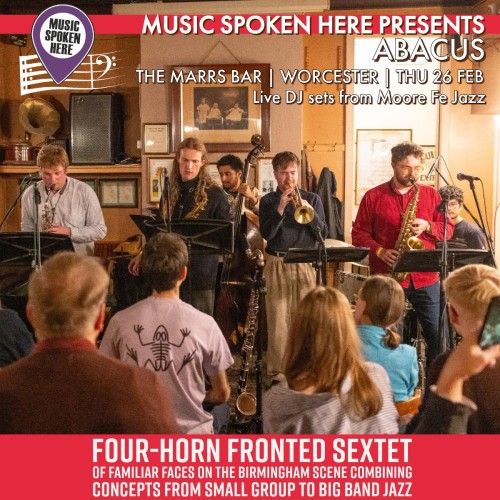
Abacus, Music Spoken Here, The Marr’s Bar, Worcester, 26/02/2026.
Liam Brennan, James Romaine – alto saxes, James Borland – trumpet, Simeon May – tenor sax, bass clarinet, Josh Vadiveloo- double bass, Kai Chareunsy – drums
Another excellent audience turn out for this Music Spoken Here event at The Marr’s Bar and this performance by Abacus, a sextet led by alto saxophonist and composer Liam Brennan.
Like the majority of his colleagues in this unusually configured line up Brennan is a graduate of the Jazz Course at Birmingham Conservatoire. Originally from Hitchin, Hertfordshire he comes from a musical family, his mother was a professional singer and music teacher. The young Brennan began learning the violin aged around six or seven before transferring to clarinet and later saxophone.
At the age of sixteen he became more serious about jazz, inspired by such musicians as trumpeter Miles Davis and saxophonists Stan Getz and Cannonball Adderley.
At Birmingham Conservatoire he studied saxophone with saxophonists Mike Williams and John O’Gallagher and composition with Ed Puddick and the great Mike Gibbs.
In 2019 I saw Brennan play at Cheltenham Jazz Festival as part of the annual Jazz Exchange event, a performance that also featured him as a composer. I then saw him again in 2023 playing with the Midland Youth Jazz Orchestra (MYJO) at Kidderminster Jazz Club, a performance that also saw him doubling on soprano sax and flute.
Brennan graduated in 2019 and remained in Birmingham. In 2021 he and tonight’s drummer Kai Chareunsy took over the running of the well established Jazz at The Spotted Dog series, which has subsequently morphed into the Parliamentary Jazz Award winning Digbeth Jazz, now based at the Night Owl.
In 2023 Brennan was part of the Jazz Central Mentorship Scheme, which was supported by Jazz Midlands, a consortium of West Midlands based promoters. Brennan was mentored by trumpeter and composer Laura Jurd, with whom he presented his Collidescope project, which also included Borland and Chareunsy. Borland and James Romaine were participants on the same scheme in 2024.
Brennan is currently studying for a Masters in Jazz Composition and Improvisation in Gothenburg, Sweden, this following previous studies in Oslo and Copenhagen. As an EU citizen, thanks to his Irish heritage, he has the option to stay on in Gothenburg once his degree has been completed.
As part of his composition studies in Birmingham Brennan began to write and arrange for big bands. He sees Abacus as vehicle for him as a composer, the unusual chordless line up of four horns plus rhythm acting as a bridge between big band and small group jazz. He draws inspiration from a similar line up led by the Israeli bassist and composer Omer Avital that recorded the “Asking No Permission” live album at Small’s Jazz Club in New York City.
As a composer and arranger Brennan draws further inspiration from Gil Evans, Oliver Nelson and John Hollenbeck, of Claudia Quintet fame. In addition to writing his own material he also likes to play around with standards, altering the structure in a style that he describes as “heavily arranged”. His own pieces are tightly structured but as the Abacus line up develops in live performance the individual members are now being afforded greater freedom for self expression.
Brennan also has his own Large Ensemble, for which he has written “The Castle Cove Suite”, a work based on his Irish heritage. Running a big band on a permanent basis is economically prohibitive, but Brennan sees Abacus as an enjoyable and effective alternative.
Tonight’s date was effectively the launch of Abacus’ eponymous debut live album, which was recorded at a 2023 performance at The Spotted Dog. It features four original compositions from Brennan, all of which we heard tonight, plus Brennan’s arrangements of tunes by Hale Smith, John Coltrane and Omer Avital.
Following the successful appearance of the London based all female octet at the previous MSH event promoter Dave Fuller introduced Abacus as “The Boys From Brum”, a slight misnomer as May is an old friend of Brennan’s and actually studied at the Guildhall in London. It was May’s second visit to an MSH event following his appearance with guitarist Jakub Klimiuk’s quintet in October 2024. The others five members are all Birmingham alumni, so I guess the label is fair enough.
From the outset it was obvious that Brennan’s composition studies have paid handsome dividends. Opener “Bop It, Twist it, Pull It” featured some fascinating writing for the horns with the use of counterpoint an integral component. A former MYJO member and now a bandleader in his own right, Borland took the first solo, a convincingly fluent statement that deployed many of the weapons of the trumpeter’s arsenal - smears, vocalisations etc. It was a lengthy excursion that was also impressive in terms of sheer stamina. He was followed by Romaine who was similarly impressive on alto. After these two expansive explorations Brennan signalled a return to the ‘head’ as the evening got off to an impressive and enjoyable start.
May had begun the set on tenor sax but switched to bass clarinet for “Cycles” and was the featured soloist, his sinuous playing accompanied by Vadiveloo’s steady bass pulse and the chatter of Chareunsy’s sticks on rims. May was also involved in an absorbing series of bass clarinet / alto sax exchanges with leader Brennan, and of course there was plenty of interplay between the full horn section too.
“One For Alan”, the exact identity of the dedicatee was not announced, began with a gentle horn chorale and saw May continuing on bass clarinet. Even following the addition of double bass and brushed drums the music retained something of a ‘chamber jazz’ quality, with May’s bass clarinet taking the melodic lead. But Brennan is a multi-faceted writer capable of varying the mood within a specific piece and here the music began to gather a lurching momentum as Chareunsy graduated from brushes to sticks and the collective sound became more strident and ‘full on’.
An intelligent and often poignant arrangement of John Coltrane’s beautiful ballad “Naima”, named for the composer’s first wife, cooled things down a little with May switching back to tenor sax and sharing the solos with Borland.
The second ‘outside’ item was “I Love Music”, a piece written by the American pianist and composer Hale Smith (1925 – 2009). Ushered in by the twin altos and with May reverting to bass clarinet this piece featured Brennan as a soloist for the first time, an extended outing fuelled by propulsive bass lines and crisp drumming. At times I was variously reminded of the playing of Lee Konitz and Ornette Coleman, as the rhythms became more loose limbed and free-wheeling as the piece progressed.
An excellent first set concluded with Brennan’s jazz arrangement of the traditional Irish folk tune “Drowsy Maggie”, a nod to Brennan’s Irish heritage. Brennan first heard the tune on an album by The Chieftains and he introduced the piece with a passage of unaccompanied alto sax. A near free jazz take on the tune also included the sounds of bass clarinet and bowed bass.
Set two commenced with the sextet’s title tune, “Abacus”. This was ushered in by a brilliant passage of unaccompanied four horn interplay, which continued even after the addition of bass and drums. Periodically the group would break down into smaller units, with Borland soloing on trumpet and Brennan and May resuming their alto / bass clarinet conversation. This was a multi-faceted piece that lent itself well to improvisation and tonight’s version was segued with “Harmony Sketch”, a more freely structured, open ended composition written during Brennan’s time in Oslo.
I assume that the title of “Jack and Gil”, the opening track on the sextet’s album, represents a tip of the hat in the direction of Gil Evans, an acknowledged influence. Characterised by darting melodic motifs and intricate horn interplay this piece featured May as a bass clarinet soloist, again displaying a remarkable fluency and agility on the instrument. He was offered excellent support by Vadiveloo’s resonant bass and Chareunsy’s deft drumming. Leader Brennan subsequently took over on alto, coming more and more into his own as a soloist.
Another tip of the hat with “Wayne-Lockrane”, a homage both to the American saxophonist Wayne Shorter and the British flautist Gareth Lockrane. This was introduced by Vadiveloo at the bass, playing both with and without the bow, subsequently joined by the plaintive wail of Brennan’s alto. Romaine subsequently took over the melodic lead as the rest of the horns were added, with May on tenor sax. Chareunsy bided his time, only joining when Borland assumed the lead. Eventually the two altos emerged as the featured soloists, Brennan going first, followed by Romaine, the pair probing deeply above a variety of martial and swing rhythms.
The sextet signed off with “IVORVI”, simply meaning “four or six”. This was a punchy piece with influences dating right back to New Orleans. Concise solos were the order of the day with Brennan leading things off on alto, followed by Borland on trumpet, May on tenor and Romaine on alto, this sequence going round a full five times before changing the order on the sixth to May, Brennan, Borland, Romaine, who all delivered a more extended closing statement.
This was a very impressive performance from Abacus that was warmly received by the MSH audience. I had wondered how a chordless sextet would go down at The Marr’s Bar and had been pretty uncertain about quite what to expect. What we got was some quality original writing, imaginative arrangements of the ‘outside’ material and some terrific playing from all the members of the sextet, all of whom performed with skill and verve. The main source of delight was Brennan’s writing for the horns which was bright, colourful intelligent and chock full of interesting details. The rapport between the four horn players was excellent throughout with bass and drums offering flexible and functional support, there were no real bass and drum features.
The “Abacus” album, which includes “Jack and Gil”, “I Love Music”, “Naima”, “Abacus”, “Wayne-Lockrane” and “IVORVI”, plus Omer Avital’s “Know What I Mean” stands up well in the home listening environment and features all the virtues that made tonight’s performance such a success. Well done “The Boys from Brum”.
blog comments powered by Disqus