

by Ian Mann
October 25, 2026
/ ALBUM
A thought provoking work that draws inspiration from a broad range of musical, cultural and sociological influences influences.
Al Swainger’s Pointless Beauty
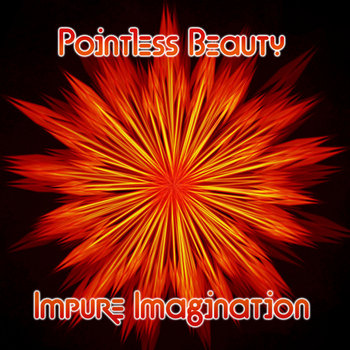
“Impure Imagination”
(Other Compass Records OCRPB011)
Al Swainger – bass, synths, guitar, piano, Jon Clark – drums, George Cooper – piano, Rhodes, Mike Outram – electric guitar, Gary Alesbrook – flugelhorn, muted trumpet
“Impure Imagination” is the third album from Bristol based bassist and composer Al Swainger’s Pointless Beauty project.
Swainger is something of a renaissance man, a bassist, composer, producer and educator who also works as a visual artist.
I initially heard his playing in his role as a jobbing jazz double bassist on the Bristol and South Wales jazz scene, a reliable sideman who has worked with saxophonists Kevin Figes and Tommaso Starace, vocalist / percussionist Tammy Payne and singer Becky Brine among many others.
The list also includes saxophonists Alan Barnes, Simon Spillett, Greg Abate, Alex Clarke, Sam Crockatt, Alex Garnett and Pete Long, trumpeters Byron Wallen and Bryan Corbett, guitarists James Chadwick and Denny Ilett and pianists Dave Newton and Craig Milverton.
Swainger also plays electric bass and is a prolific session musician who works across a variety of musical genres. Recent engagements include work with the BBC National Orchestra of Wales, Blue Lion Function Band, Michele Drees Jazz Tap Project and art rock band Grice.
In January 2024 Swainger ‘depped’ at short notice for the unavailable Andy Cleyndert at a performance by the Clark Tracey Quintet of Stan Tracey’s two Dylan Thomas inspired suites “Under Milk Wood” and “A Child’s Christmas in Wales” at the Black Mountain Jazz Club in Abergavenny.. Swainger stepped seamlessly into the breach and more than played his part in a magical evening of words and music (the performance also featured the narrating skills of Clark’s son, Ben Tracey) that earned a rare five star review from me.
https://www.thejazzmann.com/reviews/review/clark-tracey-quintet-black-mountain-jazz-melville-centre-abergavenny-28-01-2024
BMJ demonstrated their gratitude to Swainger by inviting him back to Abergavenny to perform with his own Pointless Beauty group in March 2025. This was another ‘multi-media production’, with the music this time accompanied by visuals, the latter made possible by an Arts Council grant.
The Pointless Beauty show at Abergavenny was a huge success both musically and visually and is reviewed here;
https://www.thejazzmann.com/reviews/review/al-swaingers-pointless-beauty-black-mountain-jazz-melville-centre-abergavenny-30-03-2025
The life of a jobbing jazz bassist and session musician was never likely to wholly fulfil Swainger’s creative urges. These find full expression in Pointless Beauty, a project that began in 2013 that performs music that its creator describes as “cinematic fusion for the emotionally curious”.
This has resulted in two CD releases to date, 2017’s “After & Before”, which featured Swainger on bass and keyboards alongside trumpeter Neil Yates, guitarist Mike Outram, keyboard player George Cooper and drummer Mark Whitlam.
This was followed in 2022 by “Hearts Full of Grace”, much of which was written during the Covid lockdown period. This featured a different version of the group with Swainger and Cooper joined by trumpeter Gary Alesbrook, drummer Jon Clarke and guitarist Ant Law. The album takes its title from a quote by Martin Luther King;
“All we need to serve…is a heart full of grace, a soul generated by love”.
Swainger’s Bandcamp page also includes a number of digital releases under the Pointless Beauty banner, ranging from single tracks and EPs to the full length digital album “A Lonely Vigil” (2014). Several of these are largely solo recordings rather than full band projects.
As can be seen some pretty heavyweight names have passed through the ranks of Pointless Beauty. Yates, Outram and Law are musicians with national reputations who have all appeared on these web pages on numerous occasions. The other players are all top quality ‘regional’ musicians, the cream of Bristol and the West Country, and many of these are also regular presences on the Jazzmann site.
Swainger is a thinker as well as a musician and artist. His liner notes for “Impure Imagination” reflect on the nature of art and identity while musing on the thorny subject of AI (artificial intelligence). Interestingly for this new recording Swainger utilises AI as a compositional device, but more on that later.
Here’s his album cover essay in full, culled from his Bandcamp page;
“One of the questions I find hardest to answer about the art I make is: What is it?
I understand the need behind the question. We look for reference points because they help us feel oriented. But for me, the reason to make something is often to explore the spaces between things that already exist.
The more I simplify the answer, the less true it can begin to feel. Too much legibility can become a kind of self-censorship, carving away the strange, fragile or unresolved parts that made the work worth making.
Perhaps a more useful question is: How do I find a way to belong? For me, belonging does not always come from recognition. Sometimes it comes from curiosity, shared uncertainty, and accepting that some things arrive on their own terms.
Many of the tracks on this album look, from different angles, at the promise and danger of invisible systems with real-world consequences. Where and how are we encouraged or allowed to express ourselves? Who speaks for us when agency is removed? What happens to our sense of humanity when automated processes are trusted too far?
Our lives are very often shaped by seeming chaos. Sometimes that means grief, loss and instability. Sometimes it brings joy, insight and liberation. Fragility and imperfection feel central to what makes us human, and I find myself drawn to the things that resist being smoothed out.
When our culture prioritises speed, repeatability and instant recognition, there is still value in patience, imperfection and surprise.
In a digital world, our sense of belonging can be conceptual as much as geographical. If I belong anywhere, then it’s in the music I compose, the art that I make and the live performances I give.
There’s more than enough room for you too, if you’d like to join me.
Al Swainger, 5 May 2026 ”
The album commences with the scene setting “This Paper House”, a short solo, lyrical piano piece performed by George Cooper that acts as a kind of overture for the album as a whole.
The three part composition “The Wheel” emerges in atmospheric fashion with the industrial clicking of Clark’s percussion augmented by the gently swirling sounds of synth and Rhodes and the ghostly, muffled tones of Alesbrook’s flugel. The music gradually begins to build in intensity, but retains its air of atmospheric mystery. Swainger’s electric bass subsequently emerges as the lead instrument as he solos above an ambient backwash, his languid bass sound sometimes reminiscent of the great Eberhard Weber. The final part sees the band establishing a near funk groove that provides the vehicle for an invigorating series of keyboard, flugel and guitar exchanges, all powered by the leader’s bass, now more like Pastorius than Weber, and Clark’s powerful drumming.
“Seedling” is introduced by the sound of a stylus dropping onto a vinyl record. Outram’s guitar then steers us towards a loping groove that provides the basis for collective group improvisation plus some fine individual moments from Alesbrook on flugel, Outram on guitar and Clark at the drums. The overall sound is still basically ‘fusion-esque’, with Swainger the producer skilfully mixing acoustic and electronic sounds together to create a genre straddling sonic landscape that is very much his own. This is one of the pieces that was played at Abergavenny where Swainger described his composition as “a piece representing a conversation between four people over an extended period of time that is variously amicable and animated, with periods of disagreement”.
Credited to Swainger and Clark “Pacing the Web” commences with a whimsical march, paced by Clark’s drums and Alesbrook’s muted trumpet, with synth and electronics also in the mix. Cooper emerges as the first soloist on gently trilling Rhodes, eventually handing over to the more muscular timbres of Outram’s guitar. Alesbrook then weighs in on muted trumpet, helping to create a group sound reminiscent of that of electric era Miles Davis. Indeed Davis is one of Swainger’s acknowledged influences, alongside such diverse figures as Chick Corea,Bill Evans, Wayne Shorter, Bill Frisell, Prince and David Bowie.
A passage of unaccompanied acoustic piano introduces “We’re Only Haunted”, a lyrical ballad that also features the sounds of the leader’s bass and Clark’s brushed drums. Guitar and flugel are subsequently added, with Alesbrook eventually emerging as a soloist, immediately followed by Outram.
The album is structured like a two act play and the composition “Out of Time” functions as the ‘interval’. It’s a piece that was also played at Abergavenny where Swainger informed us that it was inspired by the ringing of church bells in Valencia, with Swainger attempting to transpose their complex interlocking patterns to his bass. This recorded version begins as a duet between Swainger on bass and electronics and Cooper at the piano, an engaging dialogue with the leader producing some astonishing sounds from his instrument. Drums, guitar and flugel are subsequently added as part of an interlocking maelstrom of melody and rhythm as Swainger realises his ambitions for this piece in a full band context.
The second ‘act’ begins in the same way as the first with a passage of solo piano from Cooper introducing the episodic composition “What the Fire Forgot”. However this time around the music evolves into a full band performance with the addition of flugel, guitar and drums, with Alesbrook’s flugel assuming the melodic lead. Swainger takes a solo on liquidly melodic electric bass, followed by Alesbrook on velvety flugel horn and Outram on melodic electric guitar. Cooper then takes over on acoustic piano, before handing back to Alesbrook. The piece continues to ebb and flow with a second short passage of solo piano followed by a soaring guitar solo from Outram. Whichever instrument assumes the lead the pervading spirit is one of co-operation rather than competition, with all parties serving the music faithfully.
“I Wish (Upon a Disused Star)” represents Swainger’s first experiment with AI. Words written by Swainger were given artificial voice by ElevenLabs, “directed, edited and musically placed” by Swainger. The artificially generated ‘female’ voice declares “I wish upon a disused star that I could be real and not an avatar”. ‘She’ sings wordlessly too. The voice is integrated with the instruments to create a convincing ‘avant pop’ song, so convincing that on first listening and having not read the press release in full I was scanning the cover for the guest vocalist. The voice of the ‘singer’ even appears to express a degree of emotion and frustration as the piece progresses. It all makes for intriguing, and perhaps important, listening.
“Who // Are // We” returns us to instrumental territory, another episodic piece ushered in by Cooper at the piano, but also featuring electronics and later an unstoppable drum groove that fuels further solos from Cooper on piano, Alesbrook on flugel and Outram on guitar, the latter again reaching for the stratosphere. There’s something of an acid -jazz / nu jazz feel about the music here, a characteristic that informs the album as a whole.
“Fractured Grace” is two minutes of spacey, slightly sinister ambience generated by Swainger solo, deploying a combination of bass and electronics.
The album concludes with the nine minute epic “On Borrowed Dreams”, the second piece to feature AI generated voices. With synths and electronics playing a significant part in the arrangement it’s perhaps the most obvious ‘prog rock’ piece in the programme as it moves through a series of distinct phases, floaty and ambient at first before Clark establishes a bustling, hard driving drum groove that elicits instrumental solos from Alesbrook on flugel, Cooper on Rhodes and Outram on guitar. The AI voices are variously deployed to provide soaring backing vocals on the groove led passages and slowed down spoken word passages in the opening and closing ‘ambient’ sections.
“Impure Imagination” builds upon the success of the two Previous Beauty albums and like its predecessors is a thought provoking work that draws inspiration from a broad range of musical and cultural influences. It’s not a conventional jazz album, but jazz is an important component of the music alongside rock, pop, electronica and more. The writing is imaginative and intelligent and the playing by all members of the group is excellent throughout. This is an album that can be enjoyed on a purely musical level, but its underlying cultural and sociological themes certainly make you think. The way in which Swainger blends acoustic and electronic sounds is consistently intriguing and imaginative with mixing and mastering engineer Alex Killpartrick playing a key role in helping Swainger to pull all the disparate elements together so successfully.
Swainger’s blend of jazz, prog and more certainly appeals to me. I’d suggest that he might like to attempt to take the Pointless Beauty band onto the prog rock circuit of gigs and festivals – it’s a strategy that has worked for Living in Shadows, Zoe Gilby and Andy Champion’s jazz / prog project, and I note that Welsh pianist Dave Jones has been doing the same with his Stratospheric project.
Living in Shadows has been very well received by the prog rock community and the group has played a number of prog rock festivals during the summer of 2026. Meanwhile Gilby and Champion have retained their distinctive individual jazz identities. Theirs is a strategy that might work for Swainger too.
In the meantime recordings featuring Al Swainger can be purchased here;
https://alswainger.bandcamp.com/
See also;
https://www.alswainger.com/
blog comments powered by Disqus