

by Ian Mann
April 08, 2026
/ ALBUM
It’s rare to hear trad jazz played as brilliantly as this and I genuinely enjoyed listening to this album.
Alyn Shipton’s New Orleans Friends
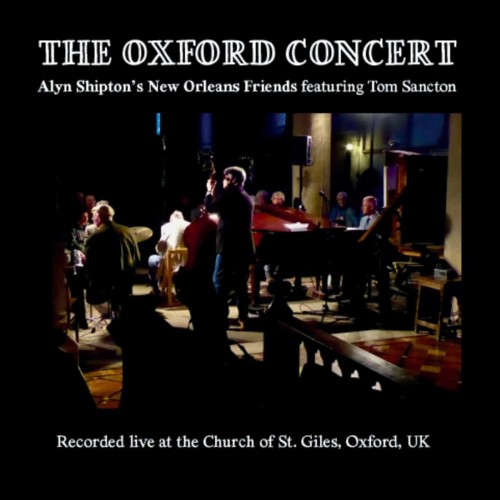
“The Oxford Concert”
Alyn Shipton – double bass, Tom Sancton – clarinet, Alan Gresty – cornet, Martin Litton – piano, Simon Picton – banjo, Trevor Richards – drums
Alyn Shipton (born 1953) is perhaps best known for his roles as a jazz journalist, author, historian, educator and broadcaster. He was the jazz correspondent for The Times for over twenty years and is currently the presenter of Jazz Record Requests on BBC Radio Three.
He also used to present the highly informative, and much missed, Jazz Library series on Radio Three, sometimes taking the series ‘out on the road’. I recall seeing him interview the late, great pianist and composer John Taylor at the 2012 Cheltenham Jazz Festival.
I remember meeting with him once at Cheltenham in the early days of The Jazzmann. He was very pleasant and as a professional journalist and broadcaster was also very supportive of the efforts of this dedicated and enthusiastic amateur blogger. His positive comments meant a lot and it was both an honour and a pleasure to meet him. Thank you, Alyn.
Shipton is a contributor to Jazzwise magazine and is also a published author with several books on jazz history to his credit, including biographies of Fats Waller and Bud Powell. He has also edited the memoirs of such notable musicians as Doc Cheatham, George Shearing and Chris Barber.
As an educator he has taught at Oxford Brookes and Exeter Universities and he is currently a lecturer in Jazz History and a research fellow at the Royal Academy of Music in London.
In addition to his journalistic and academic achievements Shipton is also a working musician, a skilled double bass player who has recorded with trumpeters Freddie Kohlman, Clive Wilson and Pat Halcox, cornetist Ken Colyer, saxophonist / clarinettists Sammy Rimington and Bill Greenow, clarinettists Herb Hall and Bob Wilber, pianist Butch Thompson and many more. He has been a member of the Inter Cities Jazz Band, the London Ragtime Orchestra and currently plays with the Buck Clayton Legacy Band and its smaller variant the Buck Clayton Legacy Quintet.
As can be seen from the names listed above Shipton is an admirer of traditional New Orleans jazz and leads his own group Alyn Shipton’s New Orleans Friends. Formed in 2019 the sextet’s primary influence is New Orleans clarinettist George Lewis (1900 – 68) and particularly Lewis’ celebrated 1954 album “Jazz at Vespers”, recorded at a church service in Oxford, Ohio and featuring a programme comprised of jazz arrangements of hymns and spirituals.
Lewis performed other “Jazz at Vespers” concerts in other church locations in the US and Shipton has taken his own project to perform at various religious spaces around the UK. Shipton’s own “Oxford Concert” was documented at a performance at St. Giles Church, Oxford on 11th May 2024, part of the regular Jazz at St. Giles series of live events.
It represents the second concert recording by ASNOF, the first having featured a different line up comprised of Shipton, trumpeter Finlay Milne, clarinettist Adrian Cox, guitarist / banjoist Simon Picton, pianist Richard Simmons and drummer Emile Martyn. Only Shipton and Picton remain from this incarnation but the material on both discs is similar, being drawn from Lewis’s “Jazz at Vespers” repertoire.
The story of how the current line up of the New Orleans Friends came together is best summarised in the press release accompanying the “Oxford Concert” recording;
“Alyn Shipton formed the New Orleans Friends in 2019 to celebrate the music of the great Crescent City clarinetist and bandleader George Lewis. Every member of the band, along with Alyn himself, has spent time in New Orleans, learning the music at first hand from the musicians who created it. But this particular concert is special, as the clarinetist, Tom Sancton, grew up in the city and was encouraged to play by Lewis himself. Tom is now one of the leading exponents of the style, anywhere in the world.
He and Alyn met as students at Oxford University in 1972, and formed their first band together then, which also included the drummer on this album, Trevor Richards. He was also a student at the time, at Surrey University, but he had already spent time in the USA studying drums with the great Zutty Singleton, and later lived and worked in New Orleans for many years. Trevor has played and recorded with many legends of traditional and swing era jazz, and although he, Tom and Alyn have played together occasionally over the years, this collection finds Trevor reunited with his original band-mates in Oxford, 52 years after their very first concert in the city!
Also joining them in the line-up is cornetist Alan Gresty, a long-term member of Monty Sunshine’s band and at one time co-leader of the very popular UK band, the Ragtimers, with clarinetist Brian White. He has played alongside several New Orleans legends and keeps the authentic cornet style alive. Martin Litton, on piano, is an acknowledged expert on the style of Jelly Roll Morton, but here he catches all the nuances of the Big Easy’s piano tradition, fitting perfectly into the rhythm section. And that section is completed by the Scottish-born banjoist Simon Picton, well-known in the UK and Europe for his fine and empathetic playing.”
The music is very obviously rooted in the New Orleans tradition and the programme commences with Thomas A. Dorsey’s “Precious Lord” with Shipton combining with banjoist Picton and drummer Richards to set the rhythmic pace as Gresty’s cornet and Sancton’s clarinet intertwine, with both also delivering fluent, blues tinged solos. Picton’s banjo also comes briefly to the fore, as does Litton’s piano, before cornet and clarinet again combine to round things off in joyous fashion, with Simmons’ press rolls urging them on.
Garfield Haywood’s “Streets of the City” is given a similar treatment with propulsive rhythms again encouraging some terrific interaction between cornet and clarinet prior to further impressive individual solos. The offerings from Picton and Litton are no less worthy and their solos are equally well received by the audience. The whole band then coalesce on a rousing outro that elicits a highly enthusiastic reaction from the crowd.
The pace slows during the first part of Kenneth Morris’ “Just a Closer Walk”, initially a kind of funeral march paced by banjo, bass and drums, topped by blues tinged horns. A solo drum break from Simmons’ then introduces the lively ‘second line’ section of the tune with the now frantic rhythms eliciting effusive solos from Sancton on clarinet and Picton on banjo, with the audience clapping along to the latter. There’s no letting up in terms of pace as Gresty takes over on cornet, although Litton’s piano feature, unaccompanied at first, does give the other players a moment of rest before the build up to the big finish.
The hymn tune “The Old Rugged Cross”, written by George Bennard, follows. Again it’s a relatively slow start with clarinet and then cornet prominent in the early stages. The interplay between the horns again impresses, as does the individual soloing.
Next up is Lewis’ adaptation of “Over The Waves”, a waltz written by the short lived Mexican violinist and composer Juventino Rosas (1868-94). The arrangement begins in waltz time with Sancton taking the melodic lead, before exploding into swing with the whole ensemble really tearing it up. Sancton’s dancing clarinet continues to lead before he eventually hands over to Litton. The pianist delivers an excellent solo, urged on by leader Shipton at the bass. Litton is a musician whose playing I have enjoyed on numerous occasions over the years as he used to play in the Welsh Border area on a regular basis. It’s then back over to Sancton to take us storming out.
Th clarinettist also features prominently on George Lewis’ own “Jerusalem Blues”, which primarily serves as a vehicle for Sancton’s fluent and emotive soloing. He is rewarded with a rapturous reception from the Oxford audience.
The album concludes with “Algiers Strut”, written by ‘Nawlins trumpeter Kid Thomas Valentine (1896-1987) and named for the New Orleans suburb of Algiers. As the title might suggest it’s a high energy finale with Richards hurrying things along from the drums as Sancton and Gresty exchange ideas and Litton demonstrates his mastery of New Orleans piano styles. Sancton then features as a soloist, eventually handing over to Picton, a genuine banjo virtuoso. Finally it’s the turn of Simmons with an explosive drum feature. The horns then combine effectively on the effervescent outro.
I’ll admit that I’m not always a huge fan of trad jazz but it’s rare to hear it played as brilliantly as this and I genuinely enjoyed listening to this album. At times I was reminded of the music of the Preservation Hall Jazz Band, whose playing I got to enjoy during my one and only visit to New Orleans way back in 1991.
Although credited as the leader Shipton seems happy to remain in the engine room and its the other players who grab the attention as soloists. All are hugely impressive as individuals but this is an ensemble that also functions very effectively as a BAND. At times Litton’s piano is a little low in the mix but this is a small quibble in the context of the recording as a whole.
This may be ‘Jazz as Repertory’ but “The Oxford Concert” is still a very exciting recording and those audience members that were privileged to be there must have had a great time. For the rest of us it’s great to have the material available on disc.
blog comments powered by Disqus