

by Ian Mann
September 01, 2026
/ LIVE
This young quartet’s affectionate, but not slavish, tribute was warmly received by an appreciative audience. An excellent evening of music making that certainly exceeded my expectations.
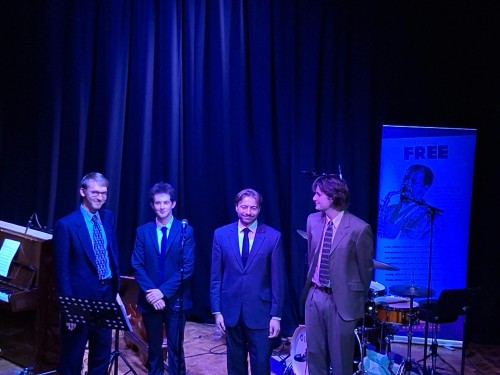
Benedict Stephens Quartet presents The Bill Henderson Project, Black Mountain Jazz, Melville Centre, Abergavenny, 30/08/2026.
Benedict Stephens – double bass, John Johnson – vocals, Tom Barber -piano, Phil Thompson – drums, percussion
Manchester born, Cardiff based bassist Benedict Stephens studied at the Royal Welsh College of Music and has established himself as an in demand presence on the South Wales jazz scene.
A highly accomplished double bass player he has performed with vocalists Debs Hancock and Kat Rees, harpist Ben Creighton-Griffiths, trombonist Tiggy Blackwell, drummer Patrick Barrett-Donlon, pianist Newman Tai, saxophonist Glen Manby and the Siglo Section Big Band among others.
Stephens’ first project as a bandleader sees him leading his own quartet in a tribute to the late American jazz vocalist and actor Bill Henderson (1926 – 2016).
As an actor Henderson appeared in twenty six films and twenty three TV series but it’s his work as a jazz vocalist that really concerns us here. As a leader or co-leader he released a dozen albums between 1959 and 2008 as well as guesting on numerous other recordings.
Henderson worked with many of the leading figures in the jazz firmament, among them vocalists Nancy Wilson, Shirley Horn and Chris Connor, pianists Horace Silver, Oscar Peterson, Ramsey Lewis, Tommy Flanagan and Wynton Kelly, bandleaders Count Basie and Thad Jones, saxophonists Eddie Harris and Pete Christlieb, trumpeter Booker Little, bassist Charlie Haden and drummer Chico Hamilton, plus many others.
Ten years after Henderson’s passing he remains something of a forgotten figure in jazz circles. I have to admit to knowing precious little about him prior to tonight’s event.
The Stephens Quartet’s tribute focusses on one particular aspect of Henderson’s career, the album “Bill Henderson with the Oscar Peterson Trio”, released on the Verve record label in 1963. Much of tonight’s material was sourced from that recording, although other important moments from Henderson’s career were covered too.
During the course of the performance Stephens explained that the Henderson / Peterson album was one of the first jazz recordings that he ever heard and that it represented an important formative influence both for himself and tonight’s vocalist John Johnson. Stephens and Johnson were schoolfriends, and although the singer is still based in Manchester he was the bassist’s first choice as the vocalist for this project. Pianist Tom Barber and drummer Phil Thompson are both Cardiff based – and for those of you who might have been wondering, yes Tom is the son of pianist Jim Barber, the latter a long time stalwart of the South Wales jazz scene.
The Henderson / Peterson album featured the deluxe rhythm section of star bassist Ray Brown and long time Peterson associate, drummer Ed Thigpen. By all accounts tonight’s arrangements stuck pretty closely to those on the recording, but with the trio members stretching out much further on the instrumental solos in the freedom of the live music environment.
The performance commenced with a song sourced from that recording, Cole Porter’s “At Long Last Love”, which has also been recorded by Frank Sinatra and by Henderson collaborator Nancy Wilson. Wisely Johnson didn’t attempt to sing it like Sinatra, or even like Henderson, although his phrasing was closer to that of the latter. Barber and Stephens both impressed with extended instrumental solos while Thompson gravitated between brushes and sticks as the music required. The drummer was also featured in a series of exchanges with pianist Barber.
Announcing duties were shared between Johnson and Stephens, with the latter explaining something of the origins of the project before the quartet played “You Are My Sunshine”, another song from the recording. This was introduced by a voice and piano duet with Barber’s blues tinged piano complementing Johnson’s vocals. Double bass and brushed drums were subsequently added. Closer in execution to the recording there were no extended instrumental solos, and the song began as it ended with just voice and piano.
The first departure from the album repertoire came with “Am I Blue?”, a ballad also recorded by Ethel Waters and Billie Holiday. Introduced by a passage of unaccompanied piano from Barber Johnson’s vocals were also complemented by the sounds of double bass and brushed drums. Barber’s subsequent piano solo was flowingly lyrical and the performance concluded with a voice and piano duet.
On the Henderson / Peterson recording the traditional American folk tune “The Crawdad Song” was re-invented by Henderson as the blues “Baby Mine”. Tonight’s version was introduced by a double bass and vocal duet between Stephens and Johnson, with brushed drums and piano subsequently added. An increase in pace brought about a piano solo from the consistently impressive Barber. The conclusion of the song saw the pianist drop out, leaving the trio of voice, double bass and brushed drums, with Stephens eventually left alone for an unaccompanied bass coda.
“I Wish You Love”, described by Johnson as “a break up song that also manages to be joyous”, was also recorded by the Henderson / Peterson Quartet. Here the song represented something of a vehicle for Stephens, who introduced the piece with a passage of unaccompanied double bass and later delivered an extended solo that was striking for its sheer dexterity. Stephens is an excellent technician and is the latest in a line of superb Wales based bass players that includes Paula Gardiner, Ursula Harrison, Ashley John Long, Aidan Thorne and BMJ’s own Nick Kacal. In between this and Johnson’s vocalising we also enjoyed a swinging and expansive piano solo from Tom Barber.
Also from the featured recording the upbeat “A Lot Of Livin’ To Do” saw the quartet romping through a song with lyrics that seem to celebrate the ‘American Dream’. Much covered in the 1950s and 60s the optimism of the lyrics looks a little jaded in 2026. This was an ensemble piece that included no instrumental solos.
The first set concluded with an unexpected twist as Stephens and Thompson left the stage for Johnson and Barber to deliver a duo version of the Gershwin ballad “I’ve Got A Crush On You”. Introduced by a passage of unaccompanied piano and with Barber again featuring later in the song this performance in an exposed instrumental setting was a real test of Johnson’s vocal abilities, and one that he passed magnificently.
The second set also began in unusual fashion with all four members of the group taking part in the hand clapped intro to “Gravy Waltz”, a song written for the Henderson / Peterson album by bassist Ray Brown. Naturally Stephens’ bass was featured prominently as he shared the solos with Barber at the piano.
Also from the featured album a swinging, fast paced version of “The Lamp Is Low” again featured instrumental solos from Stephens and Barber. Written in the 1930s by composers Peter DeRose and Bert Shefter, with lyrics by Mitchell Parris, the song borrows from Maurice Ravel’s composition ““Pavane pour une infante défunte”. Thanks to John Johnson for pointing this out.
The quartet continued with the album repertoire for a beautiful interpretation of the Jerome Kern / Oscar Hammerstein ballad “The Folks That Live On The Hill”, introduced by the duo of Johnson and Barber and with double bass and brushed drums subsequently added.
The leader’s bass introduced a gently swinging arrangement of the Arthur Schwartz / Hoard Dietz song “I see Your Face Before Me”, with voice and brushed drums added as Johnson delivered the first verse in trio format. The addition of Barber then presaged instrumental solos for piano and double bass.
A move away from the Henderson / Peterson album repertoire came with “Señor Blues”, a composition by the pianist Horace Silver and originally recorded as an instrumental for the 1956 album “6 Pieces of Silver”. Silver later wrote lyrics for the tune and with Henderson featuring as vocalist the new version was released as a single in 1958. It still ranks as one of the Blue Note label’s biggest selling singles.
Introduced by the trio of Stephens, Barber and Thompson, the latter hand drumming and deploying small items of percussion, the piece embraced Silver’s familiar blending of hard bop with Latin influences and included instrumental solos from Barber and Stephens plus a series of exchanges between the two, and also between bass and drums, with Thompson variously acting as both mediator and facilitator. Meanwhile Johnson delivered Silver’s self aggrandising lyrics of an inveterate womaniser in playful and insouciant fashion, even adding his own improvised lyrics with a reference to Abergavenny. Naturally this proved to be very popular with the audience.
Another non-album item, “Baby Won’t You Please Come Home” was delivered in the form of a ballad with Barber’s lyrical piano solo followed by Stephens’ melodic bass solo, this incorporating use of the bow. Johnson’s vocals were underpinned by Thompson’s martial, but subtle, rhythms.
Prior to the final number Stephens thanked BMJ’s Debs Hancock and Mike Skilton, and also soundman Dave, who had done an excellent job, attaining an excellent balance between the voice and instruments.
The quartet finished with the fast paced and playful “Sweet Pumpkin”, with Johnson’s rapid fire lyrics delivered above Stephens’ propulsive bass lines. A bass and drum dialogue was followed by a final piano solo from Barber.
This young quartet’s affectionate, but not slavish, tribute was warmly received by an appreciative, and pleasingly substantial audience and the deserved encore was a vocal version of the Bobby Timmons hard bop classic “Moanin’”, famously recorded by Art Blakey and The Jazz Messengers and also by Timmons himself in the piano trio format. Jon Hendricks later added lyrics and the song was then covered by Lambert, Hendricks and Ross. It was the vocalese version that we enjoyed here with Johnson’s delivery of Hendricks’ lyrics augmented by instrumental solos from Stephens and Barber, plus a full on drum feature from Thompson as the music gathered an unstoppable momentum.
This was a great way to end an excellent evening of music making that certainly exceeded my expectations. I’m not always a big fan of male jazz vocalists but Johnson gave an impressively mature performance and proved to be an excellent interpreter of the quartet’s chosen material. Since the show I’ve also enjoyed checking out Henderson himself on Youtube. Again I’ve enjoyed what I’ve heard and I’m delighted to have been introduced to Henderson’s music by these four highly talented young men.
I was previously familiar with the playing of Stephens and Barber, having seen the latter with the RWCMD Big Band. Johnson and Thompson represent exciting new discoveries and my thanks go to all the band members for speaking with me after the show.
Well done guys, a good night’s work and a fitting tribute to Bill Henderson, a musician that Stephens thinks deserves a bigger profile. In their own way Stephens and his quartet are raising awareness of Henderson’s legacy and I’d like to think that were others in the audience who have subsequently checked Henderson out on line.
blog comments powered by Disqus