

by Ian Mann
January 29, 2026
/ ALBUM
A classy piece of work that demonstrates Goldsby’s gifts as both a player and a writer. The playing from the members of one of the top contemporary jazz orchestras in Europe is exceptional throughout.
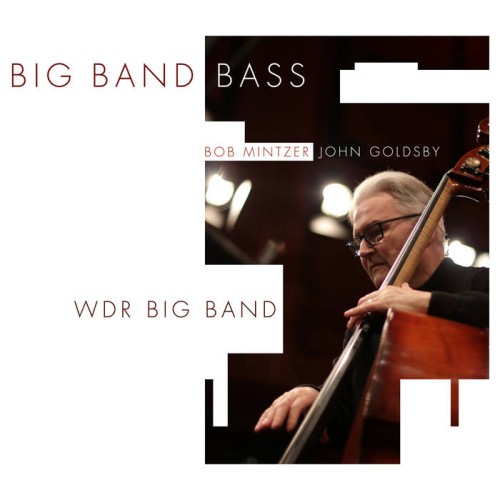
WDR Big Band featuring John Goldsby and Bob Mintzer
“Big Band Bass”
(Bass Lion Publishing)
WDR Big Band
Bob Mintzer – Principal Conductor, tenor saxophone
John Golsdby – double bass
Johan Horlen, Karolina Strassmayer, Ben Fitzpatrick, Paul Heller, Jens Neufang – reeds (saxophones, flutes, bass clarinet)
Wim Both, Rob Bruynen, Andy Haderer, Ruud Breuls – trumpets
Ludwig Nuss, Raphael Klemm, Andy Hunter – trombones
Mattis Cederberg – bass trombone
Billy Test – piano
Hans Dekker – drums
Guests;
Bastian Stein – flugelhorn (track 4)
Paul Shigihara – guitar (track 8)
Xavi Torres – piano (track 8)
Stefan Pfeifer-Galilea – alto sax (track 8)
Jonathan Bobel, Phillip Hayduk – trombones (tracks 3-7)
In December 2024 the American born bassist John Goldsby stepped down after thirty years in the musical ‘engine room’ of the Cologne based WDR Big Band. Released in November 2025 “Big Band Bass” represents a celebration of those thirty years with an album that sees Goldsby stepping forward as both a composer and a soloist. Seven of the album’s eight tracks are written by Goldsby and he features as a soloist on five of them.
In addition to his work with the WDRBB Goldsby has also released a number of small group recordings, these often featuring sub-divisions of the larger ensemble, a case in point being “Segment”, a 2021 trio recording featuring Goldsby, pianist Billy Test and drummer Hans Dekker, the rhythm section of the WDRBB. Under Goldsby’s leadership the album comprised of five original compositions by Goldsby and three by Test, plus two standards from the pens of jazz immortals Charles Mingus and Charlie Parker. Review here;
https://www.thejazzmann.com/reviews/review/the-john-goldsby-trio-segment
Goldsby’s other small group recordings under his own name include “Tales of the Fingers” (1993), “Live at the Nachbar” (2008) “Space for the Bass” (2009) “The Visit”, a duo set with pianist Bill Dobbins, also 2009, and “The Innkeeper’s Gun” (2010). There has also been a series of “WDR Big Band Small Group Sessions” recordings.s
Goldsby was born in Louisville, Kentucky and established himself on the local jazz scene before moving to New York in 1980. Following fourteen years in the ‘Big Apple’ he took up a post with the WDR Big Band and emigrated to Germany in 1994.
During his time in New York Goldsby performed regularly with the drummer and bandleader Mel Lewis, who frequently travelled to Europe to work with the WDRBB. Goldsby credits Lewis with playing a substantial role in the WDRBB’s development and the Band began to employ more American musicians, including trumpeter John Marshall, who encouraged Goldsby to audition for the bass chair following the retirement of the Band’s Belgian bassist Jean Warland.
During his time as a professional musician Goldsby has worked with many of the greats of jazz, among them pianists Jay McShann, John Lewis and John Hicks saxophonists Dave Liebman, Michael Brecker, Scott Hamilton, Johnny Griffin and James Moody, trumpeters Benny Bailey, Tom Harrell and Roy Hargrove, drummers Louie Bellson, John Marshall and Peter Erskine, guitarist Barney Kessell and vibraphonist Gary Burton. This list is by no means comprehensive and readers are referred to Goldsby’s website http://www.johngoldsby.de for further biographical details.
Goldsby is also an acclaimed educator who has held a number of teaching posts at a variety of German educational establishments. In addition to providing lessons and on line courses he is also the author of several books concerned with bass playing techniques. He is also a featured writer for Bass Player magazine and other specialist journals relating to the instrument.
I saw Goldsby perform live with the WDRBB back in 2018 when the Band, led by saxophonist and conductor Bob Mintzer were involved in a collaboration with the British born pianist, keyboard player and composer Bill Laurance (of Snarky Puppy fame) at that year’s EFG London Jazz Festival. This hugely enjoyable event took place at the Queen Elizabeth Hall and my review can be found as part of my Festival coverage here;
https://www.thejazzmann.com/features/article/efg-london-jazz-festival-day-ten-sunday-november-25th-2018
I’m reasonably certain that the majority of the Band that played at the QEH are also present on this recording. I do recall being particularly impressed by alto saxophonist Karolina Strassmayer, who is among the musicians featured here.
In his liner notes Steven A. Cerra of the Jazz Journalists Association favourably compares “Big Band Jazz” with recordings by other big bands led by bassists, notably Ray Brown, Christian McBride and Ron Carter. Praise indeed – Goldsby is rubbing shoulders with some very heavyweight company.
Mintzer’s primary role on the album is that of conductor and arranger. Five of of the eight pieces feature his arrangements of Goldsby’s compositions. Dave Horler and Michael Abene arrange one Goldsby piece each.
However the album commences with “Sonatinita”, written and arranged by Vince Mendoza, who has also enjoyed a lengthy association with the WDRBB. An intriguing arrangement features all of the saxophonists doubling on flutes, their bright and airy high register sounds contrasting very effectively with the deeper sonorities of Goldsby’s double bass, which remains prominent throughout the piece. Eventually the tune gathers greater momentum, the change of tempo representing the launching pad for fluent solos from trombonist Ludwig Nuss and Goldsby on double bass, the latter largely with only Dekker’s economical percussion for company.
Arranged by the British trombonist Dave Horler, a former WDRBB member, Goldsby’s own “In the Hills” announces itself rather more forcibly, with Cerra making comparisons to the music of Stan Kenton. Again Goldsby’s bass is foregrounded much of the time as part of a bright, punchy and intelligent arrangement that includes some colourful horn voicings. The featured soloists are the same as on the opening track with trombonist Nuss going first, followed by Goldsby at the bass, a virtuoso outing that displays an admirable dexterity.
“Blue Balloon” takes its inspiration from hard bop with Mintzer taking over the arranging duties. Pianist Billy Test enjoys moments of prominence but the featured soloists are saxophonists Johan Horlen (alto) and Paul Heller (tenor) plus trumpeter Ruud Breuls, who all enjoy expansive and frequently powerful excursions delivered with great skill and imagination. Breuls solo punctuates that of the two saxophonists as Goldsby drops back to fulfil his usual supporting role.
“Kleopatra’s Secret” takes its title from the name of the resident white Burmese cat at the Brenners Park Hotel in Baden Baden. A suitably slinky Mintzer arrangement features lush horn voicings that include the sounds of flutes and bass clarinet. Test delivers a flowingly lyrical piano solo, accompanied by Goldsby’s bass and Dekker’s drums (brushes first, sticks later) as the “Segment” trio is re-united. Similarly fluent and intelligent solos come from Bastian Stein, guesting on flugelhorn, and Strassmayer on alto sax.
“You Can Call Him Maestro” features a gently swinging Mintzer arrangement that includes the sounds of flutes and muted brass in its early stages. Goldsby then takes over with a sumptuous and highly melodic bass solo. There’s a continuing focus on lower register sounds with the deep resonances of the trombone solo from guest Jonathan Bobel. There’s also an uncredited saxophone solo as the music continues to gather momentum, the arrangement increasingly strident and punchy.
The ballad “Dahlia Garden” was inspired by another location in Baden Baden, the Lichtenthaler Allee. Again arranged by Mintzer the piece elicits a wondrously tender and fluent baritone sax solo from Jens Neufang, this followed by an exquisite bass solo from Goldsby that really demonstrates his gift for melody both as a player and as a composer. Neufang’s playing on this piece has attracted favourable comparisons with that of Harry Carney in the Duke Ellington band, which represents praise of the highest order.
By way of contrast the final Mintzer arrangement “Baron’s Dilemma” is an uptempo big band ‘burner’, a three tenor saxophone chase featuring the rousing soloing of Ben Fitzpatrick, Paul Heller and Mintzer himself. Goldsby and the rest of the rhythm section provide furiously energetic propulsion, with drummer Dekker sounding as if he’s really enjoying himself.
The album concludes with Michael Abene’s arrangement of the Goldsby composition “Sergio”, a Brazilian flavoured piece dedicated to a tour guide that the bassist met during a visit to that country. Its breezy samba rhythms and elegant horn arrangements frame Goldsby’s final solo of the set, a lengthy excursion that is both articulate and joyous as he signs off after thirty glorious years at the heart of the WDRBB.
“Big Band Bass” is a classy piece of work that demonstrates Goldsby’s gifts as both a player and a writer. As Cerra points out Goldsby’s compositions display a definite flair for melody and his tunes are well served by a trio of exceptional arrangers in Mintzer, Horler and Abene, the latter a former Principal Conductor of the WDRBB.
The orchestrations generated by these three, and also Mendoza, are rich and colourful both in terms of textures and dynamics and the playing from the members of one of the top contemporary jazz orchestras in Europe is exceptional throughout.
All in all it represents a fine way for Goldsby to sign off, although I’m sure we’ll be hearing a lot more from him in other musical contexts.
blog comments powered by Disqus