

by Ian Mann
April 01, 2026
/ LIVE
I was pleasantly surprised and hugely impressed by Brass Band Bychan and particularly so by their decision to perform all original music.
Brass Band Bychan, Black Mountain Jazz, Melville Centre for the Arts, Abergavenny, 29/03/2026
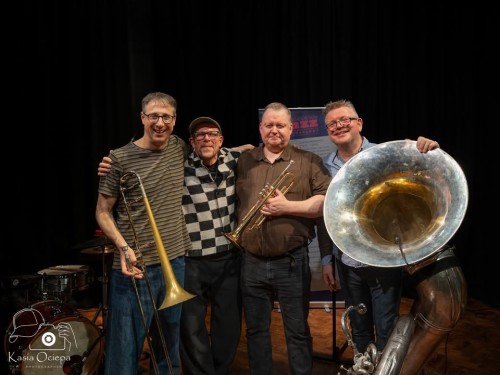
Gareth Roberts – trombone, Gethin Liddington – trumpet, Alastair Stewart – sousaphone, Mark O’ Connor – drum kit
Black Mountain Jazz will celebrate its 20th Anniversary in 2026, a remarkable achievement for Club founder Mike Skilton and his team.
The Club started at the Crown & Sceptre pub in Mardy on the outskirts of Abergavenny before moving into the centre of town for two stints at the Kings Arms punctuated by a period at the now closed Swan.
BMJ moved to its current home at the Melville Centre for the Arts at the beginning of 2016 and has enjoyed a fruitful relationship with the venue for the past ten years, something that looks set to continue. The Melville has hosted may memorable shows during its time as BMJ HQ, the majority of which have been reviewed by The Jazzmann, who has been covering BMJ events since 2008.
Along the way the successful Wall2Wall Jazz Festival has been established to augment the regular Club and Youth Workshop programme. Black Mountain Jazz really has been one of the great success stories of Welsh jazz and also of the wider UK jazz scene.
In this anniversary year Mike Skilton has been researching the history of BMJ and for tonight’s event had brought along three handsome laminated posters, all signed by the performers, from the Club’s early days at the Crown & Sceptre. These were particularly relevant to tonight’s event as three of tonight’s musicians, trombonist and leader Gareth Roberts, trumpeter Gethin Liddington and drummer Mark O’Connor all appear on those early posters. Club stalwarts all they have all appeared at BMJ many times over the years in a variety of different line-ups.
The first of these posters was for a performance by the cult Cardiff band Heavy Quartet in December 2006, BMJ’s second ever event. Roberts was part of the HQ line-up on that occasion.
In January 2007 BMJ welcomed the much missed Jones O’Connor group featuring Mark O’Connor at the drums, his brother Chris on bass and the unrelated Jones boys, Richard on guitar and Paul on keyboards. This line-up recorded two albums and even attracted the attention of the London jazz media.
Roberts, Liddington and Mark O’Connor were all members of Roberts’ own quintet, which visited in June 2007, the line-up completed by Paul Jones and Chris O’Connor.
Roberts himself has been a regular presence on the Jazzmann web pages since 2006. His two quintet albums “The Attack of the Killer Penguins” (2006) and “Go Stop Go” (2010) are reviewed on this site as is the Heavy Quartet album “Hardware” (2009), on which Roberts features prominently as both musician and composer.
I’ve also enjoyed Roberts’ playing in a live context on multiple occasions whether as the leader of his own groups, as a member of Heavy Quartet or as a busy sideman. He also co-leads a quartet with pianist and composer Dave Jones (no relation to Paul and Richard, as far as I’m aware).
For a number of years Roberts was the musical director of the Monmouth Big Band, an ensemble featuring some of South Wales’ leading jazz musicians. Roberts composed and arranged for the band, including writing “The Monmouthshire Suite” specifically for them, in addition to conducting and playing. He has since relinquished this role, but the Band itself has continued under the guidance of trumpeter Mike Prestage.
Roberts latest project is Brass Band Bychan, the name translating as “Little Brass Band”. It features his long time associates Liddington and O’Connor plus the sousaphone player Alastair Stewart, who was making his first visit to BMJ.
BMJ recently hosted the Full House Brass Band, led by saxophonist Jack McDougall (Jack Mac), another Abergavenny regular and also a member of the BMJ house band, the BMJ Collective. It was interesting to compare the two.. The FHBB is a five piece featuring sax, trumpet, trombone, sousaphone and drum kit and specialises in arrangements of tunes by contemporary New Orleans brass bands such as the Rebirth Brass Band, the Dirty Dozen brass band and others. I’ve seen the FHBB on a couple of occasions and have thoroughly their performances, which have combined a flamboyant energy with considerable musical skill on a series of inventive arrangements. Brass Band Bychan is no less skilled but put the focus on Roberts’ original writing, which I found to be very refreshing. There’s room for both approaches and I consider myself to be fan of both outfits.
BBB commenced with a new arrangement “Go Stop Go Man”, effectively the title track of Roberts’ 2010 quintet album and a composition also recorded by Heavy Quartet. Stewart ushered the piece in on sousaphone, soon joined by O’Connor at the drums. Roberts and Liddington then joined the party with the trumpeter taking the melodic lead and delivering the first solo. Roberts’ trombone solo was accompanied by drums only, with sousaphone subsequently added. Stewart’s astonishingly agile sousa bass lines were a feature of the music throughout the evening, his playing of the huge instrument representing an impressive feat of physical resourcefulness.
A new Roberts original was titled “Hymfft”, pronounced “Humphed”, but nothing to do with Humphrey Lyttelton as a jazz listener might have surmised. Instead “Hymfft” is favourite word used by Roberts’ young son to express his dissatisfaction with something. This began with an unaccompanied trombone intro featuring vocalised low end growls, with Roberts eventually joined by sousaphone, drums and Liddington’s plunger muted trumpet. Roberts also deployed a plunger mute during the course of his trombone solo. Meanwhile Liddington discarded his mute to solo with an open bell. Stewart enjoyed – if that’s the right word – a brief sousaphone solo before Liddington picked up the plunger again on the outro.
Roberts informed us that his original “Hardd Gri”, translating as “Beautiful Cry”, was originally inspired by the music of bebop pianist Bud Powell, but had since mutated into something else entirely. Described by its composer as a “fifteen bar ballad” this also featured plunger muted trombone, but the feel of the music was completely different with Roberts’ solo underpinned by O’Connor’s gentle mallet rumbles and unexpectedly sensitive sousaphone. Liddington deployed a bucket mute to soften his sound at the beginning of his trumpet solo, later removing it as the music evolved, underpinned by semi-martial rhythms, a slow march featuring the sounds of sousaphone and drums. Beauty isn’t always a quality associated with jazz brass band music but it was very much in evidence here.
The prosaically titled “Four Bass Lines” was introduced by an unexpectedly compelling unaccompanied sousaphone feature, with O’Connor’s drums subsequently added. Roberts and Liddington shared the melody briefly before diverging to experiment with elements of counterpoint in a series of trombone and trumpet exchanges. Each then stretched out further with fluent and expansive individual solos with Liddington going first. His trumpet solo certainly brought a smile to O’Connor’s face, as did a Roberts trombone solo that explored the full sonic possibilities of the trombone, with vocalised sounds again a feature. Stewart and O’Connor then entered into a dialogue that evolved into a full on drum feature, with O’Connor making effective use of cowbell as Roberts and Liddington returned for the outro. Stewart’s playing of the four bass lines of the title was genuinely impressive and he was an integral part of the BBB sound.
An excellent first half concluded with the appropriately titled “Something Happy”, described by Roberts as “a workshop tune”. Roberts is also an acclaimed music educator and regularly utilises this tune at workshops for primary school children – “it’s an eight bar tune you can do anything with”, he explained. It certainly lived up to its title and was a fun way to round off an excellent opening set. Embracing something of a South African Township feel it included solos from both Roberts and Liddington plus a further series of exchanges between the pair, underpinned by Stewart’s remarkably mobile sousa bass lines. Stewart was also evolved in a dialogue with O’Connor that again evolved into a drum feature. Great stuff.
The second half kicked off with “Coup d’etoot”, introduced by Stewart on sousaphone, his fat but agile bass lines fuelling the trombone and trumpet exchanges of Roberts and Liddington as the pair traded solos. Stewart and O’Connor then enjoyed their own dialogue before trombone and trumpet returned for the outro.
“Coup d’etoot” was specifically written for BBB but this second set also saw Roberts dipping deep into his back catalogue with new arrangements of a couple of tunes from his 2006 debut album “The Attack of the Killer Penguins”. First up was the opening track from that record, an adaptation of the traditional Welsh folk tune Wrth Fynd Efo Deio I Dywyn”. A live favourite in its quintet format this rollicking tune was just as entertaining in its BBB incarnation. A solo trombone intro featuring vocalised sounds emerged into a trombone and trumpet dialogue with both Roberts and Liddingtom deploying plunger mutes. As Liddington stated the folk melody Stewart and O’ Connor weighed in on sousaphone and drums respectively with Stewart’s propulsive bass lines subsequently fuelling the rousing trumpet and trombone solos of Liddington and Roberts. Culminating in a drum feature from O’Connor this item was very well received. Twenty years on from “Penguins” it remains a perennially popular live favourite.
From the same album “Mop Dancing” was written by Roberts about his habit of knocking over pints of beer when performing in the pubs and clubs in Cardiff, the landlady frantically mopping up the spillages as the band played on. Another infectious and highly melodic tune this also proved to be a crowd favourite with Stewart’s sousaphone intro followed by the melodic exchanges of Liddngton and Roberts, these followed by more expansive individual solos from the pair.
Roberts’ “A Celebration of Stubbornness” represents the composer’s good natured dig at his wife’s obstinacy and has been in the repertoire of his regular quartet for some time. The first half of the piece is a gentle romantic ballad that tonight featured the warm, rounded sounds of trombone and sousaphone, with trumpet subsequently added as O’Connor temporarily sat out. The more up-tempo second part was ushered in by trombone with O’Connor joining the party, combining with Stewart to add rhythmic heft to the soloing of Liddington on trumpet and Roberts and trombone. Centred around a recurring motif this up-tempo romp concluded with a drum feature from the excellent O’Connor.
Roberts’ wife also supplied the title of “Siw Piw”, named for “a fictitious weather forecaster from Pembrokeshire”. Again specifically written for Brass Band Bychan this featured the trombone / trumpet interplay of Roberts and Liddington on the intro, and also included solo features for both, plus Stewart on sousaphone.
I’ll admit to not always being a huge fan of the brass band format but I was hugely impressed by Brass Band Bychan and particularly so by their decision to perform all original music – bar the odd Welsh folk tune. Perhaps I shouldn’t have been surprised, Roberts, Liddington and O’Connor have been consistently delivering the goods for over twenty years. Meanwhile Stewart proved to be an exciting new discovery.
The crowd wasn’t quite as big as for some recent BMJ events but the performance itself was excellent and those that were there were highly appreciative of the band’s efforts. I was pleasantly surprised and thoroughly enjoyed this evening’s performance. Well done to Gareth and the guys.
I’d certainly be more than happy to see Brass Band Bychan again, particularly as Roberts is now writing specifically for what is a very well balanced group. Roberts, Liddington and O’Connor have been working together on a regular basis for years and have developed a strong rapport, while Stewart has quickly established himself as a key member of the project.
Thanks to Gareth and Mark for speaking with me after the show and Gareth for verifying the set list details.
blog comments powered by Disqus