

by Ian Mann
July 23, 2026
/ ALBUM
Maintains the high standard of playing and writing that has distinguished Molley’s previous albums, with the current line-up of the quartet particularly well suited to this project.
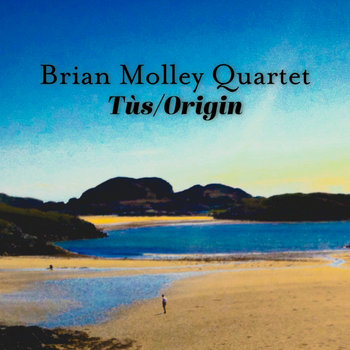
Brian Molley Quartet
“Tùs/Origin”
(Self Released)
Brian Molley – saxophones, Tom Gibbs – piano, David Bowden – double bass, Stephen Henderson – drums
A slightly belated look at this latest release from the Scottish saxophonist and composer Brian Molley, which was first issued in March 2026.
Molley first came to my attention as a founding member of the acclaimed Scottish reeds/brass group Brass Jaw and appeared on their début album “Burn” back in 2006. Originally a saxophone quartet Brass Jaw subsequently adopted a different instrumental format when Molley departed the group’s ranks to concentrate on a solo career, his place being taken by trumpeter Ryan Quigley.
One of Molley’s longest running engagements has been as a member of drummer Stu Brown’s Twisted Toons project, the critically acclaimed interpretation of the music of composer and musical inventor Raymond Scott, the man best known for the soundtracks of Bugs Bunny and other Loony Tunes cartoons. Brown released the album “Twisted Toons” in 2009 and the success of the project has ensured that he has toured it extensively (I caught his sextet, featuring Molley at Black Mountain Jazz in Abergavenny in 2012) including several prestigious jazz festival appearances including Cheltenham, Manchester, Gateshead and London. Brown has since broadened his remit to explore the music of other composers of music for cartoons such as Carl Stalling and Scott Bradley.
An important figure on the wider Scottish music scene Molley has also appeared with a wide variety of jazz, classical and pop ensembles including the Scottish National Jazz Orchestra.
As a bandleader he released his first quartet album “Clock” in 2013, a modern mainstream recording that featured Brown on drums, pianist Tom Gibbs and bassist Mario Caribe. Review here;
https://www.thejazzmann.com/reviews/review/brian-molley-quartet-clock
The same line up then recorded “Colour and Movement” (2017), an album that ranged further and which revealed the quartet’s growing interest in Indian music following a series of successful tours to the sub-continent. Review here;
https://www.thejazzmann.com/reviews/review/brian-molley-quartet-colour-and-movement
“Modern Traditions” (2021), with Brodie Jarvie replacing Caribe on bass, took things a stage further with Molley extending his range of instruments to include flute and bass clarinet. Review here;
https://www.thejazzmann.com/reviews/review/brian-molley-quartet-modern-traditions
Next came “Intercontinental”, a collaboration between the BMQ and the Indian percussionist Krishna Kishor. Review here;
https://www.thejazzmann.com/reviews/review/brian-molley-quartet-with-krishna-kishor-intercontinental
I’ve yet to hear 2025’s “Journeys”, recorded in Rajasthan and a collaboration between the members of the BMQ and the Indian musicians of the Asin Langa Ensemble, led by vocalist and sarangi player Asin Langa.
Molley has also been involved in collaborations with both Brazilian and Moroccan musicians.
Molley’s latest project, “Tùs/Origin” introduces a new quartet with long time collaborator Gibbs continuing at the piano alongside bassist David Bowden and drummer Stephen Henderson. The last two are best known as the rhythm section of the widely acclaimed Fergus McCreadie Trio, led by pianist and composer Fergus McCreadie.
With “Tùs/Origin” Molley seeks to explore the links between traditional Scottish folk music and early jazz. He posits that certain elements of Gaelic music, most notably call and response and improvisation, were taken by travellers to the New World and subsequently played an important role in the eventual development of jazz.
Here’s how Molley’s Bandcamp page summarises the new album;
“Brian Molley Quartet blend Scottish folk, hoedown, fugue, Afro-Caribbean dance, gospel and jig in a suite exploring why the origins of jazz are a lot more Scottish than we all think!”
Numerous Scottish jazz musicians have incorporated elements of traditional Scottish folk into their own music and there are many players who straddle the boundaries between the two genres. Folk elements represent a core part of Fergus McCreadie’s music so the bass and drum team of Bowden and Henderson represents the perfect rhythm pairing for Molley’s latest project.
The album commences with “Ode to Frederick Douglass, Parts One and Two”, Molley’s dedication to the former slave and political activist / statesman Frederick Douglass. In his role as an abolitionist Douglass visited Scotland in the 1840s and 50s. Molley’s piece is actually very brief and acts as a kind of overture for the album as a whole, ushered in by a stately, almost hymnal, passage of unaccompanied piano from Gibbs. Molley’s solo tenor saxophone is subsequently added, unadorned at first but subsequently subjected to an element of electronic manipulation that I’m not convinced is absolutely necessary. This is a piece that is beautiful enough with just the sounds of piano and undoctored tenor.
The opener segues almost immediately into the vigorous “Ritornello Ceilidh” with the leader’s tenor negotiating some tricky melodic lines with their roots in traditional jigs and reels. The whole piece is played at a terrific pace with Molley eventually digging in to deliver some powerful sax soloing more obviously rooted in the jazz tradition but with the folk elements still occasionally bubbling to the service. The rhythm section, and particularly Henderson, remains fiendishly busy throughout.
The album is represented as a kind of suite so again there’s a rapid transition into the more reflective “Cianalas (longing for home)”, initially a wistful piece featuring the sounds of gently rolling piano, bowed bass and shimmering cymbals, and eventually that of the leader’s keening soprano sax.
But this is a two part piece and the melancholy and nostalgia doesn’t last forever and the mood begins to pick up during the course of an invigorating and inventive piano solo from Gibbs, followed by dexterously plucked double bass excursion from Bowden. Molley, now back on tenor also adds an expansive and ultimately uplifting tenor sax solo, before that introductory melancholy makes a return at the close, ushering us into a reprise of “Ode to Frederick Douglass”, initially performed as a beautiful sax and piano duet, before subtly brushed drums are added. The electronic aspect also returns and is more effective second time around.
“Dance of the Waves” begins with a piano motif that sounds as if it’s been borrowed from a sea shanty while Henderson’s skipping drum grooves and the leader’s prancing soprano are perfect reflections of the tune’s title. But this is very much another two part composition and a sudden stylistic shift sees the music enter more obvious jazz territory with the spirit of the Blue Note record label very much to the fore. We may have started in Scotland but now we’re very much in America. This second section incorporates thrilling, high energy solos from Molley, now on tenor, and Gibbs at the piano as Bowden and Henderson stoke the rhythmic fires. The folk element returns at the close, reintroducing an element of both wistfulness and whimsicality.
I believe that the title of “The Man and the Lion” is sourced from Douglass’ writings. It is a folk tinged jazz ballad performed by the duo of saxophone and piano. Molley and Gibbs portray a sense of lyrical melancholy with the excellent Gibbs, a bandleader in his own right and a true stalwart of the Scottish jazz scene, delivering a beautiful piano solo.
The title of “Trail of Tears March” references the forced evacuation of Native Americans from their ancestral homelands. Henderson’s slow drum march introduces the piece, joined by bass and piano and finally Molley’s ruminative, delicately probing tenor sax.
The following “Frederick’s Lament” is essentially a continuation, based around the same melodic motif and martial rhythm but containing a stunning piano solo from Gibbs, an exultant peal of notes rather at odds with the tune’s title. It’s followed by an unaccompanied double bass solo from Bowden that seems rather more in keeping, up until the moment that he starts up the vigorous and propulsive motif that kickstarts the final piece.
“Storm, Whirlwind and Earthquake” is as energetic as its title might suggest, fuelled by Bowden with the assistance of Henderson and Gibbs. We’re back into Blue Note territory, with a hint of New Orleans along the way. Molley’s tenor wails fluently above the hard driving rhythms while Gibbs again delivers the goods with another dazzling piano solo. Henderson also impresses with a powerful but intelligent drum feature and Bowden makes another brief cameo.
“Tùs/Origin” maintains the high standard of playing and writing that has distinguished Molley’s previous albums, with the current line-up of the quartet particularly well suited to this project.
At around thirty five minutes in length the album is relatively short by contemporary standards but this is a unified work, a ‘suite’ if you will, and in this sense the recording is very much a success, fully realising its objectives.
“Tùs/Origin”, plus Molley’s other albums as a leader, are available via his Bandcamp page here;
https://brianmolley.bandcamp.com/music
See also;
http://www.brianmolley.co.uk
blog comments powered by Disqus