
by Ian Mann
November 03, 2026
/ LIVE
It’s been a long time since I last enjoyed freely improvised music of this quality and the whole event represented an enjoyable and invigorating musical experience.
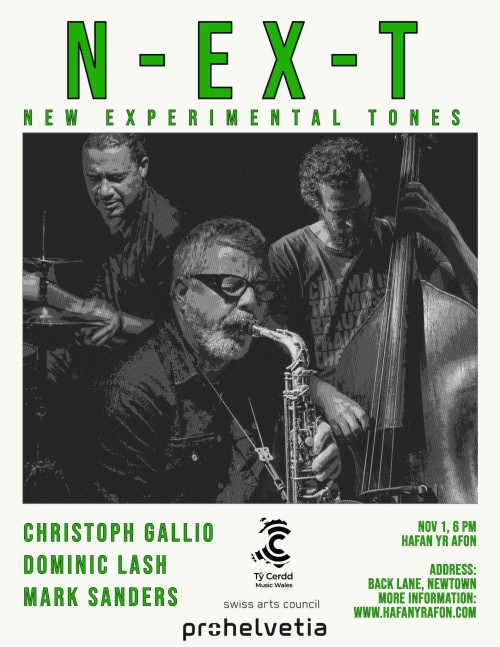
Christoph Gallio / Dominic Lash / Mark Sanders, Hafan Yr Afon, Newtown, Powys, 01/11/2026.
Christoph Gallio – alto, soprano & c-melody saxophone, Dominic Lash – double bass, Mark Sanders – drums, percussion
Tonight marked my first visit to Hafan Yr Afon, which translates as “Haven on the River”, a new community and cultural space in Newtown, Mid Wales.
The venue is managed by two genuine creatives, ceramic artist Claudia Lis and musician Barry Edwards. I regard Barry and Claudia as personal friends, having first known Claudia when she was a committee member at Shrewsbury Jazz Network. She and Barry later ran the Hermon Chapel Arts Centre in Oswestry, a venue where I reviewed several jazz, folk and improvised music performances during the period 2017 – 2019.
The pandemic occasioned the end of their tenure at the Hermon and they have been keen for me to visit their new venue in Newtown for some time. At last I have managed to do so, and I’m very pleased that I did.
The new purpose built Hafan Yr Afon opened in 2022 in a delightful riverside location and as a modern, environmentally friendly building it represents a warm and welcoming space with an excellent cafe that hosts numerous community groups in addition to the general public.
There is also an intimate upstairs performance space where Barry co-ordinates the venue’s music programme, which includes jazz and folk events plus the N-Ex-T series, of which the Gallo – Lash – Sanders performance was a part.
Standing for New Experimental Tones the N-Ex-T series reflects Barry’s love of improvised music. A graduate of the Jazz Course at Birmingham Conservatoire he is primarily a guitarist and has worked in an improvised music context with musicians such as saxophonists Mark Hanslip and Bruce Coates, flautist Neil Metcalfe, bassists Colin Summervell, and Trevor Lines and drummer Ed Gauden. He has also given solo performances featuring guitar, electronics and flute under the name Bazmatron. A genuine multi-instrumentalist he also plays drums with the current edition of The Plague Doctors Cure All group alongside saxophonist Lyndon Owen, guitarist Will Cass and bassist Tom Callinswood.
I must admit to not having seen much music at the freer end of the jazz spectrum since the closure of the Queen’s Head in Monmouth where Lyndon Owen curated the jazz programme and regularly brought heavyweight improvisers from the UK, Europe and beyond to the venue. It really was a treat to see such musicians in such intimate surroundings at a venue so relatively close to home, the kind of players that were otherwise rarely seen outside of big cities like London and Birmingham. I still miss the ‘Queens’ and my regular dose of improv, hopefully the N-Ex-T programme at Hafan Yr Afon will go some way to replacing it, although Newtown represents a longer – and trickier – drive for me than Monmouth.
Two of tonight’s trio, bassist Dominic Lash and drummer / percussionist Mark Sanders were both ‘Queens’ regulars and each has featured regularly on the Jazzmann web pages.
Lash, now based in Cambridge after several years of living in Oxford has worked with many leading figures on the international improvised music scene including saxophonists Tony Bevan, Evan Parker and John Butcher, guitarists John Russell and Joe Morris, pianist Alexander Hawkins, electronic artist Paul Obermayer and drummers Chris Corsano, Javier Carmona, Phil Marks and Tony Buck (of The Necks).
Lash has worked regularly as a member of Hawkins’ groups and was also part of the international ensemble Convergence Quartet featuring Hawkins, American cornettist Taylor Ho Bynum and Canadian bassist Harris Eisenstadt.
He has also collaborated regularly with guitarist / clarinettist Alex Ward and was part of Ward’s Predicate group, a quartet that also included Sanders and saxophonist Tim Hill.
Lash was also a member of Konik, a trio that also featured the Bristol based musicians Mark Langford (reeds) and Roger Telford (drums, percussion). This line up released the album “Angel Pavement” in 2017. Review here;
https://www.thejazzmann.com/reviews/review/konik-angel-pavement
Lash has also recorded as the leader of his own quartet, an ensemble featuring the talents of Hawkins at the piano plus the Spanish musicians Javier Carmona on drums and percussion and Ricardo Tejero on tenor saxophone and clarinet. The group began as a trio featuring Lash, Hawkins and Carmona in 2009 with Tejero joining the ranks in 2011. Lash subsequently recorded the duo album “Southville, Summer” with Tejero in Bristol during 2012. Mixing composition and improvisation the Lash Quartet released the album “Opabinia” on the Babel label in 2014. Review here;
http://www.thejazzmann.com/reviews/review/dominic-lash-quartet-opabinia/
Birmingham based drummer and percussionist Mark Sanders is one of the most in demand performers on the UK free jazz and improv circuit. An incredibly busy musician he has performed with many of the leading names in his chosen field, including US based musicians such as trumpeter Wadada Leo Smith, trombonist Roswell Rudd, saxophonists Charles Gayle, John O’Gallagher and Ken Vandermark, flautist Nicole Mitchell, bassist Henry Grimes and pianists Myra Melford, Matthew Shipp and Sylvie Courvoisier.
He has worked with many leading British and European improvisers including saxophonists Martin Speake, John Butcher, Xhosa Cole, Paul Dunmall, Tom Challenger, Tobias Delius, Trevor Watts and Rachel Musson, trumpeters Alex Bonney and Gabriele Mitelli, vocalists Elaine Michener, Cleveland Watkiss and Lauren Kinsella, cellist Hannah Marshall, guitarist Stian Westerhus, vibraphonist Corey Mwamba, pianists Pat Thomas, Steve Beresford, Robert Mitchell and Steve Tromans and bassists Joelle Leandre, John Edwards, Chris Mapp, Olie Brice, Neil Charles, Ruth Goller and Nick Jurd.
Like Lash he has worked regularly with both Alexander Hawkins and Alex Ward.
I’ve been fortunate enough to see Sanders perform live at a variety of locations, including of course the ‘Queens’, and with a broad range of different line-ups over the years. Among these was a performance by the Somersaults Trio (Sanders, Tobias Delius, Olie Brice) at the Hermon in Oswestry in 2019. However the most memorable of them all has to be the extraordinary performance given by the Sarost trio of Sanders, saxophonist Larry Stabbins and bassist Paul Rogers at the 2025 Bath Jazz Weekend. The Sarost performance is reviewed as part of my Weekend coverage here;
https://www.thejazzmann.com/features/article/fifth-annual-bath-jazz-weekend-widcombe-social-club-bath-sunday-5th-january-2025
In addition to his work in jazz and improvised music Sanders has also worked in the fields of contemporary classical and opera and also with rock musicians such as bassist and composer Jah Wobble. Sanders is also an acclaimed educator with teaching posts in Birmingham, London and Leeds.
So much for the British components of tonight’s trio. I have to admit to being previously unfamiliar with the playing of the Swiss saxophonist Christoph Gallio. Born in 1957 he is based in Baden near Zurich and initially studied classical saxophone before turning towards jazz and improvisation under the mentorship of Steve Lacy.
For the past ten years Gallio has led his own trio Day / Taxi with whom he has recorded four albums. The group has been through a number of line up changes but currently features bassist Silvan Jeger and the American born drummer Gerry Hemingway.
His other projects include Road Works, an ensemble featuring Raphael Loher piano, electronics // Ernst Thoma synthesizer // Dominique Girod double bass // Nicolas Stocker drums.
Gallio has also recorded duo albums with the clarinettist Markus Eichenberger and the British drummer / percussionist Roger Turner.
His Stone Is A Rose Is A Stone Is A Stone ensemble performs musical settings of the poetry of Gertrude Stein and features vocalist Sonia Loenne plus Vito Cadonau on double bass and Flo Hufschmid on drums & percussion.
Others with whom Gallio has recorded include cellist Alfred Zimmerlin, synthesiser player Matthew Ostrowski.
Like Sanders this experienced musician has played with many leading international improvisers including such luminaries as drummer Rashied Ali, bassist William Parker and pianist Irene Schweizer.
British musicians with whom he has worked include saxophonist Cath Roberts, bassist Olie Brice, vocalist Phil Minton, guitarist Fred Frith, drummer Andrew Lisle and mandolin player Phil Durrant.
Gallio has toured internationally and played with a phenomenal number of people. For a full overview of his career and for details of all his current projects please visit;
http://www.gallio.ch
The Gallio / Sanders / Lash trio is a regular working ensemble and represents just one of Gallio’s many projects. Tonight’s event was the first of three British dates with other events scheduled to take place in Bristol and Manchester.
In December 2022 the trio’s set at Cafe Oto in London was recorded and subsequently released as the live album “Live At Cafe Oto London” by the Swiss label Hat Hut Records in 2024. The recording captures the trio’s power, energy and freewheeling musical inventiveness, qualities that were very much in evidence again tonight over the course of four improvisations of varying length that saw Gallio deploying all three instruments in his saxophonic armoury.
Tonight’s event was supported by the Cardiff based organisation Ty Cerdd, which does so much to support music in Wales, and also by the Swiss Arts Council’s Prohelvetia scheme. Jazz and improvised music has been generously supported by this scheme and as a result the Swiss scene is one of the strongest in Europe and has produced many exceptional musicians with international reputations.
Gallio commenced on alto saxophone as the trio embarked on the near forty five minute unbroken improvisation that would form the first set. Lash’s arco bass drone set the scene, joined first by Sanders’ cymbal shimmers and crashes and then Gallio’s increasingly garrulous alto sax. Gallio is a notably physical player, his various bodily distortions including standing on one leg or going into a pugnacious crouch that often mirrored the impassioned nature of his playing.
Meanwhile Lash moved between arco and pizzicato playing and also embraced various extended bass techniques including bowing below the bridge and using the body of the instrument as a form of auxiliary percussion.
The flow of Sanders’ loose limbed polyrhythmic drumming, achieved via an extensive collection of sticks, mallets and brushes, helped to shape the flow of the music, variously instigating, or responding to, the frequent changes of dynamics. In addition to a small standard drum kit his set up also included a variety of gongs and small cymbals plus a number of other small percussive devices, all of this adding to the overall sonic palette.
The ebb and flow of the music embraced various small episodes within a broader sonic canvas that achieved an overall sense of cohesion thanks to the skill and well established rapport of the players.
These episodes included a short passage of unaccompanied double bass as Sanders paused before entering into dialogue with Lash via his brushed drum commentary. The bassist can also be a highly physical player and his vigorous bowing provoked a response from Sanders, the drummer switching to sticks to provide a volcanic drum rumble that triggered the return of Gallio. The saxophonist’s impassioned, high register alto blasting elicited a suitably thunderous response from Sanders as Lash variously assaulted his bass with hand or bow.
Eventually the storm blew out with Gallio effecting a long, slow fade as Lash dropped out entirely, leaving the field free for a passage of unaccompanied drums and percussion, including the use of gongs and small cymbals, that completely held the attention of the small but knowledgeable and appreciative audience.
Lash eventually responded with some vigorous bowing as Gallio added the sounds of squiggling alto sax. Now it was the turn of Sanders to drop out as Lash, still flourishing the bow, and Gallio entered into musical debate.
Sanders eventually returned with the gentle ringing of gongs and the lightly skittering sounds of brushes on the kit. Lash continued with bow, but his move to pizzicato was the trigger for another belligerent sax solo from Gallio as he began to ramp up the tension once more, eliciting a suitably powerful response from both Lash and Sanders.
As the music reached a kinetic peak Gallio breached the mood, diffusing the tension by gradually fading away into silence and leaving Sanders and Lash to continue the debate via the sounds of brushed drums and bowed bass.
The saxophonist made a fairly rapid return, still blasting away belligerently as Lash used the body of his bass as a form of percussion.
The music continued to veer between dynamic extremes with a gentle passage of hand drumming from Sanders followed by a bass and drum dialogue and then by a passage of unaccompanied bass, with Lash’s playing becoming increasingly aggressive and animated before fading away.
This proved to be the calm before the storm as Gallio unleashed a final sax salvo, his visceral, impassioned playing further fuelled by Sanders’ dynamic drumming and Lash’s percussive bowing, the storm eventually blowing itself out as this improvised tour de force concluded as it began with a solitary arco bass drone.
This had been a real musical journey, forty five minutes of intense concentration for musicians and audience alike. The crowd responded to the final release of the tension with enthusiastic, and possibly relieved, applause. This was ‘music in the moment’ played with great acumen and with total conviction.
These were qualities that continued into the second set, although overall the mood was less intense, mainly due to the fact that it was punctuated half way through with the trio playing two improvisations, the first lasting around fifteen to twenty minutes, the second around ten to fifteen.
The first improvisation of the second set featured Gallio on soprano sax and included his use of multiphonic and overblowing techniques. The stop start dynamics again elicited a range of bass playing techniques from Lash, variously plucking, bowing and strumming. A solo passage from Sanders featured the ringing, singing resonances of his array of gongs. Lash’s vigorous plucking then elicited the nearest thing to a conventional jazz solo as Gallio cut loose on squalling soprano sax, accompanied by Sanders’ kinetic drumming and Lash’s increasingly violent bass strumming. This climactic crescendo of energy was particularly well received by the audience.
Gallio moved to his third horn for the next piece, the relatively rare c-melody sax, pitched somewhere between an alto and a tenor. The instrument’s deeper tone provided a welcome contrast to the other two horns and added variety to the trio’s music. Lash ushered this final offering in from the bass, his use of the bow and a variety of extended techniques generating some suitably spooky sounds for the night after Halloween. Sanders added mallet rumbles while Gallio’s shards of sax melody were eventually developed into something approaching a ‘solo’, an exploratory, but relatively gentle excursion, accompanied by the sounds of drums and bass, the latter variously bowed and plucked. However it was almost inevitable that the music would later become more animated and garrulous and the final passage saw the trio moving towards the realms of ‘spiritual jazz’ with Gallio’s sax incantations underscored by Lash’s arco bass drone and Sanders’ inventive use of his range of metals.
Again this item was very well received and the brief encore saw Gallio returning to his principal horn, the alto sax. This was an eerie, atmospheric piece that represented the perfect wind down after a night of intense and often visceral improvisation. Ushered in by the sound of Sanders’ bowed cymbals the piece also featured the spectral timbres of Gallio’s alto as Lash again moved between arco and pizzicato techniques.
It’s been a long time since I last enjoyed freely improvised music of this quality and the whole event represented an enjoyable and invigorating musical experience. It was like being transported back to the ‘Queens’, especially with Lyndon Owen present in the audience.
It was great to catch up with Lyndon again after over a year. He is now based in Aberystwyth where he co-ordinates the Nawr series of experimental music events. Meanwhile harpist Rhodri Davies curates the Swansea equivalent.
Free jazz and improv may be a minority music but people in an audience of around thirty or so had come from far and wide for this event, including Aberystwyth, Machynlleth and ourselves from Leominster. It’s good to see a new venue choosing to present this style of music and hopefully the word will spread and audiences will continue to grow.
My thanks go to Claudia and Barry for inviting me to cover this event and to Christoph, Dominic and Mark for speaking with me after the show. I’m also grateful to Christoph for the gift of the “Live at Cafe Oto” album. I’ve been listening to this as I write and it represents a superb souvenir of both the Oto and Hafan Yr Afon gigs. Improvised music is always best appreciated in a live setting but this album also stands up well in the home listening environment.
This and other Christoph Gallio recordings are available via his Bandcamp page;
https://christophgallio.bandcamp.com/music
blog comments powered by Disqus