

by Ian Mann
November 11, 2026
/ ALBUM
“Live Again” finds him in peerless form as both a composer and performer and the live format certainly brings out the best of him. A very welcome addition to the Brubeck family catalogue.
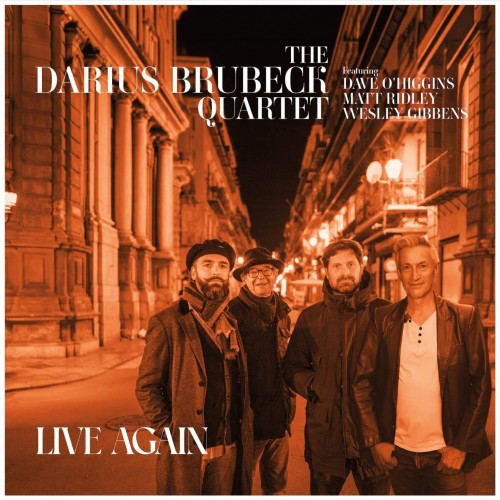
Darius Brubeck Quartet
“Live Again”
Gathering Forces GF008D/CD)
Darius Brubeck – piano, Dave O’Higgins – tenor saxophone, Matt Ridley – double bass, Wesley Gibbens – drums
Pianist and composer Darius Brubeck, born in 1947, is the son of the late, great Dave Brubeck (1920 – 2012). But there’s far more to Darius than that. He is a respected pianist and composer in his own right with over twenty albums to his credit as a leader or co-leader.
He began his career in the 1970s and has been a professional jazz musician for more than fifty years. He lived and worked in South Africa from 1983 to 2007 where he developed a career as an acclaimed educator alongside his work as a performing musician and composer. During his time in South Africa he recorded frequently with South African musicians.
Brubeck’s connection to South Africa is deep rooted, having spent over twenty years in the country as the Head of Jazz at the University of KwaZulu Natal where he initiated the first degree course in Jazz Studies offered by an African university.
Brubeck re-located to London in 2007 where he established this long running quartet featuring bassist Matt Ridley and drummer Wesley Gibbens, with Dave O’Higgins replacing original saxophonist Mike Rossi in 2011.
In addition to playing Darius’ own compositions the quartet have also paid homage to the music of the late Dave. I have enjoyed seeing the quartet live twice at Festival appearances at Cheltenham (2016) and Brecon (2017), both of which are reviewed elsewhere on this site as part of the relevant Festival coverage. Both shows featured a mix of Darius’ own compositions and famous pieces by the late Dave.
Rather than resenting living in his father’s shadow Darius has been more than happy to carry on the family name, and has also played his father’s music with his brothers Chris (bass) and Dan (drums) as Brubecks Play Brubeck.
At the time of the Cheltenham show I remember purchasing a copy of the quartet’s then latest album “Cathy’s Summer”, which I described at the time as;
“a rewarding, if not particularly demanding listen, with a good mix of eight original tunes and three standards”.
The live environment is definitely the best place to hear the Darius Brubeck Quartet and it would seem that the man himself would concur with that statement. His back catalogue includes a number of live recordings documented with different line-ups, including 2019’s “Live in Poland”, recorded with the O’Higgins, Ridley, Gibbens quartet.
In his album notes for “Live Again”, which was recorded during a four day, seven concert residency at the historic Real Teatro di Santa Cecilia in Palermo Italy in November 2025 Brubeck declares;
“I think I play better on stage than in a recording studio, and the band collectively and individually created unrepeatable musical moments”. He also cites the “Live in Poland” recording as “capturing the special synergy between musicians and audience”.
Brubeck therefore relished the opportunity to have the Palermo shows, which were commissioned by the The Brass Foundation of Palermo, recorded and the resultant album features the best takes, cherry picked from the seven performances. The focus is exclusively on the original writing of Darius Brubeck and the other members of the band and the track listing does not include any Dave Brubeck compositions or other jazz standards. Brubeck’s album notes also offer brief insights into the individual tunes, most of them very recently written
The album commences with “Matt’s Different Views”, an extended solo double bass intro featuring the powerful virtuosity of Ridley.
After a pause to acknowledge the cheers of the crowd the bassist leads the band into “Brexit Blues”, a sturdy slice of hard bop. The detrimental effect of Brexit on UK based touring musicians has been well documented. “Ten years down that road and no one appears to be happy with the outcome” is Brubeck’s terse comment on the subject. But never mind the politics, the music is an absolute delight with the crisp, driving rhythms of Ridley, Brubeck and Gibbens fuelling the muscular tenor sax soloing of O’Higgins. Brubeck subsequently takes over at the piano, his playing both fluent and highly percussive and just bursting with energy and ideas. Ridley is featured with another impressive excursion on double bass as the album gets off to a rousing start.
“Playing the Changes” was written for the documentary film “Playing the Changes; Tracking Darius Brubeck”, which in turn took its title from the book of the same name, written by Brubeck and his wife Catherine.
It’s a less frenetic piece than the opener, but hardly lacking in energy with O’Higgins stating the theme before Brubeck stretches out lyrically and expansively above an undulating groove. O’Higgins follows on tenor, probing fluently and intelligently as the momentum of the music gradually begins to build. Ridley is featured once more with a lengthy bass solo that combines great dexterity with a strong sense of melody.
Brubeck explains that he wrote “Autumn Elegy” on a rainy November day shortly before the quartet went to Palermo. It’s a piece that quietens things down even further and the overall mood is lyrical and suitably elegiac. Nevertheless there’s a slow burning intensity to O’Higgins’ extended tenor solo as he probes more and more deeply. Brubeck eventually takes over at the piano to fully bring out the tune’s elegiac qualities.
“Prelude and Funque” represents Brubeck’s ingenious homage to both J.S. Bach and Stevie Wonder. The piece kicks off with a funky, Wonder inspired groove that encourages the Italian audience to clap along. The groove is then topped by Bach inspired melodies that eventually act as the jumping off point for solos from O’Higgins and Brubeck. The pianist’s expansive solo is full of Bach inspired flourishes and acts as vehicle for him to demonstrate his virtuoso technique. In a sense this piece is a bit of a novelty, but it’s one that is both cleverly conceived and skilfully and excitingly executed.
“Transkei” is named for a coastal region that forms part of the Eastern Cape and KwaZulu-Natal areas of South Africa. Performed in the piano trio format with O’Higgins sitting out the piece is a reflection of Brubeck’s love of South Africa and its music, and its subtle Township flavourings perhaps suggest the influence of the great Abdullah Ibrahim. Gibbens was born in South Africa and this piece revolves around his musical relationship with Brubeck and is essentially a dialogue between them with Ridley acting as mediator. Gibbens sounds as if he may be playing with bare hands for much of the performance and his playing is responsive, finely nuanced, subtly detailed and above all innately musical. It makes for a superb foil to the percussive South African inspired pianism of the leader.
The letters of the title “SLEE” refer to the initials of Brubeck’s first great-grandchild Sadie Leah Engel Elmer who was born in 2025. It’s an affectionate piece performed by the quartet in waltz time as O’Higgins returns to the fold. The composer’s piano solo is both lyrical and uplifting and he’s followed by O’Higgins on tenor, who delivers with his customary assuredness and fluency. Gibbons is also featured with a concise drum excursion that is perhaps intended to depict the infant SLEE’s playful side.
Credited to O’Higgins “Searching For…” is a near three minute passage of unaccompanied tenor saxophone that explores the full range of the instrument in fluent and compelling fashion. His saxophonic journey is rewarded with a rousing audience reaction.
O’Higgins’ solo wanderings act as the curtain raiser to the closing “Somebody in Seoul”, a Brubeck composition that was actually recorded at Menuhin Hall in Cobham, Surrey, England. The melody is inspired by the Korean folk song “Arirang” while the chord changes are derived from what Brubeck describes as “an immortal jazz standard”. Judging by the title I assume that the jazz standard in question must be “Body and Soul”. It’s a delightfully relaxed performance with typically elegant solos from O’Higgins and Brubeck, sympathetically supported by Ridley and Gibbens.
At the age of seventy nine and after surviving a particularly nasty bout of Covid in the early days of the pandemic Darius Brubeck shows no signs of slowing down. “Live Again” finds him in peerless form as both a composer and performer and the live format certainly brings out the best of him. He’s superbly supported by the other members of his long running quartet and their well established rapport is apparent throughout this recording. O’Higgins, Ridley and Gibbens shine as a collective but also as individuals – “I always give each player at least one special feature in our concerts” explains Brubeck, “this is true of this album too”.
The recording teams in both Palermo and Cobham deserve credit for successfully capturing the frisson and excitement of these exceptional live performances. Meanwhile Brubeck, O’Higgins and Gibbens are all involved in the production process. It should also be noted that Gibbens is in great demand as a recording engineer in addition his abilities as a drummer.
“Live Again” represents a very welcome addition to the Brubeck family catalogue.
blog comments powered by Disqus