

by Ian Mann
July 10, 2026
/ ALBUM
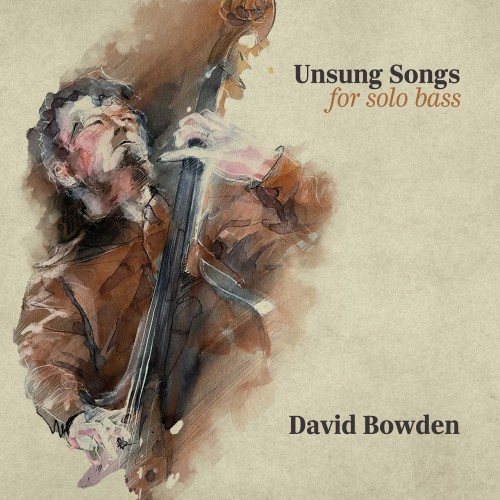
Bowden is to be congratulated on the impressive achievement that is “Unsung Songs”, an album that delivers on its artist statement.
David Bowden
“Unsung Songs”
(Self Released - Catalogue Number - DBM001US)
David Bowden – double bass
Glasgow based David Bowden is a Scottish bass player who is perhaps best known as a member of the hugely successful, Mercury nominated Fergus McCreadie Trio, led by pianist and composer Fergus McCreadie. Together with drummer Stephen Henderson he has appeared on all five of McCreadie’s albums to date and has toured widely as a member of this tightly knit trio.
Bowden is a former Young Scottish Jazz Musician of the Year but like so many other Scottish musicians his musical activities traverse the boundaries of jazz and folk. In addition to his solo career and his work with McCreadie he has also led the world jazz septet Mezcla, with whom he released the album “Shoot the Moon” on Ubuntu Records. He also co-led the jazz quartet Square One.
His jazz credits also include recordings with saxophonist and composer Brian Molley and trumpeter, composer and producer Liam Shortall aka corto.alto. He has also collaborated with the duo of guitarist Malcolm MacFarlane and saxophonist Gordon McNeil
Bowden also works frequently with folk artists and singer songwriters. Among those with whom he has recorded are Beth Malcolm, Finn Anderson, Robin Adam, Patsy Reid and Jensen McRae and the bands Dosca, Flew The Arrow and The Modern Vikings.
He has also collaborated with pop-soul vocalist Aiyana-Lee
Bowden has also worked with classical ensembles BBC Scottish Symphony Orchestra, Scottish Festival Orchestra and Manchester Collective, He also contributed, with Jensen McRae, to the score of the Spike Lee film “Highest2Lowest”.
Bowden’s first album release as a leader is a brave one. The solo double bass album is still a rare beast, although it’s a challenge that’s been taken by some of the giants of the jazz genre, among them Dave Holland, Barre Phillips, William Parker, Miroslav Vitous, Eberhard Weber and Arild Andersen. The Jazzmann has also reviewed “Live at The Ridgeway”, a 2015 solo bass recording by Bowden’s fellow Scot, Calum Gourlay.
For his own solo bass project Bowden draws inspiration from solo bass recordings by Larry Grenadier, John Patitucci and Jorge Roeder. Equally influential has been his work with singers, by transcribing and playing along with vocalists Bowden has attempted to “absorb the nuances of phrases and articulation, aiming to translate the expressive quality of the human voice on to the double bass”.
Bowden has also issued the following artistic statement with regard to the “Unsung Songs” recording.
“I wanted to discover what I could express on the instrument while making music that’s approachable. My aim would be to make music that anyone can enjoy, with no prior knowledge needed. When I’ve written for other ensembles I’ve always put the other musicians at the forefront, as is natural for a bass player. Playing solo there’s no hiding place, which pushes you to approach the instrument in a different way. It’s a rewarding challenge to combine melodic phrasing, chordal accompaniment and groove playing – all through one instrument”.
Bowden’s solo bass career began in 2023, followed by a show at the 2024 Glasgow Jazz Festival. The “Unsung Songs” album was recorded over the course of four separate sessions at Solas Sounds in Glasgow with fellow bassist Gus Stirrat (Animal Society, Fat Suit) engineering and with Israeli born, New York based bassist Or Baraket offering valuable advice with regard to bass playing technique.
The programme features six original compositions from Bowden plus solo bass re-imaginings of songs by Nick Drake, Emiliana Torrini and Chris Thile.
Things get underway with Bowden’s own composition “The Spiders Talk”. This serves notice that Bowden is able to combine a big, deeply resonant tune with an admirable dexterity. His performance on this opening piece has elicited favourable comparisons with the playing of the late, great Charles Mingus (1922-79), and deservedly so.
“From The Morning” is a reimagining of a song by the tragically short lived British singer-songwriter Nick Drake (1948-74). Bowden’s sound on the bass is more muted and lyrical and his absorption in vocal music begins to bear fruit, with the bass stating the melody of Drake’s song as Bowden makes the bass perform the kind of multiple functions outlined in his artistic statement.
As suggested by its title “WGS Blues” combines a real blues feeling with some truly virtuoso playing, Bowden’s bass again performing multiple functions.
“Singing Sands” is more contemplative and places a strong focus on the melodic qualities of the bass, while still ranging widely.
The following “Hakken-Kraks”, named for characters created by by the children’s author Dr. Seuss, exhibits similar qualities, while also adding a welcome element of playfulness.
“Snow” reimagines a song written by the Icelandic-Italian singer songwriter Emiliana Torrini. Placing the focus on melody it’s an excellent example of an “unsung song” as Bowden skilfully recreates the nuances and inflections of the human voice via his double bass.
Written by the American mandolin player Chris Thile “Jessamyn’s Reel” reflects Bowden’s interest in traditional folk music. Again it places the emphasis on the tune itself and there’s a pleasingly playful quality about the playing, but this in way detracts from the skill and virtuosity.
“Chrysalis” is more meditative, with a number of changes in terms of style and dynamics during its duration. Bowden incorporates both plucking and strumming techniques into another superb double bass performance.
The album concludes with Bowden’s own “unsung song”, “Lullaby for Esme”, written for his young daughter. Featuring the gentler side of his playing there’s a tenderness about the music and a melody that suggests that lyrics could even be added at a later point. It’s also the piece where Bowden’s playing is at its most sparse, leaving more space between the notes, a technique that proves to be particularly effective. The skilful use of the spaces between the notes imparts something of an ‘ECM quality’ to this closing performance.
“Unsung Songs” sees Bowden achieving his aim of making a solo bass album that is eminently approachable, placing the emphasis on melody rather than technique, although the exposed nature of a solo double bass album requires a degree of virtuosity on the player’s part, and Bowden delivers that too. He eschews abstraction and the use of extended techniques, although I would have liked to have heard him with the bow at least once.
Although Bowden has taken steps to ensure that this album is as accessible as possible solo double bass albums are always going to be something of a niche product and I concede that this is an album that will only suit so many people’s ears. Nevertheless Bowden is to be congratulated on the impressive achievement that is “Unsung Songs”, an album that delivers on its artist statement.
I’ll leave the last word with Bowden himself;
“I see it as a collection of songs, not just solo bass pieces – where the bass becomes the voice. The music captures exactly how I felt at the time of the recording”.
“Unsung Songs” is available via Bowden’s Bandcamp page here;
https://davidbowden1.bandcamp.com/album/unsung-songs-for-solo-bass
blog comments powered by Disqus