

by Trevor Bannister
June 14, 2026
/ LIVE
Nash’s ebullience and boundless musicality instantly communicates with his audience and lifts his compatriots to new levels of expression.
Jazz at Progress
Friday 5 June 2026
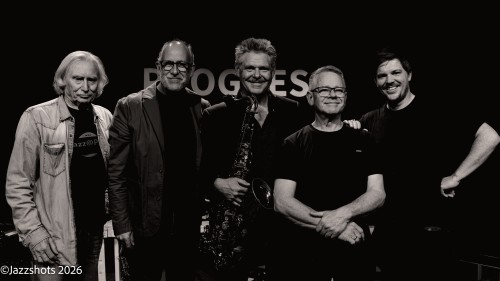
Derek Nash with the PJC Quartet
Derek Nash, saxophones: Jim Pollard, keyboard; Terry Hutchins, guitar; Stuart Barker, bass; Brian Greene, drums
The effervescent joy generated by Derek Nash and the Pangbourne Jazz Club Quartet should be bottled and distributed without prescription as a sure-fire antidote to the nation’s health issues. A master of the entire saxophone family of instruments, a composer, arranger, principal soloist and MD for the Jools Holland Rhythm & Blues Orchestra, leader of numerous innovative projects and an accomplished recording engineer, Nash’s ebullience and boundless musicality instantly communicates with his audience and lifts his compatriots to new levels of expression.
A gently swinging, Latin tinged arrangement of Kurt Weill’s ‘Speak Low’, from the 1943 Broadway musical ‘One Touch of Venus’, got the evening off to a perfect start with Nash’s warm-toned tenor saxophone blending beautifully with the sensitive accompaniment of the quartet.
Switching to alto, Nash evoked the 1940’s heyday of New York’s 52nd Street as he soared through the chord changes of Dizzy Gillespie’s fiery bebop classic “Groovin’ High”, leaving us breathless in his wake.
Despite giving the appearance of a toy instrument in his large hands, Derek Nash’s 100-year-old curved soprano sax provided the ideal sound to express the sublime beauty of Thad Jones’s ‘A Child is Born’. Stuart Barker’s gorgeous bass-lines underpinned the elegant contributions of Terry Hutchins and Jim Pollard.
The final member of the Nash saxophone family, the monster baritone, made its much-anticipated appearance in ‘Five Brothers’, a Gerry Mulligan ‘conversation piece’ originally recorded in 1953 by Mulligan’s piano-less quartet featuring trumpeter Chet Baker. The guys delivered an absolute masterclass in relaxed swing.
Nash’s wistful tenor on his own composition ‘Let Some Things Go By’, brought to mind the sad loss of ‘Saxophone Colossus’ Sonny Rollins who died aged 96 on 25 May. Sonny Rollins’ near contemporary Thelonious Monk was known as a man of few, and often no words. However, Derek Nash unearthed an illuminating hand written document (https://www.openculture.com/2012/09/thelonious_monk_scribbles_a_list_of_tips_for_playing_a_gig.html) offering tips for playing a gig. The extensive list includes such gems as ‘make the drummer sound good’ and ‘avoid the hecklers and let’s lift the bandstand’. But the phrase that really captured his imagination was ‘You’ve Got to Dig It To Dig It, You Dig’; the inspiration for the sensational number that closed the first set.
The second set opened with ‘This I Dig For You’, a tribute to the near-forgotten Hank Mobley, a particular favourite of Derek Nash. Once described as the ‘middleweight champion of the tenor saxophone’, he lacked the stature of musicians like Sonny Rollins and John Coltrane, but made many fine albums for Blue Note, including ‘Soul Station’ from which this track was taken. Brilliant!
Neal Hefti’s “Lil’ Darlin’” – an object lesson in how to swing while standing still - is naturally associated with Count Basie and his timeless album, ‘The Atomic Mr Basie’. However, the ever-imaginative Derek Nash perceived the number in a new light by accelerating the tempo by a few notches and highlighting the dazzling wire-brush skills of Brian Greene at the drums, as well as featuring himself on soprano sax. The result was an absolute delight.
Derek Nash described ‘Blue for You’, a dedication to bassist Joe Muddel, a pioneer figure in British modern jazz and prolific studio musician whose credits include the soundtrack to ‘Thunderbirds’, as a case of ‘Kansas City meets New York’, combining the raw blues of the Mid-West with the sophistication of the ‘Big Apple’. With the rhythm section laying down an earthy groove, Nash soon had the ‘pots boiling’ and the feet stomping on the big baritone horn, with suitably funky contributions from Terry Hutchins and Jim Pollard.
By now we had come to expect the unexpected, so it came as no surprise to discover that Derek Nash had re-imagined ‘Secret Love’, a smash hit for Doris Day in 1953, as a vehicle for his soprano saxophone, set to a ‘Sack o’ Woe’-style beat, blended with a hint of Scottish heather. The transformation worked magnificently.
The bitter sweet emotions of ‘Everything Happens to Me’, an early hit for Frank Sinatra when he was a vocalist with the Tommy Dorsey Orchestra, rounded the evening off perfectly with its vivid evocation of a smoky late-night bar. Except that the gig wasn’t quite over! With seconds to spare before the clock struck the bewitching hour of 10.00, Derek launched into the unmistakeable tones of Sonny Rollins’ ‘St Thomas’, a heartfelt tribute to the late- ‘Saxophone Colossus’ and a fitting conclusion to a superb evening of jazz.
In his introduction to the evening MC Paul Johnson promised that ‘Whenever Derek and these guys play together the atmosphere is electric.’ He was absolutely right and one can understand why the PJC Quartet is held in such high regard by the host of guest stars who regularly appear at Pangbourne Jazz Club. They will have gained many new friends as a result of this concert. Further details of the club, now celebrating its 10th anniversary, are available on https://www.pangbournejazzclub.com/
As ever, our thanks to the volunteers of the Progress Theatre who give their time so generously to keep jazz live in Reading. Further details of the theatre’s many activities are available on
https://progresstheatre.co.uk/
TREVOR BANNISTER