

by Ian Mann
October 19, 2026
/ ALBUM
The “Airborn Suite” is an impressive piece of work that explores a wide range of inspirations and influences and which embraces a similarly broad swathe of musical styles. Intelligent & sophisticated.
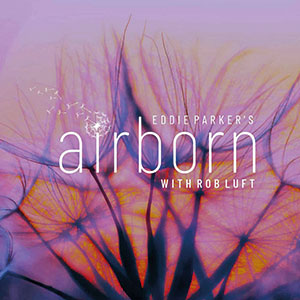
Eddie Parker’s Airborn with Rob Luft
“Airborn”
(Pig Records PIG22)
Eddie Parker – flute, bass flute, baroque flute, keyboards, piano, Rob Luft – electric guitar, 12 string guitar, Dave Manington – double bass, Jay Davis – drums
Flautist, keyboard player and composer Eddie Parker first came to prominence with the late 1980s phenomenon that was the now legendary Loose Tubes big band, an ensemble whose influence still resonates on the British jazz scene to this day.
I’ve been a fan of Parker’s playing since those heady Loose Tubes days. A founding member of the ensemble he played on the band’s three classic 1980s albums “Loose Tubes” (1985), “Delightful Precipice” (1986) and “Open Letter” (1988). He also wrote for the band, contributing compositions to the second and third albums.
He also appears on the three archive live albums later released on Loose Tubes keyboard player Django Bates’ Lost Marble label between 2010 and 2015.
Parker was part of the band when they reformed for a series of club and festival appearances in 2014, performing a mix of old classics and new material composed specifically for these events. The new tunes can be heard on “Arriving”, the third and final release in Bates’ Lost Marble series.
Following the initial demise of Loose Tubes Parker became a member of Bates’s Delightful Precipice ensemble, which many observers regarded as being effectively a continuation of Loose Tubes. He appeared on the Delightful Precipice albums “Summer Fruits (and Unrest)” (1993) and “Winter Truce (and Homes Blaze) (1995) and also on Bates’ earlier small group recording “Music for the Third Policeman” (1990).
The 1990s also saw Parker establishing himself as a composer and bandleader in his own right with the release of the albums “Transformation of The Lamp” (1994) and “Everything You Do To Me” (1996), both credited to the Eddie Parker Group and released on FMR Records. The EPG later mutated into the sextet Mister Vertigo, self releasing the album “Live at The Vortex” in 2006.
The 90s also saw Parker working with the late, great South African pianist and composer Bheki Mseleku (1955 -2008) and I recall seeing Parker perform as a member of Mseluku’s band at Brecon Jazz festival back in the day. Parker appears on Mseleku’s acclaimed 1992 album “Celebration”.
Others with whom Parker has worked include the electronic duo A Man Called Adam, reggae artist Trevor Walters, Nigerian singer songwriter Keziah Jones and Malian vocalist Oumou Sangaré. He has also been a regular member of Will Gregory’s Moog Ensemble. It’s an appropriately varied mix for a musician who likes to describe himself as a “qualified eclectician”
In recent years Parker has led the still ongoing EscherSteps, a quartet that explores the interface between jazz and progressive rock and which also features Parker as a vocalist. These days Liverpool born Parker lives in the Forest of Dean and I recall seeing him perform with EscherSteps at the Queens Head in Monmouth some years prior to the unfortunate closure of that much missed venue.
He also led the twelve piece Debussy Mirrored Ensemble, which investigated the music of the French classical composer Claude Debussy in a jazz context. This was a project that attracted a substantial amount of attention and acclaim.
Meanwhile Airborn is is an all instrumental unit that variously draws on jazz, rock and 20th century classical music. The quartet’s debut album was recorded at London’s Porcupine Studio by engineers Nick Taylor and Alex Bonney in December 2025, just before they played a particularly well attended live show at The Marr’s Bar in Worcester as part of promoter Dave Fuller’s enterprising Music Spoken Here series. I was fortunate enough to attend this exceptional show and my review of the event, from which much of the above biographical detail has been sourced, can be found here;
https://www.thejazzmann.com/reviews/review/eddie-parkers-airborn-music-spoken-here-the-marrs-bar-worcester-11-12-2025
At the Worcester show Parker explained just how he came to recruit rising star guitarist Rob Luft, a prolific bandleader in his own right whose solo work has regularly reviewed on The Jazzmann, to the Airborn project.
We learnt that a then very young Luft had ‘depped’ for regular Loose Tubes guitarist John Parricelli at a Loose Tubes reunion gig at Ronnie Scott’s back in 2014 and did this so brilliantly that Parker immediately though “I’ve got to work with this guy”.
It’s taken a while for the partnership to come to fruition. Luft’s own rise in the last eleven years has been remarkable and he’s now a musician with an international reputation with several albums as a leader or co-leader to his credit. Parker may be twice Luft’s age but he clearly has a huge respect for the sheer musicianship of the gifted young guitarist. The Airborn band name even stems from a play on Luft’s surname, which is of course the German for air, as Parker explained.
Airborn began as what Parker described as “a posh covers band”, playing material composed by some of his favourite jazz musicians, among them guitarist John McLaughlin, trumpeter Kenny Wheeler and pianists John Taylor and Keith Jarrett. He explained that he was fascinated by the way in which McLaughlin’s bombastic jazz rock outfit Mahavishnu Orchestra and the chamber jazz trio Azimuth (Wheeler, Taylor and vocalist Norma Winstone) often used similar harmonies but deployed them so differently. Later Parker began to write for the band, which now performs original material almost exclusively.
Airborn’s debut album features the fourteen movement “Airborn Suite”, a work that draws inspiration from such diverse musical sources as the 20th century Austrian avant garde composer Arnold Schoenberg and the rock guitarist Carlos Santana.
Parker’s writing sometimes borrows from dodecaphonic or ‘twelve tone’ music as pioneered by Schoenberg and his fellow Austrian composers Alban Berg and Anton Webern. It’s a style of music that is often regarded as being harsh and challenging, but Parker also sees the beauty in it, and has cited Berg’s violin concerto as an example.
At Worcester the band played the “Airborn Suite” in its entirety, plus an encore of the Keith Jarrett composition “Le Mistral” from “Treasure Island”, Jarrett’s 1974 album for Impulse! Records, this representing a brief return to their “posh covers band” incarnation.
Parker’s album notes talk us through some of pieces forming part of the suite, which commences with the atmospherics of “Prelude”. This scene setting introduction features the sounds of Parker’s wooden baroque flute above a shimmering ambient backdrop featuring the sounds of Manington’s bowed bass, Luft’s gauzy guitar effects and Davis’ cymbal embellishments. Parker also describes the piece as containing “a sequence of blossoming harmonies, from which much of the rest of the suite is derived”.
“Airborn 1” features a more orthodox jazz-rock sound as Manington puts down the bow and Luft takes flight on guitar while Parker himself focusses on keyboards, deploying both electric piano and organ sounds. The leader features as an electric piano soloist alongside Luft’s soaring guitar. The piece later drifts into increasingly ambient territory as it concludes in atmospheric fashion.
“Interlude: Sextet” is a brief (twenty nine seconds) musical amuse bouche featuring the sounds of multi-tracked flutes.
Then we’re into the flute led “Airborn 2” with Parker featuring as a flute soloist. He’s followed by the excellent Manington, a composer and bandleader in his own right, most notably as the leader of his Riff Raff sextet. Parker was a teenager in the 1970s and has credited the progressive rock groups Jethro Tull and Focus as influences on his flute playing.
Those influences are also apparent on the breezy “Airborn 3”, which features Parker soloing on bass flute, at one point with only drummer Jay Davis for company. Davis excels on a piece that includes some unusual time signatures, his beats underpinning another spiralling, restlessly inventive guitar solo from Luft.
“Interlude: Quartet” re-introduces some of the harmonies first heard on “Prelude” and is another atmospheric offering, led by what again sounds like bass flute. Parker himself comes up with his own description for this short but evocative piece; “shimmering like gossamer on a summer afternoon”. He also tips his hat to his fellow Liverpudlians, The Beatles by adding “picture yourself in a boat on a river”.
On “Rock Latin” Parker tips his hat to the jazz rock fusion of the 1970s, a piece variously inspired by Jethro Tull, Mahavishnu Orchestra, Santana and Weather Report. More obviously groove driven than anything that has gone before, and almost funky at times, the piece features Parker at the keys and deploying a variety of keyboard sounds, most notably electric piano as he shares the solos with Luft. Davis shows up strongly with something of a drum feature towards the close.
“Interlude; Duo” is a brief (just over a minute) duet between Parker on flute and Luft on guitar.
This is followed by the album’s lengthiest track, “To Plant a Tree”, which clocks in at a little over eight and a half minutes. Parker’s liner notes explain the reasoning behind the title; “In this often threatening, unpleasant and uncertain world planting a tree is a most hopeful thing to do. A tree is an act of faith, a time machine, a tree seeds other trees”.
Beginning with the sound of unaccompanied piano, joined first by guitar and then drums and bass, this episodic piece embraces a Metheny like melodicism with Luft taking the first solo, a skilfully orchestrated excursion that demonstrates his command of tone, timbre, melody and dynamics. The leader follows with a more concise statement on acoustic piano, a reminder that Parker started out at that instrument before switching to the flute under the influence of Ian Anderson and Thijs van Leer (and by extension Roland Kirk). Meanwhile Manington delivers a delightfully melodic bass solo.
Following the mellifluous of “To Plant A Tree” the next piece, “Wonky Clockwork” offers a complete contrast. Parker has described it as being “unashamedly dodecaphonic” and its title is highly descriptive, the music sounding jumpy, nervous, and unpredictable with staccato collective phrases punctuated by a series of drum breaks from Davis, some of them quite extended. It’s a piece that represents something of a tour de force for Davis, a rising star who is an increasingly in demand presence on the UK jazz scene.
As a collective the members of Loose Tubes were politically committed and back in the 80s live performances regularly included comments about such issues as apartheid and nuclear waste / weapons. Parker retains that kind of commitment and when playing live often introduces the composition “Cortège” with the words;
“If protesting using words, banners and flags is to be made illegal, then every note I play is a protest”, adding “I think you know who I’m referring to”.
The tune itself begins in suitably funereal fashion with the murky drone of Manington’s arco bass accompanied by Davis’ cymbal shimmers and scrapes, Luft’s slide guitar atmospherics and the eerie, ghostly sound of Parker’s flute, an icy whisper crying in the wilderness. Davis’ mallets introduce a slowly marching rhythm that underpins the ambient washes of Luft’s guitar solo. That rhythm continues as Parker returns on flute and Manington on arco, but only Davis remains at the end, “soldiering on loyally towards oblivion”, as Parker puts it. It’s a strangely compelling piece, a haunting blend of sadness and beauty.
Davis’ drums then introduce the odd meter 5/4 grooves of “Airborn Five”. “You can dance to this!” declares Parker, although he does admit that it could prove a little difficult. Nevertheless there’s something infectious about the quirky rhythms, and also about Luft’s restlessly inventive guitar soloing. Parker himself features on keyboards and also takes a solo on what sounds like a Fender Rhodes. The influence of Herbie Hancock’s Headhunters ensemble has been suggested as a possible inspiration for this particular tune. Davis’ drums feature strongly towards the close.
“Interlude: Solo” is a short (forty one seconds) passage of unaccompanied acoustic piano from Parker.
The album concludes with “Oke Quixote”, the title a Parker homage to the genius of the late, great trumpeter and composer Kenny Wheeler (1940 – 2021) and particularly Wheeler’s celebrated Don Quixote inspired “Windmill Tilter” suite from 1969. It’s a lively offering featuring Parker on synth in its early stages, soloing above the crisp, propulsive rhythms laid down by his colleagues. Luft subsequently takes over on guitar to deliver another spiralling solo, rich in terms of melody, colour and invention. Parker describes this piece as “a final escape velocity jaunt into infinity, and a return to original elements” as the album eventually concludes in much the same atmospheric manner as it began.
Parker’s first album release for a number of years is a very welcome addition to his catalogue. The “Airborn Suite” is an impressive piece of work that explores a wide range of inspirations and influences and which embraces a similarly broad swathe of musical styles. Yet for all this it still sounds remarkably cohesive, with a recognisable group identity and with the brief interludes acting as refreshing musical palate cleansers between the more substantial compositions, or movements. The use of recurring motifs emphasises the unified concept behind the overall work.
Parker is fulsome in his praise for Luft, and rightly so. His contribution is immense and fully justifies the joint billing that he receives on the album cover. However one shouldn’t underestimate the contributions of Manington and Davis, who fully enter into the spirit of the project and who are both excellent throughout.
Parker himself is superb on both flute and keyboards and his writing combines intelligence and sophistication with his self confessed eclecticism.
It’s an album that mixes jazz and rock influences and the sound is very ‘prog’ at times. Potential listeners include Parker’s traditional ‘Loose Tubes’ audience and also Luft’s ever expanding fanbase. The ‘prog rock’ influence should ensure that the album holds some appeal for adventurous rock listeners in addition to the usual jazz demographic.
Having enjoyed Airborn’s Worcester performance so much it’s particularly satisfying for me to be able to hear the music on disc. Eddie Parker is one of the nice guys of British jazz, he’s also a hugely talented instrumentalist and composer and this album deserves to put him very firmly back on the musical map.
“Airborn” is released on the Pig Records label run by Bristol based saxophonist Kevin Figes. It can be purchased here;
https://pigrecords.bandcamp.com/
blog comments powered by Disqus