

by Ian Mann
October 07, 2026
/ ALBUM
An evocative piece of work with Hamp’s words a skilful blend of the mystical and the mundane, his texts complemented by the similarly evocative instrumental sounds created by the Eyebrow duo,
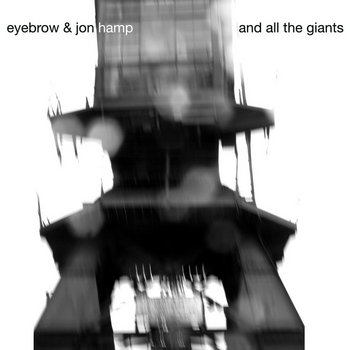
Eyebrow & Jon Hamp
“and all the giants”
(Self Released)
Pete Judge – trumpet & electronics, Paul Wigens – drums & percussion
with Jon Hamp – spoken word
Eyebrow is the Bristol based duo of trumpeter Pete Judge and drummer Paul Wigens, a long running musical alliance that released its debut album “Desire Lines” back in 2009.
Eyebrow have since released “Elemental” (2010), “Still and Still Moving” (2012), “Garden City” (2014) and “Strata” (2017). The last named of these is reviewed here;
https://www.thejazzmann.com/reviews/review/eyebrow-strata
2019’s “Track Record” was a collaboration between Eyebrow and the poetry collective The Spoke.
Meanwhile the live recording “Eavesdropping” was released in 2023 but is actually a 2012 performance in which the Eyebrow duo collaborated with guitarist / keyboardist / percussionist Chris Vine.
“And All The Giants” represents Eyebrow’s second music and poetry collaboration and sees them joined by the Bath based poet, writer and performer Jon Hamp. The music on the album is all composed by Judge and Wigens while the words are sourced from Hamp’s book “Dry Wood & Kind Light : The Kelston Poems”.
I’m grateful to Pete Judge for sending me a review copy of this album, which was first released in April 2026.
Judge is best known as the trumpet player in the acclaimed jazz / rock / electronica quartet Get The Blessing, a group whose recordings and live performances have been featured extensively on the Jazzmann web pages. Something of a musical polymath Judge also plays with the folk / jazz acoustic trio Three Cane Whale, whose 2020 album “303” is reviewed here;
https://www.thejazzmann.com/reviews/review/three-cane-whale-303
Judge has also been a member of the Bristol based group Dakhla Brass, whose 2018 album “Murmur” is reviewed here;
https://www.thejazzmann.com/reviews/review/dakhla-brass-murmur
Judge is more than just a trumpeter, he is also an accomplished multi-instrumentalist who has released three albums of solo piano music, all recorded on the grand piano at the St. George’s venue in Bristol. The second of these, simply titled “Piano 2”, is reviewed here;
https://www.thejazzmann.com/reviews/review/pete-judge-piano-2
Judge spreads his musical net far and wide as a prolific session and studio musician and has recorded and toured with a variety of artists across a broad range of genres. He has also composed music for theatre, radio and dance productions. Among those artists with whom he has worked are Noel Gallagher, Super Furry Animals and the folk artist Jim Moray, plus numerous others.
Wigens has a similarly broad CV and has also worked as a session and touring musician across a similarly wide range of musical genres in addition to working in the worlds theatre and film. Artists with whom he has collaborated include Natacha Atlas, Damo Suzuki, Gary Lucas and the band The Blue Aeroplanes. He has sometimes performed as a ‘dep’ with Get The Blessing, standing in for regular drummer Clive Deamer.
Jon Hamp has previously collaborated with photographers and with other musicians. The album “and all the giants” has been described as “looking out across the sprawl of Bristol from the slopes of Kelston Roundhill, and summoning up a new mythology”. His words represent a something of a love letter to Bristol and the wider West Country and are couched within the ambient soundscapes created by Wigens and Judge. His album notes, written in the form of a poem, offer further insights into the work.
Album opener “12 miles upstream” is a brief instrumental that commences with the eerie, ambient sounds of electronically enhanced trumpet and the rustling, rumbling and shimmering of various items of percussion.
It slides almost imperceptibly into “starfield bridges” (all the tune titles are in lower case) with Wigens’ drums and percussion initially to the fore. Hamp’s spoken word narrative describes the River Avon at night, flowing through the Somerset landscape as the human and canine habitants of the area sleep. His words are complemented by the sounds of electronics, the mournful cry of Judge’s echoed trumpet and the slow, funereal march of Wigens’ drums. As the pace of the march increases and the music gradually grows in intensity Hamp’s words evoke the mythical giants of Kelston Roundhill as Judge’s trumpeting becomes increasingly incantatory, before, eventually the music gradually fades away.
“through” is a brief instrumental interlude featuring the sounds of gauzy trumpet and the gentle rustle and rattle of cowbells.
The centrepiece of the album is the ten minute title track, which emerges out of swirling electronic mists to feature the gentle sounds of Judge’s Arve Henriksen like trumpet. Hamp’s recitation of the first stanza of his poem takes place against this backdrop and is evocative and scene setting, his speaking voice imparting the words with an appropriate gravitas. Wigens’ drums are added as the giants look out at night over Bristol, the Somerset Levels, the Avon Gorge and even the M4. The history of Bristol as a port city is evoked, with several districts and streets specifically referenced, as are present day human activities as Hamp’s words juxtapose the mythical with the everyday. At the heart of the musical performance is a majestic trumpet solo from Judge that occurs mid way through the piece, his playing complemented by an underlying electronic soundwash and the implacable drum grooves of Wigens.
“soft sickle swathe” is another instrumental interlude, performed by Wigens on what sounds like a collection of cymbals and gongs, the sounds chiming and metallic.
Drums usher in “mason’s track”, soon joined by Judge’s vaguely Middle Eastern sounding trumpet. Judge stretches out at length before Hamp eventually joins the proceedings. Here his words describe the human activities of construction and industry and actually include the line “soft sickle swathes”. It’s my assumption that this piece is about Bath rather than Bristol, although I may be wrong. Following the conclusion of Hamp’s narration there is another substantial all instrumental episode.
The album concludes with “crusoe’s beard”, with Hamp’s words drawing parallels between the ancient and the modern, history and the present day, imagining a single West Country time line linking all these things. The music is simultaneously melancholic and anthemic with Judge’s trumpet looped and layered above Wigens’ ever evolving drum patterns.
At around thirty three minutes in length “and all the giants” is comparatively short by modern CD standards. It is however an evocative piece of work with Hamp’s words a skilful blend of the mystical and the mundane, his texts complemented by the similarly evocative instrumental sounds created by the Eyebrow duo, As Judge and Wigens both play with great skill and sensitivity throughout.
Hamp’s speaking voice works well with the music and he invests his words with an appropriate sense of conviction and gravitas that enhances the evocativeness of the music. I certainly enjoyed listening to “and all the giants” but as with so many recordings featuring the spoken word I’m not sure whether it’s an album I’d necessarily want to return to on a regular basis. For me such projects are perhaps best experienced in the live environment as one off events rather than on disc. I don’t know if “and all the giants” has actually been performed live but I can envisage it being presented as a successful audio-visual or multi-media project.
Despite my reservations it’s good to see that the words and music have been documented on CD and I’d like to say thanks again to Pete for forwarding me a review copy.
“and all the giants”, plus other Eyebrow recordings, can be purchased here;
https://eyebrow.bandcamp.com/music