

by Ian Mann
September 21, 2026
/ LIVE
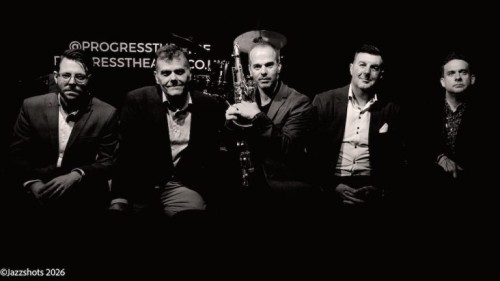
"High five! Five-Way Split put together a great programme of originals and standards, all played with flair and high-energy". Guest contributor Clive Downs enjoys the music of this all star quintet.
Jazz at Progress / Jazz in Reading
Progress Theatre, Reading Friday 18 September 2026
Five-Way Split
Rob Barron piano, composer
Quentin Collins trumpet, flugelhorn, composer
Matyas Hofecker double bass, composer
Matt Home drums, composer
Vasilis Xenopoulos tenor saxophone, composer
During Covid many artists were able to spend time working on new projects. The five musicians we heard tonight started to meet and work on new compositions and arrangements during that period. Since then, they have firmly established themselves in the jazz world.
Vasilis’ composition “Out of Wayne’s Bag”, started the evening, with a driving minor number, and a nod to the great tenor player Wayne Shorter. The Progress (almost full) house clearly enjoyed a high energy performance in the vein of the great Blue Note /Art Blakey ‘Jazz Messengers’ bands of the 1960’s. Vasilis showed in his solo how important articulation is in improvisation.
Rob Barron’s first composition of the evening, “Dr. Stol” (the title a cryptic reminder of the location of London’s 606 club - Lots Rd) followed. Quentin switched to flugelhorn, for a very melodic, Latin-tinged piece. Tenor and flugel combined effectively, alternating unison and two-part harmony. Quentin contributed a dazzling solo.
Rob introduced Quentin Collins’ tune “XO Buzz” explaining the term referred to the trumpeter’s favourite tipple. He reminded us there was no leader in the band (hence introductions were shared five ways). A restless melody evoked, perhaps, the first effect of the spirit (or the after effects?) - while later a more mellow mood seemed to develop, with two-part harmony from the horns, and a laid-back piano interlude. The bass solo created almost vocal cadences.
“Pandora’s Box” featured the virtuoso Matt Home on drums. Vasilis explained the sad story from Greek mythology. His composition was a minor piece, with a major middle section. This selection in particular brought back memories of some ‘hard bop’ classics of the 1960’s.
“All the Way” (the first standard of the evening) - made famous by Sinatra, amongst others, showed the band’s ingenuity in arranging. An original melody was transformed by rephrasing and adding connecting figures to make a memorable new number. Played at medium tempo, the soloists skilfully added melodic echoes of the main tune into their improvisation.
Vasilis’ “Two Little Alphas” (so-called for his two young sons, both of whom have names beginning with “a”) depicts their energy and the spirit they bring to the household. Some intriguing dissonance in the number seemed to hint at the charming disorder of those scenes.
“Soho Soirée” (another reference to musical London from Rob) is a medium tempo minor theme. The melody is very rhythmically varied - held notes, stabs, and weaving figures. A trumpet solo began quietly, built, and alternated louder and softer. As with all the evening’s performances, the band supported each other’s playing by listening and responding - careful group interaction that all bands strive for.
One of Henry Mancini’s lesser know compositions, “Dreamsville” (written for a TV series), a beautiful ballad, was realised with a delicate piano introduction from Rob. The main figure in the piece is deceptively simple: in this arrangement two-part harmony (tenor and flugel), against a repeated piano/bass/ drums motif, enhanced the attractive theme. A carefully constructed bass solo was a highlight of this selection.
Featuring drums, “Encounter” (a melody based on the chords of “Love for Sale”) is a very fast minor composition, allowing Matt to display his inventiveness. A series of 8-bar, then 4-bar exchanges between each player showed how quick-witted they are even at that tempo.
As an encore, the tempo slowed down for the evocative ballad “Sunday in New York” by Peter Nero. A piano intro took us into the tenor solo statement, before more trumpet/tenor two-part harmony, solos, and the piece ended with some collective improvisation.
High five! Five-Way Split put together a great programme of originals and standards, all played with flair and high-energy.
Vasilis, on his return, mentioned how much the band appreciated the ambience of the Progress Theatre, and extended his thanks to the house staff. Jazz in Reading also expresses thanks to the Progress volunteers - front of house, and the technical team behind the scenes, and to Hickies for its support.
CLIVE DOWNS