

by Ian Mann
January 21, 2026
/ ALBUM
The trio’s treatment of these well known classical themes is consistently interesting and inventive, and as a result the music sounds fresh and exciting.
Fugue & Groove Trio
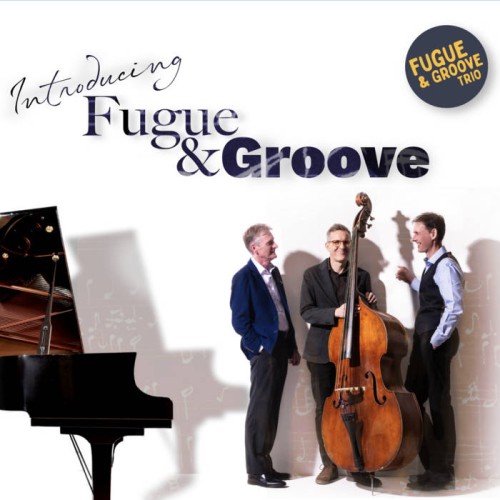
“Introducing Fugue & Groove”
(Richkey Records RKR004)
Richard Hughes – piano, Simon Smith – double bass, Steve Street – drums
The Worcester based Fugue & Groove Trio is led by pianist Richard Hughes and the group’s debut album “Introducing Fugue & Groove” appears on his own label Richkey Records.
In 2019 the imprint released Hughes’ album “Solo Piano” which saw him exploring a selection of jazz standards and pop tunes.
His latest project is the Fugue & Groove Trio which teams him with bassist Simon Smith and drummer Steve Street with whom he explores well known pieces from the classical canon. This trio now seems to be Hughes’ primary creative outlet and the Fugue & Groove Trio appear to have gained something of a following on the Midlands jazz scene.
In his liner notes for the trio’s debut Hughes explains the choice of band name thus;
“The name Fugue and Groove reflects the two musical worlds they explore. ‘Fugue’ is a nod to classical structure and counterpoint, while “groove” evokes rhythm, vitality, and the essence of jazz. Together, they create a dynamic fusion. It isn’t just about blending styles; it’s about taking familiar themes into new territory, responding to each other’s ideas in the moment, and inviting listeners along on a surprising, playful journey”.
He cites Bach and Chopin as being significant influences on the classical side and Horace Silver, Ahmad Jamal and the Modern Jazz Quartet from the jazz perspective. He also acknowledges the significance of the French pianist Jacques Loussier (1934 - 2019), whose “Play Bach” series of jazz adaptations of JSB’s works reached out to a surprisingly wide listenership in the 1960s. Although falling out of fashion Loussier continued to explore the music of Bach and other classical composers well into the 21st century. He was also an accomplished composer in his own right.
I have to say that when I first gave this album a spin it was Loussier’s trio that immediately sprang to my mind.
The trio kick off with “Softly, as in a Fugue-ish Sunrise”, which sees them introducing classical elements, notably J.S.Bach’s “Toccata and Fugue”, to a gently swinging arrangement of the jazz standard “Softly as in a Morning Sunrise”. Pianist and leader Hughes stretches out above a subtly propulsive double bass and brushed groove and there are also concise features for bassist Smith and drummer Street.
Unaccompanied piano introduces the trio’s adaptation of Beethoven’s “Adagio Cantabile”, to which they apply an agreeable jazz lilt. The arrangement is imbued with blues and gospel influences that for me sometimes recalled the playing of Keith Jarrett, another musician who has been known to explore the jazz and classical music interface. However the band themselves cite the Japanese pianist Hiromi as a primary source of inspiration here.
The lively, fast moving adaptation of C.P.E. Bach’s “Solfeggio” combines classical structure and technique with jazz and blues elements, with the bebop style particularly influential.. It’s a piece that demonstrates just how skilled a pianist Hughes is and he receives excellent support from Smith and Street, with the later briefly breaking cover with a fleeting brushed drum feature.
The trio now tackle J.S.Bach’s famous “Air on a G String”, a tune popularised by Loussier and pilfered by Procol Harum. It’s to the trio’s credit that even at this late date they’re able to put something of their own stamp on it with a performance that is variously laid back, gently swinging and subtly playful.
“Meditation” is a piece written by the French Romantic composer Jules Massenet (1842-1912) which the trio approach in the spacious style of an ECM ballad with Street adopting the role of colourist at the drums. Hughes’ piano soloing is suitably lyrical, while Smith’s bass acts as the fulcrum.
The trio’s arrangement of Ravel’s “Pavane for a Princess” invests the piece with a subtle bossa nova rhythm, this providing the impetus for Hughes’ inventive piano soloing, with Street featuring briefly towards the close.
The adaptation of Chopin’s “Waltz in C# Minor” sees the trio alternating between waltz time and 4/4 as they impart the famous melody with a genuine jazz swing in its latter stages, with Street’s vigorously brushed drum grooves setting the pace and acting as the catalyst for Hughes’ vivacious piano soloing.
Faure’s “Pavane” is another famous work to be given an innovative jazz style treatment in an arrangement that combines lyrical passages with more rhythmic, hard driving sections with Hughes the featured soloists. The intro and outro both revolve around Smith’s pedal bass motif.
“Loves Greeting” takes the melody of Elgar’s “Salut D’Amore” and presents it in a swinging arrangement reminiscent of a jazz standard. Smith enjoys his lengthiest solo of the set on well articulated double bass.
The concluding “Turkish Delight” is an adaptation of the theme from Mozart’s “Turkish March” performed in a latin / samba style. Powered by Smith’s propulsive double bass grooves it’s the most energetic piece on the album and I suspect that it probably also closes the trio’s live shows. Hughes features strongly as a soloist, as he does throughout the album, and there’s also a colourful and energetic solo from Street as the drummer is finally let off the leash.
“Introducing Fugue & Groove” was recorded at Sansom Studios in Birmingham with Olly Sansom and the sound quality is excellent throughout and represents a major factor in the album’s success. Although its very much Hughes’ album both Smith and Street are also heard at their best and the playing of all three musicians is excellent throughout.
I was pleasantly surprised by how much I enjoyed this album. The trio’s treatment of these well known classical themes is consistently interesting and inventive, and as a result the music sounds fresh and exciting.
The album is laid back and melodic enough to make appealing background listening and there may be commentators who will find it all a little bit too tasteful and bloodless. But dig deeper and there are lots of interesting things going on to maintain the attention of the serious listener.
The Fugue & Groove Trio is an act that I’d now like to check out in the live environment and as both myself and the band are based in the Midlands that will hopefully prove to be a realisable ambition sometime during 2026.
“Introducing Fugue & Groove” is available here;
https://richiekeys.bandcamp.com/album/introducing-fugue-groove
See also;
https://fugueandgroove.co.uk/
blog comments powered by Disqus