

by Ian Mann
February 12, 2026
/ LIVE
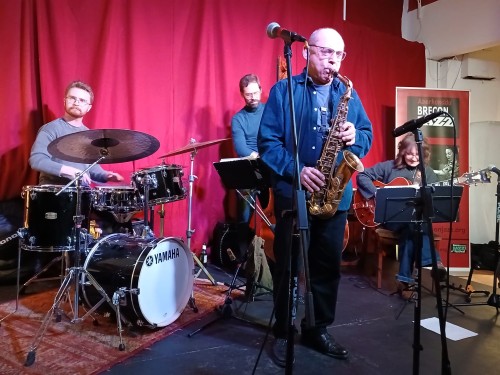
An excellent evening of jazz, genially presided over by Manby, that was very well received by a substantial and appreciative audience. There was some quality playing from all four musicians.
Glen Manby / Lizzie Beesley Quartet, Brecon Jazz Club, The Muse Arts Centre, Brecon, 10/02/2026.
Glen Manby – alto sax, Lizzie Beesley – guitar, Ashley John Long – double bass, Tom Williams – drums
Brecon Jazz Club’s February event featured a cross-generational quartet co-led by alto saxophonist Glen Manby, a stalwart of the South Wales jazz scene for more than thirty years, and the young guitarist Lizzie Beesley, a musician still at the beginning of her career. Joining them were drummer Tom Williams, a student at the Royal Welsh College of Music and Drama in Cardiff, and Ashley John Long, the brilliant double bassist who is also a major player on the Welsh jazz scene and a musician with a burgeoning UK wide reputation thanks to his work with John Law, Yetii and others.
Manby has also come to the attention of a wider audience thanks to the release of two impressive albums “Homecoming” (2016) and “When Sunny Gets Blue” (2024), both of which are favourably reviewed elsewhere on The Jazzmann.
“Homecoming” featured a stellar London based quintet featuring trumpeter Steve Waterman, pianist Leon Greening, bassist Adam King and drummer Matt Home. Review here;
https://www.thejazzmann.com/reviews/review/glen-manby-homecoming
The follow up relied on more locally based talent with Manby joined by drummer John Gibbon, pianist Guy Shotton and bassist Olly Blanchflower, but was equally enjoyable. Review here;
https://www.thejazzmann.com/reviews/review/when-sunny-gets-blue
I first recall seeing Manby play way back in 1994 when he led his quartet in a performance at the now long defunct Cardiff Bay International Jazz Festival. I have seen him perform many times since at venues in Brecon and Abergavenny as the leader of his own groups and sometimes with the bands of others.
Manby was also a member of the cult Cardiff band - and Brecon Jazz Festival favourites - The Root Doctors, led by trombonist/vocalist Mike Harries.
He also played with a number of other popular bands across a range of jazz and other genres on the South Wales live music circuit, including Red Beans ‘ n’ Rice, Bomb and Dagger, The Questionnaires, Love Parade, guitarist Rob Haddon’s Praxis group and vocalist Li Harding’s quintet. Currently he is a member of Chapter Four, the house band at Cardiff’s Chapter Arts Centre, which also features pianist Jim Barber, bassist Don Sweeney and drummer Greg Evans.
But Manby’s first love was always jazz and particularly the music of the bebop and hard bop eras. As a jazz musician he has chosen to concentrate on alto saxophone (he has also played tenor) and cites his main influences on the instrument as being Charlie Parker, Cannonball Adderley, Sonny Stitt, Phil Woods, Jackie McLean, Paul Desmond and the UK’s own Peter King. Other sources of inspiration include trumpeter Tom Harrell and tenor saxophonists Sonny Rollins, Warne Marsh and Mario Rivera.
Manby has been tutored by a whole host of illustrious saxophonist / educators and has also spent time overseas studying in the USA and Switzerland in addition to gaining an MA in Jazz from the Royal Welsh College of Music and Drama (RWCMD) in Cardiff. He has also taught saxophone at the RWCMD and at Cardiff University.
One audience member had brought in a copy of the 1996 Brecon Jazz Festival brochure, which included a picture of a then very young Manby, who was playing with his quartet of the time on the popular Stroller programme. Happy memories.
I’ve been unable to unearth any truly significant information about Beesley, but suspect that like Williams she is also studying at the RWCMD. Lynne Gornall and Roger Cannon of Brecon Jazz decided to invite her to The Muse to play with Manby after seeing her perform alongside the French guitarist Jean Guyomarc’h (BJC’s January guest) at the Coaltrain’s venue in Barry.
I’d previously encountered Tom Williams’ playing when he appeared as a member of the Full House Brass Band, a vibrant New Orleans inspired ensemble led by saxophonist / vocalist Jack Mac (Jack McDougal), at The Muse as part of Brecon Jazz Festival’s Springtime Jazz Day in April 2025. Review here;
https://www.thejazzmann.com/features/article/brecon-jazz-festival-springtime-jazz-day-festival-various-venues-brecon-12-04-2025
As for Long I’ve seen him play so many times and with so many different people that it’s impossible to even think of trying to list them all here. He’s a phenomenally talented bass soloist capable of playing across a wide variety of jazz styles and is also a highly accomplished classical double bassist, specialising in the baroque. In addition to a busy career as a super-versatile bass player Long is also highly accomplished on his ‘second instrument’, the vibraphone and occasionally plays gigs on the vibes. It was his second visit to Brecon Jazz Club in 2026, having been part of the trio led by the French guitarist Jean Guyomarc’h that had visited in January. Review here;
https://www.thejazzmann.com/reviews/review/jean-guyomarch-hot-club-trio-brecon-jazz-club-the-muse-brecon-20-01-2026
Given the rather ‘ad hoc’ nature of tonight’s line up it came as no surprise that the programme was largely standards based, although Manby did manage to squeeze in a couple of his original compositions, one in each half.
The first of two lengthy, value for money sets commenced with Long and Williams ushering in the standard “On Green Dolphin Street”. Beesley added gentle guitar chording before Manby delivered the opening theme statement and took the first solo. He was followed by Beesley, who favoured a clean, orthodox jazz guitar sound, but in this instance she was too often drowned out by the sound of Williams’ ride cymbal. I’ve often commented that a bass solo by Ashley John Long is never, ever boring and that was the case here with his feature including some typically virtuoso playing. It’s good to see the wider jazz scene becoming to appreciate the enormity of his talent.
A subtly swinging arrangement of “Softly As In A Morning Sunrise” saw Williams deploying brushes at the start as Manby stated the theme before handing over to Beesley for the first solo. Manby followed with a more expansive excursion on alto. Long was next to feature prior to a series of trades by Beesley and Manby with drummer Williams.
Manby handled the bulk of the announcing duties but it was Beesley who spoke to the audience for the first time to introduce “Sandu”, a bebop standard written by the late, great trumpeter Clifford Brown. Williams’ brushed drum grooves underpinned Manby’s theme statement and blues inflected opening solo, with Beesley following on guitar. Once again there was a series of exchanges between sax and guitar with the drums before Manby restated the theme.
With the group growing in terms of both confidence and fluency Manby introduced the first of the original compositions. His tune “One For Bill” was originally written as a homage to Bill Evans but Manby now names Sonny Rollins as an additional dedicatee. Like the majority of Manby’s compositions this piece was written in the bebop idiom with a typically tricky bebop style ‘head’ providing the jumping off point for the composer’s fluent alto soloing, this fuelled by Long’s propulsive bass lines and the sizzle of Williams’ cymbals. Further solos were to follow from Beesley and Long.
In the context of a well paced set the energy of Manby’s original represented an effective contrast to the more reflective “Emily”, a jazz waltz written by the film composer Johnny Mandel. Initially approached in the style of a ballad this saw Williams deploying brushes as Beesley produced one of her most expansive solos of the set, a fluent and thoughtful meditation. Williams switched to sticks as Manby took over on alto, with the music beginning to gain momentum. Long delivered another brilliant bass solo and briefly flourished the bow towards the close as the music re-entered ballad territory.
A nervous Beesley introduced a version of Wes Montgomery’s “Four on Six” which was performed in guitar trio format with Manby temporarily sitting out. Long’s propulsive bass motif and Williams’ rapidly brushed drums supported Beesley’s guitar solo, another expansive offering that featured her best playing thus far. Long, a vital component in the success of this trio performance, was also featured extensively.
Manby returned for the final number of the first set, an arrangement of the jazz standard “I Remember April”, introduced by the sounds of double bass and brushed drums and with Manby again delivering the opening theme and taking the first solo. Beesley followed, visibly growing in confidence as a soloist with that tricky trio item out of the way, while Williams added a neatly constructed drum feature.
Following a relatively short break the quartet resumed with another nod of the head in the direction of Sonny Rollins and a version of the Rollins composition “Doxy”. Beesley took the first solo, followed by a particularly impressive outing from Manby. There was also a series of trades between the co-leaders and Williams at the drum kit.
An extended brushed drum intro ushered in “How Deep Is The Ocean”, with solos coming from Beesley, Long and Manby.
The saxophonist revealed that the standard “I’ll Be Seeing You” represented something of a recent discovery for him. The easy swing generated by the rhythm section even tempted a few dancers to their feet at this well attended event. Lynne Gornall expressed herself delighted with the size of the audience turnout on a wet, foggy and generally rather nasty February night. The featured soloists were Beesley, Manby and Long, with the bassist making a particularly brilliant contribution.
From the “Homecoming” album Manby’s own “Mayfly” was equally well received, another bebop inspired offering with Manby’s high register alto lightly dancing in a manner befitting the tune’s title. The agility of Long’s bass solo also reflected the subject matter, as did Beesley’s nimble guitar soloing.
A playful version of Duke Ellington’s “Take The A Train” also delighted the audience with Beesley, Manby and Long the featured soloists, the bassist also entering into a series of exchanges with Williams that evolved into a full on drum feature.
The quartet elected to cool things down again with a performance of the celebrated jazz ballad “Body and Soul”. This was introduced by the intimate duo of alto sax and guitar with brushed drums and double bass subsequently introduced. Manby took the first solo, followed by Beesley, whose guitar was underpinned by Long’s languid bass undertow and Williams’ brushed snare and delicate cymbal work. Long’s melodic double bass solo was followed by Manby’s closing theme statement and attendant variations.
The quartet signed off with a vivacious version of Thelonious Monk’s tune “In Walked Bud”, a composition that I’ve got used to hearing as a vocal item following recent performances of the piece by singer Zoe Gilby and Claire Victoria Roberts. This all instrumental interpretation saw Long’s rapid bass walk and Williams’ vigorously brushed drum grooves fuelling probing solos from Beesley and Manby followed by a bass feature from Long, who stated the tricky melody on his bass before treating it to a typically stunning variety of variations. There were occasions when Long threatened to upstage his bandmates, not with any intention of doing so so but simply because of his sheer natural ability.
Following two lengthy sets and with the hour getting late Lynne Gornall didn’t insist on an encore but nobody felt in any way short changed following two sets of high quality music.
All in all an excellent evening of jazz, genially presided over by Manby, that was very well received by a substantial and appreciative audience. No real surprises in the tune selection, other than the welcome inclusion of a couple of very good originals. Long did rather threaten to steal the show but there was some quality playing from all four musicians.
blog comments powered by Disqus