

by Ian Mann
May 26, 2026
/ ALBUM
The music of “Redleaf” is difficult to categorise (as is always the best way) but it is richly evocative and superbly played, striking a good balance between composition and improvisation.
Hilary Geddes
“Red Leaf”
(Earshift Music EAR118)
Hilary Geddes – guitar, Matthew Harris – piano, Max Alduca – double bass, Alexander Inman-Hislop – drums
“Redleaf” is the second album from this quartet led by the Australian guitarist, composer and improviser Hilary Geddes. It follows 2021’s “Parkside”, recorded by the same line up, as listed above.
Sydney based Geddes is a prolific collaborator and has also worked with vibraphonist Niki Johnson, saxophonists Jeremy Rose and Jack Stoneham, vocalist Tiana Young and drummer Chloe Kim among many others.
Geddes works across a variety of music genres and is the lead guitarist of the cunningly named Sydney rock group The Buoys, an all female quartet, with whom she uses the stage name Shreddes.
A leading figure on the Sydney music scene she has also played with the indie group Jackie Brown Jr., soul singer Lady King and the jazz, blues and roots ensemble Bonnie Kay and The Bonafides. She has also toured with the Indian / Australian world jazz ensemble Three Seas.
Geddes is a graduate of the Sydney Conservatorium of Music and also studied at the Hochschule für Künste in Bremen, Germany.
Away from the jazz and rock worlds she works as a sound artist with a focus on site specific projects.
Geddes is a frequent award winner and the Jann Rutherford Memorial Award supported the writing and recording of “Parkside”. In 2021 Geddes was awarded a Freedman Jazz Fellowship and the development of “Redleaf” has been supported by the Freedman Foundation. Geddes is also the 2026 Jazz Artist in Residence at Sydney Radio MMBS Fine Music.
Geddes’ work with her quartet focusses on her abilities as both a guitarist and a composer. However there is still an emphasis on spontaneity and improvisation and “Redleaf” was recorded over the course of a single day in December 2023 with Laurence Pike acting as producer.
The album aims to capture “soundscapes, timbral approaches to improvisation, to sonify feelings and different moods”.
The opening track, simply titled “Riff”, commences with a delicate, scene setting passage of unaccompanied electric guitar. Around a minute into this episodic piece the titular riff first occurs, jagged and angular and provoking some tight, sparky interplay between the members of the group, before an unexpected return to the solo guitar calmness of the opening section. Geddes is an artist who likes to keep her audience on its toes. As the rest of the band rejoin Geddes embarks on a guitar solo that is also full of unexpected twists and turns, combining flowing melodies, taut riffing and more loosely structured passages. Her bandmates respond well to Geddes’ restless, but intrinsically melodic, inventiveness.
“The Needling” places a greater emphasis on melody and lyricism, but still retains something of an underlying edge. The piece unfolds slowly and organically via expansive but melodic solos from Geddes and pianist Matthew Harris.
Emerging out of a tempestuous ‘free jazz’ passage “Under Oaks, Not Olives” eventually embraces a more melodic, composition based approach with the interplay between Geddes’ guitar and Harris’ piano again a crucial component. Alduca (a bandleader in his own right, Geddes is part of his group) enjoys a short cameo as a bass soloist before handing over to Geddes and Harris, who both solo expansively. Inman-Hislop provides consistently inventive drum commentary throughout.
“After The Rain” features lush, impressionistic passages, but never sticks to a predictable course, in fact some of the music is very loosely structured. For all this the music remains highly atmospheric with Geddes making judicious use of her range of guitar effects, as she does throughout the album.
Paced by Inman-Hislop’s mallet rumbles the near funereal pace of “All That Glisters Is Not” only adds to the beauty of another atmospheric masterpiece. Bassist Alduca features as a soloist, playing pizzicato, but is later heard with the bow. Geddes’ guitar soars gracefully, almost semi-Floyd like at times.
“First” continues a sequence of tunes that make use of atmosphere and space. This loosely structured, suitably atmospheric piece features the sounds of gently rippling guitar and piano arpeggios allied to bowed bass and the delicate rustle of percussion. With Geddes making subtle use of her FX it’s almost translucent, shimmering like a mirage. Towards the close the rumble of drums and the more insistent piano chording is allied to harsher guitar textures is perhaps intended to signify some kind of coming threat.
Both the album liner notes and the press release accompanying the recording acknowledge that modern Australia is built on stolen or unceded land of the First Nations. Sydney stands on land historically inhabited by the Cammeraygal and Gadigal people, while Geddes’ birthplace in the town of Griffith occupies the country of the Wiradjuri.
The album liner notes contain the following statement;
“This album was written and recorded on stolen Gadigal land. We acknowledge the Traditional Custodians and recognise their continuing connection to Country, Waterways and Culture. We pay our respects to Elders past and present and acknowledge that sovereignty was never ceded. This always was and always will be Aboriginal Land”.
I assume that the title “First” references the First Nations and that the heavy drum beats at the close symbolise the coming of the Europeans, destroying the fragile Aboriginal Eden musically depicted in the first half of the piece.
Inman-Hislop’s drums introduce “March”, with the sound of bowed bass and guitar effects also in the mix. Guitar and piano then combine to lead a piece that slowly advances in the implacable manner that its title might suggest. Minimalist influences combine with the rich textural atmospherics that define much of the album.
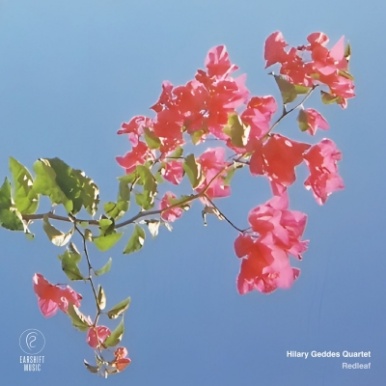
The closing “Three Five Ten” incorporates Geddes’ field recording of waves breaking on Redleaf Beach near Sydney, the location that gives the album its title. Her sparse guitar chording and Harris’ lyrical piano phrases, allied to Alduca’s economical bass and Inman-Hislop’s delicate cymbal work, combine to create a richly evocative sound picture, concluding the album on a gently elegiac note. As we’ve seen Geddes is something of a musical and cultural polymath, the artwork for “Redleaf” is also hers.
Geddes’ guitar playing has evoked comparisons with Bill Frisell and Pat Metheny ( it’s tempting to think of Harris as Geddes’ Lyle Mays) but on this album she very much finds her own instrumental and compositional voice and is particularly adept at deploying her guitar as a soundscaping device .If there are comparisons to be made I’d also cite John Abercrombie, plus the British guitarist Rob Luft, who is of a similar age to Geddes, and who has also developed, presumably independently, a sound that is very much his own and who is also particularly adept at using his guitar and its attendant effects as a textural tool.
The music of “Redleaf” is difficult to categorise (as is always the best way) but it is richly evocative and superbly played, striking a good balance between composition and improvisation. Geddes is the dominant musical personality but her bandmates are fully tuned in to her vision and offer skilled and empathic support.
The Hilary Geddes Quartet is currently touring the “Redleaf” album in Australia. I’d love it if they were able to bring this music to the UK too.
blog comments powered by Disqus