

by Ian Mann
February 09, 2026
/ LIVE
An excellent evening of jazz that featured a well balanced mix of original compositions and jazz standards, some of the latter rarely heard in this instrumental format.
Inscape Jazz Quartet, Kidderminster Jazz Club, St. Ambrose’s Parish Centre, Kidderminster, Worcs., 06/02/2026.
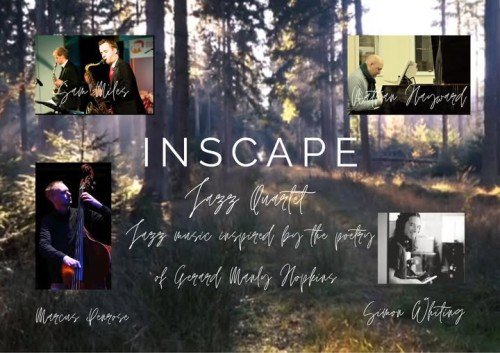
Nathan Hayward – piano, Sam Miles – tenor saxophone, Marcus Penrose – double bass, Simon Whiting – drums
2026 got off to an excellent start at Kidderminster Jazz Club with a visit from the Inscape Jazz Quartet, led by pianist and composer Nathan Hayward. Even on a rainy February night with the roads awash with surface water St. Ambrose’s Parish Centre hosted an audience numbering around fifty, which helped to give tonight’s event a warm and welcoming atmosphere. KJC organiser Annette Gregory announced herself delighted with the turnout for KJC’s first event since November 2025. The good people of Kidderminster and its environs were clearly in the mood to see and hear some top quality live jazz.
Providing the music was a group that was new to me and one that I suspect that most of the audience was probably unfamiliar with. That the audience members were prepared to ‘take a punt’ and come along to see a new band playing predominately original material is very much to Annette’s credit. Since founding KJC in 2019 she has built a loyal following and audiences have learned to trust her judgement with regard to the artists that she books. It’s an achievement that is all the more commendable when you consider the setbacks that she has faced, notably the Covid hiatus, which happened when the Club was less than six months old, plus a couple of changes of venue engendered by circumstances beyond Annette’s control. Yet here we are in 2026 with KJC happily settled in its new home at St. Ambrose’s and the proud possessor of ‘Delphina’, an acoustic upright piano acquired via a successful Arts Council grant application. Well done Annette.
Band leader Nathan Hayward was to make effective use of ‘Delphina’ tonight as he led his quartet through a series of original compositions plus a well chosen, and sometimes decidedly eclectic, set of standards. The publicity for the event suggested that we were to hear music that was “lyrical, thoughtful and poetic” and this was a summation that was pretty much spot on. The focus was very much on melody and story telling rather than bravado displays of technique. That said all of the musicians were highly accomplished technicians, but all deployed their considerable abilities wholly in the service of the music.
Leader Hayward left university with a first class honours degree in jazz music and now combines his work as an educator and author with that of a performing jazz musician. He has published two jazz piano instruction books and is currently working on a third. As a committed Christian Hayward’s writing is informed by his faith and he has previously released the album “Songs From a Spacious Place”, a collection of what he describes as “original devotional songs, gospel songs and hymns written in the spacious places of the English countryside”.
The Inscape Jazz Quartet represents Hayward’s jazz project and once again the music is informed both by his Christian faith and by his love of nature. These are themes that also found expression in the work of the poet and priest Gerard Manley-Hopkins (1844-89), whose writings represent the main inspiration for Hayward’s original compositions for the Inscape project.
The word “Inscape” itself was coined by Manley-Hopkins to describe “the unique essence of things”. During the course of the performance Hayward told us something about Manley-Hopkins’ ideas and even read us a few lines of his poetry, but kept the talking relatively brief as he and the group put the main emphasis on the beauty of the music.
Prior to this evening the only musician on stage whose playing I was previously familiar with was bassist Marcus Penrose. I have seen and heard him play as a sideman with pianist / composers Will Butterworth and Philip Clouts and as a member of the ‘chamber jazz’ trio Tournesol (Penrose, Butterworth and alto saxophonist Seb Pipe).
Penrose is also the leader of the trio Aurelius, which also includes Butterworth and drummer Marco Quarantotto. Featuring the writing of both Penrose and Butterworth the trio has released two albums, “The Process” (2019) and “Rize’s Cave” (2025), both of which have been reviewed elsewhere on The Jazzmann, as have releases by Butterworth, Tournesol and Clouts.
Hayward decided to ease both the audience and his bandmates in gently by commencing with a standard, an arrangement of “If I Were A Bell”. This saw Miles distinguishing himself as a highly melodic saxophonist with a warm and smooth tone as he made the opening theme statement and delivered the first solo. Hayward followed at the piano, with Whiting switching from brushes to sticks as the leader’s soloing became more expansive. Penrose’s double bass solo saw the drummer reverting to brushes before Miles returned to restate the theme and offer a further series of variations on the outro. An excellent opener that introduced the individual instrumental voices of the band and demonstrated their low key virtuosity.
Hayward’s first Manley-Hopkins inspired original was “The Golden Echo”, an attractively melodic composition inspired by Manley-Hopkins’ poem “The Leaden Echo and The Golden Echo”. The poem is a two part work that compares the extremes of human emotions. Hayward even read a few lines of the poem prior to the musical performance. Hayward’s piece is inspired the second half of the poem, “The Golden Echo”, a paean to beauty and positivity. These qualities are reflected in the music with Hayward’s opening arpeggios helping to set up a gently rolling groove that underpinned Miles’ buoyant sax melodies and subsequent soloing. Hayward followed at the piano, relishing the opportunity to step out of his supporting role.
Introducing “Bluebell”, a second Manley-Hopkins inspired original, Hayward explained something about the story behind the title. With a naturalist’s eye Manley-Hopkins was interested in studying the structure of a single bluebell rather than admiring a carpet of them en masse. This was his way of determining the its “individual essence” or “Inscape”. Hayward compared this with a jazz group’s interpretation of a jazz standard with both the individual musicians and the band as a whole trying to discover the “individual essence” or “Inscape” of the piece in question. A very perceptive and appropriate analogy.
In terms of composition this was a simple piece, in common with the “Inscape” theory, with the musicians improvising around just three chords. Again the focus was on melody with Miles stating the main theme and taking the first solo, but probing deeply and subtly, much in the spirit of Manley-Hopkins, over that ‘simple’ chord sequence. Hayward followed at the piano and Penrose on double bass.
“Up Jumped Spring”, a composition by the late, great trumpeter Freddie Hubbard, provided a welcome antidote to the atrocious winter weather that virtually everybody in the UK has been experiencing. This modern day standard was interpreted in the Inscape Quartet’s trademark melodic house style as the group brought out the full beauty of Hubbard’s tune. Miles’ opening theme statement and subsequent variations were followed by a piano solo from Hayward before the saxophonist stretched out more expansively.
Hayward also plays violin and occasionally performs on this instrument in gypsy jazz combos. The first set concluded with one of his favourite tunes from this genre of jazz, Django Reinhardt’s composition “Django’s Castle”. It was very unusual to hear this piece performed in this instrumental format and Inscape certainly put their own stamp on it with Miles’ sax approximating Stephane Grappelli’s melody lines and Hayward’s piano chording, allied to economical double bass and brushed drums, filling in for the more familiar chug of the rhythm guitar. Solos here came from Miles on tenor and Hayward on piano.
The second set began with a brace of Hayward originals, beginning with the Manley-Hopkins inspired “Pied Beauty”, a title inspired by GMH’s love of nature and all things “dappled, speckled and stippled”. Hayward’s piano motif combined with Whiting’s buoyant drum grooves to support Miles’ high register sax melodies and subsequent soloing, the tenor man again probing subtly but expansively. Once again the composer followed at the piano.
Hayward and Penrose were at music college together and during this period the pianist was involved with a project based on the Brazilian music style of Choro. Hayward’s composition “Choro” was inspired by this period and mixed Brazilian style rhythms with the melodic, quietly exploratory sax soloing of Miles and the dexterous and articulate double bass soloing of the consistently impressive Penrose. Introducing the piece Hayward mentioned Choro as being “the father of samba and the grandfather of bossa nova” and elements of both of these were discernible in this performance. Very few of tonight’s audience members had heard of Choro. My rudimentary knowledge of it comes from hearing pianist Huw Warren’s Choro Choro Choro project, but his version of the music sounds a lot more complex than this, at least to these ears.
Hayward announced the next piece as “my favourite ever standard”. This proved to be “I Thought About You”, which was given an inspired reading by the quartet. Initially delivered as a gently swinging ballad with Whiting initially deploying brushes the focus was again on melody with Miles’ theme statement subtly underscored by Hayward’s inventive counter melodies. Miles took the first solo with Whiting switching to sticks as the music gathered momentum and the saxophonist began to probe more deeply. Hayward’s own solo was also subtly exploratory, he’s an unobtrusive but intelligent soloist and his playing here sometimes reminded me of a less percussive Stan Tracey, another musician who also took compositional inspiration from poetry and literature.
Inspired in part by his Christian faith Hayward’s composition “Evensong” was ushered in by the duo of piano and tenor sax with Whiting subsequently adding delicate cymbal embellishments. As Penrose’s bass was added a beautiful folk like melody emerged that provided the basis for Miles’ softly plaintive tenor solo, delivered above a combination of economic piano chording, double bass and delicate brushwork. Hayward’s solo embellished the simple but effective melody, with a left hand rhythmic motif underpinning his thoughtful right hand meditations. Miles’ breathy tenor sax returned towards the close of a piece that represented a perfect example of this patient quartet’s ultra melodic ‘less is more’ approach.
That said the group did let their hair down a bit with the closing “Blue Hat”, a minor blues composed by Hayward and named for an old music college friend, an Egyptian saxophonist who habitually wore a blue hat. This ended the evening on a swinging note with Hayward taking the first solo and with Miles delivering his most forceful playing of the entire evening. The pianist and saxophonist then traded fours with Whiting, who also relished the opportunity to really cut loose for the first time.
Naturally the audience loved this and Annette Gregory had little difficulty in persuading the band to remain on stage for a well deserved encore. Hayward decided to cool things down again with his composition “Crepuscular Rays” – alternative title “Sunbeams”, which the composer though might be “a bit too twee”. The “Crepuscular” title might suggest a bit of a Monk homage but despite being written around “a lot of chords” this was still a beautiful ballad with double bass and brushed drums sympathetically underpinning lyrical solos from Miles and Hayward. Most of the audience seemed to think that “Sunbeams” should be the title.
This was an excellent evening of jazz that featured a well balanced mix of original compositions and jazz standards, some of the latter rarely heard in this instrumental format. I was very impressed with the quality of Hayward’s writing and it’s unfortunate that to date he has not been able to document the music of the Inscape Jazz Quartet on CD. Sales tonight would doubtless have been brisk had any recordings been available.
That said much of the music played this evening can be heard via Hayward’s Youtube channel and I have enjoyed revisiting a number of tonight’s originals as I write.
https://www.youtube.com/playlist?list=PL4smbxXb1IOMbmxWFI2efHHrtAuCCAWYA
See also;
https://www.nathanhaywardmusic.com/
blog comments powered by Disqus