

by Ian Mann
March 03, 2026
/ ALBUM
A very welcome souvenir of the Jazz Sabbath live experience. Listening to the music in the home environment heightens one’s appreciation of just how clever Wakeman’s arrangements are.
Jazz Sabbath
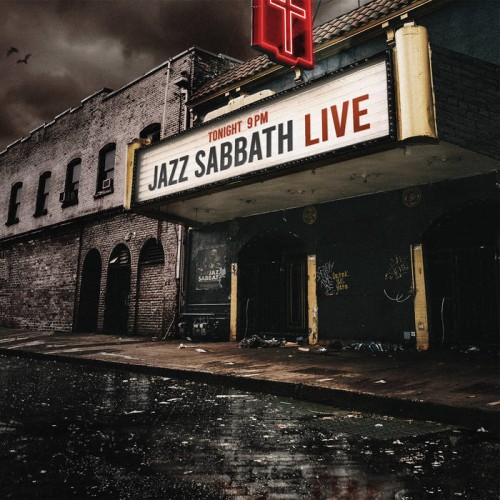
“Jazz Sabbath Live”
(Blacklake Records)
Adam Wakeman – piano, Jack Tustin – double bass, Arthur Newell – drums
At the 2025 Brecon Jazz Festival I was fortunate enough to be able to review a performance by Jazz Sabbath, a trio led by pianist Adam Wakeman dedicated to the playing of jazz arrangements of Black Sabbath songs.
I’m pleased to report that Mark van den Hoven of the band’s record label, the Netherlands based Blacklake Records, was impressed enough by my account to forward me a review copy of the group’s latest release, “Jazz Sabbath Live”. It’s the fourth volume in the Jazz Sabbath series and was documented at a performance in March 2025 at the Paradox Jazz Club in Tilburg, the home town of Blacklake. Thanks, Mark.
The release of the trio’s first album “Jazz Sabbath” in 2020 came with the ludicrous, but amusing, spoof back story of how Black Sabbath stole the compositions of sixties jazz pianist Milton Keanes (a pseudonym for Wakeman), re-invented them as heavy metal and took them all the way to the bank. It may be all a bit Spinal Tap but it’s great fun and it’s a story that the band have stuck with through the release “Jazz Sabbath Vol. 2” (2022) and “The 1968 Tapes” (2024), the latter supposedly recorded a full twelve months before the formation of Black Sabbath in 1969.
Wakeman still appears on stage in his Milton Keanes persona, sporting a grey wig and a cane. The Keanes character is meant to be eighty four years of age, the real Wakeman is fifty one The live shows also feature spoof videos outlining the Jazz Sabbath back story and these are pretty amusing, at least first time round.
Before the Brecon show I wasn’t quite sure what I would make of Jazz Sabbath. As a teenager in the 1970s I grew up with the music of Black Sabbath, Deep Purple and Led Zeppelin, but also got into various strains of prog rock and via this into fusion and eventually into more straight ahead jazz. I still harbour an affection for the music of Sabbath, Purple and Zeppelin but had moved on by the time the likes of Iron Maiden and AC / DC emerged and I don’t really count myself as a ‘metal’ fan any more.
The whole Jazz Sabbath concept seems a little arch and the back story, as amusing as it is, something of a distraction. But then I told myself that this is what jazz has always done, taken popular music, be it Broadway show tunes or heavy metal, and re-invented it, and this is just what Wakeman and his colleagues did at Brecon. In the end I was won over by the sheer inventiveness of Wakeman’s arrangements and the sheer brilliance of the playing, and particularly that of Wakeman himself. After the show I was lucky enough to talk with Adam Wakeman, a genuinely nice and down to earth guy and a brilliant musician.
At Brecon Jazz Sabbath also featured drummer Arthur Newell and bassist Joe Lee. This live recording also features Newell but has Jack Tustin on double bass. In accordance with the Jazz Sabbath myth both appear under suitably silly pseudonyms, Tustin is Jacque Tfono, Newell is Juan Take. The three studio albums also feature additional musicians, who all work under daft aliases. The Jazz Sabbath myth looks set to run and run.
Wakeman is the son of former Yes and Strawbs keyboard player Rick Wakeman and has played both keyboards and rhythm guitar for Black Sabbath and for Ozzy Osbourne’s own band. Given that father Rick guested on Sabbath’s 1973 album “Sabbath Bloody Sabbath” there’s a nice symmetry there.
Others with whom Adam Wakeman has worked as a session musician include Tony Hadley, Annie Lennox, Travis, the Company of Snakes, Strawbs, Will Young, Victoria Beckham, Atomic Kitten, Martin Barre, Uriah Heep and Deep Purple. He has also worked with his father and has recorded five solo albums, the latest being the excellent “A Handful of Memories” (2021), a solo piano recording.
The Jazz Sabbath project features Wakeman’s ingenious arrangements of Black Sabbath songs for a jazz piano trio. Apparently the idea came from Wakeman fooling around on hotel lobby pianos when Black Sabbath were away on tour, playing Sabs songs in an exaggeratedly jazz style. It’s a sound that has built a cult following of its own and although the Black Sabbath name helps to sell tickets it’s a project that wouldn’t have lasted five years and four albums if it wasn’t any good.
“Black Sabbath Live” is a double album that features arrangements of songs from Black Sabbath’s ‘classic’ 70s period when Ozzy Osbourne was still a member of the band. Indeed the recording is dedicated to Osbourne’s memory. Before his passing Ozzy expressed his approval of Wakeman’s project in his inimitable style - “I’m fuckin’ lovin’ it!”.
The material is sourced from the Black Sabbath albums “Black Sabbath”, “Paranoid”, “Master of Reality” and “Sabotage”. It’s essentially the same set list that I saw in Brecon and it’s only right that this live recording should begin with the song “Black Sabbath”, ushered in by the familiar sound effects of falling rain, rumbling thunder and the tolling of a bell. There’s a bout of audience applause as the musicians themselves take to the stage. The structure of the song is eminently recognisable with doomy, minor key solo piano passages sketching the familiar introductory lines instrumentally – “what is this that stands before me?” indeed. But soon Wakeman and his colleagues are taking the music somewhere else altogether with an uptempo swinging jazz passage featuring walking bass lines and an ebullient piano solo.
The trio remain with the first Black Sabbath album for “The Wizard”, introduced by the rapid bustle of Newell’s brushed drums. More heavily disguised than the opener this piece adopts more of an orthodox jazz feel as it progresses via a series of dynamic and stylistic changes, the trio extending the piece to nearly twice the length of the Black Sabbath original. Wakeman’s brilliant piano soloing is again at the heart of the performance and bassist Tustin weighs in with an impressive solo of his own. Newell also gives an excellent performance behind the kit and the trio round things off with a rollicking ‘honky tonk’ section that is rapturously received by the Tilburg crowd.
A solo piano introduction paves the way for the trio’s swinging interpretation of “War Pigs”, with Newell’s drums periodically coming to the fore a la Bill Ward. At the Brecon show I was reminded of the fact that Bill Ward’s drumming on the Black Sabbath original was pretty jazzy – both Ward and Ian Paice of Deep Purple grew up listening to jazz big band drummers and something of that sense of swing informed the playing of both of them. The Jazz Sabbath version of “War Pigs” naturally includes more superb playing from Wakeman but Tustin is again given his head with a highly dexterous bass solo, augmented by Newell’s deft brush work. Dynamic and stylistic contrasts again add interest to the devilishly clever arrangement.
Some of Wakeman’s arrangements were so cleverly disguised that in some instances at Brecon I didn’t even recognise the Black Sabbath original. Such a case was “Behind The Wall of Sleep”, one of the lesser known songs from Black Sabbath’s debut. Here that song is ushered in by the sounds of piano, bass and cymbal shimmers with Wakeman cleverly building and releasing tension via a series of twists and turns culminating in a furiously swinging section. Wakeman excels as ever, as does Tustin with some more fine soloing on the bass. Once again there are plenty of stylistic and dynamic shifts. In Wakeman’s hands these riff based metal tunes become infinitely malleable as he explores all their melodic, harmonic and rhythmic possibilities.
“Iron Man” was famously covered some twenty years previously by the American jazz group The Bad Plus, their version famously approved of by Geezer Butler himself, who even turned up at one of their Birmingham gigs. Wakeman’s interpretation is different again, less brutal than the Bad Plus version and more obviously rooted in jazz in terms of chord choices and sheer swingability. An introductory solo piano passage explores the space around the core motif before the trio kick in with a fiercely swinging section with Wakeman’s dancing fingers augmented by Tustin’s propulsive bass lines and Newell’s crisp drumming. The closing passage is positively riotous. I’d like to think that Geezer would approve of this version too.
The first disc concludes with “Fairies Wear Boots” from Black Sabbath’s “Paranoid” album. I always thought the metal original swung like crazy, Ward’s jazz background again, and this interpretation does so even more unapologetically. Naturally Newell plays an important role here with his drums periodically coming to the fore alongside the leader’s exuberant piano and Tustin’s muscular bass.
Disc two commences with an almost unrecognisable “Hole In The Sky” from the “Sabotage” album, another piece transformed into a jazz swingfest with solos from both Wakeman and Tustin.
Improvisation clearly plays an important role in Jazz Sabbath’s creative process. The album booklet contains the lines – “going where the songs take them, not knowing if “Paranoid” will be six minutes long or fourteen”. The Tilburg version clocks in at a little over eight minutes and transforms the metal classic into a jaunty New Orleans style march, punctuated by more considered solo piano passages from Wakeman. The excellent Tustin is again featured as a soloist.
From Black Sabbath’s heaviest album “Master of Reality” the song “Into The Void” also embraces some of that New Orleans vibe with Wakeman introducing the piece with a passage of unaccompanied piano. Soon the trio are again swinging like crazy, spinning fresh, vibrantly coloured musical cloth from the warp and weft of those dark, gargantuan heavy metal riffs. As the album booklet has it; “The album you are holing in your hands contains songs you’ve heard before, but never like this”.
Quite so, and for further evidence here comes “Rat Salad”, a brief drum feature for Ward on the “Paranoid” album which has been re-invented as a furiously swinging piano trio piece that clocks in here at nearly twelve minutes. Propelled by Tustin’s might bass lines Wakeman’s thrillingly percussive piano goes head to head with the dynamic drumming of the excellent Arthur Newell, the latter delivering a truly astonishing extended drum solo.
The album concludes with “Children Of The Grave” from “Master of Reality”,once described by Osbourne as “the most kick-ass song we ever recorded. Following a suitably creepy start that seems to put the coda at the beginning Jazz Sabbath’s version exhibits similar butt kicking qualities, but in a more obviously jazz way. But it’s not quite all hammer and tongs, there are also moments of reflection along the way, with Tustin turning in another excellent bass solo. A rousing, ferociously swinging final passage, led by Wakeman’s piano, turns this stoner anthem into a celebration, eliciting a rapturous response from the Dutch crowd.
This live recording represents a very welcome souvenir of the Jazz Sabbath live experience and listening to the music in the home environment heightens one’s appreciation of just how clever Wakeman’s arrangements are. Make no mistake despite the daft spoof back story and the rock trappings Jazz Sabbath’s music is genuine jazz that really swings and you don’t have to have any knowledge of Black Sabbath’s music to enjoy it. The standard of the music is exceptional throughout, and despite my initial scepticism I’m now very much a fan of this band and would happily see them play live again.
It’s amazing just how adaptable Black Sabbath’s music is, despite that group’s unique sound. I’d love to hear a jazz big band playing versions of Black Sabbath songs, I can just imagine those mighty riffs being blasted out by baritone saxes and trombones, that really would be quite something. Maybe it’s something Wakeman could consider, but I’d be up for listening to whoever took it on. Somebody please do.
blog comments powered by Disqus