
by Ian Mann
December 19, 2025
/ ALBUM
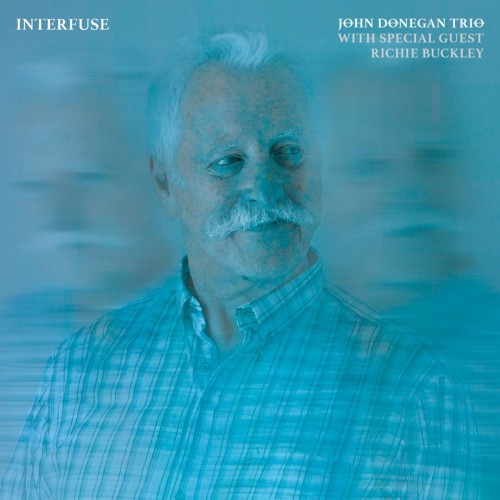
A welcome addition to the catalogue of the consistently impressive John Donegan.
John Donegan Trio with special guest Michael Buckley
“Interfuse”
(Jayde Records)
John Donegan - piano, composer, Bernard O’ Neill - double bass, John Daly - drums
with Michael Buckley - tenor & soprano saxophones
PROLOGUE
In July 2025 I was approached by pianist and composer John Donegan with a request for me to write the liner notes for his then forthcoming album “Interfuse”, which was officially released on December 1st 2025.
It was an honour and a privilege to be asked and I was more than happy to agree to John’s request. He is an artist whose work I have admired for a number of years and The Jazzmann has reviewed four of his previous albums, all recorded in a sextet format, these being “A Kite for Kate” (2019), “Shadows Linger” (2022), “Light Streams” (2023) and “We Will Meet Again, Sometime” (2024).
“Interfuse” sees him returning to the classic piano trio format, but with saxophonist Michael Buckley, like drummer John Daly a member of Donegan’s ‘Irish Sextet’, guesting on a number of tracks.
At present “Interfuse” has been released digitally and on CD, although a vinyl release with a different track listing is planned for the future, as is a full second album.
My liner notes are essentially a ‘review’, largely written in the Jazzmann ‘house style’, which is itself based on the liner notes to be found on classic Blue Note recordings.
Rather than review the album for a second time I have reproduced my liner notes below, a case of ’ Bop Will Eat Itself’, if you will.
This provides me with the opportunity to bring the album to the attention of the Jazzmann readership and to thoroughly recommend it as a highly satisfying listening experience.
“Interfuse”, plus numerous other recordings by John Donegan, can be purchased via his website;
https://www.johndoneganjazz.com/
“INTERFUSE” ALBUM LINER NOTES by IAN MANN
“Interfuse” is the new release from the Irish born pianist and composer John Donegan, originally from the city of Cork but now based in Hertfordshire, following a period of living and working in Bristol.
Donegan names his main pianistic influences as being Bill Evans, Wynton Kelly, Hampton Hawes, Bud Powell, Keith Jarrett, Chick Corea and Kenny Barron. As this list might suggest Donegan’s music is a kind of modern mainstream with the emphasis on original composition. One suspects that the sound of the Blue Note label also represents a significant source of inspiration.
The last few years have proved to be a particularly fruitful time for Donegan and has seen the release of a series of acclaimed recordings that include the albums “A Kite for Kate” (2019), “Shadows Linger” (2022), “Light Streams” (2023) and “We Will Meet Again, Sometime” (2024).
A prolific composer Donegan has written a suite consisting of twenty one short pieces that combine elements of jazz and Irish traditional music. This work has been issued on two separate albums “Siamsa, Volumes One and Two”, both released in 2018. A third volume of Siamsa and another separate work entitled “The Elegy Suite” written to commemorate all those who lost their lives in the pandemic, are both planned to be recorded at a future date.
For this latest release Donegan has returned to the classic ‘piano trio’ format with long time associate John Daly filling the drum chair and with Bernard O’Neill coming in on double bass. O’ Neill acted as the producer of eight of Donegan’s nine previous album releases and here occupies a dual role as musician and producer, excelling in both capacities. The new album also includes contributions from Richie Buckley on both tenor and soprano saxophones.
The material includes two brand new compositions plus fresh arrangements of several original pieces that have previously featured on earlier recordings. The recording features Donegan’s playing in a variety of instrumental formats, from solo piano through duo and trio to the full quartet. The album is released on both CD and limited edition vinyl is planned for the future, but with a different track listing on each format.
The CD commences with the new composition “Blues Jive”, a tune in the blues format that Donegan describes as being “Monkish and edgy”. With its martial rhythms and powerful solos it makes for a rousing start with Buckley delivering a fiery tenor sax solo, followed by a fluent, expansive and sometimes percussive piano solo from the leader. O’Neill demonstrates his credentials as a bass soloist and Daly enjoys a series of colourful exchanges with the other musicians. It’s a good introduction to the individual instrumental voices of the band.
Title track “Interfuse” is track two on the CD. It’s a tune that first appeared in sextet form on the “A Kite For Kate” album but is re-worked here as a solo piano performance. It’s an introspective piece with a modal theme and this solo piano version focusses on the beauty and lyricism of the tune, emphasising its melodic qualities.
The third track is “Funny Isn’t It?”, a composition originally recorded in a solo piano format on the album “Jen’s Progress”. Donegan explains the title thus; “I wanted to create something very simple with a chromatic figure on the left hand which was intended to be amusing - hence the title”. The piece is updated here in the piano trio format and has lost none of its idiosyncratic charm. Donegan introduces the piece unaccompanied, later joined by Daly’s deft cymbal work and O’Neill’s double bass. The pianist then solos more expansively, shadowed by the rhythm section, with Daly sporadically breaking cover with a series of lively drum breaks before the opening motif returns towards the close.
“Five to One” re-introduces the full quartet and draws on literature for its inspiration as Donegan explains; “The idea behind the tune is an imaginary conversation taking place with five of Ireland’s foremost literary giants: Oscar Wilde, George Bernard Shaw, W.B Yeats, James Joyce and Samuel Beckett. All these writers have been influential in my appreciation of modern Irish literature and were hugely innovative in their works”. The tune is written in a 5/4 time signature and has a melody inspired by Irish traditional music. Buckley’s tenor sax takes the lead before handing over to Donegan for the first solo, the saxophonist later returning with a more expansive solo of his own. There’s also a drum feature from Daly on a piece that resembles a Celtic version of Dave Brubeck’s celebrated “Take Five” and which originally appeared on the album “Siamsa Suite, Vol 2”.
“A Song For Ciara” appears on the CD and is a solo piano re-working of the title track from Donegan’s1997 album. It’s a tender dedication to his eldest daughter and the performance again places the emphasis on melody, lyricism and beauty.
The sixth track is “Rumba De Ciudad”,a tune that first featured in a sextet format on the album “A Kite for Kate”. Donegan clearly enjoyed revisiting this Latin flavoured tune in a piano trio setting, his playful pianism complemented by Daly’s percussive exotica and O’Neill’s supportive bass, with the latter also coming to the fore with a lively double bass solo.
“Sonorial”,is a composition that was originally recorded as a solo piano piece on the “Light Streams” album, a performance that earned favourable comparisons with the playing of Keith Jarrett. “The title came from the style of the piece which is sonorous and melodic”,explains Donegan. These are qualities that remain very much in evidence on this delightful trio rendition, which combines Donegan’s piano lyricism with the sympathetic support of the rhythm section, with Daly producing a finely detailed and richly nuanced performance at the kit.
The new composition “A Resolute Rose”, a dedication to Donegan’s young granddaughter Rosemary, who survived a serious childhood illness. This piece was recorded as a piano / soprano sax duet and is a heartfelt dedication to the spirit and determination of its subject. Buckley makes a beautiful contribution to this tender and lyrical piece, as does its composer.
The CD concludes with “A Kite for Kate”, the second sextet piece to be re-imagined in the piano trio format. O’Neill’s bass plays a significant early role in this version of an inherently joyous tune and Daly also weighs in with a colourful drum solo. There’s also a passage of unaccompanied piano with Donegan’s fingers dancing over the keys, something that continues as the bass and drums subsequently return. The composer states that he enjoyed re-working this tune in a trio format and on the evidence of this vivacious group performance it’s easy to see why.
“Interfuse” represents a welcome addition to the catalogue of the consistently impressive John Donegan. The good news is that the sessions, which were held over the course of four days of rehearsing and recording, yielded enough material for a proposed second album that should appear sometime during 2026. This will feature three new compositions plus further re-workings of previously released material. On the evidence of the excellent “Interfuse” this will be another release to really look forward to.