

by Ian Mann
February 03, 2026
/ LIVE
One of the most memorable ‘ambient’ (for want of a better term) live music performances that I have experienced and one of the best all round events that I’ve seen at Sy ; Gigs.
Jonny Nash and Tomo Katsurada Duo / Christopher Haddow, Sy; Gigs, The Darwin Room, Shrewsbury Library, Shrewsbury, 01/02/2026.
PROLOGUE
The first event in the fourth season of the highly successful series of Sy; Gigs, instigated and curated by Chris Taylor, attracted a sold out audience to the 100 capacity Darwin Room at Shrewsbury Library.
Today’s matinee performance was the second event to be hosted at what is a relatively new venue for Sy; Gigs. In September 2025 the solo guitarists Gwennifer Raymond and Elizabeth Still were the first artists to appear at the Darwin Room. I was unable to attend as I was covering the Wall2Wall Jazz Festival in Abergavenny but I was able to catch up with Raymond later in the year when she gave a brilliant performance at The Jam Factory in Hereford, an event staged by Herefordshire based promoters Weirdshire and one which I attended as a paying customer, so no review. I have however reviewed Shropshire based Still’s music when she appeared as part of the quartet Haress at an Sy; Gigs event at St. Alkmund’s Church, part of a double bill with the Tara Clerkin Trio in May 2024. My account of that event can be found here;
https://www.thejazzmann.com/reviews/review/haress-tara-clerkin-trio-sy-gigs-st.alkmunds-church-shrewsbury-23-05-2024
Today represented my first visit to the Darwin Room and I was hugely impressed with it as a venue. Shrewsbury Library is housed in a Grade 1 listed building that was the site of Shrewsbury School until 1882. Charles Darwin was educated there, attending the school in 1818. The Room that bears his name is situated upstairs and is spacious and airy, affording great views over the town, including the nearby Shrewsbury Castle. I got the impression that the Darwin Room may once have been the School Chapel and there was certainly something of a church like atmosphere about it, which was very much in keeping with the Sy; Gigs aesthetic, the series also deploying St. Alkmunds Church and the Unitarian Church as venues. Like all of the spaces that Sy ; Gigs uses the acoustics were excellent and very well suited to the kind of music that the series presents.
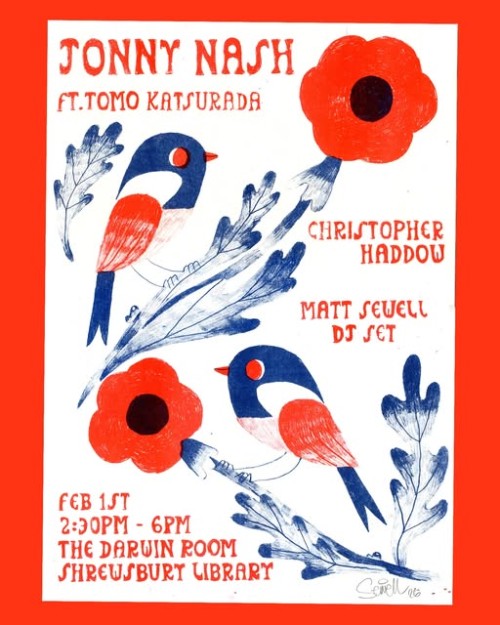
Before the show and at the interval Taylor’s friend Matt Sewell performed a DJ set that mixed the sounds of ambient instrumentals with indie rock and pop. Sewell also designed the beautiful event poster that illustrates this article.
CHRISTOPHER HADDOW
Christopher Haddow – guitars, lap steel guitar, tape loops, electronics
The first artist to appear was the Glasgow born, Gloucestershire based guitarist and electronic musician Christopher Haddow. Taylor had first seen him play at the Hidden Notes Festival in Stroud, where Haddow had played a set at Sound Records, an independent record shop that also hosts regular live music events.
Suitably impressed Taylor invited Haddow to Shrewsbury to play a set for Sy; Gigs, a performance opportunity that this experimental artist was more than happy to accept.
Haddow released his debut album “An Unexpected Giant Leap” on the Glasgow record label Errol’s Hot Wax in September 2024. An all instrumental recording it features his experiments with a series of guitars, plus tape loops and a variety of electronic effects that Haddow describes as “atmospherics”. The album also includes guest contributions from Josh Longton on double bass and Jamie Bolland on piano. The album can be purchased here;
https://www.errolshotwax.com/products/810256-christopher-haddow-an-unexpected-giant-leap
The programme is comprised of nine relatively concise ambient instrumentals with the eight minute title track the longest in duration. The music is inspired by Haddow’s experience as a new father and he describes the album as “a contemplative journey evoking the hazy moments of early parenthood”.
Haddow has subsequently been working on a follow up and we were to hear some of the fruits of those labours today. His set up included a variety of guitars, an array of electronic devices, aka ‘atmospherics’, and a tape loop featuring sounds from various sources including those of the family home, also occupied by his wife and two young children.
He commenced with an unbroken sequence lasting around twenty five minutes that included the whirr of the tape loops allied to the eerie use of guitar and electronic effects, plus the skilful deployment of vibrato on the guitar.
This was richly immersive music and the combination of guitar and tape loops almost inevitably reminded me of the music of Robert Fripp and Brian Eno on albums such as 1973’s “No Pussyfooting” and its 1975 follow up “Evening Star”. Haddow acknowledges Eno as an influence, alongside guitarists John Fahey, Link Wray and Marisa Anderson.
Looking around the room I witnessed many people listening with their eyes closed, but in contemplation or meditation rather than sleep – although I can’t speak for those lounging around on the bean bags at the front.
In addition to the use of old fashioned tape loops I got the impression that there was also what has now become a more conventional manner of live looping going on as Haddow continued to draw listeners into his sound-world. At one juncture he laid the guitar on his lap and deployed a number of devices (among them a hard headed mallet of the type used on tuned percussion instruments) on the strings, and also on the body of the guitar to create a kind of percussive effect.
After around fifteen minutes Haddow turned the tape loop off and switched to lap steel guitar, his sound now less Fripp and Eno and more Bill Frisell as something a country twang was introduced to the proceedings, although this too was the subject of a degree of live looping. If the genre “Ambient Americana” doesn’t already exist Haddow might just have invented it, his lap steel improvisations conjuring up images of the wide open spaces of the American Mid West.
Haddow’s second piece was shorter and relatively more conventional and featured him playing two different electric guitars, a Gretsch and a Fender, during its duration. Again it exhibited something of a country / Americana tinge and acted as a demonstration of his considerable abilities as a finger style guitarist. Once again the sound was expanded via the use of live looping.
During the course of researching his review I unearthed the Youtube footage of Haddow’s performance at Stroud, with Chris Taylor visible in the audience. The first sequence is very similar to today’s suggesting that this section is largely written. It could well be that this long form piece will represent the bulk of the new album. The Stroud show also includes four shorter instrumentals, including one played on acoustic guitar, this representing another excellent example of Haddow’s guitar picking skills. The Stroud show concludes with a short item dedicated to the memory of the then recently deceased Keith, the founder of the Glasgow based Optimo Music label, which released the 2018 album “The Hare, The Moon and The Drone” by the band Jacob Yates and the Pearly Gate Lockpickers, of which Haddow was once a member, as were Josh Longton and Jamie Bolland.
Christopher Haddow at Sound Records, Stroud here;
https://www.youtube.com/watch?v=UUFd82Wb8UI
JONNY NASH / TOMO KATSURADA DUO
Jonny Nash – guitar, vocals, electronics, Tomo Katsurada – guitar, electronics
The second set of this matinee event featured another Scottish born guitarist, vocalist and electronic musician Jonny Nash, who is now based in the Netherlands after spending several years living and working in both India and Japan.
He worked as a DJ before concentrating on his work as an instrumentalist, both as a solo artist and as a member of the international trio Gaussian Curve, a group also featuring the Italian musician Gigi Masin and the Dutch musician Marco Sterk.
A prolific solo artist Nash’s releases include the albums “Phantom Actors” (2014), “Exit Strategies” (2015), “Eden” (2017), “Make A Wilderness” (2019), “Point of Entry” (2023) and the recent “Once Was Ours Forever” (2025). He runs his own record label Melody As Truth and all the recordings mentioned here are available via Nash’s Bandcamp page.
https://jonnynash.bandcamp.com/music
Today’s show was billed as Jonny Nash featuring Tomo Katsurada but such was the level of rapport between the performers that I prefer to think of them as equal contributors, hence my decision to bill them as a duo.
The versatile Katsurada makes a guest appearance as a cellist on Nash’s most recent album but today the Japanese musician focussed on guitar during the course of a set that featured seven concise pieces of music, predominately instrumental but also featuring Nash’s understated but distinctive vocals. I’m assuming that the majority of the material was sourced from “Once Was Ours Forever”, but no tunes / songs were announced and I was unable to get hold of a set list so no titles will be forthcoming during the course of this review.
The music was in a similar vein to Haddow’s, relaxed, drifting, ambient and drawing on an eclectic range of influences. Frequently it was simply downright beautiful.
Once again the use of electronics represented a significant part of the performance. The opening piece was richly atmospheric and featured what sounded like sampled bird song alongside the ethereal vibrato of Katsurada’s guitar. Nash added his fragile, almost subliminal vocals. His singing reminded me of that of Charlie Beresford, guitarist and vocalist with the group Fourth Page in addition to being a prolific solo artist and regular duo collaborator. Nash’s vocals were buried too deeply in the mix for me to attempt to decipher the lyrics, but given the style of music one suspects that this was entirely intentional. The piece was also notable for a ‘solo’ from Katsurada that again made effective use of vibrato effects, generated I suspect by skilful use of the tremolo arm rather than the use of e-bow, a device that Nash was to deploy later.
The next piece opened with the guitars of the right handed Katsurada and the left handed Nash sketching a delicate tracery. This item was also notable for Nash deploying a combination of e-bow and finger slide to create eerie and ethereal textures, these further enhanced by Katsurada’s further use of vibrato. The two musicians switched roles easily with any ‘solo’ episode from one underpinned by the sympathetic cyclical chording of the other.
The third piece saw Katsurada using his thumb on the top strings of his guitar to generate a bass guitar like sound, his recurring motifs underpinning Nash’s cleanly picked guitar melody lines and subsequent spidery solo.
The fourth item featured further delicate guitar interplay plus Nash’s fragile vocals. The already intimate rapport between the two musicians seemed to reach fresh heights with both also featuring as ‘soloists’, with Katsurada conjuring some extraordinary high register sounds from his instrument that were both beautiful and astonishing.
Item five featured an extended unaccompanied intro from Nash with the use of e-bow and other electronics helping to generate a richly atmospheric sound. Katsurada again made effective use of vibrato but was also content to provide simple chordal backing to a Nash solo that again made excellent use of the e-bow and which was hauntingly beautiful.
The sixth piece featured another solo intro from Nash, this time featuring both guitar and vocals, later augmented by Katsurada’s ethereal guitar shadings. Katsurada’s richly evocative solo deployed a kind of ‘wide screen’ chorus effect, soaring above Nash’s underpinning arpeggios. The pair then changed roles with Katsurada’s ethereal shimmer underscoring Nash’s e-bow enhanced solo as he took his chance to soar.
Nash then spoke for the first time to thank the organisers, the light and sound engineers, the audience and, of course Katsurada.
The seventh and final item, effectively an encore, was the shortest tune of the set, another slice of space age Americana that juxtaposed the eerie sound of the e-bow with a country like twang.
If Haddow’s performance had been immersive this duo set took things to a whole other level. This was music that was truly transportive and transcendent and many members of the audience rose to their feet to applaud the duo. After the show the line at the merch desk was the longest I have ever seen at an Sy; Gigs event. The percentage of the audience that bought items of merch (vinyl, T shirts) must have been extraordinarily high. Ant it wasn’t just Nash’s stuff that was selling, Sewell’s gig posters proved to be highly popular purchases too.
This was one of the most memorable ‘ambient’ (for want of a better term) live music performances that I have seen. In addition to the brilliance of the musicians themselves other factors included the building, the lighting, for which Chris Taylor also expressed appropriate gratitude, and also my fellow audience members, who were remarkably attentive throughout, utterly transfixed by the music. If all that wasn’t enough dusk fell during the course of the performance, the gradual darkening of the sky, even on a wet, miserable February day enhancing the atmosphere even more.
I had hoped to speak with Jonny after the show and get details of the set list but the queues were so long that I soon abandoned that idea. It had been raining heavily for five hours and with a 40 mile journey ahead of us we decided not to hang about and to head for home.
But we were very glad we made the trip for one of the best all round events that I’ve seen at Sy ; Gigs. All in all a rather splendid afternoon out.
blog comments powered by Disqus