

by Ian Mann
February 17, 2026
/ ALBUM
Her most personal, but also most political, recording to date “Unspoken” represents a powerful and thought provoking statement from Campiche.
Julie Campiche
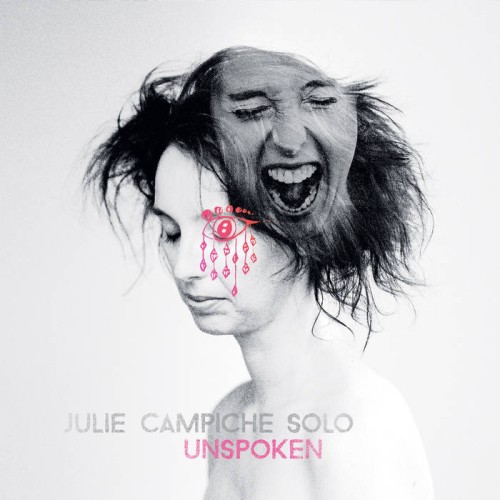
“Unspoken”
(Ronen Rhythm Records RON47)
Julie Campiche – harp, vocals, electronics, samples, shruti box
with
Fabien Iannone – bass, tom
“Unspoken” is the third album from the Swiss harpist and composer Julie Campiche. Its predecessors “Onkalo” (2020) and “You Matter” (2022) were both recorded by her regular quartet featuring saxophonist Leo Fumagalli, bassist Manu Hagmann and drummer Clemens Kuratle.
Both quartet albums are favourably reviewed elsewhere on The Jazzmann as is an exceptional live performance by the quartet at the 2022 Wall2Wall Jazz Festival in Abergavenny, a genuine Festival highlight and one of the most memorable live gigs that I have seen in recent years. It was a real privilege to see the band at a venue so close to home and to meet all the members of the quartet after the show.
https://www.thejazzmann.com/reviews/review/julie-campiche-quartet-onkalo
https://www.thejazzmann.com/reviews/review/julie-campiche-quartet-you-matter
Campiche first came to my attention when she performed as part of “New Switzerland”, a livestream event showcasing emerging Swiss jazz talent that formed part of the 2020 online EFG London Jazz Festival. She appeared alongside the bands Ikarus and Trio Heinz Herbert and my account of this fascinating and highly enjoyable event can be found here;
https://www.thejazzmann.com/features/article/new-switzerland-julie-campiche-ikarus-trio-heinz-herbert-efg-london-jazz-festival-livestream-14-11-2020
I also covered a livestream from the Unterfahrt Jazz Club in Munich in April 2021, probably the best streamed event that I witnessed during the whole of lockdown. This was largely due to the music but the experience was helped by the extremely high standard of the sound and visuals. At this time the quartet’s material was still largely being sourced from the “Onkalo” album but there was a teaser for the next release with the inclusion of “Aquarius”, the opening track on “You Matter”. My review of the Munich show is here;
https://www.thejazzmann.com/reviews/review/julie-campiche-quartet-livestream-from-unterfahrt-jazz-club-munich-germany-28-04-2021
The Julie Campiche Quartet is only one part of the restlessly creative harpist’s output. She is also involved in an international Strings Project, leads a standards trio and is a member of the all female trio Majudi. With vocalist Mirjam Hassig she is a member of the quartet Aye! and she has also been involved in a number of theatre projects.
The quartet have also produced a series of videos in conjunction with the trapeze artist Vanessa Pahud and have worked with the Baroque ensemble Capelle Jenensis, with whom they released the album “Transitions” in 2024.
Campiche has also been involved in a wide range of collaborations with a variety of European jazz musicians and has appeared at numerous jazz festivals all across the continent. For further details of her musical activities visit her website http://www.juliecampiche.com
In terms of subject matter both “Onkalo” and “You Matter” have mixed the personal with the political with Campiche placing a particular emphasis on environmental concerns. “Unspoken” is arguably her most overtly political work to date, one which looks at the world from a strongly feminist perspective. It’s also pretty much a genuine solo album with Campiche handling all the vocals and playing the majority of the instruments, albeit with additional rhythmic support from bassist / percussionist Fabien Iannone on five of the eight tracks.
The material features eight musical portraits of inspirational women, some famous, some anonymous whose work has challenged patriarchal social norms. This is music that champions sisterhood and resistance and celebrates feminine power. The album appears on Ronin Rhythm Records, the label established by Campiche’s fellow Swiss, the pianist and composer Nik Bärtsch.
A highly informative album booklet written by Campiche offers valuable and highly detailed insights into the inspirations and stories behind the individual tracks.
Opening track “Anonymous” takes its title from a quote by Virginia Woolf – “For most of history ‘Anonymous’ was a woman”. For this piece Campiche has gathered recordings of women across the globe reciting these words in their own tongue, the names of some of the participants are listed in the booklet, while others chose to remain suitably anonymous. Campiche describes these recordings as; “A chorus of women’s voices to create a sense of community. Voices that reveal the woman behind the anonymity, voices that remind us that we are not a minority but that we are one half of humanity”.
Musically the piece blends the sounds of the recorded voices with those of Campiche’s harp and electronics, plus sampled beatboxing and drumming to create an immersive soundscape. The vocal recordings are spliced together, single voice statements of Woolf’s phrase merging together to create a multi-layered polyglot chorus. At just under three minutes duration the piece is relatively brief, but it makes its point eloquently and emphatically.
“Grisélidis Réal” represents Campiche’s tribute to the Swiss born activist Grisélidis Réal (1929 – 2005), who championed the rights of sex workers. The music includes words sampled from the French documentary film “Prostitution” and makes effective use of samples and found sounds, among them footsteps on cobbles symbolising prostitution and the noise of a photocopier representing Real’s activism. The sound of children laughing is a reminder that sex workers are also often mothers with families of their own. The piece is a celebration of Real’s life and work, the mood joyous and angry by turns. Campiche may be a harp virtuoso, and her playing of the instrument is at the heart of the music here, but even with the quartet her playing has never been about virtuoso soloing or mere technique. Instead she sees the bigger picture, a masterful sound-scaper who deploys her instrumental and electronic skills to create a music that is bigger than herself and which makes profound socio-political comment.
Campiche uses the name “Rosa”, the third item in this series of musical portraits, as a generic for the thousands of women who work illegally in the economic shadows of Western society as carers or childminders, earning money that she sends back to her family in her less affluent homeland. It’s a situation that is tacitly accepted by wealthy Western societies. As Campiche observes; “Rosa is everywhere. She is indispensable and yet must remain invisible”.
Essentially this is an all instrumental piece centred around the harp, but also featuring Campiche’s wordless vocals. Repeated melodies signify mounting tension and melancholy while the use of layered voices represents the universality of the song’s theme. Iannone also makes his first appearance, his electric bass helping to give the music additional rhythmic heft.
“Andréa Bescond ” celebrates one of Campiche’s contemporaries, the French polymath Andréa Bescond (born 1983). Bescond is variously a dancer, actor, choreographer, author, director, scriptwriter and film maker who deploys her artistic talents to denounce violence against women and children and to fight for justice, protection and prevention for the vulnerable.
Again aided by Iannone this is the most rhythmic piece thus far, mixing harp arpeggios with dissonance, breathy wordless vocals and rhythmic explosions to create a dystopian soundscape that gives a voice to the righteous anger that unites Bescond and Campiche.
In Campiche’s words “Los Patronas” celebrates “a group of Mexican women who help Central American migrants travelling on merchant trains in search of a better future in the United States, by providing them with food and water. Las Patronas prepares 300 meals a day which they toss in bags to the migrants passing by in the trains. Their work is dangerous and physically demanding. Despite challenges such as harassment and threats from the authorities and criminal groups, these women continue their courageous humanitarian mission. They have become a symbol of hope and solidarity for innumerable Central American migrants.”
The music features Campiche singing the Spanish language lyrics of the poem “Tiempo y Espacio” written by Mirta Antonia del Pino. The multi-tracked vocals are accompanied by the sounds of a shruti box and Iannone’s tom drum. It’s beautiful and strangely moving, even for those of us unable to fully understand the lyrics.
“Tarana Burke” celebrates another living person, the New York born activist Tarana Burke, the founder of the Me Too movement. She began her work in 2006 but became more widely known in 2017 in the wake of the Harvey Weinstein case. Commencing with the phrase “it didn’t kill us, it made us stronger” the piece includes words sampled from Burke’s acceptance speech for the Variety Power of Women Award in 2018. Burke’s message is one of resilience and resistance against sexual violence, the power of her words matched by Campiche’s dramatic, brilliant orchestrated musical backdrop, realised via a combination of harp, vocals, samples and electronics.
On “Maman Di Ciel” Campiche pays homage to the Paris based street artist, a campaigner against incest and intra-familial violence and a champion for the parental rights of women.
The album liner notes recount this disturbing tale;
“Her 7-year-old daughter has been placed in paternal custody. In custody with the same father who is under penal investigation for incest! To let her daughter know that she is fighting for her, she places images of colourful humming birds that they once drew together along the street to her school.”
The music makes use of looping techniques to create what Campiche describes as a “vocal polyphony” based around the English language phrase “why can’t you hear?”. The harp plays a bass melody allied to a countermelody designed to imply imbalance and instability while an improvised vocal melody is intended to suggest the singing of a lullaby. The various elements combine to create a dramatic and thought provoking piece of music.
The album concludes with “Zaïna”, the first piece of music that Campiche ever composed. She says of its inclusion here;
“Its inclusion is truly symbolic as it embodies the essence of innocence. Every woman, before taking on the feminine identity and the social construct associated with it, is first and foremost a human being”.
She also quotes Simone de Beauvoir: “We are not born woman, we become it”.
Musically it is the only piece not to feature any electronic embellishment. It emerges from near silence, even Campiche’s breathing can be heard as she delicately plucks the harp strings, the melody slowly unfolding. Wordless vocals are also added, giving the musical a serene choral quality, occasionally punctuated by shards of harp generated dissonance. There’s a spaciousness about the music that is reminiscent of the ECM aesthetic. As on the previous track Iannone is in there somewhere, but his role is less easy to define.
Her most personal recording to date “Unspoken” represents a powerful and thought provoking statement from Campiche. This is an album that addresses serious social and political concerns but which is also a success in purely musical terms. Campiche’s deployment of harp, voice and electronics is masterful and the way in which she inserts the various speech samples into the fabric of the music is similarly impressive. It’s a process that began with the inclusion of a sampled speech by Greta Thunberg on the track “Fridays Of Hope” on the “You Matter” album. In addition to her skills as an instrumentalist and orchestrator Campiche also impresses with her work as a vocalist.
Also playing their part are Iannone, plus Campiche’s co-producer Leo Fumigalli and an engineering team featuring the co-producers plus Iannone, Martin Ruch and Nik Bärtsch.
This is an album that I enjoyed listening to, but which also made me think. It would certainly be interesting to see the music performed live and Campiche has a number of solo shows scheduled throughout 2026. Details of her schedule can be found on her website here;
https://www.juliecampiche.com/en/Shows
At the end of the day I probably prefer the fuller sound of the whole quartet but “Unspoken” represents an important record in its own right.
blog comments powered by Disqus