

by Ian Mann
April 15, 2026
/ LIVE
The most satisfying music often straddles the boundaries between composition and improvisation, something that Let Spin continue to do with increasing aplomb.
Let Spin, Shrewsbury Jazz Network, The Hive Music & Media Centre, Shrewsbury, 11/04/2026.
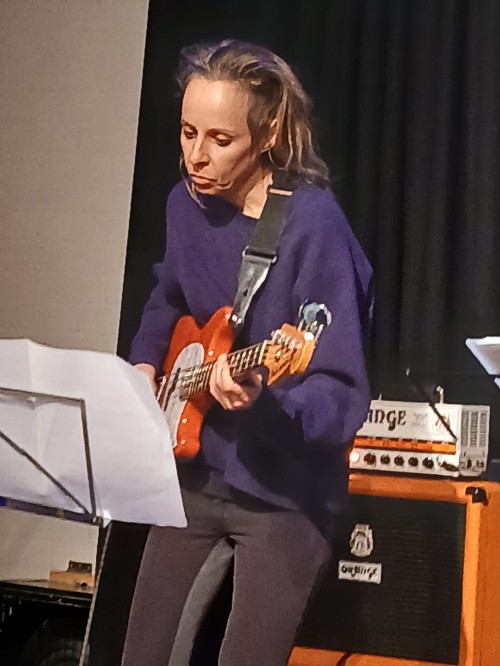
Chris Williams – alto & baritone saxes, flute, electronics, Moss Freed – guitar, baritone guitar, electronics, Ruth Goller – electric bass, vocals, electronics, Finlay Panter – drums, percussion
Describing themselves as a “collaborative quartet” and as a “post-jazz quartet” the band Let Spin has been together in its original incarnation for more than a decade and has released a total of five albums to date.
I first discovered the band at the 2012 London Jazz Festival when they gave an excellent performance at the Green Note in Camden as part of a double bill with vocalist/violinist Alice Zawadzki’s group. My account of that show can be read as part of my Festival coverage here;
https://www.thejazzmann.com/features/article/london-jazz-festival-2012
(The Let Spin performance is the final item in the article).
Although that was my first exposure to the music of Let Spin I was already aware of the work of the individual musicians concerned. Even back in those days Let Spin was considered something of a ‘supergroup’, bringing together musicians from the Manchester and London jazz scenes. Saxophonist Chris Williams was well known to me through his work with Led Bib, bassist Ruth Goller from Oriole and Acoustic Ladyland, Freed from his own Moss Project and Finlay Panter from the Beats & Pieces Big Band.
In addition to their work as Let Spin the individual members have all gone on to work prolifically on other projects, either as group leaders or as in demand side people. All have featured on the Jazzmann web pages on a regular basis in a wide variety of musical contexts.
Most of the material played at the Green Note found its way on to the group’s superb eponymous début album which was released on the Manchester based Efpi record label in early 2014. Review here;
https://www.thejazzmann.com/reviews/review/let-spin
The band followed this with “Letting Go”, also on Efpi, in 2015, another strong showing that consolidated their earlier success. Review here;
https://www.thejazzmann.com/reviews/review/let-go
Their third album “Steal The Light” (2020) saw them experimenting more widely with electronics and post production techniques, with sound engineer Alex Killpartrick playing a substantial role in the creative process. Nevertheless the group’s core identity remained fully intact. Review here;
https://www.thejazzmann.com/reviews/review/let-spin-steal-the-light
Let Spin’s fourth album, “Thick as Thieves” (2022) represented a celebration of the quartet’s 10th anniversary and also heralded a new approach. All four members of the group are writers and all of the albums have seen the compositional duties shared relatively evenly between the members of the band. “Thick as Thieves” was no exception but was presented as a single unbroken performance, with the ten written pieces, again shared around the members of the quartet, integrated into fully improvised passages to create a cohesive whole. My review of the “Thick as Thieves” recording can be found here;
https://www.thejazzmann.com/reviews/review/let-spin-thick-as-thieves
This more open approach, with a greater emphasis placed on improvisation, also found its way into the group’s live performances, and indeed actually originated in this environment. This was very much in evidence when Let Spin visited The Hive for a Shrewsbury Jazz Network event in 2023. The performance consisted of two unbroken sets, each around forty five minutes in duration and with the group performing a mix of composed and improvised music. All four musicians were equipped with sheet music but the performance very much had the feel of an improv gig about it as the group skilfully wove the composed and improvised elements together to create a coherent whole. Review here;
https://www.thejazzmann.com/reviews/review/let-spin-the-hive-music-media-centre-shrewsbury-11-02-2023
Tonight’s return visit saw Let Spin adopting a similar approach, again playing two unbroken sets, these both even longer than last time. The group’s music has continued to evolve during the interim with Williams, Freed and Goller each deploying an even wider array of foot pedals and other electronic devices and effects. They have also expanded their sound via additional instrumentation, with Williams adding the sounds of baritone sax and flute to his customary alto and Freed deploying baritone guitar in addition to his conventional electric six string. Moreover Goller’s voice is now being deployed more liberally, her growing interest in singing piqued by Skylla, her project with vocalists Lauren Kinsella and Alice Grant.
Tonight’s events represented the official launch of Let Spin’s fifth album “I Am Alien”, which was released by Discus Music on April 10th 2026, the day before tonight’s gig. The Shrewsbury date was the first of a short UK tour in support of the new recording, which takes a similar approach to “Thick as Thieves” by presenting the eight compositions as part of a single integrated performance.
Featuring Goller’s artwork the album has an agreeably dark edge about it, the group’s sound a blend of jazz, rock and experimental music that acts as a mirror to these turbulent times. Recorded in October 2024 at the Lightship 95 studio in London the session also yielded further material that will be released by Discus later in the year as the digital only EP “We Are Kindred”.
Tonight’s opening set took “Blockade”, a composition by Panter that represents the third track on the new album as its starting point. As in 2023 the ‘set list’ was reminiscent of a graphic score with the names of tunes listed in a deliberately haphazard fashion, pieces that could be dipped into and out of or simply ignored as the group saw fit. Sheet music was again deployed but as before it was the band’s skilful blending of written and improvised material to create a constantly evolving, but convincingly coherent, whole that really impressed. This was an immersive, if occasionally disturbing, listening experience as Let Spin made effective use of colours, textures and dynamics with the inventive use of electronics a key element of the band’s sound.
Set one began with the sound of Williams’ electronically enhanced baritone sax as Panter deployed items of small percussion before switching to more conventional brushes. Electric bass and baritone guitar were then introduced, with Freed making effective use of his extensive array of pedals. The music slowly began to gather in terms of denseness and intensity as sounds were looped and layered, with Freed’s guitar sounding a little Frisell like at times.
Panter’s graduation to sticks brought a more obvious rock influence to the music, courtesy of Freed’s guitar and the increasingly powerful and baleful wail of Williams’ baritone sax, sometimes reminiscent of his work with Led Bib. At other times the chunky, odd meter math rock riffing allied to the roar of the sax reminded me of such prog rock titans as King Crimson and Van Der Graaf Generator.
Williams’ solo eventually came to a peak and he temporarily dropped out, leaving Freed, Goller and Panter to continue as a ‘power trio’ with Freed and Goller deploying extended guitar and bass techniques as the gnarly, prog rock style riffing continued, finally coming to the boil some twenty five minutes into this opening sequence.
An alternative sound now emerged, softer and with the gently echoed sounds of the electric instruments merging with Panter’s mallet rumbles and Goller’s ethereal wordless vocals. This atmospheric section also saw Freed moving to regular electric guitar as Panter deployed a bow on his cymbals to generate a suitably eerie sound.
This quieter passage also saw Williams taking the opportunity to switch to alto sax and the music now began to build in intensity once more with a more regular groove fuelling Williams’ alto sax melodies as the music took on more of a ‘song like’ structure, this the vehicle for relatively conventional solos from Freed and Williams. Guitar and bass then entered into dialogue prior to an unaccompanied electric bass passage from Goller, to which the sounds of alto sax and brushed drums were subsequently added.
Another change of mood and pace with a fast and furious final section featuring Goller’s vigorously strummed electric bass, Freed’s luminous showers of guitar notes and the emotive cry of Williams’ alto sax, all underpinned by Panter’s powerful, but flexible drum grooves. As before his drum kit was set up to face the other members of the band and his intelligent and adaptable playing represented an essential part of the overall creative process. As Williams’ alto eventually dropped out an abstract ‘power trio’ passage brought the first set to a close, with Goller stepping up to the mic to introduce her fellow musicians and to thank the audience for their concentration during the course of this absorbing and compelling first set.
The second set commenced with a dialogue between Williams on alto sax and Panter at the drums, later joined by Freed on guitar, who deployed extended techniques, such as utilisation of feedback and the insertion of objects under the strings. He also made use of a floor mounted effects unit.
A passage of staccato odd meter riffing in the classic ‘power trio’ format followed, with the sound of guitar augmented by muscular bass and drums, the music growing in terms of urgency and intensity.
A dialogue between alto sax and guitar presaged an alternative trio passage featuring Williams, Freed and Goller with the latter deploying extended bass techniques and Freed using a finger slide as Panter temporarily sat out.
The breaking down of the group into smaller units continued with a guitar and drum dialogue, with Goller subsequently joining the debate.
The addition of Williams on baritone sax led to a bout of jagged collective riffing, this forming the basis for consequent baritone sax and electric bass solos underpinned by high energy odd meter grooves. Goller’s bravura bass solo was followed by a drum feature from Panter, bringing this tumultuous section to a close.
A gentler, more atmospheric passage saw more instrument swappage with Williams moving to flute and Freed to baritone guitar. A solo baritone guitar passage then led into the climactic final section with Williams reverting to alto sax as the band coalesced around a powerful unison riff to bring the evening’s performance to a rousing finale.
If anything this was even better than the band’s performance at The Hive in 2023. Let Spin have continued to hone and develop their approach while introducing additional sonic components in the shape of baritone sax, flute, voice, baritone guitar and even more electronics.
Tonight’s two absorbing melanges of composed and improvised material were immersive, sometimes challenging, and were woven together in a manner that was rich in terms of colour and texture. The astute command of rhythm and dynamics was also a key component of the band’s sound and there were even occasional moments of musical humour to leaven the dystopian edge that informed much of the music.
It’s been fascinating to watch the development of Let Spin over the years, as the focus has switched from the largely through written music of its early days, which was also excellent, to the mix of composition and improvisation that defines the band’s current approach. The most satisfying music often straddles the boundaries between composition and improvisation, something that Let Spin continue to do with increasing aplomb.
Let Spin are currently touring the UK. The remaining dates are as follows;
More information at;
https://www.facebook.com/LetSpin/
blog comments powered by Disqus