

by Ian Mann
August 02, 2026
/ ALBUM
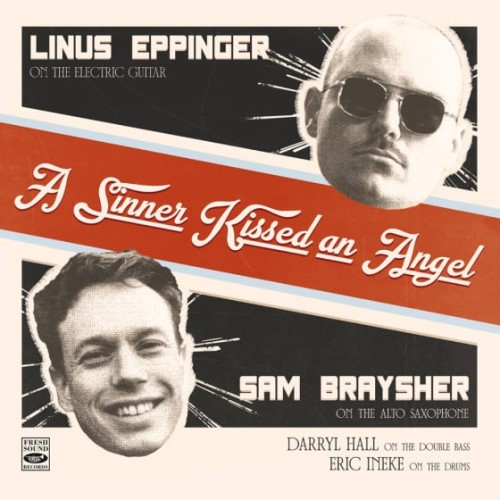
A highly enjoyable mainstream album performed by an international, cross-generational quartet.
Linus Eppinger / Sam Braysher
“A Sinner Kissed an Angel”
(Fresh Sound New Talent Records FSR -CD 5147)
Linus Eppinger – electric guitar, Sam Braysher – alto saxophone, Darryl Hall – double bass, Eric Ineke – drums
I’m grateful to saxophonist Sam Braysher for sending me this copy of his latest recording, which sees him co-leading an international quartet in the company of German born Amsterdam based guitarist Linus Eppinger. The line up is completed by the veteran Dutch drummer Eric Ineke and the American bassist Darryl Hall, the latter suggested by Eppinger. Hall had not played with Braysher or Ineke before but slotted into the group seamlessly on this selection of jazz standards chosen by the co-leaders.
British saxophonist Braysher first came to my attention in 2018 with the release of the duo recording “Golden Earrings”, a collaboration with the American pianist Michael Kanan. Also issued on the FSNT imprint this impressive and enjoyable recording is reviewed here;
https://www.thejazzmann.com/reviews/review/sam-braysher-with-michael-kanan-golden-earrings
The Braysher / Kanan axis later toured the album in a quartet format, augmented by bassist Conor Chaplin and drummer James Maddren.
In 2021 I also reviewed Braysher’s trio album “Dance Little Lady, Dance Little Man”, recorded with bassist Tom Farmer and drummer / vibraphonist Jorge Rossy.
https://www.thejazzmann.com/reviews/review/sam-braysher-trio-dance-little-lady-dance-little-man
Braysher was also part of The Fresh Sound Ensemble, a unit featuring the numerous British musicians signed to the FSNT label. This grouping released the album “Common Threads” in 2023. Review here;
https://www.thejazzmann.com/reviews/review/the-fresh-sound-ensemble-common-threads
In 20224 Braysher released “That’s Him; the Music of Kurt Weill”, a recording featuring the London based rhythm section of pianist Matyas Gayer, bassist Dario Lecce and drummer Steve Brown, with guest vocals from Sara Dowler. I have to admit that this appealed rather less to my personal tastes than Braysher’s previous releases and for the moment that album remains unreviewed.
Others with whom Braysher has worked include pianist Gabriel Latchin and trumpeter Miguel Gorodi.
I have to admit to previously being unfamiliar with Eppinger, who names Wes Montgomery and George Benson as his primary influences on the guitar. He has recorded two albums with his own quartet, which includes Darryl Hall, He also works with the Amsterdam rhythm and blues band The Hi-Stakes and with a jazz / latin ensemble named The Leaning in Underground, whose core quartet line-up is sometimes augmented by the vocalist Paula Bila. Eppinger also teaches at the Conservatorium van Amsterdam.
American bassist Darryl Hall is a former winner of the Thelonious Monk Jazz Prize and has worked with pianist Cedar Walton, saxophonist Ravi Coltrane and vocalist Carmen Lundy amongst others. He is now based in France.
Ineke is a veteran of Dutch jazz who has been on the scene since the 1960s and has accompanied such leading names as saxophonists Dexter Gordon, George Coleman, Johnny Griffin and Al Cohn, pianist Barry Harris and many, many more.
Braysher and Eppinger first came together as members of a band named Rebop and the pair have continued to work as a duo both in the UK and the Netherlands, often augmented by local rhythm sections.
When the time came to record their project they asked Ineke, whom they had worked with in Den Haag, to play drums, while Eppinger approached Hall to play bass. The rhythm section of Ineke and Hall gelled immediately, as Eppinger had predicted, and following warm up gigs in Den Haag and Amsterdam the newly constituted quartet entered the recording studio.
Braysher’s liner notes offer brief insights into the individual tune selections. The programme commences with “A Smooth One”, credited to Benny Goodman but possibly the work of Goodman’s guitarist Charlie Christian. One assumes that the latter is another of Eppinger’s influences and Eppinger features prominently on this gently swinging, blues tinged arrangement, paced by Hall’s big toned bass and Ineke’s crisply brushed drums. Eppinger reveals himself to be a highly fluent soloist steeped in the jazz guitar tradition. Braysher keeps his powder dry for a long time before coming to the party and delivering an elegant, smooth toned alto sax solo. Ineke also steps out of the shadows to trade fours with the co-leaders as part of a colourful drum feature.
“I Told You So”, a Latin flavoured tune composed by the American pianist George Cables was brought to the quartet by Eppinger. Cables is one of the many musicians that Hall has previously played with and the bassist messaged Cables during the course of the sessions to tell him that they were recording his tune. And a fine job they make of it too, maintaining the relaxed vibe as they effortlessly tackle the tune’s rhythmic complexities. Braysher delivers the first solo, his alto sound gently incisive. He’s followed by Eppinger on guitar and Hall on bass, the latter delivering an extended solo that demonstrates great dexterity and an innate sense of swing.
The jazz standard “Put On A Happy Face” is delivered with suitable joyousness, with Braysher taking the first solo followed by Hall on double bass. Eppinger’s arrangement includes brief musical figures originated by the guitarist.
The next item represents something of a left-field choice, an arrangement of “Spooky”, a song once sung by Dusty Springfield. Braysher’s alto mimics Springfield’s vocal lines while Eppinger gets to solo over a two chord vamp. Despite the pop and rock influences the quartet’s homage to Dusty is definitely still jazz!
A singer also helped to inspire the quartet’s next choice, the ballad “Roundabout”, composed by Vernon Duke. This instrumental interpretation was inspired by a recording by vocalist Chris Connor. Ineke’s brushed drums underpin Braysher’s haunting alto sax meditations and Eppinger’s tasteful guitar interventions.
Arrangers Eppinger and Hall put their own stamp on “Never Let Me Go”, a tune usually performed as a ballad but here given a more contemporary up-tempo Latin flavoured treatment. Braysher’s alto again takes the melodic lead but Eppinger emerges to deliver an elegant guitar solo, followed by Braysher on alto.
The pace really picks up again with “Room 608”, a rhythm changes tune written by the pianist Horace Silver. This features the quartet at their most beboppish / hard boppish with a fleet fingered guitar solo from Eppinger, while Braysher, who has already demonstrated his talents as a ballad player, gets the opportunity to unleash his inner Charlie Parker. Ineke enjoys an ebullient drum solo prior to the closing theme statement.
Braysher’s choice of the song “That Sunday, That Summer” was inspired by a version recorded by Nat King Cole. The quartet approach the tune in a jaunty, almost Latin-esque fashion with Braysher and Eppinger combining on the theme and Eppinger delivering the first solo, followed by his co-leader.
The title track was recorded in 1941 by a young Frank Sinatra, then singing with the Tommy Dorsey Orchestra. I’ve also read that is was once recorded by saxophonist Wardell Gray. The song was first introduced to Braysher and Eppinger by the promoter Susan May-Robinson. Introduced by a short passage of unaccompanied guitar it’s performed as a beautiful ballad, with Braysher again sounding particularly haunting on alto. Eppinger also features as a soloist on a piece paced by Ineke’s delicate brushwork and Hall’s languorous bass.
The album concludes on an energetic note with a rendition of Charlie Parker’s “Relaxing at Camarillo”. This bebop classic is delivered at a suitably fast clip with Braysher delivering the first solo, followed by Eppinger on guitar, Hall on double bass and finally Ineke at the drums as he trades fours with the co-leaders.
“A Sinner Kissed an Angel” is a highly enjoyable mainstream album performed by an international, cross-generational quartet. For a young man Braysher’s command of the jazz idioms of an earlier age is remarkable and his love for the music of the Great American Songbook and of the bebop era shines through in everything he does. Eppinger exhibits similar qualities with regard to the jazz guitar tradition. Hall and Ineke also add greatly to the success of the album, bringing a wealth of jazz experience to the project.
This review represents a slightly belated look at an album that first came out in May 2026. I hope Braysher and his colleagues feel that it was worth the wait.
blog comments powered by Disqus