

by Ian Mann
May 18, 2026
/ LIVE
Its creators describe their music as being simultaneously “accessible, groovy and mysterious”, all qualities that were present in tonight’s captivating and highly enjoyable performance.
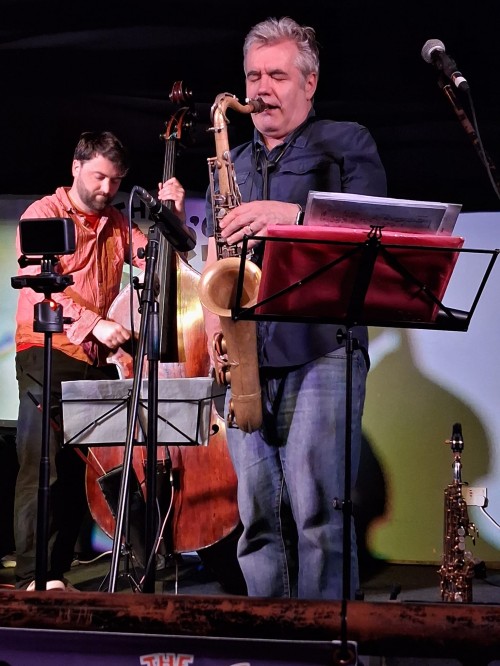
Mark Lockheart Shapeshifter Trio, Music Spoken Here, The Marr’s Bar, Worcester, 14/05/2026.
Mark Lockheart – tenor & soprano saxophones, electronics, Huw V Williams – double bass, electronics, Jay Davis – drums
This long awaited visit to Worcester by saxophonist and composer Mark Lockheart with his latest project Shapeshifter represented the third appearance at a Music Spoken Here event by a former member of the celebrated British jazz collective Loose Tubes. Previous Loose Tubes alumni to have played for MSH at the Marr’s Bar are saxophonist Iain Ballamy and flautist Eddie Parker.
Lockheart first made his name with Loose Tubes, the twenty one piece ensemble that made waves on the UK jazz scene and beyond in the late 1908s and early 1990s. Gleefully mixing jazz with global music influences Loose Tubes was a joyous, colourful, irreverent collective of young musicians who really shook up the UK jazz scene of the time and even attracted a degree of mainstream media attention “we were on television!” a still incredulous Lockheart told MSH promoter Dave Fuller as he was interviewed by the latter as part of the regular ‘Piece Talks’ series of scene setting pre-gig discussions.
“It was an amazing time, an amazing band”, Lockheart told Fuller as they continued to talk about Loose Tubes, also adding “it was a launch pad for all of our careers, a melting pot of styles that gave us the confidence to experiment with our own projects”.
I was lucky enough to see Loose Tubes on several occasions first time around but Dave Fuller had to wait until the 30th anniversary reunion shows in 2024, which of course I attended too, reviewing their Cheltenham and Brecon festival appearances for The Jazzmann. It’s Fuller’s intention to bring as many ex Tubes to MSH at possible – so far it’s three down, eighteen to go!
The majority of Loose Tubes compositions were written by keyboard player Django Bates and bassist Steve Berry and Lockheart didn’t actually write for the band. He began to find his feet as a composer with Perfect Houseplants, a quartet that he co-led with pianist Huw Warren between 1992 and 2000. Lockheart, Warren and bassist Dudley Phillips all wrote for the quartet, which was completed by ex Loose Tubes drummer Martin France, and the group released five albums between 1992 and 2000. Folk influences also fed into the Perfect Houseplants sound and I was very much a fan of this eclectic, and to these ears very British, ensemble. I recall seeing them at a sparsely attended gig at the 1994 Llangollen Jazz Festival and then twenty one years later at a reunion show at a sold out Vortex as part of the 2015 EFG London Jazz Festival. I loved them both, but it’s only the Vortex gig that is reviewed on these web pages.
Lockheart also spoke of his “second career” with Polar Bear, the quartet (later quintet) led by drummer and composer Seb Rochford. Apparently Rochford saw Lockheart perform at the 606 Jazz Club in London and phoned him up the next day asking “do you want to join my band?”. At this time the pair had never met, so this was very much a ‘spur of the moment’ decision on Rochford’s part. It was also an inspired one. Featuring Rochford’s compositions exclusively Polar Bear recorded six albums between 2004 and 2015, with two of these nominated for the Mercury Music Prize. Polar Bear’s music attracted a younger than usual audience demographic and attracted a degree of attention from the rock press. “we were popular, we had big audiences”, Lockheart told Fuller. I was lucky enough to witness Polar Bear playing live on several occasions and numerous reviews of both recordings and live performances can be found elsewhere on these web pages.
Lockheart has been part of the two most influential UK jazz acts of the last forty years in Loose Tubes and Polar Bear and this is something he should be justly proud of. But we shouldn’t overlook a consistently excellent solo career that has seen him record in a variety of different instrumental formats from a duo with former Loose Tubes guitarist John Parricelli to full jazz orchestra. He has recorded regularly in a quartet format but has also worked intermittently with various editions of a twelve piece ensemble that was initially known as the Scratch Band. He was also part of the co-operative trio Malija with pianist Liam Noble and bassist Jasper Hoiby.
As a leader Lockhart’s work has been consistently interesting and always of a high standard and it’s fair to say that his body of work as a solo artist is among the most consistently impressive in contemporary British jazz. A number of albums and live performances under Lockheart’s own name and as a member of Malija are reviewed elsewhere on these pages.
In 2022 Lockheart recorded the alum “Dreamers” with an electric quartet featuring Tom Herbert on electric bass, Dave Smith on drums and Elliot Galvin on keyboards. This line up piqued his interest in electronics, something also influenced by listening to Wayne Shorter’s playing with the 1980s incarnations of Weather Report.
Lockheart’s own use of electronics is one of the components of his latest project Shapeshifter, a trio with the younger musicians Huw V Williams (double bass) and Jay Davis (drums). Shapeshifter first came into existence when Williams invited Lockheart to jam with himself and Davis at Williams’ studio / shed. Jamming on jazz standards and Ornette Coleman tunes the trio quickly established a rapport and decided to continue working together as a band. The individual members also began to compose for the band and Williams subsequently suggested that they make a recording. Recorded at Lightship Studios in London (it really is an old lightship moored on the Thames) the trio’s debut album, simply titled “Shapeshifter” was released in early 2026 and is jointly credited to all three members of the group, emphasising the democratic nature of the trio, although its tempting to think of it as Lockheart’s band due to his comparative seniority. The album, which has been released to considerable critical acclaim, features compositions from all three individual musicians, plus three collective improvisations.
Guest contributor Mike Wright wrote briefly about the trio’s performance at The Hive in Shrewsbury earlier this year. His account can be found here;
https://www.thejazzmann.com/reviews/review/mark-lockheart-shapeshifter-trio-shrewsbury-jazz-network-the-hive-shrewsbury-14.03.26
For the technically minded among you Lockheart informed Dave Fuller that his range of effects for Shapeshifter include;
space echoes, delays, pitch shifter, reverb and live looping.
Tonight these electronics were judiciously applied on the trio’s signature tune “Shapeshifter”, a Lockheart composition that also opens the album. Initially centred around a nagging, echoed tenor sax phrase and a consistently unfolding, increasingly forceful rhythmic groove this featured a deeply resonant double bass solo from Williams. A more conventional tenor sax solo from Lockheart again deployed subtle electronic effects before the earworm of a hook returned, triggering a drum feature from Davis. The piece was also notable for Williams’ use of the bow, his arco phrases looped to generate a deep drone that you could feel in your chest as much as hear. This is a trio rooted in improvisation and spontaneity, so tonight’s rendition was subtly different to the recorded version, which features Lockheart doubling on bass clarinet.
The trio continued with the album running order and “Come On Over”, another Lockheart composition and a piece that reminded me of Polar Bear with its loping rhythmic groove and its use of electronic effects – the electronic musician Leafcutter John was a member of Polar Bear from the second album onwards and had a profound effect on the group’s sound. Like Shapeshifter Polar Bear was a chordless group, fronted by the twin tenor saxes of Lockheart and Pete Wareham, plus drums, bass (Tom Herbert) and electronics. Lockheart’s deployment of his array of foot pedals allied to that groove definitely edged this piece into the kind of sonic territory occupied by his former band.
The Williams composition “Milking The Stone” was introduced by Davis at the drums, subsequently joined by double bass and by a tenor sax now shorn of electronic effects. Lockheart’s sax explorations were underpinned by a hypnotic rolling groove before the music tightened around a taut riff, this eventually providing the foundation of a further drum feature from Davis.
Forming a segue the aftermath of “Milking The Stone” was an atmospheric and loosely structured collective improvisation later titled “A Good Day in Worcester” by Williams. This featured the sounds of brushed drums and bass both bowed and plucked. It also saw Lockheart moving between tenor and soprano saxophones. Effectively this episode was the equivalent of one of the improvised passages on the album, one of which is called “A Good Place”, hence Williams’ choice of title.
The bassist shared announcing duties with Lockheart, “on the backing vocal mic”, as he joked, emphasising the democratic nature of the trio. The first set concluded with a segue of the Joe Henderson tune “Inner Urge”, one of the pieces the trio jammed on in its early days, and Lockheart’s own “Strawberry Moon”.
Henderson also led saxophone trios so his piece was an ideal vehicle for Shapeshifter, whose use of electronics allowed them to put a contemporary spin on the old warhorse. Nevertheless there was plenty of scope for the three instrumentalists to stretch out with extended individual features.
Introduced by Williams at the bass “Strawberry Moon”, with its echoed tenor sax and loose limbed grooves marked another foray into Polar Bear style territory with Lockheart’s extended tenor sax solo adding an extra degree of urgency before the performance culminated in a drum feature from Davis.
Although a few MSH regulars were conspicuous by their absence there was still a respectably sized, and very supportive audience at The Marr’s Bar to give Shapeshifter a rapturous reception for an excellent first set.
Set two commenced with “Leeds Place”, named for the London street where Davis’ home studio is located. Introduced by Williams at the bass this also featured the sounds of tenor sax and brushed drums and featured a tricky, but infectious sax led melodic hook. The performance also included a lengthy double bass and drum dialogue that again saw Williams making effective use of the bow.
The sounds of arco bass also featured on the intro to Davis’ composition “Glow”, a reflective composition that also featured gently probing tenor sax ruminations plus a further pizzicato bass solo from Williams as Davis graduated between brushes and sticks.
A lengthy, largely improvised sequence took its inspiration from “Tangs”, the collectively improvised piece that closes the album. The recording features Lockheart on soprano and he started on the straight horn here, his explorations underpinned by fluid bass and drum grooves during the course of a passage that hinted at the Ornette Coleman tunes that the trio played in its early days. Williams eventual use of electronics to loop and layer the arco bass drone that he had generated then took the music into a different sonic terrain as Lockheart made the switch to tenor, creating a circling riff that was again suggestive of the music of Polar Bear.
Written on Valentine’s Day” Williams described his composition “14-2-25” as “a love song gone wrong”. Introduced by its composer at the bass, accompanied by Davis’ mallet rumbles and cymbal shimmers, this was an atmospheric, ruminative piece featuring delicate brush work from Davis alongside Lockheart’s tentative, subtly treated tenor.
Also by Williams the title “Rule Of Three”, presumably titled for the trio, felt more celebratory as an atmospheric intro featuring the sounds of bowed bass and tenor sax evolved into an angular, cerebrally funky groove with the clatter of Davis’ sticks on rims the trigger for solos from Lockheart on tenor and Williams on vigorously plucked bass, prior to an increasingly dynamic drum feature.
The audience loved this and invited the trio back for a deserved encore. Again reaching back to their early days performing the material of others they decided upon “”Strange Meering” by the American guitarist Bill Frisell. This is a piece that is becoming something of a modern day standard, but it was unusual to see it being tackled by a guitar-less trio. Kick started by Williams’ bass intro this included a series of tenor sax and drum exchanges followed by a more extended bass feature from Williams. The tune remained highly effective in this format and sent the Marr’s Bar crowd home happy, many of them clutching a copy of the “Shapeshifter” album and related releases, always the sign of a successful gig.
The “Shapeshifter” album also sounds excellent in the home listening environment. Produced by Lockheart himself the album has been favourably received by both critics and audiences. Lockheart spoke to Fuller about the album’s “big, lush, powerful sound” and described its music as being simultaneously “accessible, groovy and mysterious”, all qualities that were present in tonight’s captivating and highly enjoyable performance.
My thanks to Mark and Huw for speaking with me at the interval and after the show. I’m particularly pleased that the evening turned out to be such a success after having previously suggested MSH and The Marr’s Bar to Mark as a suitable venue for his “new trio with younger musicians and electronics”.
IAN MANN
Promoter Dave Fuller adds;
Shifting shapes (and merch) at The Marr’s Bar
Massive thanks to everyone who came through for Shapeshifter on Thursday. The new trio, whose debut album was released in March, featured Mark Lockheart on tenor and soprano saxes and saw the return to our stage for drummer Jay Davis (Airborn, December 2025) and bassist Huw V Williams (Jakub Klimiuk Quintet, October 2024).
Though a chordless trio, Mark and Huw’s creative use of electronics filled the sonic space in a way that is rarely experienced in similar trios, noted in particular on the improvised piece “A Good Day In Worcester” where Huw used effects and looping along with the bow to build a rich, dynamic soundscape on his double bass. For the most part, the trio performed tunes from the album, with a cover of Joe Henderson’s “Inner Urge” during the first set that featured an impressive solo from Jay. The whole experience was made all the more entertaining with Huw’s jovial public service announcements and ‘backing vocals’.
I’ll leave the detailed review to our resident, award-winning journalist Ian Mann on TheJazzMann.com, but this was once again a top-notch performance of creative, improvised music that captured the audience and had them lining up at the merch table to take CDs and vinyl home with them - a positive endorsement and a great way to support musicians so they can continue to make more great music for us to enjoy!
We’ll have a video from the gig up on YouTube in the next week or so, once we’ve had chance to review the recordings. If you subscribe to our channel you’ll be notified when it is published.
DAVE FULLER
blog comments powered by Disqus