

by Ian Mann
April 19, 2026
/ ALBUM
An excellent leadership debut from Lukassen. His writing is intelligent and multi-faceted and embraces a broad variety of styles and dynamics. The standard of the playing and singing is excellent.
Niklas Lukassen
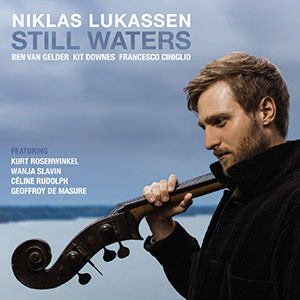
“Still Waters”
(Heartcore Records HCR33)
Niklas Lukassen – acoustic & electric bass, vocals, Ben Van Gelder – alto sax, flute, Kit Downes – piano, Hammond organ, Francesco Ciniglio – drums
with guests ;
Kurt Rosenwinkel – guitar, Wanja Slavin – alto & soprano sax, Celine Rudolph – vocals, Geoffroy Da Masure – trombone
On 14th March 2026 I reviewed a performance by saxophonist and composer Emma Rawicz and her trio at St. Michael and All Angels Church in the remote Welsh village of Cwmdu, half way between Brecon and Crickhowell. The trio featured vibraphonist Jonny Mansfield and double bassist Niklas Lukassen. My review of this interesting and enjoyable concert can be found here;
https://www.thejazzmann.com/reviews/review/emma-rawicz-trio-st-michaels-and-all-angels-church-cwmdu-powys-14-03-2026
After the show I spoke with all three musicians and Lukassen was kind enough to provide me with a review copy of his latest album “Still Waters”, which was released in February 2026. The line-up features a core quartet that includes the British pianist and organist Kit Downes, which will help to give the album an additional significance for UK jazz listeners. Dutch saxophonist Ben Van Gelder and Italian drummer Francesco Ciniglio complete a truly international group.
Lukassen was born in Germany’s Black Forest and spent time living, studying and working in both Berlin and New York City, where he was mentored by the great Ron Carter, before relocating to London. He plays both double bass and bass guitar and also bass cello, an instrument loaned to him by instrument maker Mark Zandveld. Lukassen plays the bass cello in a trio featuring the British musicians Gwilym Simcock (piano) and James Maddren (drums).
Another of his international collaborations is the quartet Echo featuring the British musicians Immy Churchill (vocals) and Jonny Mansfield (vibraphone), plus drummer Ananda Brandao, who is based in France.
A glance at Lukassen’s gig schedule on his website at http://www.niklaslukssen.com reveals that he is a phenomenally busy musician who works prolifically as both a leader and a sideman in the UK and internationally. A highly versatile musician his playing is featured in a myriad of different line-ups and in a wide variety of musical contexts.
Among his engagements is his role as one of the three double bassists who work with vibraphonist Gloria Yehilevsky. Prior to meeting Lukassen at the Rawicz performance I had actually seen him play live once before when he appeared with Yehilevsky and fellow bassists James Owston and Aram Bahmaie at the Queen Elizabeth Hall as part of the 2025 EFG London Jazz Festival. A brief account of this intriguing performance can be found as part of my Festival coverage here;
https://www.thejazzmann.com/features/article/efg-london-jazz-festival-2025-day-three-sunday-16-11-2025
“Still Waters” represents Lukassen’s debut album as a leader and features twelve of his original compositions, two of which feature lyrics and vocals. It appears on Heartcore Records, the label established by the German born, New York based guitarist Kurt Rosenwinkel. In addition to the core quartet Rosenwinkel is one of the four featured guest artists, whose ranks also include saxophonist Wanja Slavin, vocalist Celine Rudolph and trombonist Geoffroy De Masure. t
Things get underway with the all instrumental “The Deep”, performed by the core quartet. This short piece acts as a kind of overture and offers a brief introduction to the album’s principal personnel. Over the course of just sixty six seconds it manages to explore a range of styles and dynamics with Van Gelder’s incisive alto sax, Downes’ piano and the leader’s bass all coming briefly to the fore.
Also featuring the core group “Estuary” is both more expansive and more lyrical, a piece with a strong narrative arc that unfolds organically over the course of its five and a half minute duration. Introduced by Downes at the piano this item initially features a gentler saxophone sound in addition to those of melodic double bass and brushed drums. The tune’s quiet mid section features a dialogue between Downes and Lukassen that evolves into a lyrical bass solo from the leader, with Ciniglio’s deft, finely nuanced drum commentary added. Downes then takes over briefly at the piano before the re-emergence of Van Gelder on alto alto imparts the tune with a greater urgency and momentum, eventually steering the music into turbulent, near free jazz waters as Ciniglio jettisons brushes for sticks. Like most of Lukassen’s pieces this is a multi-faceted composition that embraces a wide variety of moods, styles and dynamics.
These qualities also apply to “Metamorphosis”, which begins with a tentative alto sax / piano duet, with drums and bass added almost surreptitiously, before helping to steer the music into more forceful territory, with Downes doubling on Hammond. As befits the tune’s title there’s a final unexpected transition as the leader’ bass takes over towards the close.
“Palisade” introduces guest performers Kurt Rosenwinkel (guitar) and Geoffroy De Masure, two of Lukassen’s former tutors. Both make major contributions as soloists on a piece based around a slowly evolving odd meter groove. De Masure’s idiosyncratic trombone solo is followed by further statements from Van Gelder on alto and Rosenwinkel on guitar, whose lithe and slippery solo is a definite album highlight. De Masure continues to be an important part of the overall ensemble, his trombone now providing an element of counterpoint in addition to colour and texture.
Introduced by a passage of unaccompanied piano from Downes “Karma” sees the quartet augmented by another guest performer, German saxophonist Wanja Slavin, performing on alto. This piece sees Slavin and Van Gelder variously doubling up or sparring with each other. On another admirably diverse composition the leader provides a melodic double bass solo while Downes again doubles on Hammond.
“To Climb A Mountain” marks a return to the core quartet line up and is a typically multi-faceted piece that emerges from a loosely structured introduction in the classic piano trio format. The addition of Van Gelder’s alto introduces a more formal melodic component but there’s still an agreeable looseness about the playing as Downes emerges as the first featured soloist, fluent and inventive above the skittering bass and drum grooves. Van Gelder then probes intelligently on alto as the music continues to unfold, gradually gathering momentum.
The first vocal item is “Interlude”, with English language lyrics sung by guest vocalist Celine Rudolph. In this hauntingly beautiful contemporary take on the jazz ballad tradition Rudolph receives sympathetic support from just two members of the quartet as drummer Ciniglio and bassist / leader Lukassen sit out entirely. Downes on piano plays a particularly significant role at the heart of the music while Van Gelder’s melodic embellishments and his saxophone solo are also worthy of praise.
Slavin returns, this time on soprano sax, for “The Traveller”. Here an insistent Brazilian style rhythmic groove propels the fluent soloing of Slavin, Downes and Van Gelder, plus the fiery interplay of the two saxophones prior to an unexpectedly quiet resolution featuring the leader’s bass.
“Brother” features Lukassen on liquidly lyrical electric bass alongside Downes on piano and Van Gelder on alto sax.
The fast moving, fusion-esque “Rainbow Surfer” sees the return of Rosenwinkel who adds a mercurial solo to this complex piece with its tricky melodic theme and busy rhythmic patterns. Drummer Ciniglio also turns in a particularly dynamic and striking performance.
Lukassen adds his own vocals to “Luna”. He had originally intended to use a guest singer but was persuaded to retain his own vocals on this intensely personal composition. Fragile, but quietly confident, Lukassen’s vocals are accompanied by the sounds of Hammond, alto saxophone, with Van Gelder doubling on flute, and delicately brushed drums. Part lament, part celebration the English language lyrics were inspired by the death of somebody close to Lukassen, as he explained in an interview with Charlie Rees for UK Jazz News;
“The song “Luna” was born of an unexpected and very personal call from someone close and very old, who told me that he could feel that he would die very soon. Inspired by this final conversation, “Luna” tells the story of a person at the end of their life, talking to the moon. Nighttime is familiar to the moon, watching on as the world sleeps; unaware of the man’s day-to-day worries. Embracing their final moments, the dying person lets go of bitterness and past mistakes and settles into the quiet of the night. Beneath the calming moonlight, they shut their eyes forever in peace”.
Although suitably reverential the music begins to take on something of an anthemic quality towards the close, a quality encouraged by Van Gelder’s alto sax solo, which acts as a kind of bridge between the two parts of the song.
The album closes with “Still Waters Run Deep”, effectively the title track. After intentionally starting the album with something of a bang, defying the expectations suggested by the title, Lukassen concludes the record with something more lyrical and introspective. It’s a delightful small group performance from the core quartet with the leader’s bass and the skitter of Ciniglio’s brushed drums underpinning the lyrical piano and alto sax melodies.
“Still Waters” represents an excellent leadership debut from Lukassen. His writing is intelligent and multi-faceted and embraces a broad variety of styles and dynamics. The two vocal items add variety and each of the two songs convinces in its own right.
There’s an agreeable edge and urgency to some of the instrumental music that reflects its origins in the New York and Berlin jazz scenes, but there are many lyrical and beautiful moments too. The standard of the playing and singing is excellent throughout and each of the guest performers make vital and substantial contributions.
There’s some confusion as to the running order as those on Bandcamp and the printed CD differ. I’ve gone with Bandcamp in this regard, but primarily listened to the music on disc.
blog comments powered by Disqus