

by Ian Mann
August 25, 2026
/ ALBUM
The album is chock full of melodic, intelligent and highly evocative compositions and both the soloing and the overall ensemble playing is superlative throughout. A candidate for his best album yet.
Ben Crosland Quintet
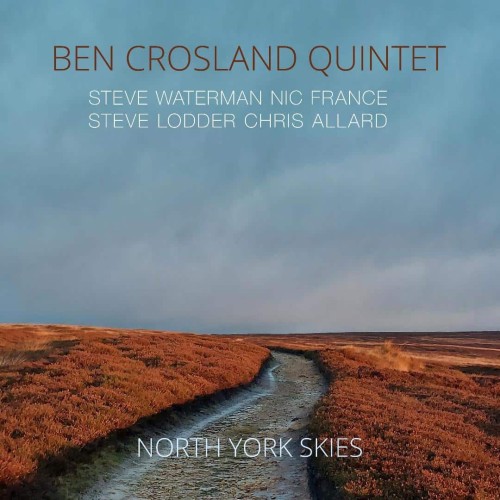
“North York Skies”
(Jazz Cat Records – JCCD21)
Ben Crosland – electric bass, Steve Waterman – trumpet, flugelhorn, Steve Lodder – piano, Fender Rhodes, Hammond C3 organ, Chris Allard – guitar, Nic France – drums
The Yorkshire based bassist and composer Ben Crosland has been a regular presence on the Jazzmann web pages for a number of years, firstly as the leader of the chamber jazz trio Threeway, featuring trumpeter Steve Waterman and pianist Steve Lodder, with whom he released the albums “Songs Of The Year” in 2009 and “Looking Forward, Looking Back” (2014), the latter also featuring contributions from guest musician Jim Hart (vibraphone).
At one point Threeway was expanded to a sextet to form the Ben Crosland Brass Group, with the core trio joined by trombonists Mark Nightingale and Barnaby Dickinson and trumpeter Martin Shaw. This line up released the album “An Open Place” in 2012, a collection of eight compositions commissioned for the 2011 Marsden Jazz Festival and inspired by works of art at the Yorkshire Sculpture Park near Wakefield.
More recently Crosland has delivered two highly popular albums of jazz arrangements of Kinks tunes, the first “Ray Davies Songbook” appearing in 2016 with “Vol. 2” following in 2019. The quintet on these recordings featured Crosland and Lodder plus Dave O’Higgins (tenor & soprano sax), John Etheridge (guitar) and Sebastiaan de Krom (drums).
All of the Threeway, Brass Group and Quintet albums mentioned above are reviewed elsewhere on the Jazzmann and I have been fortunate enough to witness Crosland’s bands playing live on a couple of occasions, namely Threeway at the 2012 Lichfield Real Ale, Jazz & Blues Festival and the Ray Davies Songbook quintet at an excellent gig for Shrewsbury Jazz Network in 2018.
Crosland is based in Huddersfield from where he runs his own Jazz Cat record label, and although he is a proud Northerner who has resisted the temptation to move to London he is more than just a good “regional” musician. Amazingly he used to combine his musical activities with a legal career, working as a barrister in the courts of Northern England.
Crosland’s playing and writing skills have seen him work regularly with nationally known musicians. In addition to those musicians previously mentioned others with whom he has collaborated include saxophonists Alan Skidmore, Stuart MacDonald, Mike Hall and Rod Mason, guitarists Adrian Ingham, Jim Mullen, Steve Buckley and Stuart McCallum, pianist Dean Stockdale, trombonist Dennis Rollins and drummers Dave Walsh, Eryl Roberts, Robert Howard and Dave Tyas
Running his own label has enabled Crosland to record frequently, leading his own groups in quartet, quintet and octet formats and often adopting “northern” themes as the inspiration for his writing. Over the course of a lengthy and productive career Crosland has recorded more than twenty albums as a leader or co-leader. He was also a member of guitarist John Etheridge’s Trio North, together with drummer Dave Tyas.
Crosland has also been a part of the Marston Jazz Festival team for more than thirty years and has performed frequently at the Festival.
Many of Crosland’s works are broadly conceptual with compositions inspired by a specific theme or place. Such a project was the 2021 quintet release “Solway Stories”, partially inspired by the passing of Crosland’s late mother, Dorothy in 2019. Mother and son had visited the South West of Scotland in 1988 and his memories of that visit inspired Crosland to compose the suite of pieces that became “Solway Stories”, a recording that is also covered on this site with my review forming the basis for most of the preceding biographical information.
“Songs of Solace and Reflection” (2022) was effectively Crosland’s ‘lockdown album’ and featured a series of pieces written and arranged during by the pandemic and eventually recorded by an ensemble featuring Theo Travis – flute, alto flute, Alan Barnes – clarinet, bass clarinet, Steve Waterman – trumpet, flugelhorn, Clare Bhabra – violin and Deirdre Bencsik – cello. This album is also reviewed elsewhere on this site.
The 2020s have been a phenomenally creative time for Crosland. 2024 saw the release of “Harken!”, recorded with the Threeway trio plus guest John Etheridge. This too is reviewed elsewhere on this site.
2025 saw the digital only release “Wooltown Reflections”, a suite of compositions inspired by the “Wool City” of Bradford.
Crosland’s new album is the latest in a series of recordings inspired by specific landscapes, in this case the North York Moors. He describes the work as “a love letter” to the titular location, adding “the twelve compositions are inspired by the beauty and majesty of the Moors and the surrounding countryside, the legends and characters that abound there, and some personal connections with this lovely area”.
The personnel on this album is essentially the same quintet that appeared on the “Solway Stories” album, with Waterman, Lodder and Allard all returning but with Nic France taking over from Dylan Howe in the drum chair.
The album commences with “The Optimist”, named for one of the trains on the North York Moors heritage railway. It gets the album off to a suitably upbeat start with Waterman’s bright trumpet tones combining with Lodder’s Hammond above a suitably buoyant and propulsive groove. It’s a piece that fairly skips along with Waterman and Allard the featured soloists.
Title track “North York Skies” seeks to portray the vastness of the landscape and this time features Lodder soloing on Fender Rhodes. The mood is more relaxed than that of the opener, but there’s still plenty of life in the music as the piece proceeds at an agreeable mid pace with the excellent Allard again featuring as a soloist.
“Howardian Undulations” is named for the road through the Howardian Hills to Castle Howard, which Crosland describes as being “wonderfully straight, but it rises and falls like the proverbial big dipper”. It forms the inspiration for an episodic composition that commences with a scene setting passage of gently flowing unaccompanied acoustic piano from Lodder before picking up speed as an ebullient drum groove helps to fuel the agile and fiery trumpet soloing of Waterman and the fleet fingered elegance of Allard. An energetic performance by France is crowned with a series of colourful drum breaks, while Lodder delivers a sparkling piano solo that is very different in terms of mood, pace and execution to the more considered intro.
“Ballad Of Lilla Howe” takes inspiration from a 7th century burial mound (or tumulus) on Fylingdales Moor, which marks the resting place of Lilla Howe, chief minister to King Edwin of Deira, who saved the king from assassination by sacrificing himself. It’s a genuine ballad, this time ushered in by the valedictory sounds of unaccompanied flugel horn. Lodder’s Hammond gives the music an appropriately solemn, church like feel. The leader is featured with a melodic electric bass solo and he’s followed by Lodder at the C3. Waterman takes over on flugel, dovetailing neatly with Allard’s guitar.
“The Blakey Lions” is not a tribute to the Jazz Messengers but to a group much closer to home. The 1970s jazz rock trio Back Door, saxophonist Ron Aspery, bassist Colin Hodgkinson and drummer Tony Hicks, performed regularly at the Lion Inn at Blakey Ridge on the North York Moors before coming to national and international prominence. This is an affectionate, upbeat tribute, a real celebration of a group that broke out of the ‘jazz ghetto’ and acquired a substantial cult following. The original line up returned to Blakey Ridge for a series of reunion gigs in 2003, shortly before Aspery’s death. Back Door remain something of a legend in North Yorkshire and were clearly a source of inspiration for Crosland. The featured soloists on this stirring, hard grooving homage are Lodder on acoustic piano and Allard on guitar.
Crosland’s composition “George and Monty” takes its name from the resident dogs at the Lastingham Grange Hotel, where Crosland and his late mother used to stay. It’s also an affectionate homage, but one delivered at a gentler pace with Waterman featuring as a soloist on flugel followed by Lodder on acoustic piano. The momentum increases as Allard delivers a wonderfully fluent guitar solo.
The title “Breathing Space” is presumably a reference to the North York Moors National Park as a whole and has a suitably pastoral air about it with a gorgeous melody that the likes of Pat Metheny or Bill Frisell would be proud of. Allard’s solo channels something of the spirit of these two guitarists. He’s followed by the warm and mellow sounds of Waterman’s flugel.
“Fat Betty” is named for a squat medieval cross that is used as a parish boundary. There are several theories as to how this listed monument got its name. Crosland relates these in his album notes. The composition itself takes the form of a tango with France’s semi-martial rhythms underpinning the soloing of Waterman on trumpet and Crosland himself on electric bass.
“Purple Is The Colour” takes its name from the “carpet of purple heather” that cloaks the Moors in the summer months. The tune itself is a sprightly jazz waltz with a gorgeous melody, initially stated by Waterman on flugel, that once again evokes the spaciousness of the moorland landscape. Allard and Lodder add sparkling solos on guitar and piano respectively before Waterman, aided and abetted by France, is featured towards the close.
“Vigilamus” honours the iconic “golf balls” that formed part of the early warning system at RAF Fylingdales between 1960 and 1992, an unforgettable feature in the landscape for anyone (including myself) who saw them. “Vigilamus” is the station’s motto, meaning “we are watching”. Crosland honours these much missed landmarks with yet another gorgeous tune, in keeping with all the other pieces on this lengthy, but consistently engaging album. Waterman stretches out with a fluent but probing trumpet solo while Lodder features on Fender Rhodes.
“The View From Room Twelve” takes its title from the room that Crosland’s mother used to stay in at the Lastingham Grange Hotel, overlooking the Hotel’s beautiful garden. The tune captures something of that bucolic beauty with flugel horn stating the melody, accompanied by piano, bass and cymbal shimmers. Allard’s guitar eventually emerges to share the melodic lead with Waterman’s flugel. Waterman’s subsequent solo is shadowed by guitar and piano shadings and France’s delicate brushwork. The discrete use of overdubbing is deployed as Lodder’s Hammond helps to underscore his own piano solo.
The album concludes with “Ain Howe Farewell”, named for a tumulus on Spaunton Moor that is currently marked by the relatively modern Ana Cross, erected in 1949 to replace an earlier pre-Norman cross that is now displayed in Lastingham church. Crosland says of his composition;
“In my mind’s eye I see a funeral cortège processing up the moor to the sound of a marching band. ‘Ain Howe Farewell’ is my contemporary take on such a band!
“Contemporary” is perhaps the key word here for this is remarkably sprightly cortège, spurred on by France’s martial rhythms. The ‘second line’, beloved of New Orleans funerals, may be an obvious influence but there’s also an element of contemporary rock energy too. Allard feeds on this to deliver an expansive guitar solo, one of his best of the set. France’s drums come temporarily to the fore as the long march to the summit continues.
Summing up this excellent recording Crosland concludes;
“My sincere thanks go to Steve, Chris, Steve and Nic for their outstanding commitment to my music and their superb interpretations of these songs. Compositions may exist on paper but are only brought to life by great playing and these guys nailed it. We have been playing together for some time now and we really sound like a band on this record”.
He also praises engineers Ru Lemer and Andrew Tulloch for their contributions to what really is an excellent album, one that was recorded at Temple Music Studio in Surrey, the studio first established by musicians Jon Hiseman and Barbara Thompson, both sadly no longer with us.
It’s impossible to disagree with Crosland’s assessment. The album is chock full of melodic, intelligent and highly evocative compositions and both the soloing and the overall ensemble playing is superlative throughout. France takes over seamlessly in the drum chair and delivers a superb performance throughout, finding just the right balance between straightforward propulsion and rhythmic colour and nuance. His playing is consistently excellent at all times. Crosland is largely content to play an ensemble role with his electric bass at the very heart of the quintet’s music, although he does make his rare soloing opportunities count.
Apparently Crosland has just turned seventy five but his creative impulses are just as sharp as ever and “North York Skies” is at least the equal of anything else he has recorded and is even a candidate for his best album yet. Even at sixty seven minutes duration there’s no flab on this recording and it’s a joy to listen to from start to finish. Well done to all concerned.
blog comments powered by Disqus