

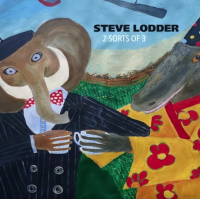
by Ian Mann
December 16, 2025
/ ALBUM
It’s a tribute to Lodder that “2 Sorts Of 3” with its mix of electric and acoustic sounds coheres so effectively as an album. This is largely due to the intelligence and quality of his writing.
Steve Lodder
“2 Sorts Of 3”
(Sleeve Records – SLV5020 in association with ECN Music)
Steve Lodder – acoustic and electric pianos, Dudley Phillips, Freddie Jensen – basses, Nic France, Marius Rodrigues - drums
The concept behind pianist and composer Steve Lodder’s latest album is a simple but effective one that sees him leading two separate trios, one acoustic, one electric.
Originally planned as two separate projects Lodder eventually decided to bring them together for this semi-conceptual recording, his third album release as a leader following “‘bout time” (2001) and “tied up with strings” (2015).
“2 Sorts Of 3” features the electric, or ‘plugged trio’ of Lodder on Rhodes Mk 8 electric piano, the latest edition, with Dudley Phillips on electric bass and acoustic bass guitar and Nic France at the drums.
The acoustic, or ‘unplugged trio’ sees Lodder moving to a Yamaha acoustic piano in the company of Freddie Jensen on double bass and Marius Rodrigues on drums.
All of the compositions are Lodder’s and the album features twelve tracks, six by each trio, these interspersed throughout the album, thus helping to create a range of moods and styles.
Lodder first came to my attention as a regular member of saxophonist Andy Sheppard’s bands in the 1980s and 1990s, an engagement that brought him into the orbit of Carla Bley, with whom he also worked.
A former Cambridge organ scholar Lodder has recorded on both organ and piano in addition to various electric keyboards. His versatility has made him an in demand session player and he has worked with a broad range of musicians across a variety of music genres. Among those with whom he has been associated are Paul McCartney, Elvis Costello, Simply Red and classical saxophonist John Harle.
More jazz oriented collaborations have been with vocalists Carol Grimes, Maggie Nicols, Monica Vasconcelos, and Ernestine Anderson, trumpeter Harry Beckett, saxophonists Mark Ramsden and Rod Mason, drummer Brian Abrahams, trombonist Annie Whitehead and guitarists John Etheridge and Deirdre Cartwright. He has also been part of jazz orchestras led by composers George Russell and Colin Towns.
Lodder is a key member, as both player and composer, of bassist Alison Rayner’s quintet (ARQ) and The Jazzmann has reviewed several recordings and live performances by this group. I have also covered albums and live performances featuring Lodder from bands led by bassist Ben Crosland and drummer Asaf Sirkis.
Lodder is also a published author, his works including keyboard instruction manuals and two studies of the music of Stevie Wonder.
Turning now to the music on this latest release, which is also conceptual in that all the tune titles are inspired by, and make reference to, the cover artwork which was painted by Louis Lodder, Steve’s son.
It’s the ‘plugged trio’ that start things off with “Onto The Water”, with Lodder conjuring up an impressive range of sounds from the recently developed Rhodes Mk8, accompanied by France’s rolling, fluid drum grooves and the counter melodies of Phillips’ nimble electric bass.
The ‘unplugged trio’ takes over for “No Smoking In The Aisles”, but there’s no loss of energy or focus in a groove driven piece that sometimes recalls e.s.t in their acoustic moments. Lodder’s flowing acoustic piano soloing is well supported by the crisp rhythmic support of Jensen and Rodrigues and the young bassist also enjoys a brief feature of his own, his playing assured and melodic.
The electric trio takes over for the next two tracks. First we hear “Komodo’s Kimono” which features a ‘classic’ Rhodes sound and harks back to the fusion of the 1970s, albeit with a contemporary twist. Lodder stretches out purposefully during the course of his Rhodes solo as France and Phillips supply urgent rhythmic impetus. There’s a short pause for breath when Phillips’ electric bass comes briefly to the fore.
“Dip Blue Deep Green” is initially more atmospheric and reflective with France impressing with the sensitivity of his cymbal work. Phillips is featured with a melodic electric bass solo, a lengthier excursion this time. The leader’s Rhodes trills charmingly as he develops his solo. The press release refers to this piece as being ‘South African tinged’, although this wasn’t particularly apparent to me. Maybe if Abdullah Ibrahim played Rhodes he might sound vaguely like this. It’s a tune that would sound beautiful in the acoustic trio format too.
In the interest of balance the acoustic trio take over for the next two pieces, beginning with the lively “Sand Twixt Toes”. This time round I can hear the “jazz-samba pulse” referenced by the press release. This is the lengthiest track on the album and Lodder solos expansively, his playing exuberant and inventive. The rhythm team respond well to the numerous twists and turns and Jensen again features as a soloist, at greater length this time and again impressing in this role.
“Ridges and Slopes” is inspired by the music of Keith Jarrett and has something of the feel of a classic Jarrett ballad with its delightful melody and subtly rootsy groove. Lodder’s playing is spacious and unhurried and he receives sensitive and economical rhythmic support from Jensen and Rodrigues. Jensen is again featured with a delightfully melodic double bass solo.
The electric trio return for “Ready The Lifeboats!”, the title a “climate change call to arms”. With the amount of rain we’ve had around here at the time of writing it’s a title that threatens to be uncomfortably prophetic. The music itself is suitably urgent, France’s insistent drum grooves approximating the sound of rapidly falling rain as Lodder adopts a variety of sounds on the Rhodes, some of them downright dirty. Meanwhile Phillips delivers a slippery electric bass solo.
The next two pieces are acoustic, beginning with “Elephant In A Teashop In Paris”. Less quirky than its title might suggest this is an unexpectedly beautiful and lyrical piece featuring Lodder’s spacious and unhurried piano soloing with the sensitively nuanced support of bass and drums. Jensen delivers another beautifully melodic double bass solo.
“Down On Mudchute Farm” is another piece with a jokey title but which constitutes a seriously satisfying piece of music. Introduced by the sound of unaccompanied piano it’s a kind of relaxed blues march that unfolds slowly and organically during the course of its five minutes or so duration. Lodder solos fluently and inventively, with Jensen and Rodrigues providing typically reliable support, with Jensen again featuring as a soloist.
It’s back to the electric trio for their final two numbers, beginning with “Red Sails Creek”, one of the most obviously ‘fusion’ pieces on the album. Lodder’s coruscating Rhodes solo is augmented by the brisk work of the rhythm team, culminating in something of a drum feature for France before the trio eventually slip away more quietly.
The electric trio present a gentler side on “The World Slips By” with the kind of delicate interplay that one might more usually associate with the acoustic incarnation. Lodder’s trilling Rhodes solo is complemented by France’s deft cymbal work and Phillips’ underlying bass. Gradually the music gathers greater momentum before the temperature cools again with a lyrical electric bass solo. Lodder is then left alone for a ruminative passage featuring solo Rhodes, before Phillips and France return towards the close.
The album concludes with “Out Of The Water”, an acoustic reprise of the opening track, introduced by a passage of unaccompanied piano and with Lodder eventually joined by double bass and drums. It’s shorter than its electric equivalent but the manner in which it fades out suggests that it might actually be part of a longer performance. If that’s the case it’s a shame that we don’t hear it until its conclusion.
It’s a tribute to Lodder that “2 Sorts Of 3” coheres so effectively as an album. The sequencing of the tracks with (approximately) alternating acoustic and electric performances helps to keep listeners on their toes and despite the different approaches of the two trios the juxtapositions are never harsh or jarring. This is largely duo to the intelligence and quality of Lodder’s writing. For a seventy four year old his music still sounds remarkably contemporary, and particularly the acoustic numbers – the sound of the Rhodes can’t help giving a retro feel to some of the electric tracks. That’s not to say I prefer one trio over the other, I’m equally happy listening to either, or in the case of this consistently engaging album both.
“2 Sorts Of 3” was released on 5th December 2025. The album launch concert will take place at the Pizza Express Jazz Club on Saturday 17th January 2026.
blog comments powered by Disqus