

by Ian Mann
February 20, 2026
/ ALBUM
The quality of the playing and writing on this album really is exceptional, and this, allied to the energy and vibrancy of the performances raises the album above the level of the mundane.
Aleph Aguiar
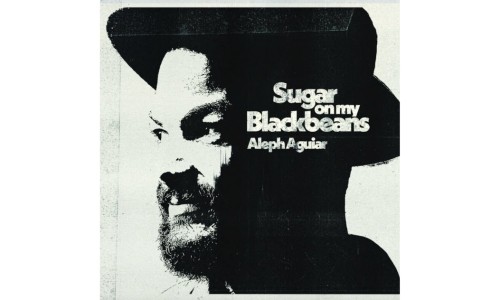
“Sugar on my Blackbeans”
(Aleph Aguiar Records – AAR001D/CD – Distributed by ECN Music)
Aleph Aguiar – guitar, Quentin Collins – trumpet, Liam Dunachie – organ, Shane Forbes –drums, Will Fry – percussion
Guitarist and composer Aleph Aguiar was born In Venezuela but is now based in London.
He began his musical career as a session guitarist in his native Venezuela, working with some of that country’s leading musicians such as Simón Díaz and Maria Rivas, both sadly no longer with us. He has also recorded with his fellow guitarist Luis Fernando Cardenas.
Since moving to the UK he has performed with bands led by trumpeter Quentin Collins, who returns the favour here, saxophonist Tony Kofi, cornetist Andy Watts and vocalists Heidi Vogel and Georgia Cecile.
He has also worked in the fields of dance, film and musical theatre. His mother and wife are both dancers and he has a strong connection with the dance world, something that is reflected in the rhythmic vibrancy of his compositions.
“Sugar on my Blackbeans” represents his third full length album release and follows ‘Pataruco’ (2015) and ‘Maku’ (2017). The album title is a nod to Aguiar’s Venezuelan heritage, black beans are a staple food in many South American countries but only Venezuelans top them with sugar.
The London based band that Aguiar has assembled for this project is a stellar line up featuring Collins on trumpet, Liam Dunachie on Hammond organ, Shane Forbes on drums and Will Fry on percussion. The music draws inspiration from the organ combos led by the American guitarists Wes Montgomery and Pat Martino while the inclusion of trumpet in the line up, as opposed to saxophone, is indicative of the importance of the instrument in Latin American music. The programme features nine original compositions from Aguiar that take inspiration from the Latin jazz of the 1960s.
Aguiar is fascinated by science and technology and has experimented with new technologies for the guitar. An interest in astronomy informs the title of opening track “Panspermia”, which references the idea that the biological building blocks for life on earth originally arrived from space. Whatever the theory it’s a lively and spirited opener with Fry’s percussion giving the music an authentic Latin feel. Aguiar’s guitar combines well with Collins’ trumpet and Dunachie’s Hammond and it’s the leader who takes the first solo, his guitar playing slippery, agile and inventive. Collins follows on trumpet, displaying his usual flair and fluency. It’s always a pleasure to hear Dunachie, who is also a superb pianist, on the Hammond, and he delivers a concise but sparkling solo.
“Mudwalk” maintains the energy levels, a highly rhythmic, funky item infused with the blues. Again Aguiar takes the first solo, fluent and inventive and with that blues influence very much apparent in his playing. Once more he’s followed by Collins who builds his solo expertly, cool and elegant at first, positively steaming later on. Dunachie’s gospel flavoured Hammond feature is positively joyous, while Forbes and Fry combine to provide an unstoppable rhythmic momentum.
“Blue Troupials” is named after the national bird of Venezuela and features a ¾ groove based on joropo, a Venezuelan dance rhythm. Collins states the main melodic theme before Dunachie takes the first solo at the Hammond. Aguiar follows, lithe and inventive, as is Collins on trumpet. Once again Forbes and Fry whip up a rhythmic storm in support of the soloists.
The title track is described as “an upbeat boogaloo” designed to capture the overall spirit of the album, which Aguiar describes as being “simple, fun and funky”. It’s a piece that sounds as if it could come straight off a classic 1960s Blue Note recording – except that Blue Note would undoubtedly have scheduled it as the opener. As regards the solos Dunachie is first out of the blocks with a blistering Hammond solo. Collins is equally exuberant on trumpet while the leader adds a typically nimble and inventive guitar solo. There’s a brief cameo from Fry prior to a raucous group crescendo at the close.
Aguiar takes his foot off the throttle for the first time with “Little Daisy”, a mostly poignant ballad punctuated by more upbeat episodes. The soloing is more relaxed and considered, but no less inventive and no less enjoyable. The leader goes first followed by Collins. Fry contributes a fascinating array of percussive sounds throughout.
The more reflective mood continues with “One For Sorrow, Two For Joy”, a tune inspired by the British magpie superstition. It commences with a gentle guitar / organ dialogue before welling up into full bloom with the addition of trumpet, drums and percussion. A slinky, slyly funky, Latin groove eventually emerges that provides the backdrop for Aguiar’s thoughtful guitar soloing, followed by Collins’ mellow toned trumpet, sounding almost flugel like. Dunachie follows on Hammond with his most delicate solo of the set.
Things hot up again in the home straight. I’m not sure if the title of “Monk Lakes” is in any way a reference to Thelonious, but the music features an upbeat and joyous with a busy, vibrant Latin groove underpinning the expansive soloing of Aguiar, Collins and Dunachie.
Drummer Forbes (of Empirical fame) and percussionist Fry make a great team and their rhythmic exuberance comes to the fore on “Reflected Three” as their infectious rhythms again fuel the soloing of Aguiar and Collins before they enjoy their own drum / percussion work out.
The Forbes and Fry axis carry on where they left off by launching us into the closing “Mondongo”, another feast of Latin jazz featuring typically fluent and imaginative solos from Collins, Aguiar, Dunachie and finally the leader. The rhythm twins finally sign off with a thunderous high energy drum battle, bringing this hugely enjoyable album to a close.
Documented over a two day period “Sugar on my Blackbeans” is essentially a ‘live in the studio’ recording with Aguiar placing the emphasis on energy and spontaneity rather than technical precision. It’s an approach that succeeds brilliantly over the course of nine vibrant and colourful performances. With players of this quality the ‘technical’ side pretty much looks after itself and the energy and the immediacy that Aguiar was seeking is there in abundance. There’s some terrific soloing here from Collins, Dunachie and, of course, Aguiar, the only player I was previously unfamiliar with. Forbes and Fry are excellent too, a ‘team within a team’ who provide the necessary rhythmic drive and colour that allows the others to thrive.
“Sugar on my Blackbeans” is an album that wears its influences on its sleeve and at first I though I might find myself criticising it for being ‘derivative’. Maybe it is, Aguiar makes no attempt to deny his debt to Montgomery and Martino (I’d add Grant Green too), but his Venezuelan heritage allows him to bring something uniquely his own to the music. He’s a hugely gifted soloists, fluent, inventive and technically excellent, qualities that Collins and Dunachie also share. The quality of the playing on this album really is exceptional, and this, allied to the energy and vibrancy of the performances raises the album above the level of the mundane and negates those potential ‘derivative’ accusations. Aguiar also impresses as a composer with intelligent compositions that bring a new twist to the sound of the Latin jazz organ combo.
For me, Aguiar represents an exciting new discovery and the prospect of seeing this music performed live represents an exciting prospect. London based readers will get the chance to see Aguiar and the band in action at the official album launch gig at PizzaExpress Live at The Pheasantry in Chelsea on Wednesday April 22nd 2026.
blog comments powered by Disqus