
by Ian Mann
April 09, 2026
/ ALBUM
Ultimately the triumph is Garland's, the instigator of the project and its principal composer, and also a true virtuoso of that rarest of musical beasts, the mezzo-soprano saxophone.
Tim Garland & Geoffrey Keezer
“Mezzo”
(Tim Garland Music – TGM1111CD – Distributed by ECN Music)
Tim Garland – mezzo-soprano saxophone, soprano saxophone
Geoffrey Keezer – piano
“Mezzo” is a duo collaboration between the British saxophonist and multi-reed player Tim Garland and the American pianist Geoffrey Keezer.
The pair have previously collaborated as part of the long running “Storms / Nocturnes” trio project, alongside vibraphonist Joe Locke.
Garland has been a regular presence on the Jazzmann web pages for many years, both as the leader of his own projects and as a member of the collaborative trios Acoustic Triangle (with pianist Gwilym Simcock and bassist Malcolm Creese) and Lighthouse (with Simcock and drummer / percussionist Asaf Sirkis). Numerous recordings and live performances featuring Garland with a variety of different line-ups have been reviewed elsewhere on this site.
Although not covered on these pages Garland has also enjoyed fruitful collaborations with the American musicians Chick Corea (piano) and Gary Burton (vibraphone). Indeed Burton adds his endorsement to this duo album, as do saxophonist Joe Lovano and pianist Billy Childs.
Another notable Garland collaboration was his membership of drummer Bill Bruford’s Earthworks group, that particular edition of the band also including Simcock.
Garland also harbours an interest in folk and classical forms and was once a member of the jazz-folk ensemble Lammas. He has also written orchestral works for ensembles including the Britten Sinfonia, London Symphony Orchestra, City of Birmingham Symphony Orchestra and the BBC Concert Orchestra.
Keezer has appeared on this site less frequently but is a musician with an impressive international reputation. A native of Wisconsin he is now based in New York City. He first made his name as a member of Art Blakey’s Jazz Messengers and subsequently worked with bassist Christian McBride.
As a leader he has recorded more than twenty albums in a variety of instrumental formats and with many of the music’s leading figures. He has also worked prolifically as a sideman, most notably with bassist Ray Brown, trumpeter Art Farmer and guitarist Jim Hall. As an educator he teaches at the prestigious Juilliard School of Music in New York.
Keezer’s association with Garland goes back some twenty five years and the pianist was the first person that Garland turned to when he took delivery of a rare mezzo-soprano saxophone specifically made for him by instrument maker Peter Jessen. The pitch of the instrument – apparently there are only twenty in the world – is pitched half way between a regular soprano saxophone and an alto saxophone – hence the use of term ‘mezzo’, meaning ‘midway’. Other exponents of the mezzo instrument include Anthony Braxton, Joe Lovano, James Carter and Jon Irabagon.
Garland was determined to put the new instrument through its paces in the exposed musical situation of a duo, a setting that he describes as “transparent”.
The album was recorded at a single session at Oktaven Studio in New York by engineer Ryan Streber and was subsequently mixed by Dan Hayden and mastered by Andrew Tulloch with Garland completing the production process at his own Oak Gable Studio in the UK.
The material includes a mix of Garland and Keezer originals plus compositions by Chick Corea, Erik Satie, Mulgrew Miller and Cole Porter.
Things get underway with the duo’s interpretation of one of Chick Corea’s most famous pieces, “La Fiesta”, which Garland tackles on mezzo-soprano, the first time that this much recorded composition has been documented on this particular instrument. The mezzo-soprano is a straight horn, like its smaller cousin the regular Bb soprano sax. In Garland’s hands it exhibits the same kind of qualities as the regular soprano, the tone may be a little lower but the incisiveness and sinuous agility that we have come to associate with the soprano is still there. Garland plays the instrument with an astonishing verve and virtuosity with Keezer the perfect foil. Garland speaks warmly of his colleague’s “conjoining of harmonic beauty, propulsive clarity and dynamic mastery”, describing it as “truly inspirational”. Keezer impresses both as an accompanist and as a piano soloist, relishing those inevitable moments when he is the solo instrumentalist.
Following the pyrotechnics of the appropriately joyous opener the duo’s gorgeous interpretation of Erik Satie’s “Gnossienne No. 1” places the emphasis on melody and beauty, but with the distinctive sound of the mezzo soprano also giving the music a dark, melancholic edge. Introduced by a passage of solo piano from Keezer it’s a performance that is more concerned with creating an atmosphere than delivering bravura displays of technique. It’s a performance of understated brilliance.
Garland’s own “To The One Who Flies” features the duo in an intense, knotty dialogue in a manner that emphasises the near telepathic rapport honed by a quarter of a century of musical collaboration. It’s a technical tour de force from both players, but melody still remains an important part of their animated, but ultimately respectful, musical conversation. Once again Garland really puts the mezzo through its paces, challenging Keezer to stay in there with him, which he does brilliantly.
Also by Garland “A Prayer At Winter” demonstrates a more reflective side of his writing and is closer in spirit to the duo’s performance of “Gnossienne”. There’s a wistfulness about the folk inspired melody that inspires some of the most lyrical playing of the set, most notably on an extended passage of solo piano.
The introspective mood continues at the start of the duo’s interpretation of “Carousel”, a waltz by the late, great American pianist Mulgrew Miller (1955-2013). It’s the first piece to feature Garland on ‘conventional’ soprano sax, but the chemistry between himself and Keezer remains unchanged. The tune gradually increases in pace as it proceeds with both musicians impressing with their solos. Keezer’s unaccompanied piano passage is particularly effusive and is perhaps more reflective of the tune’s title than the more reflective opening passages.
Garland’s composition “Out of Towner” is inspired by the late, great American guitarist, pianist, multi-instrumentalist and composer Ralph Towner (1940 – 2026), with whom Garland worked in the 1990s. At the time the “Mezzo” album was recorded Towner was still with us, but his recent passing brings an additional poignancy to the music. This piece has something of the feel of a Towner composition as strong melodies combine with sophisticated and complex harmonies and rhythms. It’s another technical masterclass from Garland on mezzo-soprano, who negotiates the serpentine melodic lines with ease. Keezer also excels at the piano, both as a rhythmic foil to Garland and then on his own dazzling solo.
The duo’s interpretation of Cole Porter’s “Every Time We Say Goodbye” was recorded in a single take and represents the perfect example of the pair’s intuitive rapport. Its thoughtful melancholy is hauntingly beautiful and one can almost sense the players listening to each other.
Keezer’s only compositional contribution is “Ghost In The Photograph”, which features Garland on regular Bb soprano sax. Its higher tone is well suited to the complexities of the rhythmic pianistic undertow, but the piece possesses a melodic and lyrical beauty too. It’s a mark of the duo’s quality that they are capable of purveying a range of styles, dynamics and emotions during the course of a single tune via the deployment of just two instruments. Keezer speaks of “Stretching every boundary we can”, which duo with an understated brilliance.
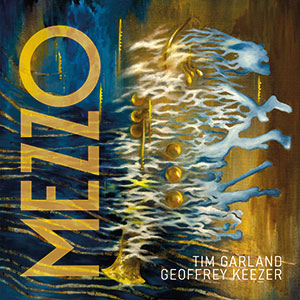
Garland returns to the mezzo-soprano for the closing track, his own composition “The Waves Between”, which takes inspiration from Esra Kizir Gokcen’s cover image of the same name. Featuring rippling piano arpeggios and folk inspired melodies this piece has been singled out by many as an album highlight, and rightly so. In his album notes Garland says of the relationship between the music and Gokcen’s visual image;
“She seems to capture the mezzo as it flows between our conscious world and subconscious depths. The random splashes she started with formed a horse-like image, which, with its graceful power and agility seems to have become the mezzo’s spirit”.
One can hear that spirit throughout the album, and none more so on this final track, the music swimming in and out of focus courtesy of a more abstract central section.
Garland is a musician who wears his virtuosity lightly, but his playing is superb throughout the album and the distinctive sound of the mezzo-soprano can’t fail to engage the listener’s attention. That’s not to downplay Keezer’s contribution and his brilliance at the piano cannot be underestimated, Neither can the work of the engineering and production team who achieve a glorious sound balance throughout. But ultimately the triumph is Garland’s, the instigator of the project and its principal composer, and also a true virtuoso of that rarest of musical beasts, the mezzo-soprano saxophone.
Mezzo is available here;
https://officialtimgarland.bandcamp.com/music
Tim Garland and Geoffrey Keezer will be playing a short series of UK live dates in October 2026.
Thursday 8 October - Ronnie Scott’s Jazz Club, London
Monday 12 October - NCEM, York
Tuesday 13 October - Watermill Jazz, Dorking
blog comments powered by Disqus