

by Ian Mann
October 12, 2026
/ LIVE
Thorp’s writing was intelligent, and intriguing with a cinematic quality that was further enhanced by Bridger’s brilliantly imaginative visuals.
Tom Thorp & Illumetris, Shrewsbury Jazz Network, The Hive Music & Media Centre, Shrewsbury, 10/10/2026.
Tom Thorp – soprano & tenor saxophones, bass clarinet, Neil Yates – trumpet, Andy Stamatakis-Brown – piano, Grant Russell – double bass, John Arnesen – drums, percussion
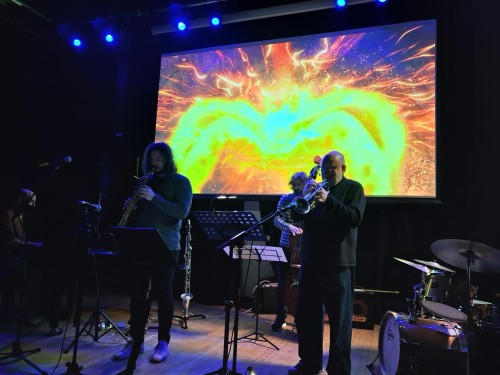
SJN’s October event brought something unique to The Hive as Manchester based saxophonist Tom Thorp presented “Here, There Be Monsters”, an audio-visual project featuring the music of Thorp’s Illumetris quintet, closely allied to the illustrations and animations of the acclaimed visual artist Steve Bridger, aka AllMighty Steve.
Thorp studied both classical and jazz saxophone at the Royal Northern College of Music in Manchester on that institution’s famous ‘Joint Course’ with the University of Manchester. He subsequently studied Jazz Composition with fellow saxophonist Tim Garland, another musician with a foot in both the jazz and classical camps, and with the hugely influential educator Steve Berry, former bassist and composer with the seminal Loose Tubes.
A frequent award winner Thorp continues to work in the fields of jazz, classical and commercial music as both a performer and composer. His jazz output includes two albums with two different editions of his former band Mercury with the eponymous debut appearing in 2013 followed by “Sea Speak” in 2016.
In 2023 he was the leader of the Polygon Saxophone Quartet, also featuring Kyran Matthews, Krszystof Urbanski and Jeff Guntren, an ensemble that released the album “Monkey Puzzle”, a collection of new compositions by Thorp and Matthews.
A stalwart of the Manchester jazz scene Thorp also curates the Beat The Jams series of early evening contemporary jazz events at the city’s Band On The Wall venue.
In 2024 Thorp’s current Illumetris group, personnel as listed above, released “Here, There Be Monsters”, a collection of nine pieces inspired by various creatures from different world mythologies, the majority of them readily familiar to the general public.
Thorp has since collaborated with the Glasgow based illustrator and animator Bridger to create the “Here, There Be Monsters Multi-Media Exhibition Show”, which is currently touring in the UK with financial support from Arts Council England.
It’s a presentation that combines the best aspects of musical performance with an art exhibition / installation. At Shrewsbury the members of Illumetris performed in front of a big screen on to which Bridger’s visual images, both fixed and moving, were projected. Meanwhile in the bar area an exhibition of Bridger’s sketches and storyboards for the project could be enjoyed, with the finished products available for purchase in the form of postcards and posters alongside the “Here, There Be Monsters” album and various other recorded works featuring Thorp and / or the other band members. It really was the complete multi-media package.
The performance saw the band play the whole “Monsters” album, albeit in a slightly different running order, over the course of two sets. There was also one new composition, inspired by the project but as yet unrecorded, but more on that later.
In addition to all the visuals the band had also thought to hire a grand piano for the occasion, a beautiful Yamaha supplied by Pickering’s Piano House from Tarporley in Cheshire.
The instrument came into its own on the opening “Prologue; The Kelpie’s Song”, performed in duo format by Thorp on soprano sax and Stamatakis-Brown at the piano. The piece is also the opening track on the “Here, There Be Monsters” album where is is performed as an instrumental. The version on this current tour also includes a voice-over, a reading of a poem written by Thorp delivered by the film, television and theatre actor Jack Tarlton. It would seem that Thorp has friends in high places, and there was to be further evidence of this later on.
Tonight’s performance featured Thorp on soprano sax, blowing directly into the innards of the piano, causing the strings to vibrate and thus creating a grandiose echoing effect as Stamatakis-Brown dutifully held down the sustain pedal. Thorp also impressed with his circular breathing technique as the music reverberated in atmospheric fashion, complementing both the words spoken by Tarlton and the visual images generated by Bridger. The Kelpies are the mythical water horses of Scottish legend and both the poem and the visuals reflected this as aquatic and equine imagery (the horses had manes made of seaweed) combined with Celtic themes and motifs. The Kelpie legend is also the inspiration for Andrew Scott’s famous giant horse head sculptures near Falkirk.
An intriguing start.
The rest of the band took to the stage for “The Phoenix”, which initially continued the reflective and atmospheric mood established by the opener. Thorp continued on soprano sax, now complemented by the sounds of piano plus Russell’s bowed bass and Arnesen’s mallet rumbles and cymbal shimmers. Bridger’s visuals depicted images of fire and magma, glowing red and orange on the screen. When Russell eventually established a pizzicato bass groove the music entered more conventional ‘spiritual jazz’ territory as Thorp and Russell combined to state the theme above a brushed drum groove. As the leader soloed on probing soprano sax space imagery appeared on the screen with a comet trailing its way across the sky. Yates was also featured as a soloist, exhibiting a similar fluency on trumpet. As the horns coalesced towards the close the Phoenix itself could finally be seen, rising from the flames, as Russell briefly flourished the bow during the final moments. The recorded version of this piece is an eleven minute epic and as a composer who also writes for classical ensembles Thorp is no stranger to writing on a grand scale, as successfully demonstrated here.
“We Have a Pixie Problem!” was an amusing, if sometimes macabre, celebration of the mischievous spirits known as Pixies that can be found in the myths of various cultures. Featuring Thorp on tenor sax and Yates on muted trumpet the music embraced a whimsicality that sometimes reminded me of Loose Tubes and its various offshoots – one sensed that the influence of Thorp’s old mentor, Steve Berry, wasn’t too far away. Bridger’s fast moving animation
depicted the malevolent Pixies setting fire to a windmill and destroying crops, in his world these were evil spirits, far removed from the cute Pixie imagery so prevalent today.
“The Minotaur” is another well known myth, the tale of the labyrinth dwelling half bull-half man creature of ancient Crete. As Thorp explained his composition embraced several interweaving lines of music, an aural depiction of the labyrinth to complement Bridger’s visual interpretation. The piece was introduced by an extended passage of solo double bass from the excellent Russell, subsequently augmented by intertwining tenor sax and trumpet melodies. Drums and piano were subsequently added, but it was Russell’s bass that continued to lead the way deeper into the musical maze, via a bass and drum dialogue that gradually gave way to a nagging piano motif, followed by a full on piano solo in the classic piano trio format. Bridger’s maze imagery and the depictions of a myriad of doors and arches took us further into the labyrinth, the sinister and frightening image of the Minotaur with its blank but scary and piercing eyes finally looming into view, musically depicted by a towering tenor sax solo from the leader.
The last monster that we met in the first set was “Grendel”, the creature from the Anglo-Saxon epic poem “Beowulf”. I mentioned previously Thorp’s “friends in high places”. In this instance his friend is Professor George Walkden, a Professor of Linguistics at the University of Konstanz in Germany. Both the album recording and the “Multi Media Exhibition Show” feature a voice-over of Professor Walkden reading extracts from the poem in the original Anglo-Saxon, a language that to these ears sounded uncannily like modern day German!
Prof. Walden’s words augmented augmented the whisper of Yates’ trumpet and Russell’s bass undertow on an atmospheric intro that eventually saw the introduction of piano, mallet rumbles and grainy bass clarinet. Yates continued to lead the way, the whispering and fluttering of his trumpet accompanied by the skitter of Arnesen’s brushed drums. Arnesen was excellent throughout the evening, conjuring a fascinating array of sounds from his drums and percussion and complementing both the music and the visuals perfectly at all times. Bridger’s visuals depicted Grendel striding through the forest en route to attack Beowulf and his followers as they feasted in Beowulf’s hall. Blending in with his surroundings and looking almost tree-like himself Grendel resembled an evil ent, if that’s not mixing up my mythologies too much. The eventual fight scene was a thrilling collision of words, music and visuals with Grendel eventually repelled to retreat into the woods to die, the arrows of Beowulf’s archers protruding from his back.
Following this particularly bloodthirsty mythological tale it was time for both the band and the audience to take a break. This had been an intense first half featuring some extraordinary music and some extraordinary visuals, an intriguing, enriching, and sometimes scary, audio-visual experience with the promise of more to come.
The start of the second set saw the quintet continuing to work their way through the album repertoire. Opener “Pegasus” eased us back in gently with its ethereal solo piano intro, accompanied by visual images of sky and clouds, and with the subsequent addition of arco bass, plus mallet rumbles and cymbal shimmers. Russell then put down the bow as he generated a pizzicato bass melody, singing along gently to the sounds that he created. The accompanying visuals included the traditional image of Pegasus the winged horse, and also the Pegasus star constellation. Thorp eventually took over by introducing an airy soprano sax melody, followed by a gently meandering solo.
The new tune “Banshee” represented a change to the quintet’s working methods. All the tunes on the “Here, There Be Monsters” album had been written by Thorp prior to his collaboration with Bridger, whose remarkable visuals were created as a direct response to the music. This piece saw Bridger creating the animation first, with the band invited to produce a musical response.
Inspired by the myth of the Irish female tree spirit the Banshee this piece was also introduced solo by Stamatakis-Brown, subsequently joined by trumpet and mallet rumbles, with the visual imagery depicting a tree in a churchyard. In accordance with its source of inspiration, also visually depicted, this was a piece that gradually developed from a whisper to scream, with Yates’ trumpet cast in the role of the wailing Banshee as Arnesen’s cymbal scrapes added an abrasive metallic edge.
It was back to the album repertoire for “In Alberich’s Mine”, a piece inspired by the dwarves of Tolkienesque mythology and their penchant for mining. This was a charmingly whimsical piece featuring the sounds of bass clarinet, Harmon muted trumpet an Arnesen’s deployment of an idiosyncratic array of small percussion, including a ‘jingle tree’ made from the lids of old tin cans. Centred around the dialogue between the leader’s bass clarinet and Yates’ trumpet this piece also featured one of Bridger’s most playful and charming animations as the dwarf miners rode in coal wagons on an underground big dipper as Arnesen’s percussion mimicked the clanking of axes. Stamatakis-Brown was also featured as a soloist with a concise, but increasingly percussive, piano excursion.
The set concluded with the final two tracks from the album, both genuine epics in their recorded form at twelve and eight minutes in length respectively.
First up was “The Last Dragon”, inspired by Thorp’s love of the Eryri (Snowdonia) National Park and by Welsh mythology. He imagined the mountain shapes as Dragon’s backs and the Dragons being driven out of Wales by human encroachment and being forced to hide in the mountains, lakes and islands. With Yates having featured prominently on the two previous items this was performed as a quartet piece with Thorp featuring on tenor saxophone. In honour of the Welsh inspiration the melody of the tune was deliberately written to be ‘hymn like’. An atmospheric intro featuring the sound of single note piano, bowed bass and mallet rumbles, plus Thorp’s wispy tenor sax melodies gradually began to evolve via a gentle passage of unaccompanied piano and a delicate piano and drum dialogue into something more powerful. Eventually the return of the leader’s tenor sax saw the wistful hymn like melody begin to unfold, slowly gathering momentum as Bridger’s visual imagery depicted the Dragon taking flight and soaring over castles, Harlech and Caernarfon maybe, as soldiers fire arrows at it. As the intensity of the music began to gather, led by Thorp’s tenor, Bridger depicted the pulsing and pumping of the Dragon’s heart before it breathed fire, setting the castles alight before it flew across lakes and seas to the mountains. Musically this was a true slow burning epic that also featured some of the most dramatic visual imagery seen thus far. A genuine audio-visual tour-de-force.
The performance closed with the final track from the recording, “Medusa”, the legendary Gorgon with snakes for hair whose stare could turn a man to stone. A frightening image that elicited a suitable musical and visual response with Russell’s eerie arco bass intro augmented by Stamatakis-Brown’s interior piano scrabblings. The coiling of snakes was reflected in the twisting, intertwining melody lines of tenor sax and trumpet as part of a near free jazz episode. The accompanying visual imagery depicted writhing snakes and the sight of a host of warriors turned to stone. Russell’s setting up of a pizzicato bass groove brought urgency and dynamism to the music and acted as the springboard for a trumpet solo from Yates’, underpinned by Arnesen’s fidgety drums. This was a piece that made effective use of dynamic contrasts with brief reflective or abstract moments punctuated by more powerful passages with Thorp eventually emerging to deliver an urgent tenor sax solo, urged on by Russell’s rapidly propulsive bass lines as the darting snakes on the head of an almost impossibly buxom Medusa continued to wriggle and writhe, with the stone warriors remaining irreversibly frozen in time. The excellent Arnesen rounded off a superb evening’s work with a drum feature played out above a recurring piano and bass motif.
Following such an epic finish to a conceptual work it was hardly surprising that no encore was forthcoming. Jamming on a jazz or bebop standard wouldn’t really have worked in this instance would it?
But what a phenomenal show we had seen. Thorp’s writing was intelligent, and intriguing with a cinematic quality that was further enhanced by Bridger’s brilliantly imaginative visuals. Bridger, who designed the logo for the Glasgow Commonwealth Games, is a serious artistic talent and despite the occasional technical glitch I think it’s fair to say that this was probably the best jazz related audio-visual presentation that I’ve seen. The music and images complemented each other perfectly and were perfectly integrated. I’ve seen shows in the past where the visual aspect has just been an indulgent and unnecessary distraction. This was very much the opposite, a unified audio-visual concept that succeeded brilliantly, with the two voice-overs also adding to the success of the event.
My thanks to Tom Thorp for speaking with me after the show and for telling me a bit more about the project, and also to John Arnesen for chatting during the interval.
Illumetris are still on tour with this show. Do check out this production out if you can. Dates and ticket links are available via Thorp’s website here;
https://www.tomthorp.co.uk/ilumetris/
Tom Thorp’s recordings can be purchased here;
https://tomthorp.bandcamp.com/
blog comments powered by Disqus